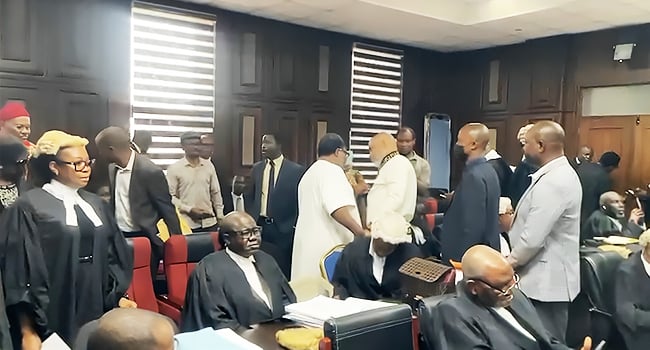
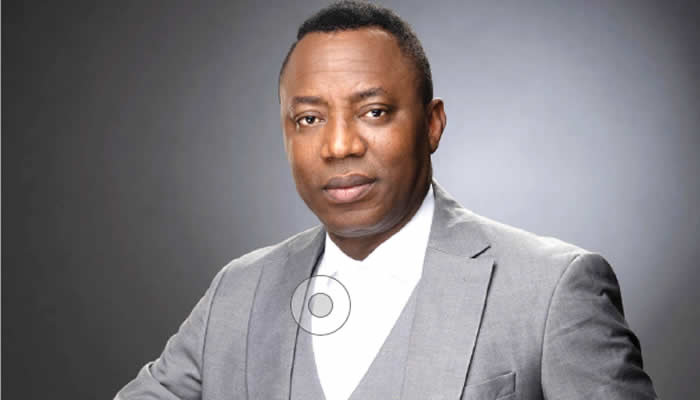
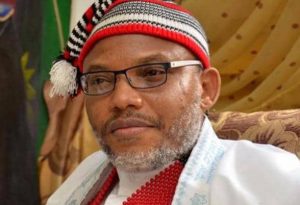
Kanu Agabi, former Attorney-General of the Federation and lead counsel to the detained leader of the Indigenous People of Biafra, Nnamdi Kanu, on Thursday, applied to withdraw his representation in the ongoing terrorism trial before the Federal High Court in Abuja.
Kanu is facing trial on a seven-count charge bordering on terrorism, filed against him by the Federal Government.
When the matter was called on Thursday, Agabi informed the court that he would no longer be representing the IPOB leader, adding that the defendant had decided to take back the case from them.
In the same manner, all the Senior Advocates of Nigeria involved in the case also announced their withdrawal from the case.
Kanu, confirming the development, told the court that he would be representing himself for now, but noted that the position might change later.
The trial judge, Justice James Omotosho, asked whether he should assign a lawyer to represent him, but the defendant (Kanu) declined.
Meanwhile, addressing the court orally to open his defence, Kanu argued that the court lacked jurisdiction to try him.
Recall that Justice Omotosho, on October 16, granted the defendant six consecutive days, beginning from October 23, to open and close his defence in view of the accelerated hearing earlier granted in the case.
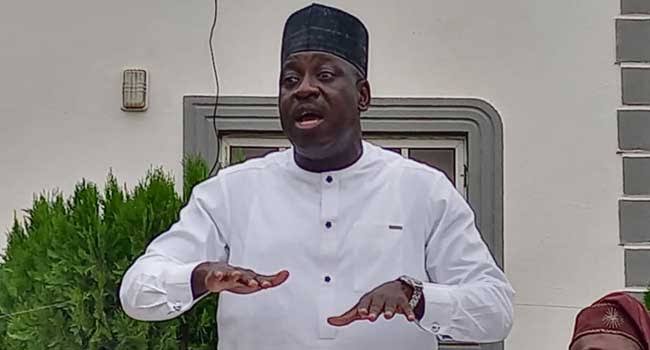
Kanu had listed former Attorney General of the Federation, Abubakar Malami; Minister of the Federal Capital Territory, Nyesom Wike; Minister of Works, Dave Umahi; Governor of Lagos State, Babajide Sanwo-Olu; a former Chief of Army Staff, Gen Tukur Buratai (rtd); a former Minister of Defence, Gen. Theophilus Danjuma (rtd), and others as part of his witnesses.
The Federal High Court in Abuja has refused the Nigeria Police Force’s bid to stop the “Free Nnamdi KanuNow” protest, allowing it to proceed as scheduled on Monday, October 20, 2025.
The Inspector General of Police, Kayode Egbetokun, had dispatched police lawyers to the court to move an ex parte motion against activist and protest organiser, Omoyele Sowore, in a bid to legally preempt the planned demonstration slated for the Aso Rock Villa.
However, Justice Umar of the Federal High Court, Abuja, declined to grant the motion, which would have immediately restrained the protest from taking place without hearing the opposing side.
The Judge instead instructed the police to formally serve notice of their application on Sowore and adjourned the case until Tuesday for a proper, contested hearing.
Reacting to the judicial decision, the protest convener, Omoyele Sowore, affirmed the court’s decision as a victory for civil liberties and doubled down on the scheduled protest.
In a statement issued on his X handle on Friday following the ruling, Sowore said, “IG of PoliceNG Kayode Egbetokun dispatched police lawyers to sue me, in an effort to halt the FreeNnamdiKanuNow protest scheduled for Aso Rock Villa on Monday.
“However, the judge, Justice Umar of Federal High Court in Abuja, refused to grant the ex parte motion, instead instructing him to serve me notice and adjourning the case until Tuesday for a proper hearing.”
The demonstration, organised under the hashtag #FreeNnamdiKanuNow, is intended to draw attention to the prolonged detention and legal fate of Kanu.
The police action was seen as an attempt to leverage the courts to prevent a potentially sensitive gathering near the seat of Nigerian power.
The adjournment to Tuesday ensures that the planned Monday protest is not currently constrained by a court order, setting the stage for a potential high-profile confrontation between protesters and security agencies around the Presidential Villa.
The outcome of the adjourned hearing on Tuesday will determine the next legal steps regarding the protest’s legality.
PUNCH Online had earlier reported that Sowore announced October 20 as the date for a protest march to demand the release of the leader of the proscribed Indigenous People of Biafra, Nnamdi Kanu.
Sowore made this known on his X handle.
According to him, the protest would be a “historic” march to the Aso Rock Villa in Abuja, while assuring that it would be conducted peacefully and legally to demand the release of the IPOB leader…”
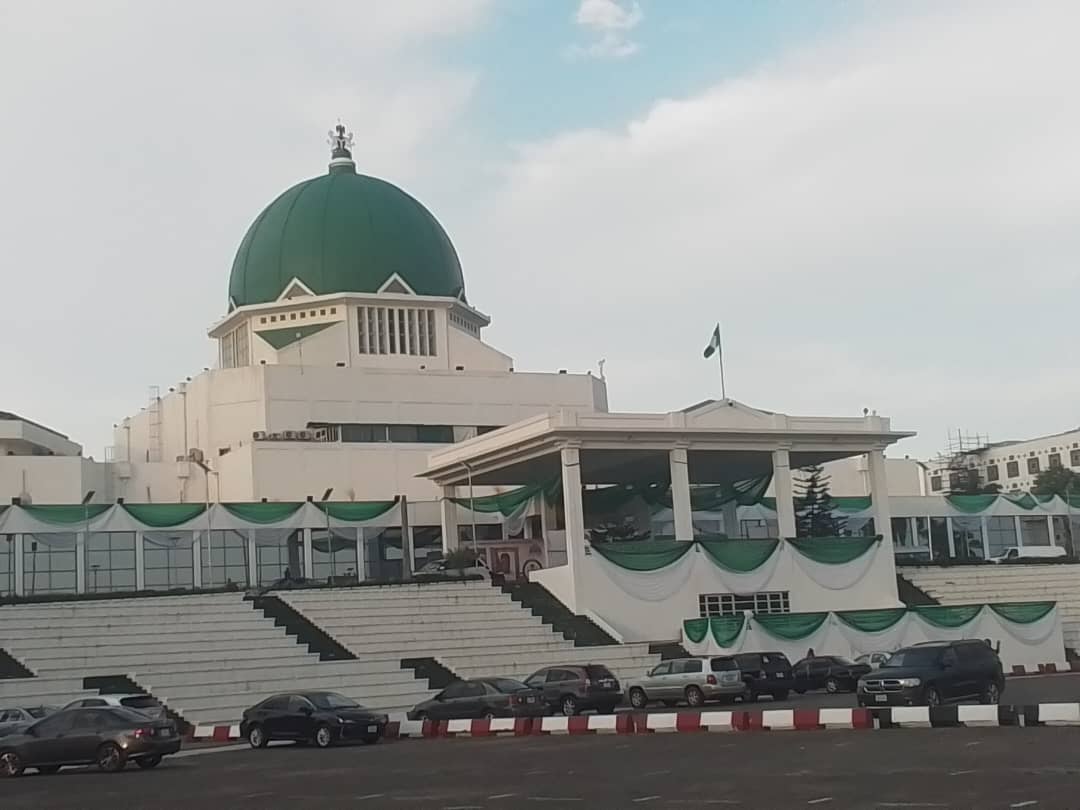
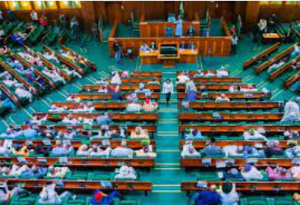
President Bola Tinubu has again written to the National Assembly, seeking approval for a fresh external borrowing of $2.3bn.
This is in addition to a plan to issue a $500m sovereign Sukuk, which will mark Nigeria’s debut in the international Islamic finance market.
The request, contained in a letter read on the floor of the House of Representatives by Speaker Tajudeen Abbas on Tuesday, complies with Sections 21(1) and 27(1) of the Debt Management Office Establishment Act, 2003.
The borrowing plan seeks legislative approval for external financing to implement the 2025 Appropriation Act, refinance maturing Eurobonds, and expand Nigeria’s debt instruments to include Islamic finance products.
Tinubu noted that “the 2025 fiscal framework anticipates $9.27bn in new borrowings to address the budget deficit, of which $1.84bn is earmarked for external sources at an assumed exchange rate of N1,500 to the dollar.”
He explained that the external borrowing would be sourced through various instruments, including Eurobonds, syndicated loans, bridge financing, or direct loans from multilateral institutions — in order to optimise cost and manage risk effectively.
A key element of the plan is the refinancing of Nigeria’s $1.118bn Eurobond, issued in 2018 at a coupon rate of 7.625% and due in November 2025.
“This is a standard practice in debt capital markets,” the President wrote. “Refinancing through Eurobonds or syndicated loans will guarantee debt sustainability and boost investor confidence.”
Tinubu maintained that refinancing maturing obligations was part of routine debt management and vital for maintaining Nigeria’s fiscal credibility.
The President’s letter also revealed a plan to issue a $500m sovereign Sukuk internationally, a move aimed at deepening Nigeria’s presence in the Islamic finance market.
The initiative follows the success of domestic Sukuk issuances, which have raised N1.39tn since 2017 to fund critical infrastructure projects such as major road construction.
According to Tinubu, the international Sukuk would help narrow Nigeria’s infrastructure funding gap while diversifying its investor base.
The government is also exploring a credit enhancement guarantee from the Islamic Corporation for the Insurance of Investment and Export Credit, a member of the Islamic Development Bank Group, to strengthen the offering.
“If the ICIEC credit guarantee is utilised, 25% of the proceeds will be used to repay relatively expensive debt obligations, while the balance will finance pre-identified infrastructure projects,” the President said.
He assured lawmakers that the Federal Ministry of Finance and the Debt Management Office would engage reputable transaction advisers to secure the best pricing and terms amid volatile global market conditions.
Tinubu further expressed confidence in Nigeria’s reputation as a consistent and credible issuer in international capital markets, noting that the proposed transactions would reinforce investor trust and ensure prudent fiscal management.
The new borrowing request comes as Nigeria grapples with the twin challenges of financing a large budget deficit and managing a complex debt portfolio.
As Africa’s largest economy, the Federal Government continues to balance its drive for infrastructure-led growth with the need to maintain debt sustainability.
The 2025 budget includes plans to raise $9.27bn in new loans, with $1.84bn coming from external sources.
Analysts say the government’s growing reliance on a mix of domestic and foreign funding reflects a pragmatic response to rising inflation, currency volatility, and high global interest rates.
Nigeria’s success with domestic Sukuk issuance has demonstrated the potential of Islamic finance to fund tangible development projects. Expanding this strategy to global markets could enhance the country’s credit profile and reduce dependence on traditional borrowing methods.
The proposed involvement of the ICIEC guarantee is also expected to lower borrowing costs by improving Nigeria’s credit rating, making the new Sukuk more attractive to global investors. Allocating a quarter of the proceeds to retire expensive debts, observers note, reflects a cautious and strategic approach to managing the nation’s debt structure.
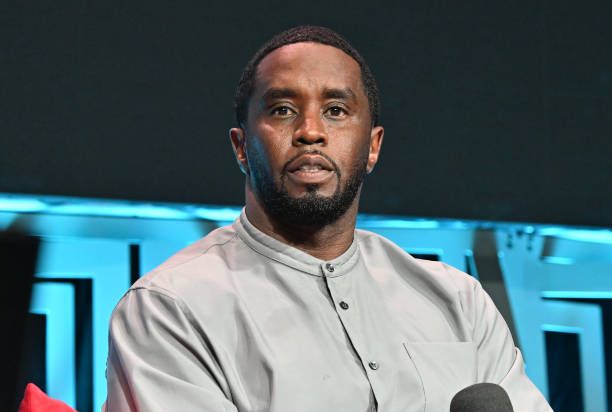
Music mogul Sean “Diddy” Combs has been sentenced to 50 months in prison after being convicted on prostitution-related charges.
Prosecutors had pushed for an 11-year sentence, but Judge Arun Subramanian imposed just over four years following an emotional daylong hearing on Friday.
Combs’s lawyers had urged a far lighter penalty of 14 months, effectively time served, since the 55-year-old hip-hop star has already spent more than a year in custody in Brooklyn, according to CNN.
Before sentencing, Combs addressed the court, expressing remorse. “I am truly sorry,” he said, asking the judge for “another chance.”
He added, “I ask your honour for mercy. I beg your honour for mercy.”
In July, a jury acquitted Combs of the most serious charges, sex trafficking and racketeering but found him guilty of two counts of transporting people across state lines for prostitution.
His former girlfriend, singer Casandra Ventura, known as Cassie, submitted a searing letter to the court.
She urged the judge to consider “the many lives that Sean Combs has upended with his abuse and control.”
Ventura described enduring years of physical, emotional and sexual abuse in her relationship with Combs.
Along with another woman, identified as Jane, she said she was coerced into “freak-offs” — sexual marathons with hired men that Combs orchestrated and sometimes filmed.
“The entire courtroom watched actual footage of Combs kicking and beating me as I tried to run away from a freak off in 2016,” Ventura wrote.
She said she continues to suffer nightmares and flashbacks “on a regular, everyday basis.”
Prosecutor Christy Slavik argued that Combs has yet to take responsibility.
“His remorse was qualified. It’s as though he thinks the law doesn’t apply to him,” she told the court.
Slavik added that Combs had booked speaking engagements in Miami in anticipation of a lighter sentence, calling it “the height of hubris.”
In defence, attorney Nicole Westmoreland described Combs as “an inspiration” to the Black community and a social justice crusader.
“No, Combs is not larger than life.
“He’s just a human being. He’s made mistakes,” she said.
She insisted he was remorseful and argued, “It’s of no benefit to anyone to warehouse him in a prison.”
Combs’s six adult children also pleaded for leniency. His eldest, Quincy Brown, called him “a changed man.” One of his daughters, D’Lila Combs, appealed to the judge, “Please, please give our family the chance to heal together. Not as headlines but as human beings.”
Legal practitioners and Civil Society Organisations have called for greater collaboration and systemic reforms to strengthen Public Interest Litigation in Nigeria.
The call was made during a special session hosted by Spaces for Change (S4C) at the PILNet Africa Regional Convening on Public Interest Litigation.
The Executive Director, S4C, Mrs Victoria Ibezim-Ohaeri, in a statement on Thursday in Lagos, highlighted S4C’s research-driven approach.
She noted that several pro bono legal interventions stemmed from extensive fieldwork and community-driven investigations.
The event was organised by PILNet, with S4C focusing on integrating human rights into social and economic governance through its rights-based research and advocacy.
Ibezim-Ohaeri cited her doctoral research on SARS operations in Anambra, explaining how many victims later secured compensation through the EndSARS judicial panels.
She added that S4C frequently partners with other research-focused organisations to uncover and document human rights violations across the country.
In a panel discussion, Prof. Adebisi Arewa of the Nigerian Institute of Advanced Legal Studies, described access to justice as the most essential human right.
He lamented the inadequate access to justice for ordinary Nigerians, stressing that its absence undermines national development and erodes human dignity.
“About 99.99 per cent of Nigerians lack access to justice,” Arewa declared, emphasising that strategic litigation both exposes systemic flaws and offers lifelines for marginalised citizens.
Former Nigerian Bar Association Chairman, Alex Morka, stressed the importance of institutionalising pro bono legal services nationwide.
He urged the NBA to consider making pro bono representation mandatory, while commending judges who assign senior lawyers to represent indigent defendants in capital cases.
On behalf of the National Human Rights Commission, Dr Lucas Koyejo, raised concerns about alleged human rights violations in Lagos.
Koyejo revealed that the NHRC’s Lagos office, which serves over 20 million residents, is staffed by only 12 lawyers, including himself.
“We receive countless complaints daily, some from individual citizens and others through partners like S4C. But our capacity remains overstretched,” he said.
The event also featured testimonies from victims of forced evictions, police brutality, and other abuses, many of whom had benefited from S4C’s legal interventions.
Their stories underscored the tangible impact of public interest litigation and the urgent need for sustained reforms in Nigeria’s justice system.
Sean “Diddy” Combs may face more than 11 years in prison, as U.S. federal prosecutors have urged a New York court to hand down a lengthy sentence following his conviction on prostitution-related charges.
As reported by Reuters and ABC News on Tuesday, in a court memo filed on Tuesday, prosecutors asked for “at least 135 months’ imprisonment” and a $500,000 fine. U.S. District Judge Arun Subramanian is scheduled to deliver the sentence on Friday in Manhattan.
Combs, 55, was found guilty on July 2 after a two-month trial on two counts of transporting male prostitutes across state lines to engage in what prosecutors described as “drug-fueled sexual performances” with his girlfriends, while he watched, recorded video, and masturbated.
He was acquitted on the more serious racketeering and sex trafficking charges, which carried a potential life sentence.
In their memo, prosecutors said Combs was “violent, abusive and left victims in fear”, and argued that despite his acquittal on the more serious counts, he remains “unrepentant.”
“The defendant will not be punished for any crimes of which he was acquitted, of course, but punishment for his crimes of conviction must take into account the manner in which he committed them,” prosecutors wrote.
They said Combs held power over the women involved, particularly Cassie Ventura, who was allegedly left “bloodied and bruised” as seen in hotel security footage.
“The defendant also horrifically physically abused Ventura throughout their relationship, a point he conceded at trial,” prosecutors said, adding that the sentence should reflect Combs’ “decades of unchecked violence” and “decades of psychological, emotional and physical damage he has inflicted.”
Combs’ lawyers have asked for a much lighter punishment, around 14 months, an outcome that could see him released by the end of the year due to time already served at Brooklyn’s Metropolitan Detention Centre since his September 16, 2024, arrest.
Defence attorneys called the government’s recommendation “draconian,” arguing in their earlier filing that it amounted to “Verdict be damned—lock him up and throw away the key.”
Combs’ legal troubles stem from his September 2024 arrest, which led to multiple federal charges, including racketeering, sex trafficking, and transportation for prostitution. His trial opened on May 5, 2025, with jury selection completed a week later.
After weeks of proceedings, the jury on July 2 acquitted Combs of racketeering and sex trafficking but convicted him on two transportation counts involving Ventura and another woman.
The Federal High Court in Abuja, on Friday, dismissed the no-case submission filed by the leader of the Indigenous People of Biafra.
Justice James Omotosho, in a ruling on Friday, held that the Department of State Services has made out a prima facie case against Kanu.
He accordingly ordered Kanu to enter his defence, as the prosecution has being able to convince the court without reasonable doubt that he has case to answer in the alleged terrorism charge brought against him by the Federal Government.
Justice Omotosho held that the evidence presented by the Department of State Services through its five witnesses were such that there was the need for Kanu to provide some explanations in the charge brought against him.
Kanu had filed a no-case submission after the prosecution closed its case in June, insisting that he has no case to answer in the charge brought against him.
Meanwhile, the Court has given the Nigerian Medical Association eight days to constitute a team of medical experts to determine the health status of Kanu.
In a ruling, Justice Omotosho ordered the NMA President to submit the committee’s report within eight days for consideration on whether Kanu should be transferred to the National Hospital for treatment.
Justice Omotosho directed that the committee, among other tasks, should assess the Department of State Services hospital to confirm whether it has the capacity to meet Kanu’s health needs.
Justice Omotosho further ruled that the NMA committee would be at liberty to make use of any hospital in the country for its investigations. He specified that the panel should comprise between eight and ten NMA members, including a cardiologist and a neurologist. The Chief Medical Director of the National Hospital must also be part of the committee.
The decision followed conflicting medical reports presented by the DSS medical team and Kanu’s private consultants.
The DSS lead counsel, Adegboyega Awomolo (SAN), disclosed the NMA’s intervention while opposing an application by Kanu’s legal team for his transfer to the National Hospital for urgent treatment.
Awomolo explained that a team of medical experts had already visited Kanu in DSS custody to assess his health, adding that the DSS medical team, led by Dr Mohammed Nasir, maintained that his condition could be adequately managed within DSS facilities.
In contrast, Kanu’s private consultants, led by Professor Martin Aghaji, a retired professor of medicine from the University of Nigeria, Nsukka, argued that his deteriorating health required urgent transfer to the National Hospital, and even suggested possible treatment abroad.
The DSS dismissed Aghaji’s report as exaggerated and suspicious, particularly for recommending foreign hospitals, and alleged that he had unilaterally altered Kanu’s medication without consulting DSS doctors who had been treating him for four years.
Awomolo further argued that transferring Kanu to the National Hospital would disrupt services and pose security risks, insisting that the federal government was committed to his safety and willing to allow him access to medical experts of his choice within DSS facilities.
Kanu’s lead counsel, Dr Onyechi Ikpeazu (SAN), however, maintained that the transfer request was based on Aghaji’s findings. He stressed that the DSS lacked the facilities to manage Kanu’s ailments and argued that it was in the interest of justice that Kanu remain alive to face the terrorism charges against him.
Ikpeazu added that his team would not oppose the NMA’s intervention, provided it was ordered by the court.
Three royal families of Adeberu, Olufadi and Ayora/Tunwase of Fusengbuwa ruling house, Ile Nla, Agunsebi, Ijebu Ode have dragged the Ogun State Government, the former National President of the Institute of Chartered Accountants of Nigeria, Otunba Abdulateef Owoyemi, Dr Kunle Hassan, the founder of Eye Foundation Hospital and two others before an Ogun State High Court sitting at Ijebu Ode over the leadership crisis rocking the ruling house.
According to the court filings dated September 17 and made available to journalists on Thursday, the representatives of the three royal families, Adedokun Ajidagba, Adeleke Adeyemi and Ademola Sonaya, specifically urged the court to stop Owoyemi from parading himself as the head (Olori Ebi) of the Fusengbuwa ruling house.
The Fusengbuwa ruling house is the next to produce the Awujale and paramount ruler of Ijebu land after the demise of 91-year-old Oba Sikiru Adetona on July 13, after reigning for 65 years.
Adedokun, according to the documents filed before the court, asserted that Owoyemi has no ancestral link to the Ile-Nla compound in Agunsebi, the historic family house of Fusengbuwa.
He listed the ruling house’s eight recognised branches as Olufadi, Ayora/Tunwase, Shenowo, Okuyandewo, Oshinuga, Adekenu, Adebiyi, and Adeberu.
The oil and gas businessman further claimed that Owoyemi hails from Ikoro-Ekiti and not Ijebu-Ode, a position he affirmed was corroborated by the late Awujale of Ijebuland, during a court proceeding at Ijebu-Ode in 2018.
Adedokun said his appointment as Olori-Ebi of Fusengbuwa was ratified on November 23, 2023, with official notification sent to the Ogun State Commissioner for Local Government and Chieftaincy Affairs and to the late Adetona.
He declared that he remains the authentic head of the Fusengbuwa ruling house and that the court should accede to the request of the three royal families and stop Owoyemi from parading himself henceforth as the head of the ruling house.
The court is, however, yet to fix a date for the hearing of the suit
Recall that the former ICAN President had insisted that he remains the legitimate head of the Fusengbuwa ruling house by virtue of the Ibadan Court of Appeal judgement of 2024, which ruled in his favour and confirmed the fact that he had been the ruling house head appointed since 2013 after the death of Prince Fasasi Adeyemi
He stated that in 2011, he was appointed as the Deputy to the then head of the family, Adeyemi and by 2013, he was appointed as the Olori Ebi after the death of Adeyemi.
Owoyemi explained that after his appointment as the Olori Ebi of Fusengbuwa in March 2013, a splinter group had also appointed the late billionaire banker and founder of First City Monument Bank, Otunba Subomi Balogun, as the head of the same family.
He disclosed that he had challenged this anomaly at a High Court sitting at Ijebu Ode and that while giving his judgment in 2018, Justice Asenuga resolved two of the issues brought before the court in his favour but failed to declare him as the Olori Ebi of Fusengbuwa.
Owoyemi explained, “I approached the Court of Appeal sitting at Ibadan and on November 28, 2024, in a judgment delivered by Justice Binta Fatima Zubairu, resolved all seven issues brought before the court in my favour.”
In a Certified True Copy of the judgment, which was made available to journalists, the three Justices of the Court of Appeal agreed that the defendants failed to prove the allegation of fraud upon which the High Court of Ijebu Ode in 2018 had failed to recognise Owoyemi as the duly appointed head of the ruling family.
He said that according to a letter dated November 22, 2023 and sent to the Permanent Secretary of the Ministry of Local Government and Chieftaincy Affairs, Ogun State, Ajidagba was appointed as the acting head of the ruling house pending the determination of the suit he filed against the 2018 court judgment.
Owoyemi disclosed, “As the Almighty God will have it, the Appeal Court upheld all my pleas, affirming my leadership of the ruling house since 2013.”
He revealed further that having been confronted with this immutable truth as dispensed by the Ibadan Court of Appeal, the other part of the ruling house, being led formerly by the renowned Ophthalmologist and founder of Eye Foundation Hospital, Dr Kunle Hassan after dialogue submitted to the decision of the court on Sunday, August 31, 2025, affirming his leadership of the ruling house.
The renowned accountant said that even the late Awujale, before his demise, called him back to the palace in February 2025 to mend fences with him, urging him to keep in touch constantly as one of the senior title holders in his government and a trusted ally.
He added that he remains a bonafide son of Ijebu land from Idowa Ijebu and that past attempts to distort history had been quashed by the November 2024 Ibadan Court of Appeal judgement
The Octogenarian urged every member of the ruling house to shun division, strife and avarice but cooperate with the leadership of the family for a rancour-free selection process for the next Awujale.
The African Democratic Congress has cautioned President Bola Tinubu against interfering in the affairs of state governments, declaring that the Nigerian Constitution does not empower the President to hire or fire elected governors.
ADC, in a statement by its National Publicity Secretary, Bola Abdullahi, on Thursday, emphasised that such actions undermine democratic principles and the autonomy of states.
Siminalayi Fubara has returned to his role as Governor of Rivers State, with the State House of Assembly also resuming its legislative activities.
This follows the lifting of the six-month emergency rule earlier imposed on the state by President Tinubu.
Tinubu officially ended the emergency rule on Wednesday, bringing to a close the special measures he had declared in Rivers State on March 18, 2025.
In a speech on the cessation of the emergency rule, the President said, “The Governor, His Excellency Siminalayi Fubara, the deputy governor, Her Excellency Ngozi Odu, and members of the Rivers State House of Assembly and the speaker, Martins Amaewhule, will resume work in their offices from September 18, 2025.
“It, therefore, gives me great pleasure to declare that the emergency in Rivers State of Nigeria shall end with effect from midnight today.”
Reacting, ADC accused Tinubu of masking politics as leadership, saying his actions in Rivers will define his legacy.
It stated, “On Wednesday, September 17, Nigerians witnessed a curious spectacle: President Tinubu directing the Governor, Deputy Governor, and members of the State Assembly in Rivers State to resume duties after serving his six-month suspension from office.
“The President’s decision to arrogate to himself the power to suspend and recall elected officials in Rivers State, as he had done, is whimsically autocratic and should be recognised and condemned as a threat to our democracy.
“The African Democratic Congress reiterates that what has happened in Rivers State over the last six months is a brazen manipulation of constitutional provisions to serve narrow political interests.
“We harbour no doubts that the situation that served as the pretext for the declaration of the state of emergency was a clear act of political contrivance that only demanded the President’s unbiased political intervention. Instead, the President chose to serve the will of demagogues in his government, deploying the power of the constitution to attack what he should have protected.”
The party decried that for six months, the will of Rivers people was ignored and their elected leaders sidelined not by a court, but by a fellow elected President.
It continued, “Now, with the wave of a hand and the ink from his pen, the same President has decided to ‘allow’ other duly elected officials back to work, as though they were his political appointees.
“Let us be clear: Governors and legislators in a democracy do not draw their legitimacy from Aso Rock. They derive it from the people who elected them. Only a competent court can remove or restrain them — not a press statement or presidential proclamation. The President is not a Headmaster, and Governors are not his pupils to be sent home and recalled at his discretion. Yet, we recall that this President once claimed to be a federalist who, as a state governor himself, fought to protect the relative autonomy of his state.
“However, with this action, the President and his men have achieved their goals, and that goal was not to restore peace to Rivers State. They now have a thoroughly pacified government in Rivers State, which has learnt its hard lessons that its primary loyalty is not to the people of Rivers State, but to Abuja. More importantly, the Rivers experience would now serve as a clear warning to other state governments in the country to behave themselves.
“In keeping with their well-worn propaganda, presidential aides announced that the President had cut short his vacation to attend to the worsening security situation in the country. This claim is indeed laughable. But it is now made clear: the President did not return because Nigerians are being killed, or because life has become unbearable for the majority. He returned for one reason only to personally oversee the return of Fubara to office and bask in the glory of the dictatorial powers that he had assumed for himself.
The ADC urged the judiciary, particularly the Supreme Court, to firmly address the issue, warning that it sets a troubling precedent.
It continued, “By removing a sitting governor and now personally directing his return, the message could not have been clearer: ‘I removed you, and I alone can bring you back.” This was not about law, or justice, or even governance. It was about control. It was about reinforcing the idea that, in today’s Nigeria, institutions may exist, but they remain subordinate to the will of one man.
“For avoidance of doubt, Section 305 of our Constitution, which provides for emergency power,s was never intended to be used as a tool for settling political scores or exerting unconstitutional control over a state. It exists for moments of genuine public danger, such as floods, epidemics, or insurrections, not for political convenience.
“The ADC, therefore, calls on the judiciary, especially the Supreme Court of Nigeria, to take a clear position on this matter, which has set a dangerous precedent. In moments like this, the judiciary cannot maintain silent indifference, or history will record them as collaborators in the subversion of our democracy.”
The Rivers State House of Assembly has scheduled 10 a.m. on Thursday to begin its post-emergency plenary.
The sitting follows the lifting of the emergency rule by President Bola Tinubu on Wednesday and the resumption of democratic governance in the state.
Our correspondent gathered that the plenary would be presided over by the Speaker, Martin Amaewhule, and would take place at the Conference Hall of the Legislative Quarters, Aba Road, where the lawmakers are sitting temporarily.