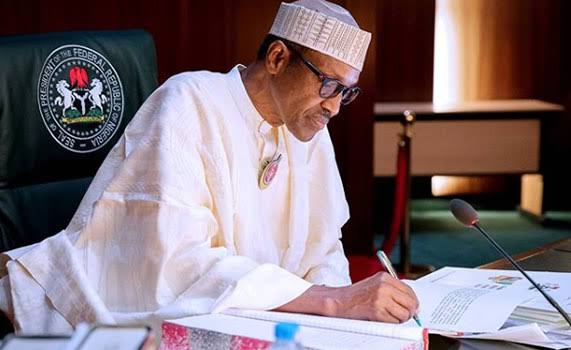
President Muhammadu Buhari has ratified the creation of a new government agency, the Nigeria Data Protection Bureau (NDPB).
The establishment of the agency followed a request made by the Minister of Communications and Digital Economy, Prof Isa Pantami.
In a statement issued on behalf of Pantami, Uwa Suleiman, obtained by POLITICS NIGERIA, his media aide, said the NDPB was established in line with global best practice and will focus on data protection and privacy for the country, among others.
He said the successful implementation of the National Digital Economy Policy and Strategy (NDEPS) for a Digital Nigeria has significantly increased the adoption of data platforms and accelerated the ‘datafication’ of the country. “This has increased the importance of having an institution that focuses on data protection and privacy,” he said.
“Furthermore, the issuance of the Nigeria Data Protection Regulation (NDPR) in January 2019, as a subsidiary legislation to the National Information Technology Development Agency (NITDA) Act 2007, has increased awareness about the need for data protection and privacy.”
Buhari also approved the recommendation of Pantami, for Dr. Vincent Olatunji to serve as the National Commissioner/Chief Executive Officer of the Bureau.
Dr. Olatunji hails from Ekiti State and, at the time of his appointment, was the Director of the eGovernment Development and Regulations Department at NITDA.
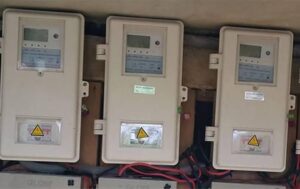
Beginning from Monday, November 15, 2021, Nigerians will pay an additional N13,766 and N26,829 to get single-phase and three-phase pre-paid meters from the eleven Distribution Companies, DISCOs.
According to a circular issued Friday in Abuja by the Nigerian Electricity Regulatory Commission, NERC, the regulator raised the price of a single-phase meter from the current cost of N44,896.17 to a revised price of N58,661.69.
It also increased the price of a three-phase meter from the current cost of N82,855.19 to a revised rate of N109,684.36.
NERC announced the increment via a circular dated November 11, 2021, and addressed to Managing Directors, all electricity Distribution Companies, DISCOs and all meter asset providers.
The circular, with reference number NERC/REG/MAP/GEN/751/2, was entitled ‘Review of the unit price of end-use meters under the Meter Asset Provider and National Mass Metering Regulations’.
With the rising cases of insecurity in Nigeria, President Muhammadu Buhari must take some bold steps including proper rejigging of the country’s security architecture as well as a consideration for state police, members of the Lagos State House of Assembly have said.
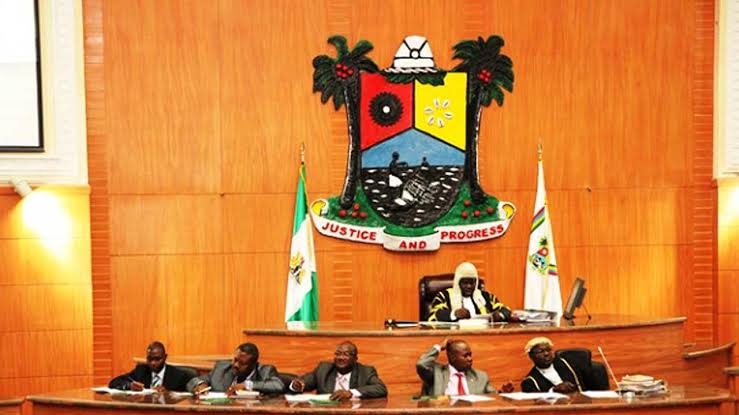
The lawmakers made their positions known on Tuesday when the majority leader of the House, Hon. Sanai Agunbiade, raised the issue under ‘matter of urgent public importance’ at plenary.
They also urged the federal government to get assistance from international organisations if that could help curtail the increased violence, kidnappings and attacks on communities across the country.
Though, they commended the Lagos government for sustaining the security and peace in the state, they urged Governor Babajide Sanwo-Olu to provide Close Circuit Television (CCTV) across the state.
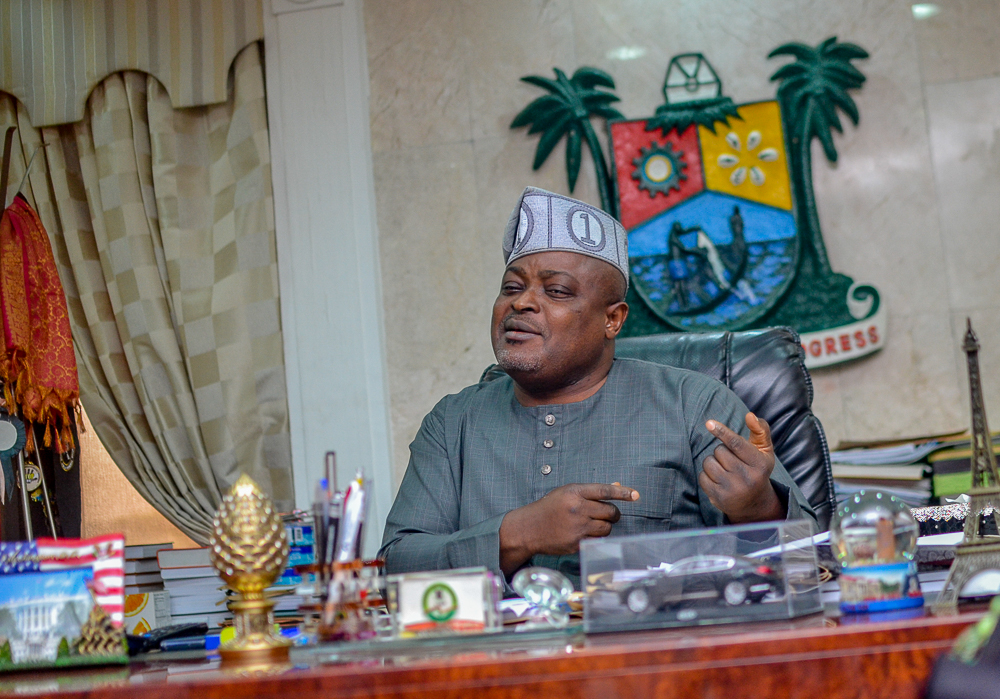
Speaker of the House, Rt. Hon. (Dr) Mudashiru Obasa, noted that there was an urgent need for President Buhari to address the security challenges facing the country with policies that should be friendly enough to attract foreign investments which would help create more employment for the youths of the country.
“We should start developing policies that have human face. The situation that the country’s youth are passing through should be of concern. We have men and women roaming the streets without jobs or anything to keep them going.
“We should do something substantial beyond giving out N10,000 to youths,” the Speaker said adding that the country must not be run in a way that would make any of its component part feel alienated as this would make the people feel like true stakeholders and reduce secessionist thoughts.
The Speaker said the challenge is huge and necessitates a further call for devolution of power.
Obasa commended the National Assembly for speaking out but added that talking alone would not solve the current situation.
He further suggested that the Lagos government should look at the commercial motorcycle operations in the state in view of recent violent clashes and the fact that some of the riders are foreigners whose identities are not known.
“We should increase the number of our security outfits in Lagos State. We should have CCTV around us to prevent what we don’t want in the state. We must be ahead of every situation in our state,” Speaker Obasa said.
Also speaking on the issue, the Deputy Speaker, Hon. Wasiu Eshinlokun-Sanni, said security challenge was multi-dimensional, adding that there was need for massive recruitment into the security agencies.
“We need security summits which should start from states and then national. We also need massive recruitments into our security agencies. This will reduce the number of people the hoodlums are recruiting and also provide employment for the youths.
“We can purchase arms and weapons from foreign countries and let them give us security intelligence reports,” he suggested.
Earlier, Hon. Agunbiade had lamented the recent rise in violence saying that no zone of the country was free.
“The level of insecurity and violence in our country is deepening. Road travels have become nightmarish, students and academic institutions have become target and are attacked with impunity. Even, our military formations are under attack. Villages and towns have been sacked. Community heads are being kidnapped unabated. It’s as if Nigeria is at war with itself.
“As a House, we have to condemn this rising level of insecurity in its entirety. We commiserate with all the states already affected by these attacks.
“We should call on President Mohammed Buhari, Commander in Chief, Federal Republic of Nigeria, to show more concern by overhauling the security apparatus in a manner that will bring us together as a nation,” he said.
Contributing, Hon. Rotimi Olowo (Somolu 1), said the county was in a troubled state. He added that Boko Haram insurgency has spread beyond Maiduguri where it started from.
According to Olowo, it would be difficult to attract foreign investors to the country with this high rate of insecurity. He suggested that the security architecture of the country should be rejigged without sentiments.
“Boko Haram started from Maiduguri and now they have moved to Kaure in Niger State. Several women were kidnapped in a place some kilometres from Abuja. It started in the north, it is now in the South East, South South and South West,” he lamented.
He also noted the violence that occurred in Lekki and Ojo areas of Lagos on Monday recalling that one of President Buhari’s promises was to tackle insecurity.
“Mr. President is experienced as a military man. We need to rejig our security infrastructure. Also, our neighbouring countries such as Niger, Chad and Cameroun are porous,” he said.
On his part, Hon. Lukman Olumoh( Ajeromi Ifelodun 1) lamented the proliferation of firearms into the country.
“Section 14 (B) of the constitution talks about security and welfare. We should look at the roles of West Africa and African Union in all of these.
“There is insecurity in Chad, Niger and other countries. I want to call on African Union, ECOWAS, United Nations to look into these,” he suggested.
Hon. Femi Saheed ( Kosofe 1) said that the country is in a precarious situation.
“There is crisis everywhere. I used to travel from Lagos to Kaduna by road as a student many years back and the people there welcomed me,” Saheed recalled adding that the situation is no longer the same.
Hon. Gbolahan Yishawu (Eti-Osa 2), on his part, said: “Insecurity is everywhere, North, South, West, East. No place is safe. LASU/Iyana-Iba and Lekki were boiling yesterday. The Nigeria police is overwhelmed; they have also become victims. Even the Nigerian Army cannot cope.
“The Federal Government of Nigeria must find new ways, we cannot continue like this. Security and welfare of the people are the primary duties of the government. We are trying in Lagos State, but we need to do more. We need to increase the manpower of LNSC, we must give them more equipment.
“The private sector should donate to our security trust fund. We must motivate the security officers. We need to improve our registration agency. We should also have CCTV in strategic places,” he said.
Hon. Rauf Age-Sulaimon (Amuwo-Odofin 2) said to address the security challenges, government must redefine the national interest. He added that there was need to increase police personnel.
“The national interest must be redefined. The government ought to secure lives and properties. The interest of the state and national interest must be paramount.
“If we have enough police and the security institutions are empowered, it would be better. Security is the most important subject in Nigeria now,” he said.
The Federal Government has prohibited the importation of refined sugar and its derivatives from the nation’s Free Trade Zones (FTZs), in a bid to protect the sugar industry, which is governed by the Nigerian Sugar Master Plan (NSMP).
The prohibition move, which came through a directive from the Minister, Ministry of Industry, Trade and Investment, was conveyed in a letter by the Nigerian Ports Authority (NPA), Lagos Port Complex, Apapa, Lagos, sent to the Terminal operators of the Lagos Port Complex (LPC), Apapa, Lagos.
The NPA letter dated 08 April, 2021, and titled ‘RE: Prohibition of Importation of Sugar from the Free Trade Zones into the Nigerian Customs Territory’, was signed by Mr. Buba Jubril for the Port Manager, Lagos Port Complex.
According to the letter, “We have for reference a letter from Honourable Minister of Industry, Trade and Investment ref: HMIT1/GEN/ CORR/008/ VOL. I/ dated 15th February, 2021 on the above subject.
“It has recently come to our notice that due to the recent location of a Sugar Refinery in a Free Trade Zone, Refined Sugar is being imported into the Nigerian Customs Territory under the concession granted to enterprises in the Free Trade Zones to export 100% of their output to the Nigerian Customs Territory, and this is real potential threat to the goals of the Nigerian Sugar Master Plan (NSMP).
“The Nigeria Sugar Industry is governed by the Nigerian Sugar Master Plan (NSMP). The NSMP provides a framework for motivating investment in the local production of Refined Sugar by securing the Nigerian Sugar market for investors in the Backward Integration Program (BIP). It does this by providing import sugar allocations for Raw Sugar to recognised investors based on the performance on the BIP and guided recognition of their installed refining capacity.
“Your Terminal is hereby informed by this letter that, in order to protect our national interest and ensure the returns in the Federal Government’s investment in the NSMP are realised, and in line with extant laws and regulations of the Federal Government of Nigeria, importation of Refined Sugar and all other sugar derivatives from the Free Trade Zones into the Nigerian Customs Territory are here prohibited by the Honourable Minister, Ministry of Industry, Trade and Investment,” the NPA letter stated.
It added that, “In view of the above, your terminals are by this letter directed to ensure strict compliance with this directive. Please accept as always the assurances of our esteemed regards.”
The Presidency has disclosed that the Highway Development Management Initiative, which is a scheme by the Federal Government to concession roads will launch a procurement portal on March 29th, 2021 to ensure competitiveness and to guarantee transparency.
HDMI is an effort of the FG to mobilize private capacity, resources, and entrepreneurship into the Nigerian highway sector; and convert roads from just social assets into assets of commercial opportunities.
“To ensure competitiveness and to guarantee transparency, a procurement portal has been developed to serve as the interface with the public and manage the HDMI from Procurement to Implementation
“All transactions will be done through this portal. No personal inquiry will be entertained by any official or staff of Federal Ministry of Works and Housing,” FG stated.
HDMI is made up of 2 categories namely the Value-added Concessions (VAC) and the Unbundled Assets Approvals (UAA), the UAA provides an opportunity for small businesses to take advantage of the commercial opportunities that are available along the Right-Of-Way. While under the VAC the road pavement and entire right of way is concessioned for development and management by the concessionaire.
The VAC will be rolled out in phases. The First Phase will involve twelve roads and cover the 6 geo-political zones. The Projected Capital Investment of N1,134,690,048,000.76 and employment potentials of over 50,000 direct jobs and 200,000 indirect jobs.
The FG also disclosed that 5.6% of the 35,000 km (1963.24 km) of the Federal road network, would be offered for concession.
The roads are BENIN – ASABA (125KM); ABUJA – LOKOJA (193KM); KANO – KATSINA (150KM); ONITSHA – OWERRI – ABA (161KM); SHAGAMU – BENIN (258KM); ABUJA – KEFFI – AKWANGA (122KM); KANO – MAIDUGURI (lot 1 Kano-Shuari 100KM; lot 2 Potiskum-Damaturu 96.24KM) LOKOJA – BENIN (270KM); ENUGU – PORT HARCOURT (200KM); ILORIN – JEBBA (129KM); LAGOS – OTA – ABEOKUTA (80KM); and LAGOS – BADAGRY (79KM).
It was reported earlier this year that the FG received the Outline Business Case Certificate of Compliance for 12 pilot federal highways billed for concession.
Following the receipt of the Outline Business Case Certificate of Compliance, the FG stated that private individuals will be allowed to build, operate and maintain assets on some federal highways that are available for concession.
The Federal Government on Tuesday issued a notice for the commencement of the procurement process for the 12 federal highways mapped for concession under the Highway Development Management Initiative.
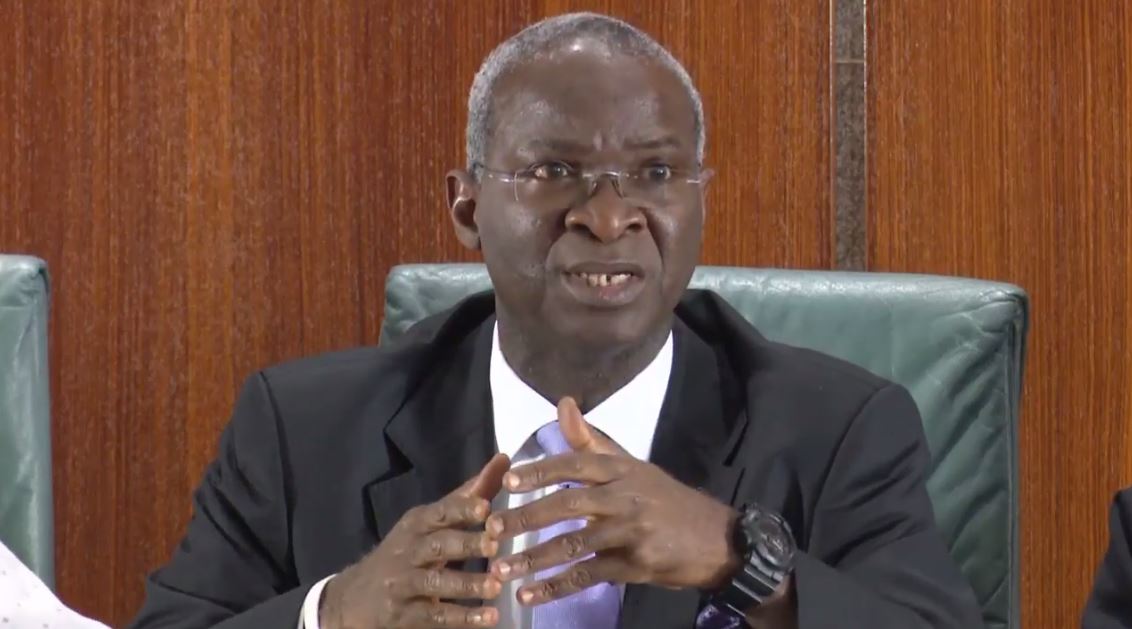
Minister of Works and Housing, Babatunde Fashola, issued the notice in Abuja and unveiled the portal that was developed to ensure that the procurement process was seamless.
The 12 highways so far mapped out for concession by the Federal Government have a combined length of about 1,963km and represents less than 5.6 per cent of Nigeria’s 35,000km federal highway network.
The 12 routes for concession under the pilot phase include Benin-Asaba, Abuja-Lokoja, Kano-Katsina, Onitsha-Owerri, Shagamu-Benin and Abuja-Keffi-Akwanga.
Others include Kano-Shuari and Potiskum-Damaturu, Lokoja-Benin, Enugu-Port Harcourt, Ilorin-Jebba, Lagos-Ota-Abeokuta, and Lagos-Badagry-Seme border.
Fashola said, “These 12 roads were carefully chosen to ensure that each of the six geopolitical zones are covered.
“The initial capital investments that we foresee is something in the order of N1.13tn and the employment potentials are an estimated 50,000+ direct jobs and 200,000+ indirect jobs.”
On the procurement portal, the minister said it was developed to ensure competitiveness and guarantee transparency, adding that it would serve as the interface with the public and manage the HDMI from procurement to implementation.
He explained that the portal would give access to relevant documents, news updates, videos, ensure the management of the public private partnership procurement process and the process of approvals and permits, among others.
“Therefore, to those writing letters of inquiry, making offers of interest on the HDMI, offering to provide services like tolling, weigh bridge, rest houses, etc, we are sorry we cannot respond to those letters in order to maintain the integrity of this process and to keep the playing field level,” Fashola stated.
He further noted that currently, the government was executing over 700 different contracts for the rehabilitation and reconstruction of over 13,000km of roads and bridges across all the 36 states including the Federal Capital Territory.
He said the HDMI was an effort by government to mobilise private capacity, resources and entrepreneurship into the Nigerian highway sector.





![[BREAKING] Power: FG Increase prices of pre-paid meters](https://www.societygazetteng.com/wp-content/uploads/2021/11/images-9-3.jpeg)