Oyo School Abduction: Journalists Group Calls for State, Community Policing

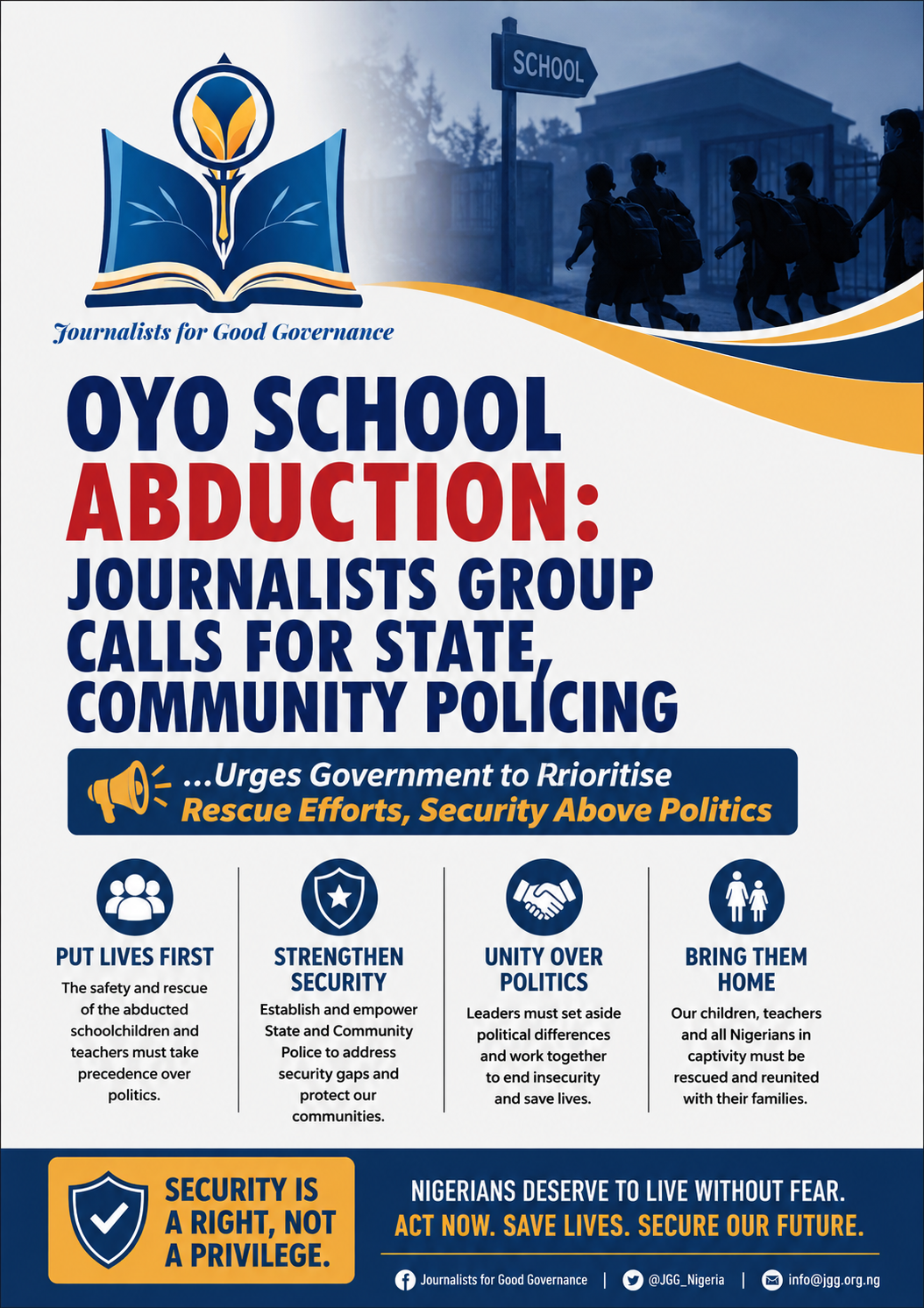
Oyo School Abduction: Journalists Group Calls for State, Community Policing

…Urges Government to Prioritise Rescue Efforts, Security Above Politics
More than two weeks after the abduction of schoolchildren and their teachers in Oyo State, a journalists’ advocacy group has called on governments at all levels to deploy every available security resource to secure the immediate release of the victims.

The group, Journalists for Good Governance (JGG), also renewed calls for the establishment of state and community policing structures as part of broader efforts to tackle Nigeria’s worsening insecurity.

In a statement issued on Tuesday, June 2, 2026, the Acting President of JGG, Bunmi Obarotimi, expressed deep concern over the continued captivity of the students and school staff, noting that one of the teachers had reportedly been beheaded while others, including the school principal, remain in the hands of their abductors.

JGG, a coalition of journalists committed to promoting accountability, good governance and effective public policy, said the safety and rescue of the victims must take precedence over political considerations.

“The attack on innocent schoolchildren and educators is a tragedy that should unite all leaders, regardless of political affiliation,” Obarotimi said. “The protection of lives and property must always come before politics.”

According to him, there is growing concern that political actors from both the ruling and opposition camps are exploiting the unfortunate incident for partisan purposes instead of focusing on practical solutions to the country’s security challenges.

“Our findings show that many political leaders are more interested in scoring political points than working together to address the insecurity crisis threatening communities across the country,” he stated.

“In many advanced democracies, moments of national tragedy bring leaders together in pursuit of lasting solutions. We urge those in positions of authority to put aside political differences, unite behind the rescue effort, and ensure the safe return of these children and other Nigerians currently held captive.”

The group also pointed to recent attacks in remote communities as evidence that criminal gangs and bandits continue to exploit security gaps in rural areas where resistance is often minimal.

JGG referenced the recent attack on Ayegunle community in Kaba-Bunu Local Government Area of Kogi State, where one person was killed and at least 33 residents were abducted, describing the incident as further proof that Nigeria’s security architecture requires urgent reform.

Obarotimi stressed the need for legislation that would establish and empower state police forces as well as community-based security organisations.

“Policing is fundamentally local in every successful security system around the world,” he said. “It is on this basis that we call on the National Assembly and State Houses of Assembly to prioritise the creation of state police and the strengthening of community security structures. Such reforms will significantly reduce the burden on federal security agencies and help address the growing security deficit that is gradually turning parts of the country into conflict zones.”

The group further urged political leaders to learn from past mistakes, recalling the 2014 abduction of the Chibok schoolgirls, which occurred amid intense political activities ahead of the 2015 general elections.

“Many of the Chibok girls are still unaccounted for today. The nation cannot afford to repeat the errors of the past by allowing politics to overshadow urgent security decisions,” the statement noted.

JGG concluded by calling on leaders across party lines to work together in confronting insecurity and restoring public confidence in the state’s ability to protect its citizens.

“Nigerians deserve to live, work and travel without fear of kidnapping, terrorism or violent attacks. The continued exposure of innocent citizens to insecurity due to political distractions and official inaction is unacceptable and must end,” the group stated.

Journalists for Good Governance Shines Searchlight on Local Government Administration

Journalists for Good Governance Shines Searchlight on Local Government Administration

…Calls for Accountability in Nigeria’s Grassroots Governance

LAGOS, Nigeria — A civil society coalition known as Journalists for Good Governance(JGG) has intensified public debate on transparency and accountability within Nigeria’s local government system, urging media professionals, civil society actors, and citizens to hold grassroots leaders accountable.

Speaking an event in Lagos recently, the acting chairman of the society, Comrade Bunmi Obarotimi said that despite reforms such as the Supreme Court’s 2024 ruling granting financial autonomy to all 774 Local Government Areas (LGAs), systemic challenges continues to hinder effective service delivery and responsible stewardship of public funds.

“Local governments are the closest tier of government to the people — yet too often they remain the least transparent. Without civic oversight and vibrant media, promises of autonomy ring hollow.” the acting chairman said.

The Journalist for Good Governance emphasised crucial roles that journalists can play in uncovering discrepancies in council spending, flagging poor service delivery, and educating citizens on their rights. Their call comes amid wider efforts by media and civic organisations to bridge accountability gaps. The civil society initiatives had previously launched monitoring campaigns to track local government expenditures and have been quietly advocating for transparency in how public money is deployed.

The leaders of the Journalists for Good Governance (JGG) highlighted the importance of physical assessment and citizens engagement on projects to boost people’s confidence, urging local councils to adopt open data platforms and proactive information dissemination in compliance with the Freedom of Information Act. Experts say the majority of LGAs currently lack operational websites or digital portals, further limiting public scrutiny.

The Journalists for Good Governance initiative aligns with sustained advocacy by civil society groups and governance experts calling for a collective approach to strengthening democratic accountability, and has decided to engage in critical and holistic assessments of how Local Governments is being run and the impact and quality of projects they embark-on and to address deficits in transparency and public trust.
Meanwhile, some state governments have signaled support for improved community engagement. In Lagos State, authorities reiterated a commitment to enhancing community media platforms as vehicles for civic participation and accountability at the grassroots level.

The renewed spotlight on local government administration has reignited public debate over fiscal responsibility and priorities. Controversies such as the widely criticised Adamawa council chairmen’s wives trip to Istanbul — which drew public outrage for perceived misuse of public funds — underscore why watchdog groups say stronger oversight mechanisms are urgently needed at the grassroots.
Citizens and activists have welcomed the journalists’ initiative, calling for sustained media engagement that goes beyond headlines to influence policy and accountability reform.

The civic rights advocates note that real change will require robust legal frameworks, a free press, and empowered communities equipped to demand transparency at every level of governance.
As Journalists for Good Governance mobilises its members, the coming months are likely to see heightened media attention on grassroots administration — from council budgets and service delivery to the enforcement of public information laws and digital transparency initiatives.

Exit mobile version