NNPCL Recorded N2.5 trillion Profit in 2022 Unaudited, Report Highest in 45 years

NNPCL Recorded N2.5 trillion Profit in 2022 Unaudited, Report Highest in 45 years
The Nigerian National Petroleum Company Limited (NNPCL) has announced its highest profit in 45 years, recording N2.548 trillion for the year 2022.

The national oil company, in its 2022 Financial Performance Report published online, emphasized that the profit recorded was the highest since its founding in 1977.

Breakdown of the Financial Report

According to the financial report, losses amounted to N803 billion in 2018 and increased to N1.7 billion in 2019.

In 2020, the report highlights a profit of N287 billion, denoted as the ‘Turning Point,’ and in 2021, the company’s profit grew to N674.1 billion, named ‘Assurance.’

According to the report, the profit continued its upward trend, reaching N2.548 trillion in 2022.

In October alone, a few months after the removal of the subsidy, the Chief Executive Officer of NNPC Ltd, Mele Kyari, said the company remitted N4.5 trillion as revenue to the federation account in October.

He made this disclosure while appearing before the Senate Committee on Finance to defend the company’s budget for the 2024 fiscal year.

  • “I am glad to inform you, Mr. Chairman and distinguished senators that as of October we can deliver N4.5 trillion into the federation account as a company to this country In 2023,” Mr Kyari said.

Meanwhile, NNPCL is yet to be audited by an independent financial auditing firm, as demanded by most stakeholders in the industry.

Oil Theft as Impediments for Growth

In addition, the national oil company still battles with myriads of oil theft incidents across the country, thus impeding the growth and revenue potential of the sector at large

For instance, last week, authorities reported the discovery and destruction of 52 illegal refineries in Abia, Imo, Rivers, and Bayelsa states. Additionally, 32 illegal connections were uncovered in various locations across the Niger Delta.

NNPC Ltd also announced that it had between December 30, 2023, and January 5, 2024, recorded 157 incidents of crude oil theft from seven incident sources and arrested 17 suspects.

However, the company affirmed its unwavering commitment to eliminate the oil theft menace, emphasizing that there would be no retreat until it was completely eradicated.

What you should know

The NNPCL has faced criticism from industry participants and stakeholders for its failure to disclose financial performance for public scrutiny.

In its 46-year history, the NNPC opened its books for the fourth consecutive time during the 2021 financial year.

Meanwhile, in November, NNPCL forecasted a revenue increase to N4.5 trillion by the end of 2023, citing the commencement of operations at the Port Harcourt Refining Company.

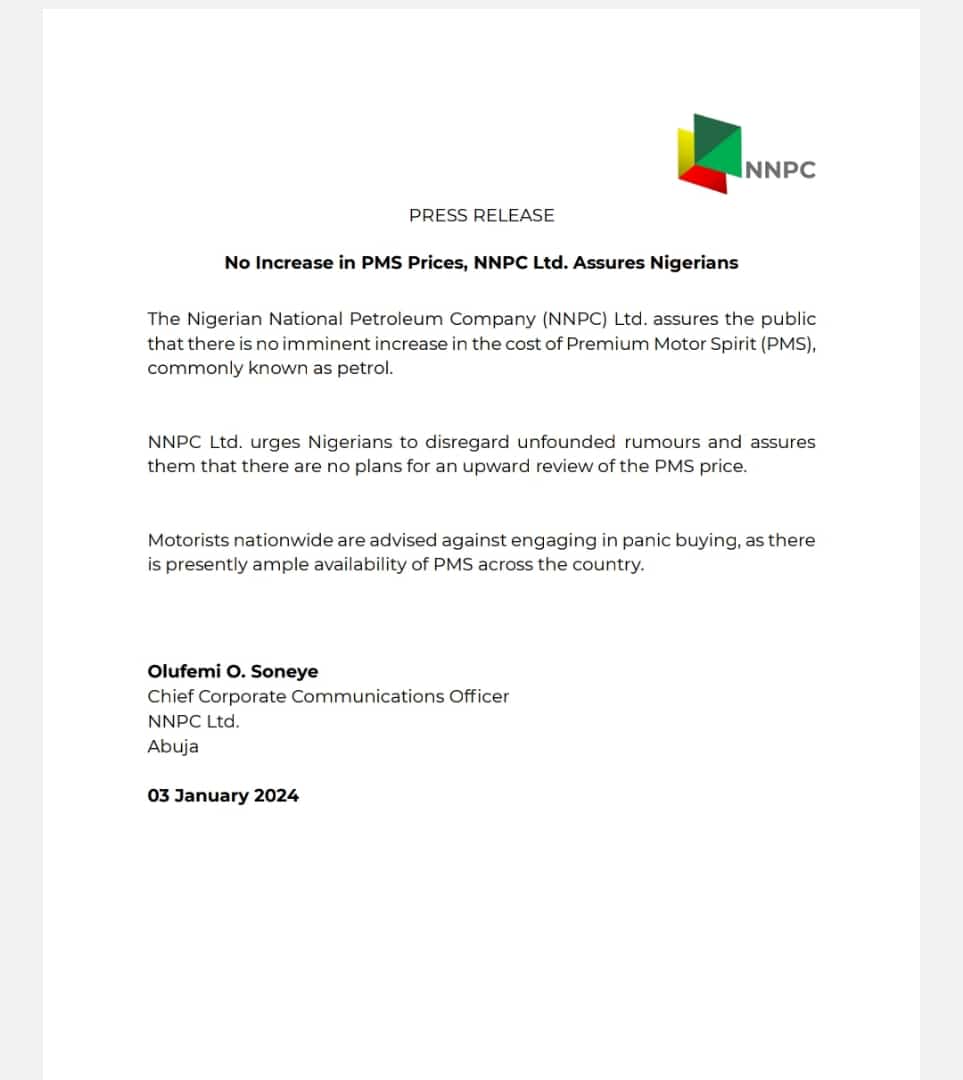
No plan to hike fuel price, NNPCL assures Nigerians

No plan to hike fuel price, NNPCL assures Nigerians

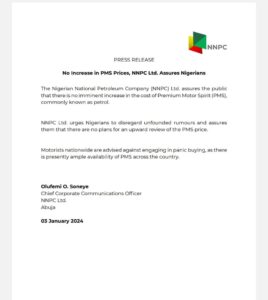
The Nigerian National Petroleum Company Limited (NNPCL), on Wednesday, declared that there was no plan to increase the pump price of Premium Motor Spirit, popularly called petrol.

NNPCL’s Chief Corporate Communications Officer, Olufemi Soneye, said in a statement that Nigerians should disregard rumours of a possible hike in petrol price.

The oil firm further urged motorists not to be involved in panic buying, as it stressed that the company had no plan to raise the cost of the product.

The statement read, “NNPC Ltd assures the public that there is no imminent increase in the cost of Premium Motor Spirit, commonly known as petrol.

“NNPC Ltd urges Nigerians to disregard unfounded rumours and assures them that there are no plans for an upward review of the PMS price.

“Motorists nationwide are advised against engaging in panic buying, as there is presently ample availability of PMS across the country.”

Some Nigerians had expressed fear following the revelation by oil marketers that the cost of petrol should be around N1,200/litre if it was not being subsidised, considering the cost of the commodity in other climes.

But the NNPCL insisted that there was no more subsidy on the product, stressing that it was now recovering its full cost on the importation of PMS into Nigeria. NNPCL is the sole importer of petrol into Nigeria.

All you Need to know about NNPCL’s $3billion Emergency Crude Repayment Loan from Afrexim Bank 

All you Need to know about NNPCL’s $3billion Emergency Crude Repayment Loan from Afrexim Bank 


The current economic situation of things in the country especially the planned increase of the fuel price was due to the deep in value of the Naira against the dollar, just yesterday a dollar was exchanged for 972 naira at the parallel market, giving serious need for the government to formulate policy that will help the Naira rally against the dollar and it was this that necessitate the NNPCL to approach the Afrexim Bank to obtain the Emergency Crude Repayment loan and the result seems to be coming in as the Naira appreciated strongly against the dollar as at close of work to the naira gained over 200 naira to close at 752 against the 970 of yesterday morning. 


This is an attempt by the president’s aide on New Media O’tega Ogra to answer some questions that might be begging for answers from the public 


What is the $3 billion loan about?

The NNPC Ltd. secured an emergency $3 billion crude oil repayment loan from AFREXIM Bank. This is not a crude-for-refined products swap but an upfront cash loan against proceeds from a limited amount of future crude oil production.


Is this loan risky for NNPC Ltd. or the Nigerian Treasury?

No. The exposure for NNPC Ltd. is very limited, covering just a fraction of their entitlements. Additionally, there are no sovereign guarantees tied to this loan.


What’s the benefit of this loan to Nigeria?

The loan will assist NNPC Ltd. in settling taxes and royalties in advance. It will also equip the Federal Government with the necessary dollar liquidity to stabilize the Naira, with limited risk.


How will the loan be disbursed?

The funds will be released in stages or tranches based on the specific needs and requirements of the Federal Government.


Will this affect fuel prices?

A strengthened Naira as a result of this initiative will lead to a reduction in fuel costs. This means that if the Naira appreciates in value, the cost of fuel will drop and further increases will be halted.


What about subsidies? Are they coming back?

No. A stronger Naira will result in lower prices from the current level, making subsidies unnecessary. The deregulation policy remains unchanged. 


How will the loan be repaid?

The loan will be repaid against a fraction of proceeds from future crude oil production. It’s a strategic move that ensures a balance between our current economic needs and future production capabilities.


What is the difference between this and previous swap deals?

This is not a crude for refined products agreement where the government does not earn any proceeds from the swap.

Exit mobile version