ZENITH BANK LAUNCHES MAIDEN GIRL-CHILD EMPOWERMENT PROGRAMME, REACHES 300 SCHOOLGIRLS
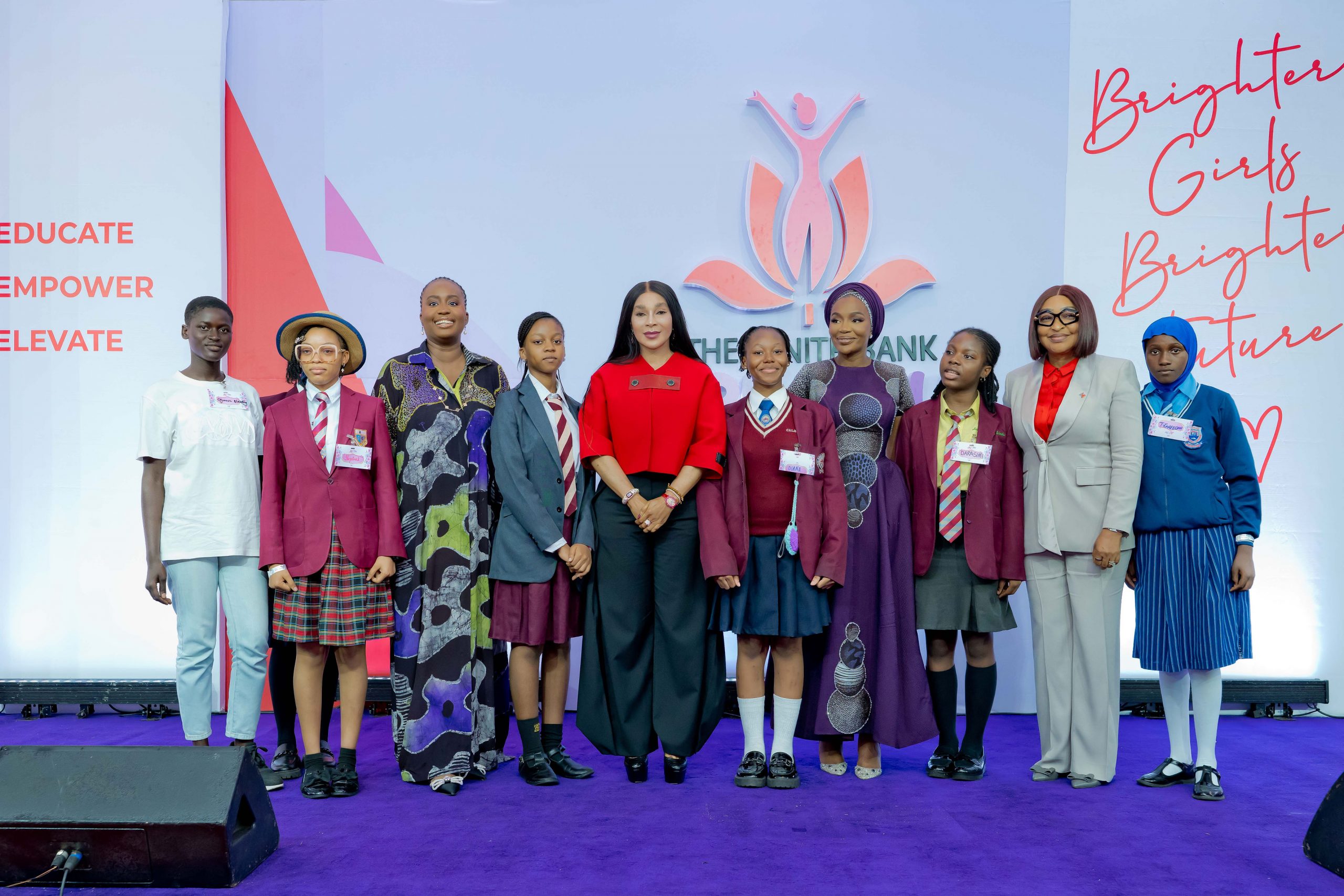
(L-R) Founder, Aruwa Capital Management, Adesuwa Okunbo-Rhodes; Group Managing Director/CEO, Zenith Bank Plc, Dame Dr. Adaora Umeoji, OON; The Queen Consort of Warri Kingdom, Her Majesty, Olori Atuwatse III ; and Executive Director, Zenith Bank Plc, Mrs. Adobi Nwapa, with girls from selected schools in Lagos during the maiden edition of the Zenith Bank Girl-Child Empowerment Programme held at the Civic Centre, Victoria Island, Lagos, on Monday.
Zenith Bank Plc has launched the maiden edition of its Girl-Child Empowerment Programme, themed “Banking on Her Tomorrow,” bringing together 300 schoolgirls aged 13 to 17 from selected schools across Lagos for a day of learning, mentorship and personal development.
Held on Monday, October 12, 2026, at the Civic Centre, Victoria Island, Lagos, the programme featured sessions on finance and investment, etiquette and personal development, social media ethics, and social relationships and interactions, equipping participants with practical knowledge and skills for their personal, educational and future career journeys.
The initiative, a brainchild of the Bank’s Group Managing Director/Chief Executive Officer, Dame (Dr.) Adaora Umeoji, OON, reflects Zenith Bank’s commitment to nurturing the potential of young girls and helping them make informed choices about their futures.
In her welcome address, Dame (Dr.) Umeoji urged the participants to believe in their abilities, pursue their ambitions and remain focused and disciplined. Drawing on examples of young girls who have achieved remarkable feats, she challenged them to look beyond their present circumstances and envision the women they aspire to become.
“To all my amazing young ladies here today, each of you possesses gifts, talents, and ideas that are capable of revolutionising the world. You can revolutionise the world with your ideas,” she said.
The GMD/CEO further encouraged the girls to explore their interests and resist societal limitations, stressing the importance of taking ownership of their futures.
“Never allow gender or age to limit your goals. Whatever interests you today, explore it. Whatever you choose to pursue in life, give it your best shot,” she said.
Delivering the keynote address, Her Majesty, Olori Atuwatse III, Queen Consort of the Warri Kingdom, encouraged the girls to embrace their identities, develop resilience and use their abilities to make a positive difference in the lives of others.
Using the mangrove tree as a metaphor for resilience, she reminded the participants that challenges need not define their futures and that their worth extends beyond academic results and external expectations.
“Every time you affirm the truth about who you are, you are building confidence. Every time the tide of life goes out and you are still standing, you are building resilience. And every time you use your gifts for another person, you are discovering your purpose,” Olori Atuwatse III said.
The programme featured interactive sessions led by accomplished professionals and personalities:
Ayanime Edem, founder of The Elite Finishing School and modern etiquette educator, discussed confidence, communication, self-presentation and etiquette.
Nigerian actress and content creator Bukunmi Adeaga Ilori, popularly known as Kie Kie, addressed responsible social media use, authenticity and digital boundaries.
Representing Zenith Bank, Thelma Okonye and Adesola Adeyemo introduced the girls to saving, responsible money management and investment, highlighting the importance of developing sound financial habits early.
While Nigerian filmmaker, creative executive and educator, Praise Onyeagwalam, Director Pink, led a session on healthy relationships, self-awareness and effective communication.
The sessions encouraged active participation, giving the girls opportunities to ask questions and engage with the speakers on issues relevant to their experiences and aspirations.
The programme also featured competitions, with cash prizes totalling over ₦1 million awarded to winners. The participants received books to encourage reading and personal growth, while musical performances by Nigerian singers Qing Madi and No. 11 added to the lively atmosphere. The event was hosted by Temi Badru, public speaker, communications coach and lawyer, with Darasimi Destiny Nadi serving as mini host.
Delivering the closing remarks, Executive Director, Zenith Bank Plc, Dr. Mrs. Adobi Nwapa, highlighted the GMD/CEO’s vision for the initiative and the Bank’s commitment to sustaining its impact.
“The programme is the vision of our GMD/CEO, who conceived and championed it, demonstrating her unwavering commitment to the empowerment of the girl child. Through her leadership, she has shown the girls what is possible when a woman dares to lead. At Zenith Bank, our commitment to the girl child extends beyond today, and we will continue to nurture their aspirations through this annual initiative,” she said.
Dr. Nwapa thanked the speakers and participants for contributing to the programme’s success and encouraged the girls to apply the lessons learnt, remain confident and pursue their aspirations with determination.
The initiative builds on Zenith Bank’s longstanding commitment to advancing opportunities for women and girls through programmes including its annual International Women’s Day Seminar, the Zenith Women’s Basketball League, the Women of Honour Awards in partnership with the Ford Foundation, the Pad-a-Queen Initiative and Z-Woman, which supports women-owned businesses through business support and access to credit at discounted rates.
Through “Banking on Her Tomorrow,” Zenith Bank is extending this commitment to a younger generation, equipping girls with the knowledge, skills and confidence to pursue their ambitions and contribute meaningfully to their communities and society.
BIC Nigeria Recognized for Decade-Long Brand Legacy at 2026 Edge Awards
L-R: Chinelo Anosike, Legal Manager, BIC Nigeria; Eniola Mayowa, Vice Chairman, Lagos NIPR & Managing Partner, StepCraft Communications; and Foluke Femi-Sanda, Marketing Manager, BIC Nigeria, at the 2026 Edge Awards.
BIC Nigeria has received two major honors at the 2026 Edge Awards, winning the Edge Outstanding Legacy Brand Award of the Decade (Corporate) and the Edge Outstanding Legacy Brand Award (Shaving Razor).
The awards, presented at Marketing Edge’s Edge Awards Night on Friday, September 25, in Lagos, recognize the brand’s sustained equity and performance in Nigeria’s fast-moving consumer goods sector over the past decade, alongside the continued relevance of its shaving razor brand to Nigerian consumers.
The double recognition reflects the longevity of BIC in Nigeria and the trust its brands have earned across generations of consumers. It also highlights the company’s focus on delivering products that meet everyday needs while evolving with changing consumer expectations.
“We are proud of these awards and thankful to Marketing Edge,” said Anthony Amahwe, General Manager, BIC Nigeria. “For us, a legacy is built through the trust people place in our products, day after day. These awards are a reflection of the work of our teams and partners, as well as the loyalty of consumers who have made BIC part of their everyday lives. They encourage us to keep building brands that remain relevant to consumers and the changing needs of the market.”
The 2026 Edge Awards brought together leading brands, corporate leaders, marketing and communications professionals, and other industry stakeholders under the theme “Celebrating Excellence Beyond Borders” to praise achievements across the marketing and business landscape. The 14th edition highlighted excellence in creativity, innovation and strategic leadership, honoring brands, businesses, professionals and agencies for their contributions to the industry.
For BIC Nigeria, the recognition reinforces the company’s commitment to building brands that remain trusted, relevant and accessible to consumers. As the company looks ahead, it remains focused on delivering reliable, quality products and creating beautiful, better everyday essentials.
NGX CEO Chiemeka emerges African exchanges association president
The Chief Executive Officer (CEO) of Nigerian Exchange Limited, Jude Chiemeka, has been appointed President of the African Securities Exchanges Association (ASEA), effective September 30, 2026.
Chiemeka, who also chairs the West African Capital Markets Integration Council, succeeds Pierre Célestin Rwabukumba, Chief Executive Officer of the Rwanda Stock Exchange, as ASEA moves to deepen integration and strengthen collaboration among African capital markets.
The association said the appointment comes at a critical time as it seeks to improve market liquidity, strengthen regional connectivity, accelerate technology adoption and promote cross-border capital flows across the continent.
With more than 30 years of experience in the capital markets, spanning securities trading, asset management and investment banking, Chiemeka has played key roles in regional market initiatives and major transactions.
Reacting to his appointment, Chiemeka described it as a privilege to lead ASEA at a time when market integration and technology-driven innovation are increasingly important to Africa’s economic development.
“It is a privilege to lead the African Securities Exchanges Association at a time when capital market integration and technology-driven innovation are paramount to unlocking Africa’s economic potential,” said Mr. Chiemeka. “Building on the solid foundation laid by my predecessor, Mr. Pierre Célestin Rwabukumba, ASEA will continue to advocate for stronger cross-border investment frameworks, deeper liquidity pools, and sustainable finance initiatives across our member exchanges,” he said.
In his outgoing address, Rwabukumba reflected on his tenure: “Leading ASEA has been an honour, and I am proud of the progress we have made in bringing African exchanges closer together. I extend my warmest congratulations to Jude Chiemeka. His extensive leadership across both the Nigerian market and WACMIC makes him exceptionally qualified to guide ASEA into its next chapter of growth.”
Under Chiemeka’s presidency, ASEA will focus on deepening cross-border market integration by facilitating inter-exchange trading and cross-listing across African jurisdictions.
The association will also prioritise digital innovation through the adoption of financial technology and modern market infrastructure to improve operational efficiency and expand retail investor access.
Other priorities include increasing capital mobility by strengthening links with global institutional investors while encouraging greater local participation, as well as promoting sustainable finance through efforts to standardise environmental, social and governance frameworks and green bond listings across member exchanges.
The appointment is expected to further strengthen Nigeria’s role in efforts to integrate African capital markets and create a more connected investment environment across the continent.
ZENITH BANK TO HOST 10TH INTERNATIONAL TRADE SEMINAR, CHARTS PATH TO UNLOCKING GREATER VALUE IN NIGERIA’S NON-OIL EXPORT SECTOR
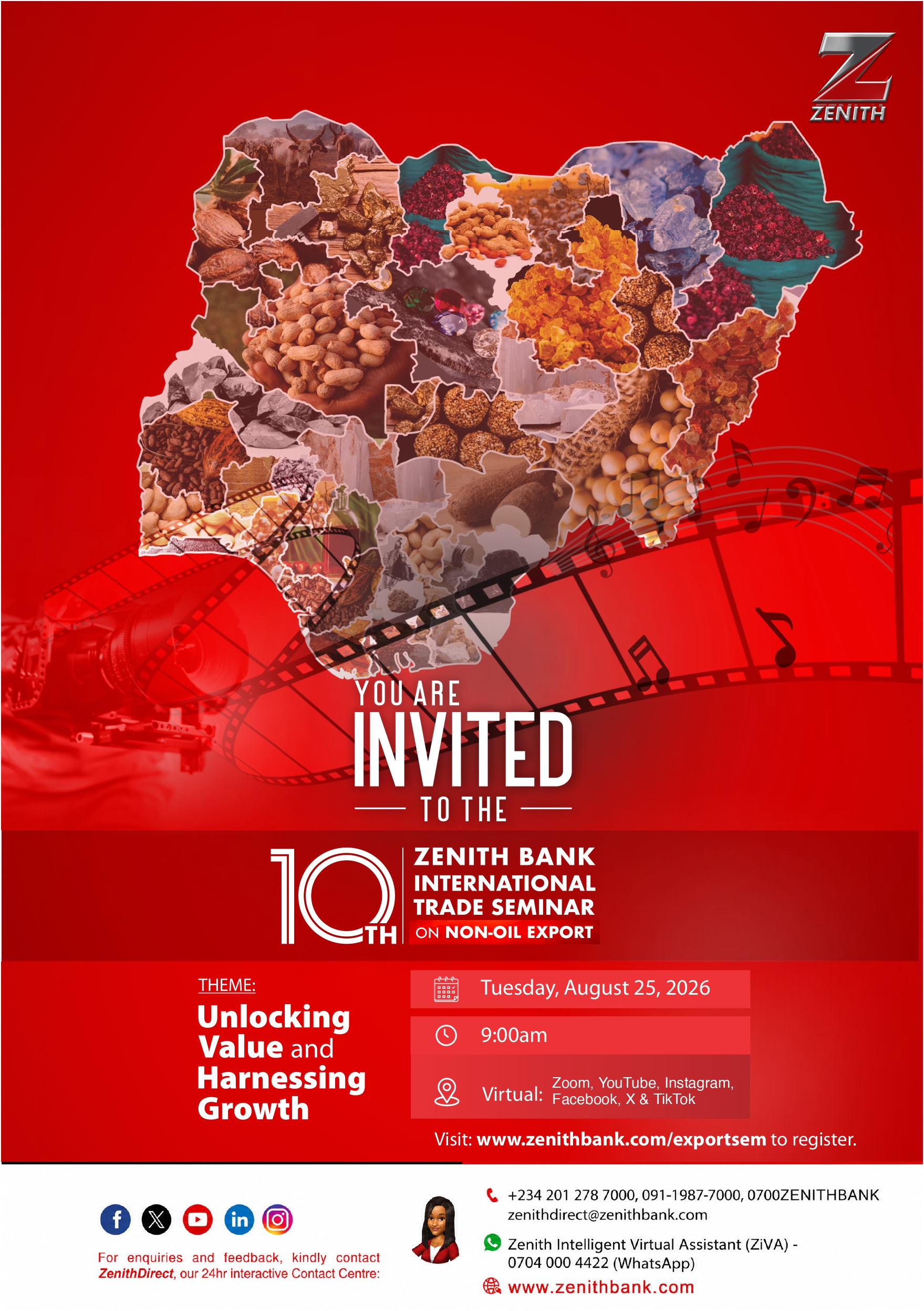
Zenith Bank Plc will host the 10th edition of its International Trade Seminar on Non-Oil Export on Tuesday, 25 August 2026, bringing together leading policymakers, regulators, exporters, manufacturers, investors and other key stakeholders to explore practical strategies for unlocking value and accelerating growth in Nigeria’s non-oil export sector.
Themed “Unlocking Value and Harnessing Growth in Non-Oil Export”, the virtual seminar will examine how Nigeria can move beyond exporting raw commodities to build globally competitive value chains, expand market access, strengthen trade infrastructure and financing, and deepen the contribution of non-oil exports to sustainable economic growth.
The high-level event will feature an impressive line-up of guest speakers, including the Secretary-General of the African Continental Free Trade Area (AfCFTA) Secretariat, H.E. Wamkele Mene; the Chief Executive Officer of Plot Enterprise Ghana Limited, Mrs Patricia Poku-Diaby; and the immediate past President and Chairman of the Board of Directors of the African Export-Import Bank (Afreximbank), Professor Benedict Oramah.
The seminar will also convene leading voices from the public and private sectors in two panel discussions. The first panel, dedicated to public sector perspectives, will bring together key stakeholders driving Nigeria’s trade, export, investment and economic development agenda. It will feature the Managing Director/Chief Executive of the Nigerian Export-Import Bank (NEXIM Bank), Mr Abba Bello; the Comptroller-General of the Nigeria Customs Service, Mr Adewale Adeniyi; the Director, Trade and Exchange Department, Central Bank of Nigeria, Ms Aderinola Shonekan; the Executive Secretary/Chief Executive Officer of the Nigerian Investment Promotion Commission (NIPC), Mrs Aisha Rimi; and the Executive Director/Chief Executive Officer of the Nigerian Export Promotion Council (NEPC), Mrs Nonye Ayeni.
The second panel, focused on private sector perspectives, will feature the Managing Director/Chief Executive Officer of Starlink Global & Ideal Limited, Alhaji Adeniji Adeyemi; the Group Executive Director, Dangote Group, Alhaji Sada Ladan-Baki; Senior Consultant at 3T Impex Trade Centre, Mr Bamidele Ayemibo; the Managing Director of Terra Aqua Environmental Consultancy Nigeria Limited, Alhaji Mobolaji Salako; the Managing Director/Chief Executive Officer of RMM Global, Mr Ramzi Taher; and the Managing Director/Chief Executive Officer of Lelook Nigeria Limited, Chief Mrs Chinwe Ezenwa.
The discussions will offer practical perspectives on trade facilitation, export financing, customs and port efficiency, regulation, market access, and the competitiveness of Nigerian businesses in regional and global markets.
A key focus of the seminar will be the African Continental Free Trade Area and its potential to open up a larger market for Nigerian goods and services while deepening intra-African trade. With the AfCFTA offering businesses access to a market of more than one billion people, the discussions will examine how Nigerian enterprises can leverage regional integration, build competitive value chains and seize emerging opportunities across the continent.
Zenith Bank has consistently championed conversations around trade and economic development. It remains at the forefront of efforts to support businesses seeking to participate more effectively in regional and international commerce. The Bank has also partnered with the AfCFTA Secretariat on initiatives to facilitate cross-border trade and expand access to opportunities across Africa.
Now in its 10th edition, the Zenith Bank International Trade Seminar has evolved into a leading platform for high-level dialogue on Nigeria’s trade and export ecosystem. Over the years, the seminar has brought together government, regulators, businesses, financial institutions, and other stakeholders to examine emerging trends, identify challenges, and proffer practical solutions to strengthen Nigeria’s position in global commerce.
The 2026 edition will build on this legacy, convening some of the most influential voices shaping Nigeria’s trade, investment and economic landscape around one critical question: how can Nigeria unlock greater value from its non-oil exports and translate its vast productive potential into sustainable economic growth?
The seminar will be held virtually and streamed live on Zoom, YouTube, Instagram, Facebook, X, and TikTok, enabling participants in Nigeria and around the world to join the conversation. Interested participants can register at www.zenithbank.com/exportsem
Nigeria’s Finance Talent Pipeline Gets a New Benchmark, and Access Sets It
New data from CFA Society Nigeria is reshaping how the country’s financial sector thinks about talent development, with Access emerging as the single largest source of CFA candidates in Nigeria, a distinction industry watchers say signals a deeper shift in how leading institutions are building investment expertise from within.
In its Where Nigeria’s Finance Professionals Work series, published in a national daily, CFA Society Nigeria placed Access first among employers of CFA candidates nationwide, with 82 candidates enrolled in the programme, more than double the 38 recorded at the next-placed institution and well ahead of every other bank or financial services firm on the list. Access also ranked second among employers of CFA charterholders, with 11 professionals who have completed all three levels of the Programme and met its experience and ethics requirements.
For an industry that has long measured itself by balance sheet size and branch count, the rankings point to a different kind of competition: one over who is building the deepest bench of certified, globally credentialed talent. CFA Society Nigeria compiled the data from its Salesforce Membership Database as at June 2026, and described the exercise as a way of recognising employers whose people “bring rigour, integrity and global best practices into the workplace every day.”
Analysts following the sector say the outcome is notable less for the ranking itself than for what it suggests about talent strategy across Africa’s financial services industry. A single institution developing more aspiring charterholders than the rest of the market combined raises the floor for professional standards nationally, not just within one balance sheet. Every candidate who advances through the CFA Programme adds to a shared pool of ethics-trained, analytically rigorous professionals that Nigeria’s capital markets, pension funds and asset managers all eventually draw from.
Access Holdings Group Chief Executive Officer Innocent C. Ike, commenting on the rankings, framed the achievement in terms of institution-building rather than recruitment: “Every candidate on that list represents our commitment to building institutions and professionals that endure.” The remark echoes a broader thesis increasingly voiced by market observers, that talent depth, not scale alone, is what will determine which African financial institutions earn lasting global credibility.
That distinction sits at the centre of Access’s stated ambition to become the World’s Most Respected African Financial Services Group. If the CFA numbers are any indication, the Group’s route to that goal runs less through square metres of branch network and more through the calibre of the people sitting inside it, a bet that Nigeria’s finance professionals, and the institutions that will one day hire them, are already placing alongside Access.
Zenith Bank Widens the Gap: Inside Nigeria’s Best-in-Class Lender
Zenith Bank Plc has spent 2026 collecting the kind of hardware that separates a good regional lender from a genuine African champion.
Fresh off a sweep of Euromoney’s most coveted awards, a completed acquisition in Kenya, a newly opened subsidiary in Francophone West Africa, and plans for a London Stock Exchange listing in 2027, Nigeria’s most profitable bank is now making the case that it is also the best-run one.
A close read of its unaudited first-quarter 2026 financial statements — its net interest income, fee income, capital buffers and loan book all expanding faster than the industry average — backs that case up with numbers.
The Lagos-based lender’s Group profit before tax rose 3% year-on-year to ₦361 billion in the three months to March 31, 2026, the highest absolute pre-tax profit among Nigeria’s seven largest banks and the only one of the group to combine top-line profitability with double-digit growth in net interest income, fee income and shareholders’ equity simultaneously.
Layer on a historic Euromoney double and an accelerating Pan-African build-out, and the numbers tell a story that goes well beyond one good quarter.
Zenith closed the first quarter of 2026 with total assets of ₦32.01 trillion, up 1.8% from ₦31.46 trillion at the end of December 2025, even as the balance sheet held broadly flat year-on-year against the ₦32.42 trillion reported in March 2025 — a sign of a bank actively re-shaping its asset mix rather than simply expanding its footprint.
Customer deposits, the cheapest and stickiest source of funding for any lender, climbed 7.9% year-on-year to ₦24.47 trillion, while total shareholders’ equity surged 16.3% to ₦5.17 trillion — a rate of capital accretion that outpaces balance-sheet growth and signals a bank retaining and compounding earnings rather than chasing volume.
That equity build has real consequences for market standing. Zenith Bank’s shares have gained more than 104% year-to-date through July 23, 2026, pushing its market capitalization to roughly ₦5.18 trillion.
The top three banks by market capitalization are now separated by less than 2% of market value — but Zenith is the only one of the trio backing its valuation with the industry’s fastest brand-value growth, up 33.6% on the continent, according to the latest report by Brand Finance.
While Access Holdings’ aggressively acquisitive strategy has made it Nigeria’s largest bank by sheer balance-sheet size — ₦51.56 trillion in total assets as of 2025 — Zenith’s smaller, more capital-efficient balance sheet is generating disproportionately more profit per naira of assets deployed, a theme that recurs throughout its results.
Loan Book: Growing Faster Than the Balance Sheet, Cleaner Than a Year Ago
Zenith’s credit expansion in the first quarter outpaced every other line on the balance sheet. Gross loans and advances to customers rose 8.6% year-on-year to ₦12.04 trillion, while net loans — after impairment allowances — jumped a sharper 13.2% year-on-year to ₦11.38 trillion, reflecting both fresh credit extension and an improving quality of the existing book.
That improvement in quality is the more important story for analysts and investors skeptical of loan growth achieved by lowering underwriting standards.
Zenith’s non-performing loan ratio — Stage-3, credit-impaired loans as a share of gross loans — stood at 3.79% at the end of March 2026, essentially flat against 3.82% at the end of 2025 but down sharply from 4.70% at the end of 2024, continuing a multi-year de-risking trend even as the loan book itself expanded.
Independent disclosures from full-year 2025 put Zenith’s loan-loss coverage ratio at 172.6% — meaning provisions held against bad loans exceed the value of the impaired loans themselves by more than 70%, a comfortable buffer well above what regulators require.
Growing the loan book faster than the balance sheet while simultaneously cutting the bad-loan ratio is a combination few Tier-1 African lenders can claim in the same quarter.
Interest and Fee Income: A Diversifying Revenue Engine
Zenith’s income statement shows a bank successfully diversifying away from pure interest-rate carry. Gross earnings for the quarter rose 6.1% year-on-year to ₦1.01 trillion, but the composition of that growth is the more telling detail.
Net interest income — the core spread between what the bank earns on loans and investments and what it pays on deposits — climbed 7.3% to ₦634.1 billion, the largest net interest income of any Nigerian bank in the quarter.
The standout, however, is fee income. Net fee and commission income surged 44.6% year-on-year to ₦81.0 billion, up from ₦56.0 billion a year earlier — a growth rate more than six times faster than net interest income and a clear signal that Zenith is successfully monetizing transaction banking, digital channels and card services rather than relying solely on its loan book for growth.
For full-year 2025, the bank’s net interest margin stood at 13.7%, one of the widest among Nigerian Tier-1 banks and a reflection of disciplined asset-liability pricing through a high-rate environment.
Return on Equity: Profitability That Outruns Balance-Sheet Growth
Return on average equity is where Zenith’s capital discipline shows up most clearly. The bank closed full-year 2025 with a return on average equity of 23.2% and a return on average assets of 3.4%, both figures independently disclosed alongside its FY2025 results.
That profitability was rewarded directly at the shareholder level: Zenith’s board doubled its total dividend for 2025 to ₦10.00 per share — split between a ₦1.25 interim payout and a ₦8.75 final dividend — from ₦5.00 the previous year, distributing roughly ₦410.7 billion to shareholders, one of the largest dividend payouts in Nigerian corporate history.
Cost discipline underpins the returns: full-year 2025 cost-to-income ratio came in at 45.2%, while the bank’s own Q1 2026 figures point to further improvement, with operating expenses absorbing roughly 47.15% of operating income for the quarter — a leaner ratio than the FY2025 run rate.
Against peers, the ROE story favors Zenith on a risk-adjusted basis.
Capital Adequacy: A Fortress Balance Sheet
Regulators and rating agencies alike have flagged Zenith’s capital position as a standout. The bank’s capital adequacy ratio stood at roughly 25% at the end of full-year 2025 and its liquidity ratio at 71%, both comfortably clear of the Central Bank of Nigeria’s regulatory minimums for systemically important banks. Fitch Ratings’ most recent update pegs Zenith’s standalone total capital ratio even higher, at 25.8% at end-2025, against a fully-loaded core capital ratio of 28% — a buffer Fitch frames as well in excess of regulatory requirements.
Equity research from CardinalStone projects that buffer widening further, forecasting a capital adequacy ratio of 28.7% for 2026 and 30.8% for 2027 as retained earnings continue to compound. A capital position this deep gives Zenith room to absorb credit shocks, fund loan growth internally, and — as its international ambitions make clear — write bigger cross-border checks without straining its own solvency.
A Historic Euromoney Double
The market recognition arrived in force this month. At the Euromoney Awards for Excellence 2026, presented July 16 at The Peninsula London Hotel against a record field of more than 770 entries, Zenith Bank was named both “Africa’s Best Bank” and “Nigeria’s Best Bank” — the latter for the second consecutive year, having also won the national title in 2025.
Zenith Bank, Group Managing Director Dr. Adaora Umeoji called the double “a reflection of the trust of our customers, the dedication of our unicorn workforce, and our unwavering commitment to building a truly African global financial institution.”
The Euromoney sweep sits atop an already crowded trophy shelf: Zenith has been ranked the Number One Bank in Nigeria by Tier-1 Capital for 17 consecutive years in The Banker’s Top 1000 World Banks Ranking, and has separately been named Bank of the Year (Nigeria) by The Banker in 2020, 2022 and 2024, and Best Bank in Nigeria by Global Finance’s World’s Best Banks Awards in 2020, 2021, 2022, 2024 and 2025.
Pan-African Expansion: Kenya, Côte d’Ivoire and a London Listing
Zenith’s ambitions have moved decisively past Nigeria’s borders in 2026, on three fronts simultaneously.
East Africa: In April 2026, Zenith completed its acquisition of 100% of the issued share capital of Paramount Bank Kenya Limited, following regulatory approvals from both the Central Bank of Kenya and Nigerian authorities — a deal first disclosed in November 2025.
Paramount is a modest player — ranked 33rd of Kenya’s 39 licensed banks with roughly 0.2% market share — but the acquisition hands Zenith a regulated foothold in East Africa’s largest and most stable economy, with GDP exceeding $136 billion, giving it a platform to build out corporate and trade-finance relationships beyond West Africa.
Francophone West Africa: On April 29, 2026, Zenith formally launched its Côte d’Ivoire subsidiary at SCI Wall Street in Abidjan’s Plateau business district — its first entry into Francophone West Africa after securing a license from the Ivorian Ministry of Finance and Budget in December 2025 and regulatory clearance from the UMOA Banking Commission.
The subsidiary, led by Cédric Tano, gives Zenith direct access to the eight-nation WAEMU currency bloc — Senegal, Mali, Burkina Faso, Niger, Guinea-Bissau, Togo, Benin and Côte d’Ivoire — and comes as the bank simultaneously moves into Cameroon and the Central African Economic and Monetary Community.
“We are proud to establish Zenith Bank’s presence in Côte d’Ivoire at a time of strong economic growth in the country and increasing regional integration,” Tano said at the launch. GMD Adaora Umeoji framed the move as fulfilling founder Jim Ovia’s founding vision: “to build a truly global brand with a strong presence across Africa and key international markets.”
The Ivorian entry follows a ₦350.5 billion (roughly $231 million) capital raise disclosed in 2025, of which 40% was earmarked specifically for overseas expansion, alongside a newly secured Paris branch license to support the broader Francophone Africa push.
London: Perhaps the most consequential long-term move is Zenith’s stated intent to list on the London Stock Exchange in 2027. Bloomberg first reported the plan on March 17, 2026, describing Zenith as seeking to “broaden access to capital and strengthen client services.”
A bank spokesperson told Bloomberg the rationale is explicitly deal-driven: “There are a lot of deals we have on the table to finance across the UK and other countries, for which we need to raise more capital.”
The plan builds on Zenith’s existing UK subsidiary and Manchester branch network, and would give the bank direct access to deeper international capital pools to fund the very cross-border pipeline its Kenyan and Ivorian expansions are now generating.
Taken together, the Kenya deal, the Côte d’Ivoire launch and the LSE listing plan describe a bank building simultaneously outward in three directions — East Africa, Francophone West Africa, and international capital markets — rather than defending Nigerian market share alone.
The Bottom Line
No single data point confirms Zenith Bank’s case as Nigeria’s Best-in-Class Lender — it is the accumulation of them. A balance sheet growing its loan book faster than its total assets while cutting bad debt. A revenue mix diversifying into fee income at a 44.6% annual clip. A capital position deep enough that rating agencies and equity researchers alike see room for it to widen further through 2027. A shareholder payout that doubled in a single year. And now, external validation from the industry’s most competitive award program, layered on top of simultaneous expansion into Kenya, Côte d’Ivoire and — pending 2027 — the London Stock Exchange.
Rivals can point to faster growth in isolated quarters, but none combine Zenith’s scale, capital strength and cross-border momentum in the same reporting period. That combination, more than any single metric, is what underpins the “best-in-class” label Euromoney’s judges affixed to Zenith Bank this July.
NOTE: This analysis draws on Zenith Bank Plc’s unaudited consolidated financial statements for the three months ended March 31, 2026, supplemented by independent research and data from MoneyCentral, Bloomberg, ThisDay, Nairametrics, Euromoney, Fitch Ratings, CardinalStone Research, Brand Finance and other sources. All figures are in Nigerian naira unless otherwise stated. Market capitalization and share-price data reflect trading as of the cited publication dates (July 23, 2026) and are subject to change.
BUA Cement Posts ₦16.57bn FX Gain, Accelerates Expansion with ₦60.67bn Capital Investment
BUA Cement recorded a net foreign exchange gain of N16.57 billion during the first half of 2026 compared with only N782.8 million in the same period last year and a N9.70 billion foreign exchange loss for the full 2025 financial year.
This marked reversal reflects the relatively more stable exchange rate environment that has followed the sharp currency adjustments experienced over the previous two years.
The improvement helped reduce overall net finance costs to just N3.41 billion, compared with N31.37 billion in the corresponding period of 2025, despite the company continuing to carry substantial borrowings.
Finance income also increased sharply to N18.73 billion, supported by higher interest earned on cash balances.
BUA Cement continued to generate significant operating cash flows despite paying substantial dividends and investing heavily in capacity expansion.
Net cash generated from operating activities stood at N278.45 billion, demonstrating the business’ strong cash conversion capability. Capital expenditure reached over N60.67 billion, largely invested in property, plant and equipment as the company continues expanding production capacity.
Property, plant and equipment increased to N1.22 trillion from N1.18 trillion at the end of 2025, reflecting continued investment in production assets and projects under construction. Construction work-in-progress alone rose to about N183.86 billion, highlighting ongoing expansion activities.
The earning note stated that BUA Cement is progressing with plans to expand installed production capacity from 17 million metric tonnes per annum to 20 million metric tonnes, including the construction of a greenfield cement plant in Ososo, Edo State.
Commenting on the results, Yusuf Binji, managing director and chief executive officer, said the company remained focused on capturing new growth opportunities while maintaining cost discipline.
“We have delivered a strong quarter despite the constraints encountered,” Binji said.
He noted that the company’s growth initiatives and cost optimisation programmes were gaining traction and expressed confidence that ongoing process improvements would deliver higher productivity and better cost management in the coming quarters.
“I am very encouraged by our outlook and performance over the next quarters,” he added.
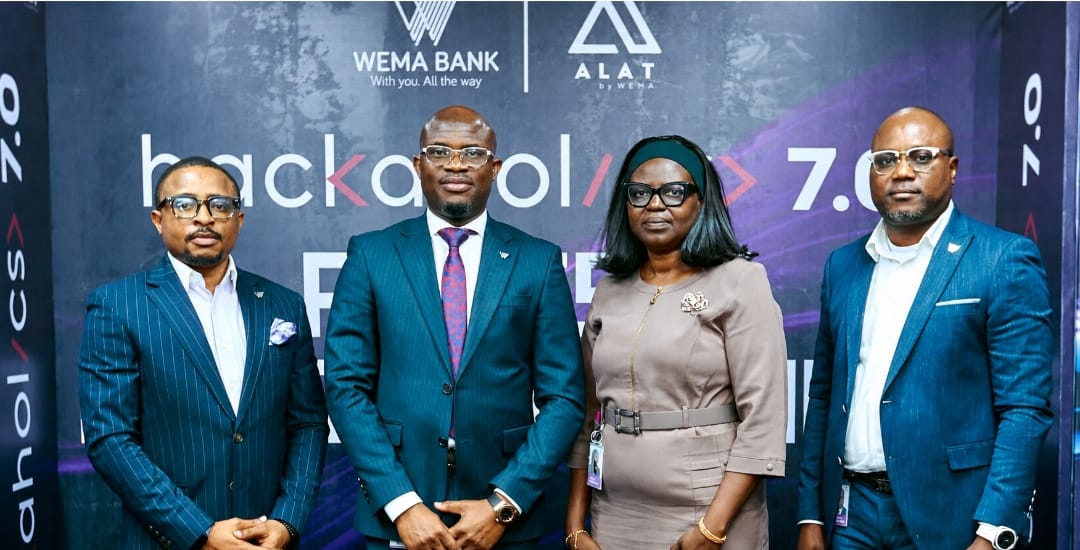
Wema Bank Announces the 7th Edition of Hackaholics
…Introduces 3 tracks, 7 Verticals, millions of naira in grant prizes
Wema Bank, Nigeria’s oldest indigenous national bank, most innovative and pioneer of Africa’s first fully digital bank, ALAT, has announced the 7th edition of its flagship innovation initiative, Hackaholics. The announcement was made at the official press conference which took place on July 1, 2026, at the Wema Bank Head Office in Lagos, Nigeria.
Launched in 2019, Hackaholics is Wema Bank’s youth and tech-focused initiative designed to serve as a platform for young Africans with creative, game changing, tech-driven ideas and products, to bring their ideas to life. Since its launch, Hackaholics has discovered thousands of groundbreaking solutions, supported over 10,000 startups, engaged 50,000 participants, developed over 100 solutions from scratch and disbursed $500,000,000 in grant prizes to dozens of winners whose remarkable solutions have earned a top spot in the past 6 editions. With the launch of Hackaholics 7.0, Wema Bank is set to execute the biggest Hackaholics edition yet.
Themed “Powering Possibilities”, Hackaholics 7.0 will kick off with an open call for applications, calling on all young Africans with creative tech-driven solutions across any of the 7 verticals: Financial Inclusion, Healthcare, Digital Transformation, Education, Sustainability, Social Impact and Future of Work. Each application is to be made via the portal at hackaholics.wemabank.com, under one of three tracks: The Startup Pitch Competition, Hackathon and the newly introduced Social Impact track. Following the application window, Hackaholics 7.0 will then proceed on a national tour which will touch 10 pitch centres across the six geopolitical zones of Nigeria. Each pitch centre will serve as a hub for innovators within the region to pitch their creative solutions and get the opportunity to secure the top spot in their pitch centre, and ultimately, proceed to the grand finale where the winners of Hackaholics 7.0 will be announced.
Speaking on the Bank’s inspiration behind Hackaholics’ exceptional seven-year journey, Wema Bank’s MD/CEO, Moruf Oseni, reiterated the Bank’s commitment to powering innovation, empowering youth and promoting economic growth in Africa. According to him, “At Wema Bank, we believe that institutions have a responsibility that extends beyond providing commercial services. We have a responsibility to create meaningful opportunities, provide the right resources, enable innovation to thrive, and support the ecosystems that will shape today’s youth as well as tomorrow’s economy. This sense of responsibility is what has driven the evolution of Hackaholics from inception till date. With Hackaholics, we have, and we are investing in the next generation of innovators, inspiring innovation that will impact lives, strengthening Nigeria’s innovation ecosystem and giving youth a platform to make meaningful use of their creativity; and the numbers continue to speak volumes”.
Declaring the application window open, Tajudeen Bakare, Wema Bank’s Divisional Executive, Business Support, added, “As we launch Hackaholics 7.0 today, we are opening up a new phase of opportunities for more Nigerian youth to challenge themselves, explore their creativity and become startup founders. I encourage every young Nigerian with a passion for innovation to leverage the opportunity that we have carefully curated through Hackaholics and get ahead of the curve in today’s dynamic work landscape. Together, we can continue to build an ecosystem where innovation flourishes, opportunities expand, and young people are empowered to create solutions that shape the future”.
Hackaholics 7.0 is free, and open to any Nigerian youth who has innovative ideas and solutions to pitch. Interested startups and innovators can apply at hackaholics.wemabank.com. All updates on the Hackaholics 7.0 journey will be made available on the Bank’s website @wemabank.com as well as its social media platforms @wemabank and @alat_ng.
Tony Elumelu at Africa Forward Summit: “Our Youth Do Not Need Handouts”
Heirs Holdings Founder tells Presidents Ruto and Macron that Africa wants partners of substance, based on equality, and that power and infrastructure must come first.
At the 2026 Africa Forward Summit, convened by Kenyan President H.E. William Ruto and French President H.E. Emmanuel Macron, Heirs Holdings Founder and Group Chair, Tony O. Elumelu, CFR, delivered a direct message to a room of heads of state, investors, and global business leaders: Africa is open for partnership, not patronage.
“We welcome true partnership — partnerships of substance and based on equity — where Africans and African solutions catalyse Africa’s future”, he remarked.
Elumelu argued that Africa’s transformation hinges on two foundational investments — electricity and infrastructure — and that private capital must do the heavy lifting.
“The private sector is what will help us mobilise capital to drive investment in infrastructure, investment in electricity. These are two critical requirements for the economic prosperity and development of Africa,” he said. “If we create the right operating environment, we will create jobs for our people. We will alleviate poverty and deliver growth and prosperity.”
With more than 65 percent of Africans under 35, Elumelu pushed back hard against the traditional language of aid.
“In Africa, we have a young population. There is no room for victim mentality. Our youth do not need handouts; they need jobs, they need improved access to electricity, they need to join the internet. What is important is providing this enablement, this infrastructure requirement, so that our young ones can realise their potential.”
His Tony Elumelu Foundation (TEF) has now provided access to training for 2.5 million young Africans and funded over 27,000 entrepreneurs across all 54 African countries — the continent’s largest entrepreneurship platform.
Elumelu signalled openness to every credible partner, regardless of geography.
“It is a good place to be at, as Africans, now. We should embrace those who want to help us catalyse growth in Africa. And let us not forget Africa is the fastest growing region globally – and it is not just demographics” he said.
“In the 21st century, the mindset must change. It should be a mindset that embraces economic prosperity and development, a mindset that creates the environment that will help us alleviate poverty in Africa, create jobs for our young people.”
Tony Elumelu’s participation at the summit aligns with Heirs Holdings’ broader commitment to driving long-term African development through strategic investments across sectors critical to economic transformation, including power, financial services, healthcare, hospitality, and technology.
The 2026 Africa Forward Summit concluded with renewed calls for deeper collaboration between governments, development institutions, and the private sector, as leaders exploredaid.
“In Africa, we have a young population. There is no room for victim mentality. Our youth do not need handouts; they need jobs, they need improved access to electricity, they need to join the internet. What is important is providing this enablement, this infrastructure requirement, so that our young ones can realise their potential.”
His Tony Elumelu Foundation (TEF) has now provided access to training for 2.5 million young Africans and funded over 27,000 entrepreneurs across all 546 African countries — the continent’s largest entrepreneurship platform.
Elumelu signalled openness to every credible partner, regardless of geography.
“It is a good place to be at, as Africans, now. We should embrace those who want to help us catalyse growth in Africa. And let us not forget Africa is the fastest growing region globally – and it is not just demographics” he said.
“In the 21st century, the mindset must change. It should be a mindset that embraces economic prosperity and development, a mindset that creates the environment that will help us alleviate poverty in Africa, create jobs for our young people.”
Tony Elumelu’s participation at the summit aligns with Heirs Holdings’ broader commitment to driving long-term African development through strategic investments across sectors critical to economic transformation, including power, financial services, healthcare, hospitality, and technology.
The 2026 Africa Forward Summit concluded with renewed calls for deeper collaboration between governments, development institutions, and the private sector, as leaders explored pathways to accelerate inclusive growth and strengthen Africa’s position within the global economy.
Wema Bank Plc Sets the Record Straight on False and Misleading Publication by NDIC on Legacy Transactions Involving Defunct Gulf Bank Plc
Wema Bank Plc has noted with concern recent media publications containing false, misleading, and wholly unsubstantiated allegations regarding the sale of certain Banana Island properties purportedly linked to the defunct Gulf Bank Plc. We unequivocally reject these claims, which are inaccurate, malicious, and clearly intended to distort the true position. For the benefit of our stakeholders—shareholders, customers, regulators, and the general public—we set out below the factual background to the transaction.
The Original Exposure and Default
In 2002, Wema Bank Plc (the Bank) made an inter-bank placement with Gulf Bank Plc in the sum of ₦4.6 billion. By August 2004, that exposure had been reduced to approximately ₦1.2 billion, after which the outstanding obligation became delinquent. In seeking to recover depositors’ and shareholders’ funds, Wema Bank pursued lawful recovery steps, which ultimately dovetailed into a criminal investigation of the then Managing Director of Gulf Bank Plc.
Based on the investigation of the Economic and Financial Crimes Commission (EFCC), the funds were found to have been diverted and used to acquire properties in Banana Island, Lagos, through two separate companies Bacad Finance & Investment Company Ltd (now known as Supra Commercial Trust Limited) and Euston Wenberg Eng Ltd. It is important to note that neither Bacad Finance & Investment Company Ltd (nor its successor, Supra Commercial Trust Limited) nor Euston Wenberg Eng Ltd is one and the same as Gulf Bank Plc. They are separate and distinct entities with no identity or equivalence to Gulf Bank. And the two companies are not subject to NDIC supervision.
In the course of its investigation, the EFCC conducted asset-tracing exercises that uncovered significant underlying fraud on a substantial scale. Following the EFCC’s findings, Bacad Finance & Investment Company Ltd and Euston Wenberg Eng Ltd voluntarily relinquished their proprietary interests in the Banana Island properties towards the satisfaction of Gulf Bank Indebtedness to Wema Bank. That process formed part of Wema Bank’s lawful recovery efforts and underscores the legitimacy of its actions against Gulf Bank.
NDIC’s Acknowledgment, Admission of Indebtedness, and Payment of Shortfall.
Critically, following the liquidation of Gulf Bank, Nigeria Deposit Insurance Corporation (NDIC) admitted Gulf Bank’s indebtedness to Wema Bank in two separate letters:
A letter dated September 26, 2007, addressed to the Federal Land Registry; and
A letter dated June 10, 2009, addressed directly to Wema Bank Plc.
These letters constitute clear and formal recognition by the NDIC of the validity of Wema Bank’s claim against the defunct Gulf Bank and its interest over the property in question. Fortunately, both letters form part of the documents frontloaded by NDIC lawyer Dr. Dada Awosika SAN in court in the ongoing proceedings before Justice Allagoa of the Federal High Court Lagos.
Furthermore, after the sale of the properties, the NDIC in fact paid to Wema Bank, the shortfall of what was due to the Bank. These facts demonstrate that the NDIC was not only aware of the transaction but actively participated in settling the outstanding balance following the sale.
In light of the foregoing:
the voluntary relinquishment by Bacad (now Supra Commercial Trust Limited) and Euston Wenberg (distinct entities not constituting Gulf Bank), of the properties in Banana Island for the settlement of the indebtedness of the defunct Gulf Bank
the NDIC’s formal admission of Gulf Bank’s indebtedness to Wema Bank via its letters of September 26, 2007 (to the Federal Land Registry) and June 10, 2009 (to Wema Bank), both of which have been frontloaded in court by NDIC itself, and the acknowledgement of the relinquishment of the Banana Island properties, and
the NDIC’s own payment of the shortfall to Wema Bank,
NDIC is precluded from and cannot in good faith contest the relinquishment of those interests or the appropriateness of Wema Bank’s recovery efforts.
While we acknowledge that the NDIC has recently commenced two separate actions against Wema Bank at the Federal High Court, Lagos, purportedly in its capacity as liquidator of Gulf Bank Plc pursuant to a winding-up order, those proceedings do not alter the material facts stated above. As these matters are currently before the court and therefore sub judice, Wema Bank will refrain from commenting further on issues that fall for judicial determination. The Bank is taking all necessary steps to contest the suits filed in court and will explore all legal and legitimate means to protect its rights and interests.
Conclusion
Wema Bank Plc remains steadfast in its commitment to the highest standards of corporate governance, regulatory compliance, and transparency. We reaffirm our dedication to ethical and prudent banking practices and assure our shareholders, customers, regulators, and all relevant stakeholders that the Bank will continue to act responsibly, lawfully, and in the best interests of all parties it serves. The Bank will continue to exert its rights and will not succumb to the shenanigans of unscrupulous individuals who want to reap where they did not sow.
FOR FURTHER INFORMATION:
For further information, please contact:
Johnson Lebile
General Counsel/Legal Adviser
Johnson.lebile@wemabank.com
About WEMA Bank Plc
Wema Bank Plc (NGX: WEMABANK) is the pioneer of Africa’s first fully digital bank, ALAT, and one of Nigeria’s most resilient banks. With decades of experience in the business of banking, the Bank has remained innovative in delivering value to its stakeholders. Wema Bank operates a network of over 150 branches and service stations backed by a robust ICT platform. The publicly quoted Nigerian company has successfully built a legacy of trust and resilience that has won it the loyalty of its customers. The Bank is constantly introducing products and services tailored to the needs of its customers at every stage of their lives. It is a proud partner to more than one million individuals, families and businesses across Nigeria, helping them achieve their personal and financial goals.
More information can be found at https://www.wemabank.com/about-us/