Five Years On, GTBank MD’s Silence Raises Questions as Bank’s Customer Complaints Mount
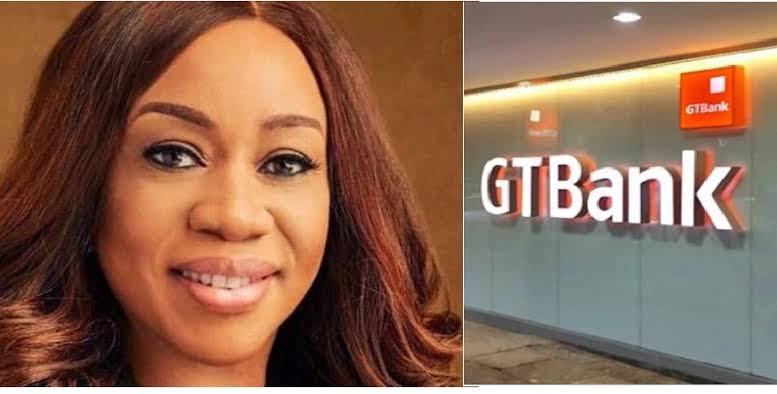
Nearly five years after her appointment as Managing Director of Guaranty Trust Bank (GTBank), Mariam Olusanya has yet to make a public appearance, a prolonged silence that is becoming increasingly difficult to ignore as customer dissatisfaction with the bank continues to grow.
Appointed in January 2021, Olusanya made history as GTBank’s first female managing director, a milestone widely celebrated as a significant step for gender inclusion in Nigeria’s banking sector. Expectations were high that her leadership would usher in a new era of engagement and transparency at one of the country’s most prominent financial institutions.
Those expectations, however, have largely gone unmet in the public sphere. Since assuming office, Olusanya has avoided media interviews, industry conferences, shareholder engagements, and other public forums where chief executives of tier-one banks are typically expected to articulate strategy, explain performance, and address customer concerns. Her absence stands in sharp contrast to her predecessors, who were highly visible and often served as the public face of the institution during both stable and challenging periods.
In practice, the public leadership role appears to have been assumed by her immediate predecessor, now the Chief Executive Officer of Guaranty Trust Holding Company (GTCO). At major events and official functions, it is the holding company CEO, not the bank’s managing director—who represents GTBank, raising questions about where executive responsibility and accountability truly lie.
While GTCO continues to report strong financial performance, critics argue that profitability alone does not absolve leadership of public responsibility. In Nigeria’s banking sector, managing directors are not merely internal administrators; they are expected to engage regulators, reassure customers, and respond visibly during moments of reputational stress. Olusanya’s near-total absence from public view is therefore widely regarded as abnormal rather than strategic.
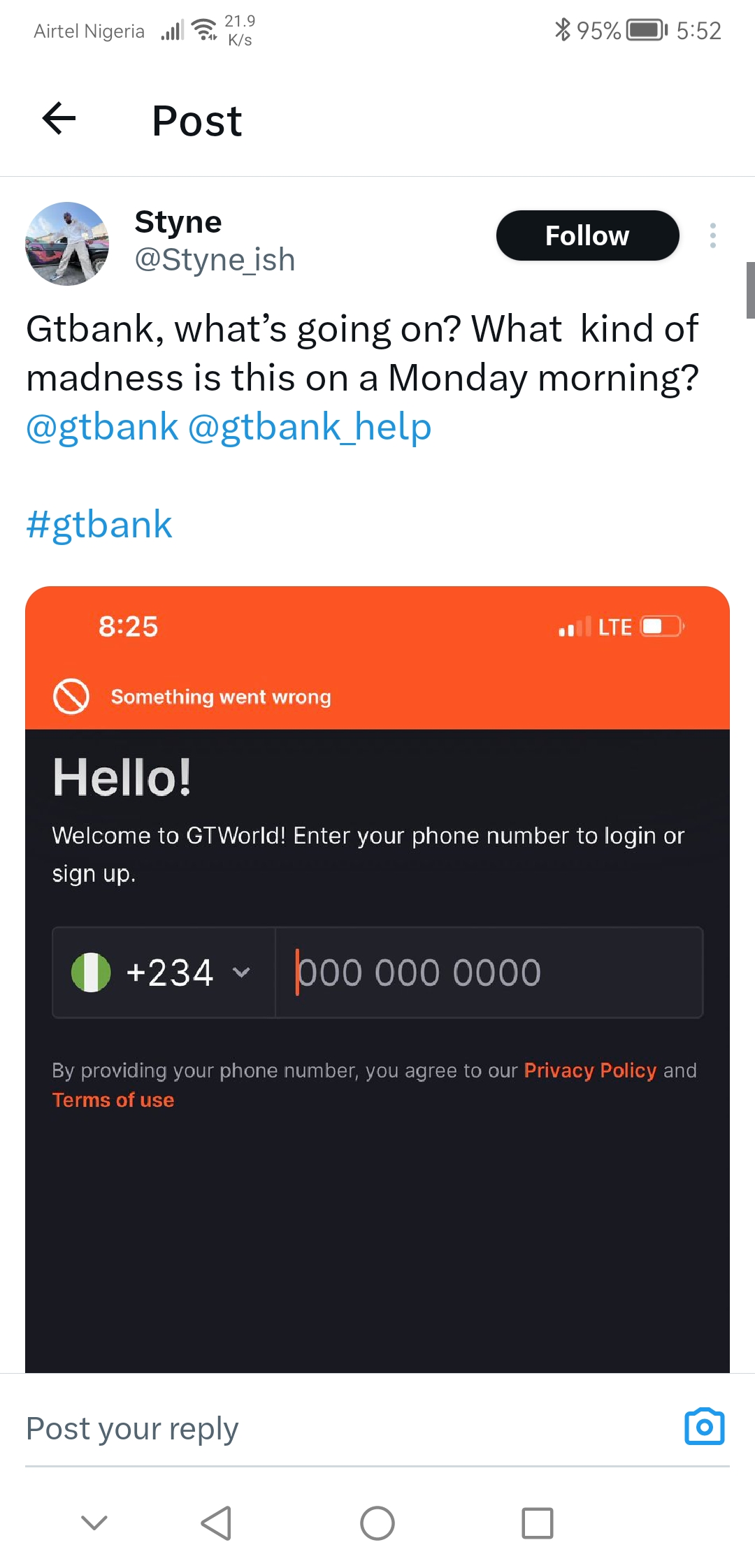
This perceived leadership gap has become more pronounced as GTBank faces a surge in customer complaints. Social media platforms are awash with reports of poor customer-service responses, unresolved disputes, alleged illegal deductions, and what many customers describe as dismissive or ineffective engagement from bank representatives. Even more troubling are growing concerns over security, with customers alleging unauthorized access to their accounts while receiving little explanation or accountability from the bank.
In an era where corporate transparency and customer trust are paramount, the lack of a visible and accountable leadership figure has fueled speculation that the bank’s communication failures reflect challenges at the top. Observers argue that a managing director who remains silent and unseen during such periods risks reinforcing the perception of an institution disconnected from its customers.
As the fifth anniversary of Olusanya’s appointment approaches, the questions continue to mount. Is her low-profile leadership style a deliberate strategy, or has it contributed to weak communication and poor customer engagement? More importantly, can a systemically important bank afford a managing director who remains largely invisible as public confidence erodes?
For now, Mariam Olusanya remains one of the most powerful yet least visible figures in Nigeria’s banking industry, a paradox increasingly at odds with the demands of modern corporate leadership.
Error or Fraud? How GTBank Ruined a Corporate Customer’s Business and Life Over a Missing Deposit
While Guaranty Trust Bank (GTBank) continues business as usual—most recently celebrating its annual Food and Drinks Festival—one of its corporate customers has been left destitute, his business ruined and life upended after trusting the bank with his money. His ordeal began last year when he attempted to move his funds to another bank after discovering unauthorized transactions on his account during GTBank’s infamous system upgrade.
According to a source close to the victim, the problem began more than seven months ago during the bank’s system upgrade. Unauthorized transactions were being made from his account, yet he was locked out and had no access to monitor or prevent the activity. Alarmed by alerts showing withdrawals he didn’t authorize—and unable to access the account—the businessman, whose supply business operations depended entirely on that account, did what any rational person would do: he decided to move his funds to another institution.
When partial access was eventually restored, he initiated a transfer to move his funds. The account was debited, but the money never arrived at its destination. It has remained “pending” or “hanging” ever since.
The source revealed that the victim immediately rushed to the bank to fill out the necessary dispute forms, desperate to save his business. His corporate account held his entire capital, operational funds, and staff salaries. Despite assurances that the issue had been resolved, and despite repeated visits to the bank, the funds—several millions of naira—are still unaccounted for.
The only glimmer of hope came when his account officer reportedly informed him that the failed transaction had finally been marked as such and that the funds would be reversed into his account. That was nearly six months ago, yet nothing has been done.
Frustrated, he enlisted the help of a lawyer—also a personal friend—to write multiple letters to GTBank. When these yielded no result, he had no choice but to initiate legal proceedings against the bank.
A disturbing trend has emerged in how GTBank handles legal disputes. The bank, one of Nigeria’s most influential financial institutions, often engages Senior Advocates of Nigeria (SANs) to stretch litigation indefinitely. A notable example is the long-standing case between GTBank and Innoson Motors, which has dragged on for nearly two decades despite what appeared to be a final Supreme Court judgment in 2019—later reversed due to technicalities.
GTBank’s reluctance to admit fault, even when evidence appears damning, suggests a strategy designed to frustrate and exhaust complainants. In this case, the aggrieved businessman now risks not only losing his business but also his entire livelihood.
One might expect the Central Bank of Nigeria (CBN), as the nation’s top financial regulator, to intervene in such situations. However, the CBN’s silence on past controversies involving GTBank casts doubt on whether the aggrieved party can obtain justice through that channel.
The broader implications are dire. If issues like this continue to go unchecked, they could undermine President Bola Ahmed Tinubu’s campaign to attract foreign investment. No serious investor will commit funds in a system where depositors’ money can vanish without resolution or accountability.
In countries like the United States, banks face heavy sanctions and are required to compensate customers promptly for unauthorized or erroneous transactions. Nigeria must adopt similar standards if it hopes to restore public confidence in the banking sector.
Meanwhile, the customer’s life has deteriorated rapidly. He is reportedly preparing to withdraw his children from private school and move them to public institutions, having lost most of his clients due to his inability to fulfill transactions for over seven months. What initially seemed like a system error is increasingly looking like a case of corporate negligence—or possibly outright banking fraud.
Trouble in GTBank Utopia as Aggrieved Customers Vows to Dump the Problematic Bank Despite Last Minutes Appreciation
…Bank Accused of Withholding Funds to Prevent Customer Migration
Guaranty Trust Bank (GTBank) is facing a potential mass exodus of customers, despite issuing a recent statement of appreciation and apology for disruptions caused by its ongoing system upgrade. The bank’s reassurances appear to have done little to pacify frustrated depositors whose financial activities have been severely disrupted.
In a statement shared on November 27 across its social media platforms, GTBank expressed gratitude to its customers for their patience during the transition to a new core banking system. The bank apologized for the service disruptions and pledged to deliver a seamless banking experience moving forward.
However, many of the bank’s customers remain unconvinced. Some believe the apology is merely a public relations move, with unresolved issues such as unrefunded deductions and unprocessed transfers still plaguing users.
One disgruntled customer, speaking to Society Gazette, described the statement as insincere, stating:
“How can you appreciate me when the core issues remain unresolved? My corporate account has been severely affected. Illegally deducted funds have not been refunded, and a transfer I made nearly two months ago is still pending. Instead of addressing these problems, GTBank chooses to issue hollow words of appreciation.”
Unresolved Issues Spark Widespread Frustration
Findings suggest that GTBank’s system upgrade has yet to fully stabilize, with numerous customers’ still awaiting refunds for hanging transactions and illegal deductions. Allegations have emerged that the bank is intentionally delaying refunds to deter customers from migrating to other financial institutions.
According to insiders, the delay in resolving customer grievances may be linked to fears within GTBank’s management that a swift resolution would accelerate the anticipated mass departure of dissatisfied clients.
Internal Challenges at GTBank
Sources disclosed that GTBank’s recent challenges stem partly from a depletion of its IT workforce. Over the past few years, many of the bank’s IT experts have left the shores of the country for better opportunities with the bank choosing not to immediately replacing them, leaving the department understaffed. This has reportedly contributed to the chaotic rollout of the new core banking system.
To address the crisis, GTBank, we reliably gathered had outsourced the system upgrade to Indian IT specialists who had been battling with it and that the bank only has recently hired new set of young personnel to bolster its struggling IT team. Despite these efforts, the transition has been fraught with setbacks, leading to customer dissatisfaction and reputational damage.
What Lies Ahead for GTBank?
As frustration among its customer base continues to mount, GTBank faces an uphill battle to minimize the number of affected customers that are bound to move their critical banking services away from the bank, though some will definitely stick with the bank provided they were able to stabilize operations. To win those who are still undecided the bank must prioritize resolving pending issues, such as refunding affected customers and ensuring smooth transactions, to stem the tide of discontent.
With a competitive banking landscape and alternatives readily available, GTBank was exposed to the risks of losing some of its long-standing customers.
This crisis serves as a stark reminder of the critical importance of customer trust and the potential repercussions of failing to deliver on promises in a digital-first banking environment.
GTBank Customer Complaints to Disappearing Deposits, Deduction Issues, and the Silent MD
Customers of Guaranty Trust Bank (GTBank) have expressed growing frustration over unresolved issues, including disappearing deposits and unauthorized deductions. Many Nigerians are also voicing their concerns about the bank’s lack of communication, with customers facing difficulties accessing their funds and receiving little to no response from bank representatives.
GTBank’s Silence and Customer Service Challenges
Since Mariam Olusanya assumed the role of Managing Director (MD) in 2021, GTBank has maintained a notably quiet stance when it comes to addressing customer complaints. In fact, Olusanya has not made any public appearances or issued any official statements during her tenure. This lack of communication has left many customers feeling neglected and confused.
Industry experts have suggested that Olusanya’s silence could be attributed to the overbearing presence of Segun Agbaje, the Group CEO, who continues to dominate public events and media coverage, often overshadowing the MD. Despite Olusanya being regarded as highly capable, rumors indicate that Agbaje’s leadership style may be pushing her out of the spotlight.
GTBank’s Corporate Communication Breakdown
The silence from the bank’s leadership has extended to its customer service department, with many customers complaining about poor service and lack of transparency. Reports from GTBank account holders describe a snobbish attitude from the bank’s staff, who have failed to resolve critical issues such as missing funds and frivolous account deductions.
In addition, GTBank has been accused of misleading customers about the status of their system upgrade, assuring clients that the process was nearing completion, while many customers still report their savings being trapped weeks after the supposed improvements began.
Public Outrage and Calls for Regulatory Intervention
The absence of a clear statement from Mariam Olusanya and the overall communication failure from GTBank has led to widespread public outcry. Customers have taken to social media and online forums to share their experiences, calling on the Central Bank of Nigeria (CBN) and the Federal Competition and Consumer Protection Commission (FCCPC) to investigate the bank’s handling of customer funds and complaints.
With no sign of action from the bank’s leadership, customers are urging regulatory bodies to intervene and ensure consumer protection and accountability in the banking sector.
Conclusion: GTBank’s Growing Reputation for Customer Service Issues
In summary, GTBank is facing mounting dissatisfaction from customers due to poor customer service, disappearing deposits, and questionable deductions. The bank’s leadership, particularly Mariam Olusanya, has remained silent, which has only added to the frustration. As the situation worsens, many Nigerians are calling for stronger oversight from the CBN and the FCCPC to protect consumers and restore trust in the financial institution
Confusion! As GTBank Customers Decries Unauthorized Transactions and Deductions in their Accounts
The crisis facing the Guaranty Trust Bank (GTBank), seems not to be abating. The bank that pride itself as one of the best in the country has been facing issues since it upgraded a couple of days ago. It initially kept the customers in the dark when the app is not opening after the bank had announced a successful upgrade thereby not giving them access to transact both banking and non-banking operations on their accounts.
As if that is not enough, the customers of the bank have also come to the social media to express their confusion and anger after they eventually gain access (though still not able to perform any successful transaction) to their accounts only to discover that there have been so many unauthorized transaction in their accounts. Whereas some are confused about the deposit and subsequent remover of monies into their supposed personal accounts, the complain of some is that there are unauthorized deductions carried out and still being carried out while their complains to the bank through digital and physical means are being treated with kid gloves.
It would be recalled that social media had recently reported that the website of the bank was hacked, though this was refuted by the bank at that time but the recent happening is questioning whether the bank is still in control of their banking platforms, and this is making slight the competence of the bank in securing the deposits of its numerous customers, who had been left in limbo by the management of the GTBank.
The bank is taking so many backlash over the recent issue as some customers are threatening seeking legal approach claiming the long disruption of banking activities has cost them huge loss.
Nigerians on the X (formally Twitter) had been coming up with several reasons for the unauthorized transactions on different accounts that. According to some Netizens, after discovering the evidence of the unauthorized transactions, expressed fear and suspicion that the transactions may be that some fraudsters within and outside the bank had hide under the upgrade to use their accounts to fraudulently transfer proceed of fraud.
GTBank has not responded in anyway to the accusations and suspicion, while giving the shocked and angry customers the silent treatment, some have taken to the social media to warn against banking with the bank over the shoddy treatment.
Below are links and screen shot of few customers on the current fiasco by the GTbank;
System Upgrade: GTBank Customers Stranded for Another Day amid Fraudsters Invasion
The crisis facing the Guaranty Trust Bank Ltd (GTBank) on the upgrade of the bank’s banking platform has extended into another day and against the statement dropped last week by the bank that some banking operations will be available during the process, the customers of the financial institution have been left stranded as none of the promised operations are working.
If it would be recollected, the GTBank had last week in a press release, notified its customers that all branches will close at noon on October 11, reopening at 9:00 a.m. on October 14.
And that digital banking services, including transfers, bill payments, and airtime/data purchases, will only be available during this process, but other functionalities will be limited for 11 hours, from 10:00 p.m. on Sunday, October 13, to 9:00 a.m. the next morning.
Findings now show that both the digital services and others services needed for day to day running of its numerous customers’ lives has not been working even after the bank had announced that the upgrade has been completed, thereby creating panicking amongst the customers.
It was discovered that many branches of the GTBank are shut for customers who has gathered around to try if they can make above the counter transaction.
This gap has also exposed desperate customers to schemes of fraudsters who are cashing in on the gap left by the bank to defraud some of GTBank’s unfortunate agitated customers.
The bank’s activities has come under scrutiny since, they started this system upgrade, as against learning from the issues that befell others, the bank which inside sources revealed is currently working to recruit new set of IT experts to help rescue it from incessant crisis it has been facing recently, seems not to have wisely prepare against such occurrence.
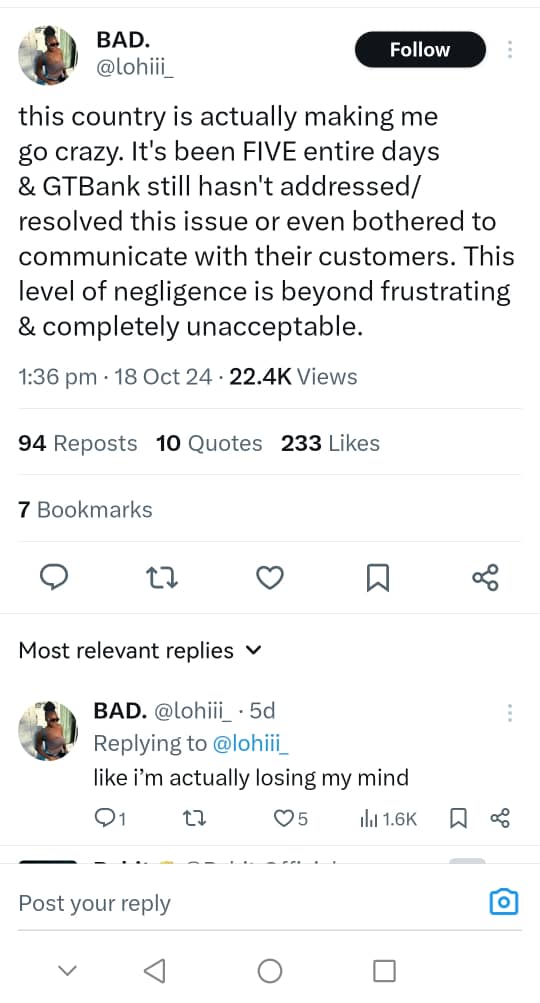
Meanwhile, customers of the GTBank has since trooped to various social media platforms to air their grievances with lost businesses and other loses or other disappointment faced.
According to an X user under the handle @monathegirl she was asking the CBN about the sanctions they will be imposing on GTBank, while also seeking for compensation for the loss accrued due to the bank’s service disruption.
Another X user facing the same frustration of doing transactions even after the bank has announced that it systems has been successful upgraded as complained;
Segun Agbaje’s GTCO (GTBank) under Scrutiny over Huge Net Income Interest Profit Declaration, despite Pending Court Cases on Overcharging
Mark Twain, American humorist, journalist, lecturer, novelist and moralist was ascribed to have said “A banker is a fellow who lends you his umbrella when the sun is shining, but wants it back the minute it begins to rain.” This simply means one can’t expect bankers to be of help when they are really needed, this much can be used to describe how the Segun Agbaje led Guaranty Trust Holding Company Plc/ GTBank, has been working against its clients for personal profit.
There has recently been so much noise about the ₦1 Trillion plus profit declared by the financial institution. According to the report made available the Segun Agbaje led group was said to have made a large chunk of the announced growth of its income from the Net Interest Income (NII), which recorded a 176.9 per cent growth to ₦491.5 billion from ₦177.5 billion last year.
For a clearer understanding the Net Interest Income (NII), is the difference between the profit earned as interest on loans given to borrowers against the money it pays out as interest on deposits or loans to depositors and its lenders.
The most common effects of net interest income on borrowers according to findings includes; Higher Interest Rates (this is the period whereby financial institutions arbitrarily raise interest rates to enable them make money). Overcharging (this is such that the financial institution manipulate things so additional fees are imposed or charges on borrowers), Stifling Innovation and Growth and many more.
With Segun Agbaje’s GTCO announcing ₦314 billion increase on the previous year coupled with the current economic crisis facing the country, there is strong indication that the many accusations against the group as inherited from the GTBank on overcharging by several companies may be founded.
If it would be recollected, the bank before and after it metamorphous into the Holdings Company it currently is, is not new to sanctions that has to be with disregard for laid down rules, in 2018, the UK Financial Conduct Authority (FCA) stopped GTBank UK from taking on new customers, note GTBank UK is an independent subsidiary of the GTCO.
The bank was later fined £7,671,800 for serious weaknesses in its anti-money laundering (AML) systems and controls between October 2014 and July 2019, the huge fine became necessary when lesser fine of £525,000 in August 2013 for serious and systemic failings fails to deter the bank.
In a similar action of disregard to rules for profit maximization the GTBank Ghana’s Foreign Exchange Trading License was suspended earlier this year over breaches of foreign exchange market regulations which include incidents of fraudulent documentation within their foreign exchange operations for a month in accordance with the relevant law in Ghana.
The Segun Agbaje led organization’s knack for bending the rules for profit was a major reason most people are calling on CBN and other relevant agencies to investigate the announced profit especially with regards to NII as the litigation against the bank on issues that has to do with overcharging is still pending before various courts in Nigeria.
If it would be recollected, overcharging is the main bone of contention of the now more than ₦20 billion case between GTBank and Innoson Motors. Innoson had dragged the bank to court for over-charging on a loan facility it got from the Segun Agbaje led bank.
Information was that Innoson has decided to conduct a proper auditing when they started getting strange charges in their account, it was the process that revealed GTBank has over-charged it to the tune of ₦786million over the course of several years dating back to 2004, after which Innoson informed the bank.
It was when the bank denied it and insisted that Innoson is still owing them that the company was forced to seek court help where a subsequently judgement was given in May 2013, and the Segun Agbaje led bank was asked to pay the sum of ₦559,374,072.09, “with a 22 percent interest on the admitted sum to be paid from March 1, 2004 since that was the interest rate on the loan, till satisfaction of the judgment debt.
The court also added a 100% penalty as stipulated in the CBN Guidelines for excess charges by banks, which brought the total judgment cost then to ₦2.4 billion, but is likely to be more that ₦2o Billion at the moment because the bank has been finding way to stop the execution of the judgement.
Another case pending in court against the Segun Agbaje led GTCO, was made public knowledge last year when GTBank through a receivers’ manager tries to illegally (by pronouncement of a court) take over properties of Stallion Group Nigeria over a purported ₦13 billion debt, whereas the CFO of Stallion Nigeria contends that it is not owing GTB any longer and that on the contrary, it is on record that it has paid more than what was outstanding to GTB by ₦6,423,700,000.
Stallion Nigeria in its application, which was granted by the Court had explained that the preliminary KPMG forensic audit report had established that GTB overcharged Stallion, in excess, fraudulent and illegal charges of ₦4,693,625,637.49, adding that GTBank had accepted this finding by the auditors.
Stallion has been in court with GTBank since 2019 over allegations and claims with Stallion winning against GTBank at the Court of Appeal, Nigeria. The Court of Appeal presided over by the Honourable Justices Daniel-Kalio, Sirajo and Banjoko, had previously delivered Judgment in favour of Stallion Nigeria against Guaranty Trust Bank Plc on 24 February, 2022 and set aside the Ruling of Honourable Justice Saidu in favour of GTBank.
The problems that come with the Overcharging and Higher Interest Rate are some of the profit driven actions the Segun Agbaje led group, has been heaping on many of their customers that makes doing profitable business difficult. While some are locked in prolong legal battle with the bank and the group as a whole, some had been forced to throw in the towel.
One of the companies that was not so lucky because of the nature of business is Toyin Subair led HiTV, in an interview the lawyer turned businessman granted a news media in 2019, he lamented how 25% – 27% interest rate becomes a burden that killed the company in his word “At 25-27% interest on debt, most businesses cannot survive and you will be a slave to the banks for life. That is why they take collateral from you. They lend against your collateral not your business case. Regardless of our strong cashflows, the funding requirements continued to increase.” He explained
Stating further while advising prospects, “HiTV was paying an average of 1.1billion Naira approximately in interests and guarantee charges annually, for over 5 years! For a new company, we did a damn good job but really got blown out. I never live by debt and so was really ignorant about how interest works up till HiTV and of course since then you won’t catch me near it. But what do you do when you have to? They say internationally that “equity is more expensive than debt”, but that is NOT true in Nigeria. Debt is way too expensive and destructive.” He continued.
Knowing the antecedent of the Segun Agbaje led financial group well-meaning Nigerians has been calling on relevant regulatory agencies to look into the declared Net Interest Income and put in place measures to make sure the effort of the government to revamp the economy will not be frustrated by the company’s insatiable appetite for profit.
Group Investigates and Exposes GTBank Unprofessional Banking Practices
An investigation report by a civic organization has been released bordering on allegations of “unscrupulous, unethical and criminal activities” levelled against the Guaranty Trust Bank Limited (GTBank), a subsidiary of Guaranty Trust Holding Company Plc (also known as GTCO PLC).
The report was released by the Global Integrity Crusade Network (GICN) and signed by its President, Edwin Omaga on Friday.
The Guaranty Trust Bank is led by Segun Julius Agbaje who is presently the Group Chief Executive Officer since August 2021.
A statement signed noted that the Private Investigation Report (PIR) is compiled pursuant to Section 24 (d) and (e) of the 1999 Constitution of the Federal Republic of Nigeria (as amended) read together with our Objective No.2.
The statement noted that it was pertinent on the group to help ensure that corrupt practices are abolished in the country.
It was noted in the report that the Guaranty Trust Bank Limited was incorporated on 19 July, 1990 and licensed to engage in commercial banking and other allied services within Nigeria and elsewhere.
The report further stated that the Bank has Ordinary Shares of 25 Billion with 8 Active Directors but its only Shareholder and Person With Significant Control is Guaranty Trust Holding Company Plc, represented by Segun Julius Agbaje.
“In the United Kingdom, Segun Julius Agbaje started the Bank by registering same at the Companies House as Rainsouth Limited with Number 5969821 on 8 December, 2006. The said Rainsouth Limited went through various changes until it became Guaranty Trust Bank (UK) Limited on 17 March, 2008.”
The group further noted that as of the time of its report, there are over 10,000 customers exposed to grave danger without their knowledge, as accounts were allegedly opened in the Guaranty Trust Bank in their name without their consent.
“One of the corrupt practices recently linked to Guaranty Trust Bank Limited in Nigeria has to do with Unsolicited Accounts Opening. This is a situation where a customer did not approach the Bank or show any interest in maintaining an account with the Bank. Yet, the Bank goes ahead to source for the customer’s information such as telephone number, date of birth, Bank Verification Number (BVN) and other vital details to open account for the customer without his/her consent.”
“The aim of this practice is to increase the customer base of the Bank, thereby giving it high ranking in terms of size, capacity and profitability. We submit that Unsolicited Accounts Opening tantamount to breach of data privacy, identity theft and can expose the innocent account holders to lots of financial crimes. As at today, there are over 10,000 customers in the database of Guaranty Trust Bank Limited who are already exposed to grave danger without their knowledge.”
It was further noted in the report that some of the affected customers threatened to sue the Bank.
The Guaranty Trust Bank asides from this were alleged in the PIR of hurriedly putting together misleading financial statements and declaring false profits to mislead the public on its financial positions.
“We have equally uncovered that Guaranty Trust Bank Limited has been declaring profits that do not reflect its actual financial performance. For instance, GTCO PIc on 11″ September, 2024 released its Audited Consolidated and Separate Financial Statements for the period ended 30 June, 2024, to the Nigerian Exchange Group (NGX) and London Stock Exchange (LSE) wherein the whooping sum of #1.004 Trillion was declared as Profit Before Tax. This caused the Group to be reported all over media as “the first Nigerian financial institution to cross the N1trillion mark in profit.”
“It is our finding that these figures as contained in the Audited Statements are mere conjectures hurriedly put together by Segun Julius Agbaje and his team to deceive the Securities and Exchange Commission (SEC), Financial Reporting Council of Nigeria (FRCN), Central Bank of Nigeria (CBN), customers/investors and the general public into believing that all is well with GTB.”
It was further stated that the bank could not justify its stated profit of N1trillion which it released to the public, with a suspicion that the profit could have been declared through roundtripping.
“Ladies and Gentlemen, there is no gainsaying the fact that Guaranty Trust Bank Limited has become notorious over the years for engaging in deceptive accounting practices to artificially inflate profit figures. For instance, no substantial pieces of evidence presented by Segun Julius Agbaje to support the assertion that GTCO PIc made over #1 Trillion in profit as at 30 June, 2024. Even at that, it is very possible that the figures were generated through roundtripping.”
“This is a process where funds are moved in and out of the Bank through different accounts or entities to create an illusion of legitimate transactions. The combination of this process and other unethical business practices within the Bank points towards the direction of systemic corruption, fraud and money laundering, which are opened for further investigation by the relevant agencies.”
“It is feared that such ugly situation if not properly checked could have the tendency of not only undermining customers/investors’ confidence in the Bank but pose significant risks to the stability of Nigerian financial sector.”
It was also revealed in the PIR report that the Guaranty Trust bank had been punished severely for different violations at the international level.
“Surprisingly, Segun Julius Agbaje did not tell Nigerians that the corporate image of Guaranty Trust Bank Limited has been terribly battered in many foreign countries where it is carrying on business. He lied by stating in the recent Audited Statements that GTCO PIc ensures compliance with disclosure requirements under the Disclosure and Transparency Rules of the UK Financial Conduct Authority (FCA). The truth is that Guaranty Trust Bank (UK) Limited was sanctioned by the same FCA to pay a financial penalty of £525,000 for breaches of Principle 3 (Management and Control) of the Authority’s Principles for Businesses between 19 May, 2008 and 19 July 2010.”
“In another development, the FCA imposed on Guaranty Trust Bank (UK) Limited a financial penalty of £10,959,700 pursuant to Section 206 of the Financial Services and Markets Act 2000. As usual, the Bank agreed to resolve this matter at an early stage and was given a 30% discount which reduced the fine to £7,671,800. The FCA in justifying this financial penalty, which was paid with customers/investors’ funds not later than 24″ January, 2023, stated that Guaranty Trust Bank (UK) Limited again failed to put in place policies and procedures to prevent and detect money laundering. FCA considered this repeated misconduct to be a direct result of the inability of the Senior Management within the Bank, over a prolonged period of time, to formulate and implement an effective plan capable of addressing the weaknesses identified in its AML and financial crime systems and controls.”
The statement further revealed that the Guaranty Trust Bank had been suspended in Ghana for various breaches of foreign exchange operations.
“our investigation took us to the Bank of Ghana where we discovered that the Foreign Exchange Trading Licence of Guaranty Trust Bank Ghana Limited (GTB) was suspended for a period of 1 (One) month with effect from 18 March 2024.”
“ The Press Release dated 4 March 2024 indicates that the said Licence was suspended as a result of various breaches of the Foreign Exchange Market Regulations, including fraudulent documentation in foreign exchange operations. By the Press Release, the Bank of Ghana cautioned GTB to put in place effective controls to ensure strict adherence to the extant Regulations and Guidelines.”
The statement wondered why the Guaranty Trust Bank allegedly carried out many infractions in Nigeria without any due sanctions to it.
“One begins to wonder the number of infractions committed by GTB in its originating country – Nigeria without due sanctions from Regulatory Bodies and Anti-Corruption Agencies. We are certain that it is not too late for the Regulatory Bodies and Anti-Corruption Agencies to act by rescuing the soul of GTB. The time to act is now!” the statement read.
The report also recommended that the Governor, Central Bank of Nigeria (CBN) should forthwith dissolve the Board and Management of Guaranty Trust Bank Limited so as to allow thorough investigations.
They also called for the suspension of Segun Julius Agbaje as Group CEO of Guaranty Trust Holding Company Plc and retrieve from him all files or documents relating to Guaranty Trust Bank Limited to avoid interference with further inquiry into the issues raised in the PIR.
It was also stated that if found guilty of Corporate Governance, CBN acting jointly with the Economic and Financial Crimes Commission (EFCC), Nigerian Financial Intelligence Unit (NFIU), Independent Corrupt Practices and Other Related Offences Commission (ICPC), the Nigeria Police Force and Department of State Services (DSS) “should deal decisively with Segun Julius Agbaje and prosecute him like Mrs. Cecilia Ibru, who practically milked the defunct Oceanic Bank Plc dry before the Banks Consolidation era in Nigeria.”
Other recommendations made include that the Nigeria Deposit Insurance Corporation (NDIC), Securities and Exchange Commission (SEC), Nigerian Stock Exchange (NSE) as well as Financial Reporting Council of Nigeria (FRCN) “should urgently step into the affairs of Guaranty Trust Bank Limited with a view to safeguarding customers/investors’ funds and portfolios before the Bank fails completely”
It was also stated that the Senate Committee on Banking, Insurance and Other Financial Institutions, “House Committee on Banking as well as House Committee on Banking Regulations should jointly or individually convene a Public Hearing whereat Segun Julius Agbaje will be summoned to appear and defend the weighty allegations contained in our Private Investigation Report (PIR).”
The group also called on the UK National Crimes Agency (NCA), Crown Prosecution Service (CPS), Financial Conduct Authority (FCA), Financial Ombudsman Service, British Prime Minister, Governor Bank of England, US Department of Justice, US Securities and Exchange Commission, Federal Bureau of Investigation (FBI), US Federal Reserve Board (FRB), British High Commissioner to Nigeria and Governor Bank of Ghana to shut down all operations of Guaranty Trust Bank (GTB) in their territories.
“By so doing, GTB will be prevented from turning the United Kingdom, United States of America and Ghana into a safe haven for money laundering, terrorism financing and other sundry economic crimes.” the statement released noted.
“That in addition to the above, UK National Crimes Agency (NCA), Crown Prosecution Service (CPS), US Department of Justice and Federal Bureau of Investigation (FBI) are requested to commence prosecution of Segun Julius Agbaje in line with appropriate laws for all the infractions he has used GTB to commit within the territories of both United Kingdom and USA.”it further read
It was also recommended that all the properties allegedly acquired by Segun Julius Agbaje using proceeds of crime in Nigeria, United Kingdom, USA and other parts of the world be confiscated and forfeited permanently to the Federal Government of Nigeria.
The Segun Agbaje GTCo’s Underhand Tactics that Destroyed Toyin Subair‘s Highflying HiTV Media Dream
…Agbaje’s Record of Financial Betrayal: The HiTV Collapse and Beyond
By Abubakar Musa
You couldn’t have forgotten so soon, many years ago, inside the massive banking hall of GT Bank, Toyin Subair wept and wailed. Yet nothing happened. Toyin was down and out, grunting and growling, but the bankers were ready to fight to the finish.
Indeed, in the complex corridors of Nigerian power and business, tables often turn, and those once perceived as underdogs can quickly rise to newfound prominence. Such is the case of Toyin Subair, the former HiTV boss, who has re-entered the political elite as the Special Assistant on Special Duties and Domestic Affairs to President Bola Tinubu. Once ruthlessly hounded by Segun Agbaje, the Group Chief Executive Officer of Guaranty Trust Holding Company (GTBank), Subair is now determined to use his newfound clout to repay Agbaje for the calculated destruction of his once-promising digital satellite broadcaster, HiTV.
Subair’s ascension to the presidency’s inner circle has rattled Agbaje, whose insidious role in bringing HiTV to its knees is widely known. What was once a professional and financial downfall for Subair has transformed into a determined vendetta. With the tables now turned, Subair is poised to extract his pound of flesh from the GTBank boss, using his leverage to settle the score.
Agbaje’s Role in HiTV’s Collapse: A Plot of Financial Ruin
HiTV was once a beacon of innovation in Nigeria’s media landscape. Launched with the ambitious goal of bringing premium football leagues such as the English Premier League and UEFA Champions League to millions of Nigerians, HiTV held a unique position as an indigenous digital broadcaster that was competing with global media giants. Its visionary founder, Toyin Subair, was widely hailed as a trailblazer in the media industry.
However, Segun Agbaje saw an opportunity not to support Subair’s promising enterprise, but to exploit and eventually crush it. Under the guise of financial assistance, GTBank extended a series of loans to HiTV between 2007 and 2010. The N9.5 billion loan package was structured not as a genuine lifeline, but as a trap—a set of onerous terms that would suffocate the company’s cash flow and make it impossible to meet its obligations.
What followed was a carefully orchestrated financial downfall. The loans were designed to bleed HiTV dry, with crippling interest rates that drained the company’s resources. Agbaje, in his role as GTBank’s chief, weaponized the bank’s facilities to ensure HiTV’s inevitable collapse. It wasn’t a failure of business on Subair’s part; it was a deliberate and calculated plot by Agbaje to eliminate HiTV as a business rival.
By 2011, HiTV had crumbled under the weight of its debts. Agbaje’s shrewd manipulation of financial instruments, paired with GTBank’s ruthless collection tactics, ensured that Subair would never reclaim the dream he had built. Agbaje’s successful exploitation of HiTV stands as a grim case study in how far some banking executives will go to assert control and crush competition.
Corporate Warfare: How Agbaje Weaponized GTBank and Law Enforcement
Agbaje’s destruction of HiTV wasn’t limited to financial instruments alone. When the company began to falter under the weight of its debts, he ramped up pressure through more aggressive and overt tactics. With HiTV on the verge of collapse, Agbaje called in the debts and unleashed a barrage of lawsuits against Subair and his company. Legal petitions flooded the courts, and Subair found himself embroiled in a vicious legal battle, while HiTV was buried under an avalanche of litigation.
Agbaje’s cunning extended beyond the boardroom and into the legal sphere. Leveraging his influence over law enforcement and legal agencies, he ensured that HiTV would have no chance of recovery. Law enforcers and banking regulators, seemingly bent to his will, became instruments of HiTV’s demise. Subair, once a celebrated entrepreneur, was left helpless as Agbaje systematically dismantled everything he had built.
Pundits argue that if Subair had been more cautious and courageous, he might have found a way to defy Agbaje’s vampiric tactics and reclaim HiTV. But Agbaje’s elaborate scheme left little room for maneuvering. The GTBank chief’s playbook for exploiting corporate clients was perfected to such an extent that few could withstand his onslaught.
Agbaje’s Reputation as a Corporate Villain
In many circles, Agbaje’s reputation as a shrewd but morally bankrupt banking executive has only grown since his success in neutralizing HiTV. His modus operandi—extend generous loans under predatory terms, then crush the debtor when repayment becomes impossible—has been employed in multiple instances, with Subair’s case being one of the most publicized.
Agbaje’s track record of exploiting and extorting promising entrepreneurs has earned him the image of a corporate thug—someone more interested in financial domination than in legitimate business growth. As critics point out, he has turned GTBank into a weapon of financial destruction, targeting companies like HiTV, only to leave them in ruins while the bank walks away unscathed.
The collapse of HiTV was not an isolated event but part of a broader pattern of corporate treachery. Agbaje, through his shadiness and corporate criminality, has positioned himself as a figure more feared than respected in the world of Nigerian banking. His critics argue that his success comes not from brilliance or innovation, but from his ability to manipulate financial systems to serve his personal ambitions at the expense of others.
Subair’s Return: Poised for Payback
Fast forward to today, and Toyin Subair is no longer the defeated entrepreneur licking his wounds after the HiTV collapse. As a close aide to President Bola Tinubu, Subair has regained his footing and now wields significant influence in Nigeria’s political high society. This newfound relevance has become a source of anxiety for Segun Agbaje, who must now reckon with the possibility that Subair will use his position to seek retribution for the destruction of HiTV.
Pundits speculate that Subair is leaving no stone unturned in his quest for payback. The scars of HiTV’s collapse remain fresh, and Subair’s determination to even the score has only grown stronger over the years. Now, with the backing of the country’s highest office, Subair is in a position to bring Agbaje to book for the calculated corporate warfare that ruined his digital broadcasting dream.
Agbaje, once the predator in control, may now find himself vulnerable as Subair eyes the opportunity to extract his pound of flesh. The former HiTV boss is poised to turn the tables, using every tool at his disposal to ensure that Agbaje faces the consequences of his ruthless tactics. For Subair, this isn’t just about financial retribution—it’s about justice for a dream destroyed and a legacy stolen.
As Agbaje continues to face public scrutiny for his role in the collapse of HiTV, the rise of Toyin Subair serves as a stark reminder that power dynamics can shift dramatically. And for Segun Agbaje, the reckoning may have only just begun.
Segun Agbaje led GTCO’s Controversial N1 Trillion Profit: A Facade of Financial Triumph?
In a country facing soaring inflation and struggling startups, Guaranty Trust Holding, GTCO’s recent claim of a staggering N1 trillion profit raises eyebrows rather than celebrations. This figure, announced by CEO Segun Agbaje, appears less a beacon of success and more a troubling indicator of systemic issues within Nigeria’s banking sector.
Critics argue that GTCO’s reported profits stem from questionable practices rather than genuine financial growth. Many see Agbaje’s announcement as emblematic of a banking culture that prioritizes profit over customer welfare. Instead of nurturing innovation, GTCO’s approach has allegedly involved significant overcharging, dubious fees, and predatory lending practices that have eroded trust among its clients.
The disbelief among Nigerians is palpable. In an economy where businesses are cutting back and inflation is rampant, GTCO’s reported profits seem implausible. Industry experts and auditors have raised alarms, questioning the legitimacy of such gains. The prevailing sentiment is that these profits are not the result of sound banking practices but rather of exploiting customers.
Accusations against GTCO are mounting, with corporate clients like Innoson and Stallion Group calling for forensic audits. These businesses are beginning to suspect that their long-standing loyalty has been met with exploitation, as they uncover discrepancies in their accounts. A notable case is billionaire Femi Otedola, whose audit has prompted others to scrutinize their dealings with GTCO, revealing patterns of overcharging and illicit deductions.
Instead of contributing positively to Nigeria’s economic landscape, GTCO under Agbaje has been accused of engaging in practices that harm the very clients it serves. The bank’s focus appears to be on profit maximization at any cost, raising concerns about its impact on businesses and individuals alike.
As pressure builds, stakeholders are urging the Chairman of the Federal Inland Revenue Service (FIRS), Zacch Adedeji, to investigate GTCO’s practices and ensure that the full 35% tax on the reported profits is enforced. However, the call for accountability extends beyond tax collection; there is a growing demand for broader reforms within Nigeria’s banking sector to promote transparency and ethical practices.
As scrutiny of GTCO intensifies, Agbaje’s claims of financial success are increasingly viewed as a fragile façade, raising questions about the integrity of the banking system as a whole.