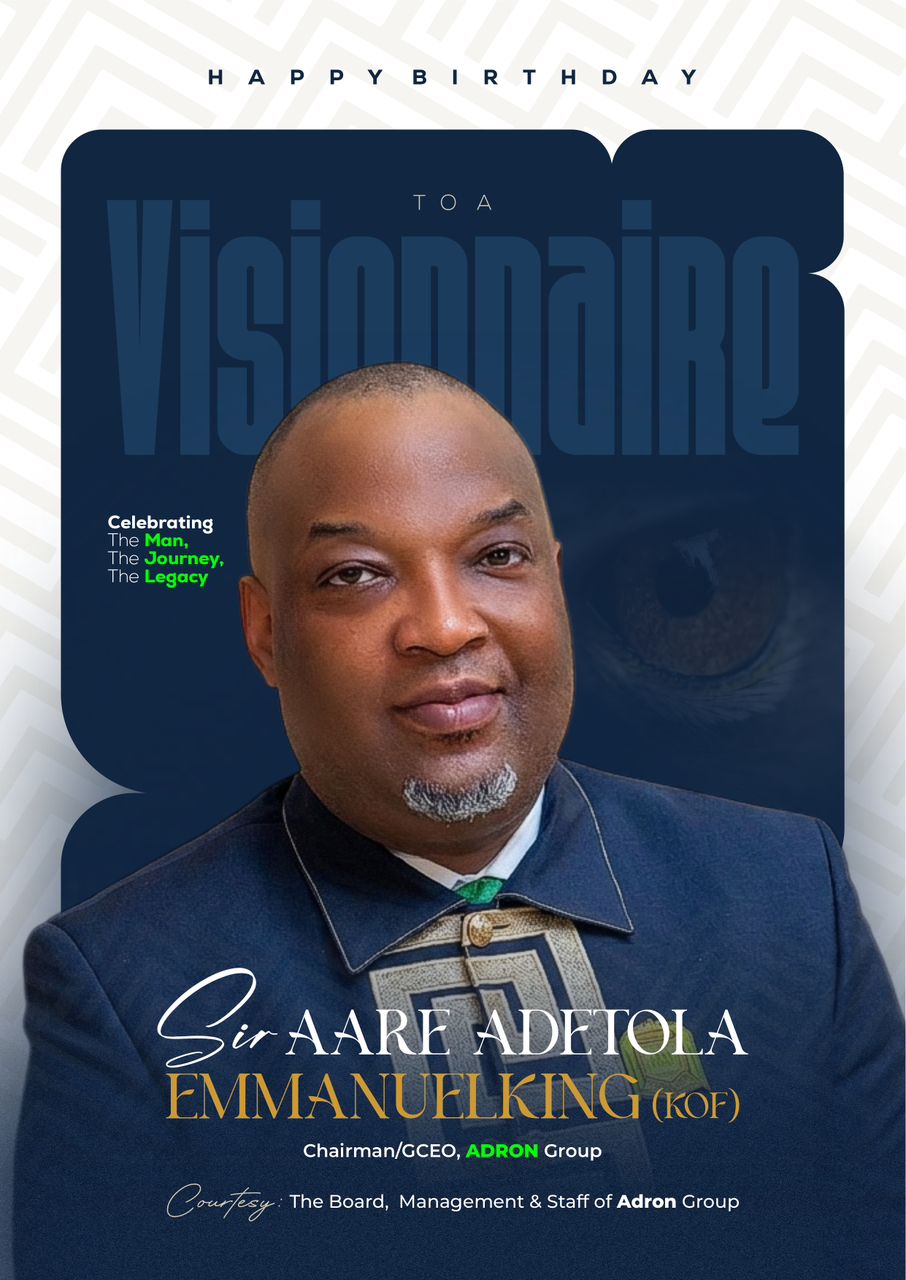
Adron Homes Celebrates Visionary Chairman, Aare Adetola Emmanuel King, at 51
The management and staff of Adron Homes and Properties Limited have joined family, friends, associates, and well-wishers across the globe to celebrate their Chairman and Chief Executive Officer, Aare Adetola EmmanuelKing, as he marks his 51st birthday.
In a statement released by the company, the milestone was described as a celebration of an exceptional leader whose vision, resilience, and entrepreneurial brilliance have not only transformed Adron Homes into a household name in Nigeria’s real estate sector but have also redefined affordable housing across the country.
Under his dynamic leadership, Adron Homes has continued to expand its footprint, delivering value-driven residential solutions while empowering thousands of Nigerians with opportunities for home ownership. His commitment to excellence, innovation, and customer satisfaction has remained the driving force behind the company’s sustained growth and industry leadership.
The statement further highlighted Aare EmmanuelKing’s passion for nation-building and community development, noting his significant contributions to job creation, youth empowerment, and the promotion of socio-economic development through real estate investments.
“As a leader, mentor, and visionary, Aare Adetola EmmanuelKing has consistently inspired a culture of excellence, integrity, and dedication within the organization. His ability to turn bold ideas into reality continues to position Adron Homes as a trailblazer in the industry,” the statement read.
The company expressed profound gratitude for his steadfast leadership and prayed for continued wisdom, strength, and sound health as he embarks on another year of impactful achievements.
As he celebrates his 51st birthday, the entire Adron Homes family proudly honours a man whose legacy continues to shape the future of real estate in Nigeria.
NASRE: Building A Safety Net For Nigeria’s Journalists
At a time when Nigeria’s media industry is strained by economic uncertainty, job instability, and shrinking newsroom resources, the Nigerian Association of Social and Resourceful Editors (NASRE) is redefining professional solidarity. More than a network of editors, it is emerging as a critical support system for journalists navigating an increasingly precarious landscape.
Founded on the principles of welfare, solidarity, and professional growth, NASRE has positioned itself as a responsive and forward-looking body within the media ecosystem. While many professional associations remain focused on advocacy and training, NASRE distinguishes itself by combining these roles with direct and practical support for journalists and their families.
At the core of its mission is a clear proposition that no journalist should be abandoned in times of need. Through financial assistance, targeted outreach, and sustained engagement, the association has supported members facing hardship, as well as widows and families of deceased practitioners. These largely understated interventions have steadily earned NASRE credibility and respect across the industry.
The organisation’s approach reflects a keen awareness of the pressures confronting media professionals, including irregular pay, job insecurity, and limited institutional backing. In such an environment, NASRE’s welfare initiatives are not merely charitable, they are essential.
Beyond welfare, the association is investing in professional resilience. Through collaboration, networking, and knowledge-sharing platforms, it is equipping editors and practitioners to remain competitive in a rapidly evolving digital media space, where adaptability is no longer optional.
Headquartered in Lagos, NASRE continues to broaden its reach, attracting a growing membership united by the need for a more responsive and supportive professional community. Its expansion signals a shift in expectations within the industry, away from symbolic affiliations towards institutions that deliver measurable value.
For many observers, NASRE represents a necessary evolution, a professional body anchored not just in ideals, but in impact. By combining empathy with structure, it offers a model of what media associations can become in challenging times.
As the industry continues to evolve, organisations like NASRE may prove indispensable. In a profession devoted to telling society’s stories, it is ensuring that the storytellers themselves are not left behind.
Adron Homes Elevates Cultural Pride as Dignitaries Grace 39th Lisabi Festival in Abeokuta
The ancient city of Abeokuta came alive in a grand display of culture, history, and unity as dignitaries from across Nigeria converged at the iconic Ake Palace Ground for the 39th edition of the Lisabi Festival, an annual celebration deeply rooted in the Egba people’s heritage.
The event, proudly supported by Adron Homes and Properties Limited, witnessed an impressive parade of distinguished personalities, traditional rulers, government officials, business leaders, and cultural enthusiasts, all captured in vibrant pictures that tell the story of a people united by history and pride.
From richly adorned monarchs in regal attire to elegantly dressed guests reflecting the depth of Yoruba tradition, the images from the festival encapsulate moments of honour, reverence, and celebration. Each photograph portrays not just faces, but influence, leaders, and stakeholders who continue to shape cultural preservation and community development.
At the heart of the celebration was the revered Oba Adedotun Aremu Gbadebo, whose presence underscored the festival’s significance as a symbol of Egba resilience and identity. Surrounding him were eminent dignitaries whose attendance further amplified the prestige of the event.
Adron Homes and Properties Limited stood out prominently, not only as a sponsor but as a key driver of cultural sustainability. Through its strategic support, the company reinforced its commitment to preserving indigenous heritage while fostering community engagement. The brand’s visibility across the venue and within the pictorial highlights reflects a deliberate alignment with culture, tradition, and people-centered development.
Beyond real estate, Adron Homes has continued to position itself as a cultural partner, investing in platforms that celebrate history and strengthen communal bonds. Its involvement in the Lisabi Festival is a testament to its broader vision of building not just homes, but legacies rooted in identity and pride.
The 39th Lisabi Festival, as captured through the lens of dignitaries in attendance, is more than an event, it is a narrative of continuity. And through its unwavering support, Adron Homes has once again set the pace, demonstrating that corporate institutions can play a vital role in sustaining the cultural heartbeat of a people.
As the echoes of drums fade and the colours of the festival linger in memory, one thing remains clear: the story told through these images is one of unity, heritage, and the enduring partnership between tradition and progress.
Oceangate Engineering Oil & Gas LTD to appeal Federal High ruling over forfeiture assets
Oceangate Engineering Oil & Gas Limited has said it will appeal to the recent ruling of the Federal High Court ordering the forfeiture of certain assets.
Barr. Nnenna Onyeaso, the Company Secretary said in a statement on Thursday insisting that neither the company nor its leadership was found guilty of any wrongdoing.
Onyeaso said that the firm has described the court’s decision as a civil asset forfeiture order based on suspicion rather than proof, stressing that the judgment did not establish any criminal liability against the organisation.
According to her, the company maintain that it has already directed its legal team to file an appeal, expressing confidence in the judicial process and the outcome of a thorough review of the case.
“To be clear, this ruling is a civil asset forfeiture order with no finding of wrongdoing against Oceangate or its leadership.
“The court’s decision rested on a legal standard of suspicion, not proof, and it is one we intend to pursue fully through the appeals process,” she said in a statement.
The firm secretary also said that Oceangate has reiterated its belief in the rule of law, noting that the appellate system exists to address such outcomes.
She added that the company remained confident that the facts of the case will ultimately affirm its integrity and business practices.
Onyeaso said that the firm also emphasised that its operations remained unaffected, stating that it continues to provide employment for many Nigerians while contributing to the country’s energy sector and broader economy.
“We have always believed in the ability of the judicial process, and that belief has not wavered,” she added.
She noted that Oceangate further expressed appreciation to its employees, partners, and clients for their continued support amid the development, assuring stakeholders of its commitment to transparency and accountability.
The Secretary said that the company reaffirmed its confidence in Nigeria as a viable destination for investment, describing the country as a land of equity, growth, and opportunity.
“We remain committed to the continued growth of our business and the communities we serve as we are optimistic that justice will prevail at the end of the legal process.
Chicago-Based Nigerian Businessman, Yomi Akingbade under Scrutiny Over Alleged Workplace Misconduct
+ Audio of one of his misconducts
In the ever-evolving landscape of diaspora entrepreneurship, stories of Nigerians abroad investing back home are often celebrated as symbols of progress and economic contribution.
However, recent accounts surrounding a Chicago-based Nigerian businessman have begun to raise serious concerns among former associates and employees in Nigeria.
The businessman, Yomi Akingbade who has spent several years residing in Chicago in the United States, is known to operate multiple small-scale ventures in Nigeria from abroad. While he presents himself in elite social circles as a successful investor committed to expanding opportunities back home, several former and existing employees paint a starkly different picture of his management style.
Workers who have been employed in his Nigerian businesses describe an environment marked by intimidation, delayed wages, and excessive pressure.
According to some staff members, management decisions are often communicated through abrupt phone calls and directives from overseas, leaving employees with little room for dialogue or professional input.
More troubling allegations have also emerged from female employees who claim they experienced inappropriate behavior and uncomfortable interactions during their time working under his supervision. Though many have chosen not to speak publicly for fear of professional repercussions, some former staff say the workplace culture was deeply troubling.
According to our reporter, one of Yomi’s domestic staff who preferred anonymity alleged that he had repeatedly made advances of raping her in his house in Lagos. She alleged that she had witnessed how Yomi slept with a cook and despite gracing his bed, she was fired a day she said no. The lady made available to us exclusive voice notes on her Yomi was trying to rape her with a threat.
Rumors circulated among some acquaintances that he was involved with questionable circles and substances that could easily destroy reputations if exposed, a reason he acts weirdly sometimes.
Recently, he began planning a new venture in Nigeria—a transport company that would operate inter-state buses. In conversations with friends, he described it as “the next big money move.” To the outside world, it looked like another ambitious investment by a diaspora entrepreneur.
Yet among some of his workers, the news created anxiety instead of excitement. They wondered whether the new company would simply become another workplace ruled by fear.
Efforts to speak with Yomi Akingbade proved abortive as his Nigeria line rang and no one picked it. A message was also sent to the line but no response as at press time.
ZENITH BANK ANNOUNCES THE APPOINTMENT OF KENNEDY OKWUDILI AS EXECUTIVE DIRECTOR
Zenith Bank Plc has announced the appointment of Mr. Kennedy Onuwa Okwudili as an Executive Director of the bank effective May 1, 2026. The appointment, which is consistent with the bank’s tradition and succession strategy of grooming leaders from within, will further strengthen the bank’s Executive Management.
Mr. Okwudili graduated with a Bachelor of Science (Honours) in Accounting in 1998 from the University of Maiduguri, Nigeria, with a Second Class Upper division. He obtained a Masters of Business Administration (MBA) from the Ahmadu Bello University, Zaria, Nigeria in 2008 and a Masters of Science in Accounting from Veritas University, Abuja, Nigeria in 2021.
Mr. Okwudili has over twenty-five years of cognate banking experience spanning credit and marketing, treasury, compliance as well as operations and had at different times worked in various zones and departments of the bank.
He is a Fellow of the Institute of Chartered Accountants of Nigeria (ICAN), 2013, a Fellow of the Chartered Institute of Bankers of Nigeria (CIBN), 2024 and an Associate of the Chartered Institute of Taxation of Nigeria (CITN), 2016.
He has attended several Executive Education Programmes both within and outside the country, including: Senior Leadership Development Programme at the Lagos Business School, Corporate Directorship Programme at the Harvard Business School and Oxford Advanced Management and Leadership Programme at the University of Oxford, SAID Business School.
He is currently the President of Catholic Bankers Association of Nigeria (CBAN) and a member of the Noble Order of the Knights of St. John International (KSJI).
Joint security operatives on Sunday repelled a suspected bandits’ attack on an ECWA Church in the Omugo community of Ifelodun Local Government Area, Kwara State, rescuing three abducted victims in the process.
The attack was reportedly carried out by armed men during a church service, triggering panic among worshippers and residents of the community.
A local source said the gunmen stormed the church premises and whisked away members before security forces swiftly intervened to contain the situation.
An anonymous source from the Kwara South Joint Security Watch told The PUNCH that no fewer than seven persons were abducted during the attack.
“At least seven people were abducted,” the source said, without providing further details.
Confirming the development in a statement on Sunday, the State Commissioner for Communications, Bolanle Olukoju, said security operatives successfully rescued three victims while efforts were ongoing to secure the release of others.
She stated, “We commend the immediate and coordinated response of the security forces, forest guards, and local vigilantes, which led to the rescue of three of the abducted victims and helped to repel the attackers.”
Olukoju added that the government had directed security agencies to intensify efforts to apprehend those behind the attack and ensure the safe return of the remaining victims.
“While commending the immediate response of the security forces and other stakeholders, we task them to ensure that the ongoing manhunt leads to the rescue of the remaining victims and the arrest of the perpetrators,” she said.
The commissioner further condemned the targeting of a religious centre, describing the act as both cowardly and unacceptable.
“The Kwara State Government strongly condemns the cowardly targeting of a place of worship under any guise, and we reaffirm that such acts of violence have no place in our communities,” she added.
The commissioner also urged residents to support ongoing security efforts by staying vigilant and cooperating with the relevant authorities.
“We call on community members to continue to work closely with security agencies, forest guards, and local vigilantes to bring an end to this menace and safeguard our communities,” the statement noted.
Olukoju emphasised that ongoing forest combing operations had yielded results in curbing criminal activities in the area.
“We also commend the appreciable progress made in the ongoing combing of the forests, which has significantly curtailed the activities of criminal elements across affected areas,” she said.
The government reiterated its commitment to protecting lives and property, assuring residents of sustained collaboration with all security stakeholders.
The PUNCH had earlier reported that security concerns have heightened in the state following intelligence reports of planned coordinated attacks across parts of Kwara South.
The Kwara South Joint Security Watch had earlier warned of possible attacks targeting Ifelodun, Irepodun, and Isin local government areas.
The group’s Coordinator, Olaitan Oyin-Zubair, confirmed the development, stating that intelligence indicated planned strikes on March 23 and March 28, 2026.
“Yes, it is from the intelligence that we gathered that they are planning to strike, and we don’t want to take anything for granted,” he said.
He added that security agencies have begun deploying military and paramilitary personnel, alongside air surveillance, to forestall the anticipated attacks.
Wisdom: The Principal Catalyst for
Breaking Evil Patterns — Dr. Chris Okafor
…“Demonic patterns persist until someone
rises to confront and change them.”
+ Grace Nation Global also used the occasion to celebrate mothers with special prayers and thanksgiving
Understanding how to break negative cycles requires more than desire—it demands insight, discipline, and the right spiritual principles. This formed the foundation of the teaching delivered by the Generational Prophet of God and Senior Pastor of Grace Nation Worldwide, Christopher Okafor, during the Divine Intervention and Breakthrough Service held at the church’s international headquarters in Ojodu Berger, Lagos, Nigeria.
Understanding Ungodly Patterns
Preaching in the ongoing series “Patterns,” with the subtitle “Ungodly Patterns,” Dr. Okafor explained that recurring negative experiences within families are often sustained by underlying spiritual forces and long-standing practices.
According to him, covenant practices, consistent spiritual discipline, and kingdom commitment are among the channels through which individuals can break free from such patterns.
“Demonic patterns do not end on their own,” he said. “They remain until someone rises with understanding and takes responsibility to change the narrative.”
The Role of Prayer and Spiritual Discipline
The cleric emphasized that strategic and intentional prayer is central to rewriting one’s life story. He described prayer as giving God the legal ground to intervene in human affairs.
However, he cautioned that prayer without corresponding action may delay results.
“When you pray without enforcement, results may be slow,” he noted. “But when prayer is backed by commitment, sacrifice, and alignment with God’s principles, answers come swiftly, and long-standing patterns are broken.”
Breaking Curses and Negative Cycles
Dr. Okafor further described curses as spiritual forces that keep individuals trapped in repeated cycles. He stressed that breaking such patterns requires spiritual awareness, obedience to divine instruction, and alignment with godly authority.
He also highlighted the importance of honouring both biological and spiritual guidance, noting that such alignment can play a role in overcoming entrenched limitations.
“When you follow divine instruction and remain committed,” he said, “you position yourself for freedom, and what once held your family bound begins to lose its grip.”
Service Highlights
The Divine Intervention and Breakthrough Service featured moments of deliverance, healing, miracles, restoration, and testimonies from attendees who reported positive changes in their lives.
Celebration of Mothers
The service also included a special segment dedicated to celebrating mothers across Grace Nation Global.
In his remarks, Dr. Okafor described women as pillars of society and emphasized the need to honour and appreciate their sacrifices.
He prayed for all women in the ministry, declaring that they would live to enjoy the fruits of their labour and witness the fulfillment of their destinies.
“None will die before their glory manifests,” he declared. “Every woman who has laboured will reap in joy.”
He further pronounced blessings on expectant mothers, expressing faith that by the same time next year, many would return with testimonies of fulfilled desires.
Adron Homes Deepens Commitment to Cultural Heritage, Sponsors 39th Lisabi Festival
Adron Homes and Properties Limited has reaffirmed its commitment to preserving Nigeria’s rich cultural heritage and fostering community development through its sponsorship of the 39th edition of the Lisabi Festival, one of the most revered cultural celebrations of the Egba people.
Held under the distinguished leadership of Oba Adedotun Aremu Gbadebo, the festival remains a symbolic institution that celebrates the unity, resilience, and historical legacy of Egbaland. It pays tribute to the legendary warrior Lisabi Agbongbo Akala, whose courage and leadership united the Egba people and secured their freedom.
Through this strategic sponsorship, Adron Homes and Properties Limited continues to position itself not only as a leading real estate developer but also as a custodian of culture and a partner in sustaining the traditions that shape communities across Nigeria.
Speaking on the importance of the festival, Oba Gbadebo emphasized that Lisabi serves as a vital platform for preserving the Egba people’s values, traditions, and identity, while inspiring younger generations to remain connected to their cultural roots.
For Adron Homes, the partnership reflects a deliberate alignment with the socio-cultural aspirations of Egbaland. By supporting the festival, the company is contributing meaningfully to the preservation of indigenous heritage, the promotion of unity, and the celebration of a people whose influence continues to shape the cultural landscape of Abeokuta and beyond.
Notably, Abeokuta, the capital of Ogun State is also home to key Adron Homes developments, including the prestigious Adron Homes Sunrise Park and Gardens located in Alabata, and Southgate Park and Gardens Estate in Alamala. These flagship estates further reinforce the company’s deep-rooted presence and long-term investment in the socio-economic growth of the region.
The 2026 edition of the Lisabi Festival, themed “Integrating Apprenticeship Training into Education: Opportunities and Challenges,” highlights the intersection between tradition and modern development, an area where Adron Homes continues to make an impact through its community-driven initiatives.
The festival will feature a vibrant lineup of cultural and social activities, including the iconic Woro procession, traditional rites, arts and crafts exhibitions, educational programmes, and community engagements, all reflecting the richness of Egba heritage.
Adron Homes Felicitates with Muslims, Nigerians on Eid al-Fitr Celebration
Adron Homes has extended warm felicitations to its Muslim customers and Nigerians at large on the joyous occasion of Eid al-Fitr, marking the successful completion of the holy month of Ramadan.
In a goodwill message released to commemorate the celebration, the company described Eid al-Fitr as a significant period of gratitude, reflection, and spiritual renewal, following a month devoted to fasting, prayer, sacrifice, and self-discipline.
Adron Group commended the Muslim faithful for their devotion, resilience, and commitment to the values of faith, compassion, and service to humanity, noting that these virtues are essential for fostering unity, peace, and sustainable national development.
The company emphasized that the lessons of Ramadan, selflessness, empathy, and generosity, should continue to guide individual and collective conduct beyond the festive season, especially in promoting harmony and supporting the less privileged in society.
“As we celebrate Eid al-Fitr, we urge Nigerians to embrace the spirit of unity and peaceful coexistence, which are critical to building a stronger and more prosperous nation,” the statement read.
Adron Group also reaffirmed its commitment to delivering value to its customers and contributing meaningfully to community development, while celebrating the diversity that strengthens its workforce and customer base.
The company expressed appreciation to its customers for their continued trust and loyalty, assuring them of its dedication to excellence in service delivery.
Adron Group concluded by wishing all Muslim faithful a joyful and peaceful Eid celebration, praying that the blessings of the season bring continued guidance, prosperity, and abundant grace to all Nigerians.