Parthian Partners wins Inter Dealer Broker of the year, lauded for pioneering IDB model in Nigeria
Parthian Partners Limited, Nigeria’s first interdealer broker and founder of i-invest, the first fixed income investment app in Nigeria, has won the BusinessDay Banks and Financial Institutions (BAFI) Awards for the ‘Interdealer Broker of the Year 2022’ in recognition of its impact and contribution to the overall growth and stability of the fixed income market, its financial performance – credit rating affirmed Bbb+, as well as its innovativeness and growth across different product lines.
According to the organisers of BAFI, the Inter-Dealer Broker of the Year Award was initiated this year in recognition of the critical role this little-publicized corner of the fixed income market’s microstructure plays in ensuring its efficiency. “We congratulate Parthian Partners on the celebration of its tenth anniversary. Reading reports of how the journey of building the first interdealer broker in Nigeria, at a time when the regulations did not even exist, attests to the foresight and determination of the founding team and its backers. This is the type of grit to follow the path less travelled that we celebrate at the BAFI Awards,” they explained.
Commenting on the award, the Group Managing Director of Parthian Partners, Mr. Oluseye Olusoga thanked the staff of the company for their commitment to the actualisation of the company’s vision, while dedicating the award to the firm’s clients. “Since we pioneered the wholesale fixed income financial intermediary model in Nigeria 10 years ago, Parthian Partners has remained steadfast in its commitment to matching buyers and sellers, providing independent data to participants in the fixed income market, enabling confidence in transactions, creating liquidity and price discovery, as well as facilitating the unfettered flow of capital for an efficient market,” he said. He stated that the company will not rest on its laurels but will continue to provide the best services while increasing shareholder value and returns on investment.
Now in its 10th year, the BAFI Awards were created to recognise and celebrate organisations, teams and individuals that are achieving excellence in the delivery of financial services across the entire client and customer spectrum.
Dangote Cement Shareholders up dividend by 25% to N20 per share
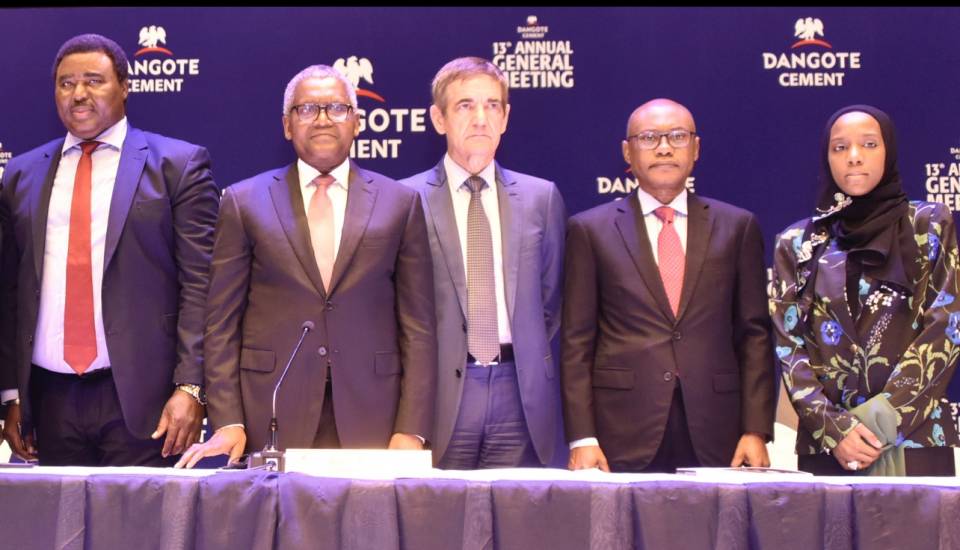
Shareholders of Dangote Cement Plc yesterday commended the Management of the company for an impressive performance despite the economic challenges in the year under review.
Unanimously, the shareholders approved N20 per share for the year ended December 31, 2021 as against the N16 paid in the preceding year. This represents a 25 per cent increase in dividend compared to the 2020 dividend of N16.00 per share, reinforcing the Company’s commitment to maximising shareholder value.
The shareholders gave their approval at the 13th Annual General Meeting (AGM) held in Lagos. They commended the management for the impressive performance recorded in the year under review. They also applauded the company for its efforts in reducing unclaimed dividend of the company.
Dangote Cement in the year under review achieved its highest profit before tax in its history at N538.4 billion. Also, the Company recorded Group volumes of 29.3Mta, up 13.8 per cent. Exceptional EBITDA of N684.6 billion was achieved, up by 43.2 per cent owing to strong cost control measures.
Chairman of the company, Aliko Dangote, said that “Over the last decade, Dangote Cement has recorded exponential growth across all areas.”
According to him, Group volumes are now at almost 30Mta, our capacity has tripled to 51.6Mta and we export cement from five countries across Africa.
“As the volatile global environment propels us into a new era of uncertainties, we are fortunate that the last two years have taught us resilience, adaptability and grit. These values are what we need to face unpredictable times in the future.
“Dangote Cement remains the leading cement company in Africa, well-positioned for a positive and sustainable future. We are resolute in transforming Africa, while creating sustainable value for our stakeholders.”
Dangote said in January 2022, the Company completed the second tranche of its buy-back programme as Dangote Cement has now repurchased 0.98 per cent of its outstanding shares, saying this share buy-back programme reflects the Company’s unwavering commitment to creating value and identifying opportunities to return cash to shareholders.
He also noted that “We began operations in our new 3Mta Okpella plant in Edo state in 2021, where we are successfully ramping up production and have contributed to creating a new industrial hub.
“We are actively deploying our alternative fuel strategy across all countries of operations, to optimise energy efficiency, reduce reliance on fossil fuels and ultimately reduce CO2 emission. Whilst we focused our efforts on meeting the robust demand of our local market in Nigeria, at the expense of our export markets, we still made significant progress in our cement and clinker exports.
“In 2021, we exported seven ships of clinker out of Nigeria and exported cement from five of our operations. Our vision is for West and Central Africa to be cement and clinker self-sufficient, while making the regional and continental free trade agreements a reality.”
He added that along with the Company’s focus on strategy, it made progress on the effectiveness and diversity of its Board with the appointment of Ms. Halima Aliko-Dangote to the Board as a Non-Executive Director effective 26th February 2022, bringing female Board representation to 27 per cent, from 20 per cent in 2020 in addition to the six different nationalities and five independent non-executive directors on our Board.
He emphasised “We continue our sustainability and governance efforts with our 7 Sustainability Pillars – ‘The Dangote Way’. The 7 Pillars: cultural, economic, institutional, financial, environmental, operational and social, provide the appropriate framework in which we have embedded our corporate values and strategic objectives.”
He said “Our strategy in 2021 focused on energy transition, which is a crucial enabler of sustainable development and climate resilience on the continent. We have increased our focus on alternative fuels in our energy mix. We are actively investing in installing mechanical multi-fuel systems that can process diverse types of wastes.”
Outlook for Dangote Cement in 2022, Group Managing Director/Chief Executive Officer of Dangote Cement, Michel Puchercos said “Our goal to be the partner of choice for those transforming Africa, while creating sustainable value for our stakeholders remains firm and clear.
“Despite operating in a challenging and fast-moving environment, Dangote Cement consistently delivers superior profitability to the shareholders. The robust demand experienced across the continent despite the COVID-19 related challenges, confirm the powerful potential of these markets.”
FrieslandCampina celebrates 150 years of grass-to-glass dairy Cooperative
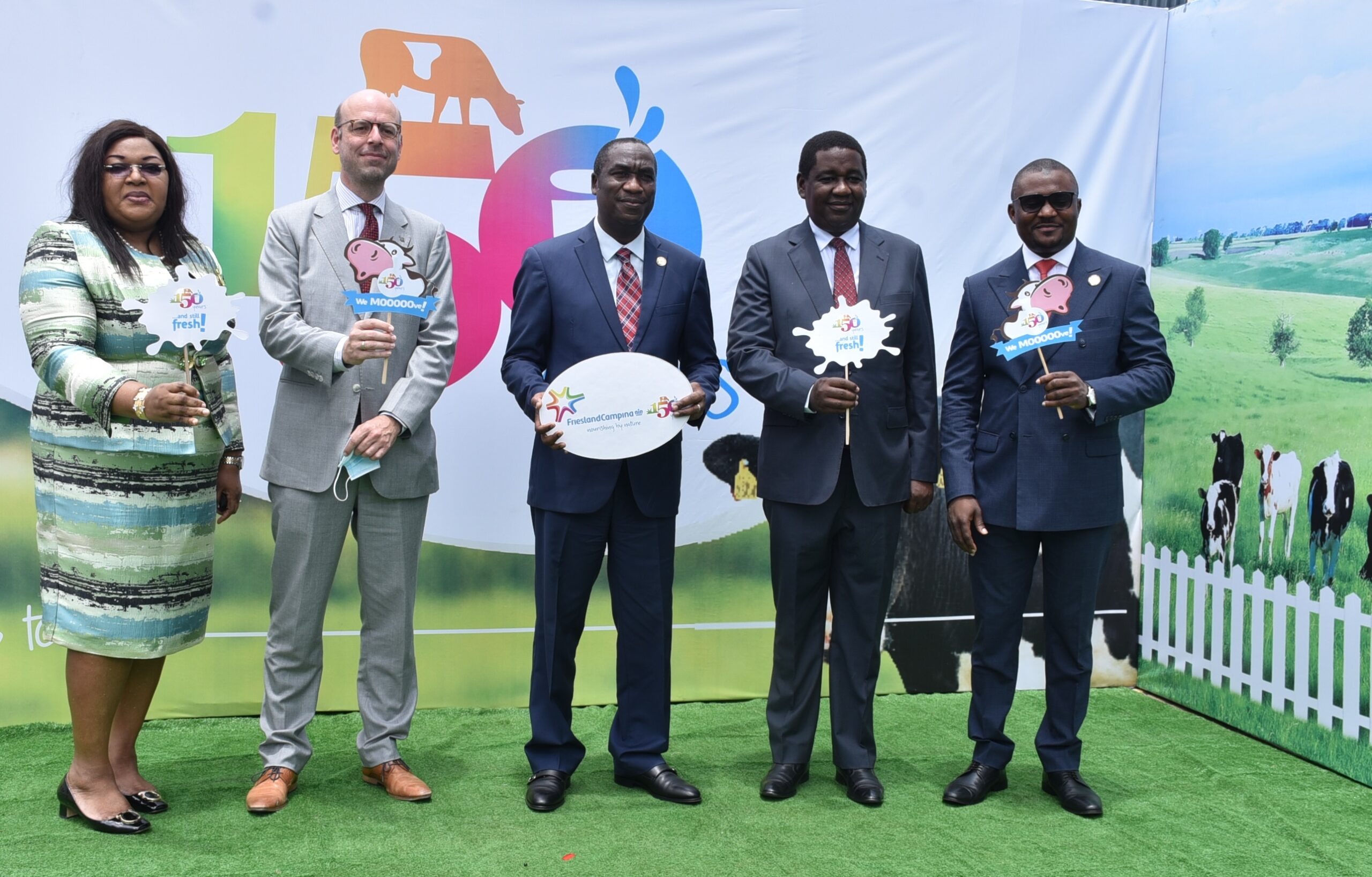
From left, Executive Director, Corporate Affairs, FrieslandCampina WAMCO, Mrs. Ore Famurewa; Consul General of the Kingdom of the Netherlands, Mr. Michel Deelen; Deputy Governor of Lagos State, Dr. Obafemi Kadri Hamzat; Managing Director, FrieslandCampina Sub-Saharan Africa Cluster, Mr. Ben Langat; and Lagos State Commissioner for Finance, Dr. Rabiu Olowo
Global dairy cooperative, FrieslandCampina has flagged off series of activities to celebrate its 150th anniversary. Starting from its international headquarters in The Netherlands Wednesday 8 September, the dairy giant hoisted its anniversary flag simultaneously in all the production locations of FrieslandCampina across the world, including Nigeria.
Ore Famurewa, Executive Director, Corporate Affairs, FrieslandCampina WAMCO who announced the flag off ceremony to the media in Lagos explained that the history of FrieslandCampina as a dairy cooperative dates back to 1871 when some farmers established the ‘Vereeniging tot Ontwikkeling van den Landbouw in Hollands Noorderkwartier’ (Association for Agricultural Development in Hollands Noorderkwartier).
She said, “This association is the oldest legal predecessor of Zuivelcoöperatie FrieslandCampina U.A. In 1872, 20 farmers in the Dutch village of Wieringerwaard in North Holland, decided to collaborate. The farmers bought a building, two cheese tubs and a weighing scale. They appointed a cheesemaker, and the first official cooperation of farmers was established.
“In the village of Warga in Friesland, a group of farmers united also formed another cooperative. After many mergers, these cooperatives finally resulted in FrieslandCampina. Today, the dairy industry is one of the Netherlands’ most important industrial sectors” Famurewa explained.
Speaking at the ceremony, the Managing Director, FrieslandCampina WAMCO and sub-Saharan Cluster, Mr. Ben Langat, said “Today, we share our history because we believe it is significant to encourage enterprise, promote collaboration and drive continued investment across the dairy industry.
“In sub-Saharan Africa, the company brands such as Peak, Bonnet Rouge, Three Crowns and Omela are household names with strong brand reputation. We have championed the dairy sector development with the formation of cooperatives for Nigerian farmers to pool milk into our collection points. This in turn is collected to our factory and these are learnings from the experience of our Company’s 150 years knowledge in dairy industry” Langat said.
Hein Schumacher, CEO of Royal FrieslandCampina N.V in a statement he made in the Netherlands said, “The company is built on 150 years of cooperative knowledge and experience. Its foundations consist of family businesses that have been members of the current cooperative and its legal predecessors for many generations. We have enterprising farmers working together daily to provide millions of consumers throughout the world with the goodness of milk, from grass to glass. I am really proud of this.”
Also speaking at the flag-off ceremony in the Netherlands, Erwin Wunnekink, Chairman of Zuivelcoöperatie FrieslandCampina U.A. said, “Our ancestors already knew that together we are strong. That was true in those days and it still is. It is the core of our identity. We have been successful in new markets by working together. We initially did this close to home in the cities, then just across the borders and eventually, all over the world. Almost all the people in the world know our cheeses and our infant nutrition. With almost 17,000 members, FrieslandCampina is one of the largest dairy cooperatives in the world. This cooperation has made us really successful.”
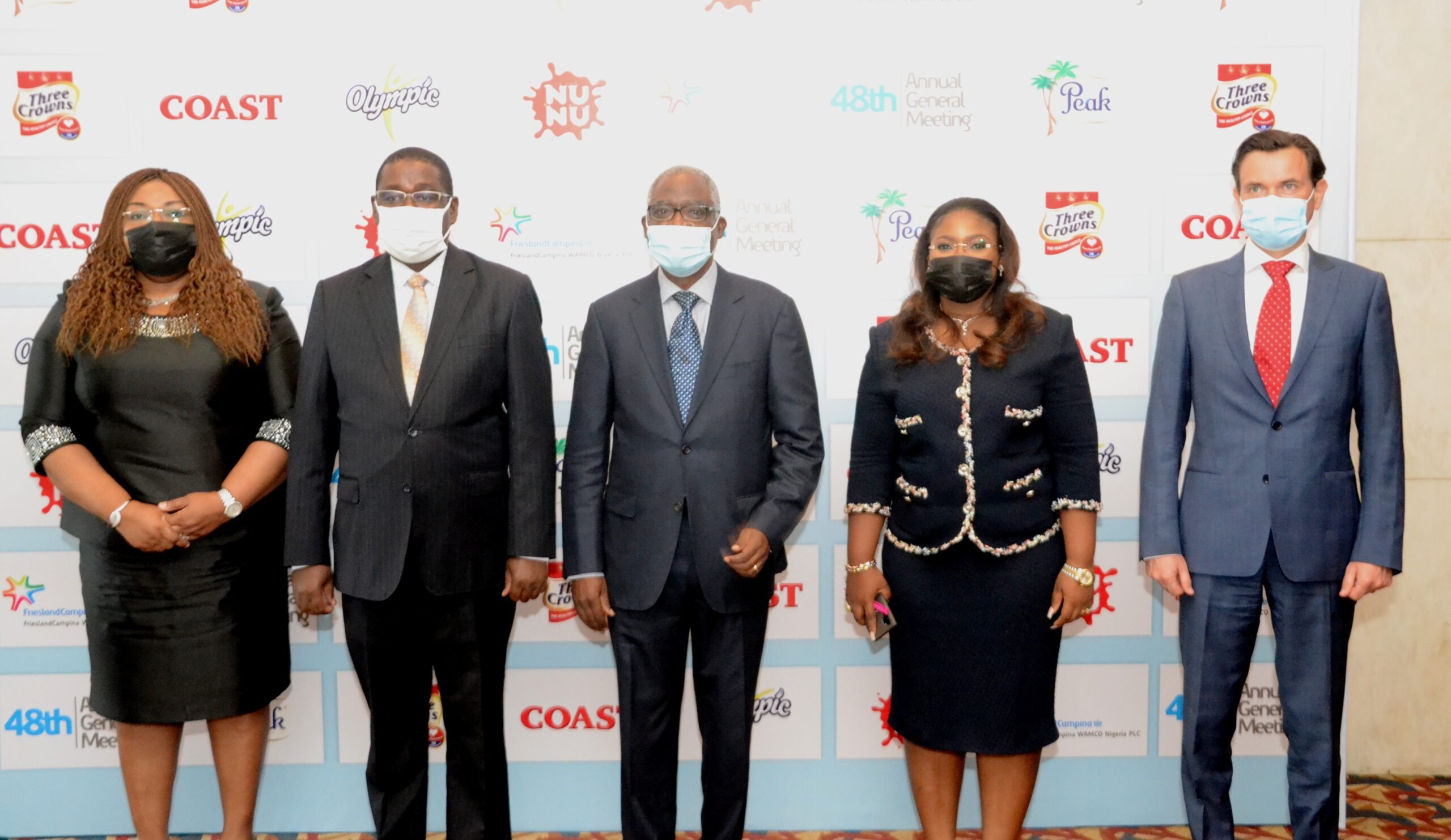
From left, Executive Director, Corporate Affairs, Mrs. Ore Famurewa; Managing Director, Mr. Ben Langat; Chairman Board of Directors, Mr. Moyo Ajekigbe, OFR; Company Secretary/Legal Adviser, Mrs. Olubukunola Olateru and Executive Director Finance, Mr. Marc Galjaard, at the 48th Annual General Meeting of FrieslandCampina WAMCO Nigeria PLC held in Lagos recently
Top dairy company, FrieslandCampina WAMCO Nigeria PLC, makers of premium milk brands – Peak, Three Crowns, Coast, Nunu and Olympic has reported a turnover of N199.5 billion. This was announced at its 48th Annual General Meeting held Thursday, 6 May 2021, in Lagos.
Speaking at the AGM, the Chairman, Mr. Moyo Ajekigbe, OFR said, “the challenging operating environment in 2020 notwithstanding, the Company’s commercial and financial performance for the year showed considerable improvement compared to the previous year. Turnover increased by 23% in 2020 to N199.5billion from N161.8billion in 2019. This was due to a combined effect of organic and inorganic growth following the acquisition of Nutricima’s dairy business. Profit Before Tax however decreased by 20.3% from N18.8 billion in 2019 to N14.9 billion in 2020 as a result of high input costs and naira devaluation impact.”
The meeting was held in compliance with COVID-19 pandemic protocols, ensuring the health and safety of all stakeholders involved. The meeting was broadcast live for shareholders and other relevant stakeholders to participate in the proceedings in line with the “Guidelines on Holding of Annual General Meetings (AGM) of Public Companies Using Proxies” as established by the Corporate Affairs Commission.
All the resolutions submitted for shareholder approval were adopted, including the approval of a total dividend payout of N6.74 per N0.50 share.
As underlined by the Managing Director, Mr. Ben Langat, during his presentation on the financial results, “2020 was shaped by the Company’s continued focus on sustainable business processes. We leveraged our brands and superior commercial expertise to deliver impressive volumes during the year. FrieslandCampina WAMCO continues to be committed to nourishing Nigerians with quality dairy nutrition. Our Board and Management will continue to take necessary steps to ensure that the growth momentum is sustained.”
Explaining the Company’s response to COVID, Mr. Langat said, “From the very first signs of the Covid-19 pandemic, our Company defined three absolute priorities; protecting the health and safety of our employees; doing all that is necessary to ensure business continuity; and supporting Nigeria to manage through the crisis, therefore, a donation of N500 million was made to the COVID Relief Fund while over N100 million worth of products were donated to low income communities during the lockdown.”
Following its expansion drive, FrieslandCampina WAMCO acquired Nutricima factory in Ikorodu during the year under review. The acquisition underlines FrieslandCampina WAMCO’s continued commitment to contribute to the development of the Nigerian dairy sector and satisfies the need for additional production capacity for FrieslandCampina WAMCO to meet the growing consumer demand for locally produced dairy.
Under its backward integration strategy, the business aggressively expanded its activities to
strengthen the dairy value chain in Nigeria. Significant to this was the establishment of the Center for Nigerian Dutch Dairy Development, Nigeria’s first national expertise Center for dairy, committed to unlocking and developing homegrown dairy expertise across the value chain. The business also established the Value4Dairy Consortium, a formidable partnership of FrieslandCampina WAMCO, URUS, Barenbrug and Agrifirm, committed to accelerate self-sufficiency in Nigeria’s dairy sector.
A look at Q1 2021 activities indicates continued economic headwinds in a volatile and uncertain business environment. However, FrieslandCampina WAMCO remains positive about the future of its business in Nigeria. The business is confident that our brands, which are well known, will continue to grow on the back of our strong business fundamentals and unique route-to-market strategy to achieve our business ambition.
The Federal Government has prohibited the importation of refined sugar and its derivatives from the nation’s Free Trade Zones (FTZs), in a bid to protect the sugar industry, which is governed by the Nigerian Sugar Master Plan (NSMP).
The prohibition move, which came through a directive from the Minister, Ministry of Industry, Trade and Investment, was conveyed in a letter by the Nigerian Ports Authority (NPA), Lagos Port Complex, Apapa, Lagos, sent to the Terminal operators of the Lagos Port Complex (LPC), Apapa, Lagos.
The NPA letter dated 08 April, 2021, and titled ‘RE: Prohibition of Importation of Sugar from the Free Trade Zones into the Nigerian Customs Territory’, was signed by Mr. Buba Jubril for the Port Manager, Lagos Port Complex.
According to the letter, “We have for reference a letter from Honourable Minister of Industry, Trade and Investment ref: HMIT1/GEN/ CORR/008/ VOL. I/ dated 15th February, 2021 on the above subject.
“It has recently come to our notice that due to the recent location of a Sugar Refinery in a Free Trade Zone, Refined Sugar is being imported into the Nigerian Customs Territory under the concession granted to enterprises in the Free Trade Zones to export 100% of their output to the Nigerian Customs Territory, and this is real potential threat to the goals of the Nigerian Sugar Master Plan (NSMP).
“The Nigeria Sugar Industry is governed by the Nigerian Sugar Master Plan (NSMP). The NSMP provides a framework for motivating investment in the local production of Refined Sugar by securing the Nigerian Sugar market for investors in the Backward Integration Program (BIP). It does this by providing import sugar allocations for Raw Sugar to recognised investors based on the performance on the BIP and guided recognition of their installed refining capacity.
“Your Terminal is hereby informed by this letter that, in order to protect our national interest and ensure the returns in the Federal Government’s investment in the NSMP are realised, and in line with extant laws and regulations of the Federal Government of Nigeria, importation of Refined Sugar and all other sugar derivatives from the Free Trade Zones into the Nigerian Customs Territory are here prohibited by the Honourable Minister, Ministry of Industry, Trade and Investment,” the NPA letter stated.
It added that, “In view of the above, your terminals are by this letter directed to ensure strict compliance with this directive. Please accept as always the assurances of our esteemed regards.”
Dangote Cement, one of Nigeria’s largest indigenous companies and the largest by market capitalization incurred a company income tax of N97 billion for the financial year ended December 2020.
This s according to the information contained in its full-year audited financial statements for the period under review.
Dangote Cement has enjoyed Pioneer Status over the years and has often been criticized for not paying enough taxes despite its mega-profits.
The N97 billion incurred in 2020 is the highest company income tax reported by Dangote Cement since it became listed on the Nigerian Stock Exchange.
It incurred N49 billion in taxes in 2019 and got a tax credit of N89.5 billion in 2018.
Despite incurring N97 billion in taxes during the year, Dangote Cement’s actual tax paid was just N20.9 billion in 2020 compared to N4.6 billion paid a year earlier.
Tax incurred in the profit and loss statement is an accounting provision and is not always the actual tax paid in cash.
Putting it into context, the dividend paid during the year is N272 billion and interest payments to its creditors totals N48.2 billion.
Despite the Covid-19 Pandemic, the Cement Giant reported full-year revenue of N1 trillion, the highest it has ever recorded since it was privatized almost 20 years ago. The company also reported a profit before tax of N373.3 billion only and a profit after tax of N276 billion, its highest since 2018.
Nigeria like most countries in the world has faced a challenging 2020 due to the impact of Covid-19 on the economy, especially the private sector. However, mega-corporations like Dangote Cement appear to have even performed better during the year. The cement industry in general also appears to have performed well during the year as the combined revenue of the top 3, Dangote Cement, Lafarge, and BUA rose to N1.47 trillion from N1.28 trillion.
The impressive result nonetheless, Dangote Cement’s margins remained strong during the year posting a gross profit margin of 57% in line with its 3-year averages. However, the higher taxes incurred in 2020 dropped profit margins to 26.7%. When compared to 2018 when it still enjoyed Pioneer status, the company posted profit margins of about 43%.
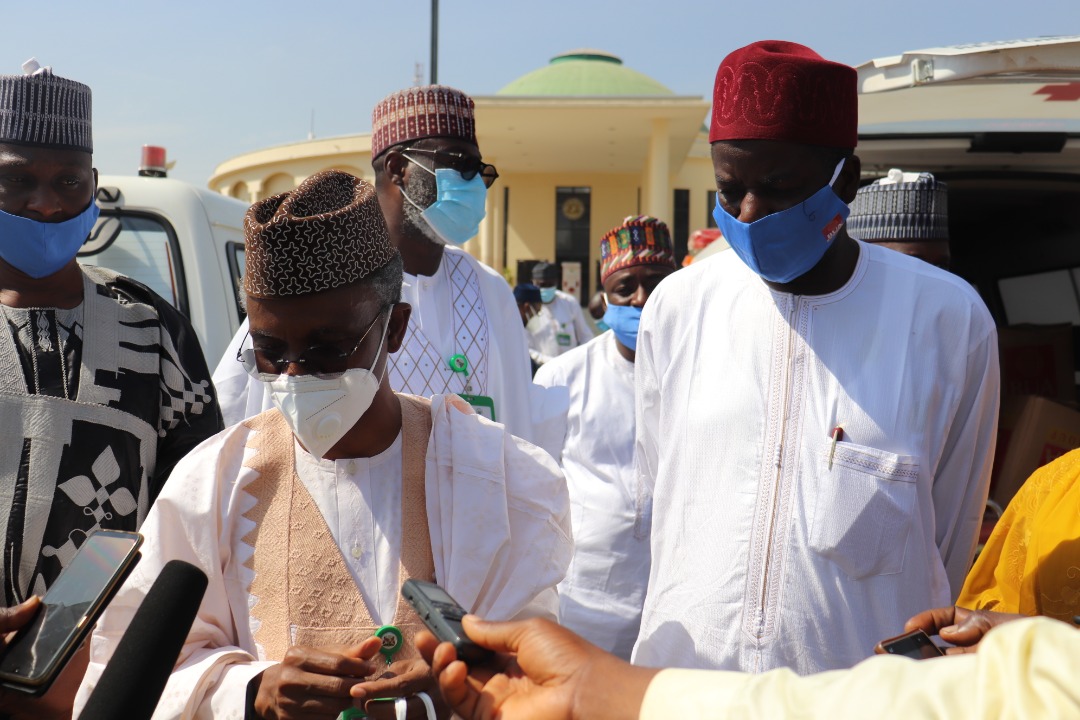
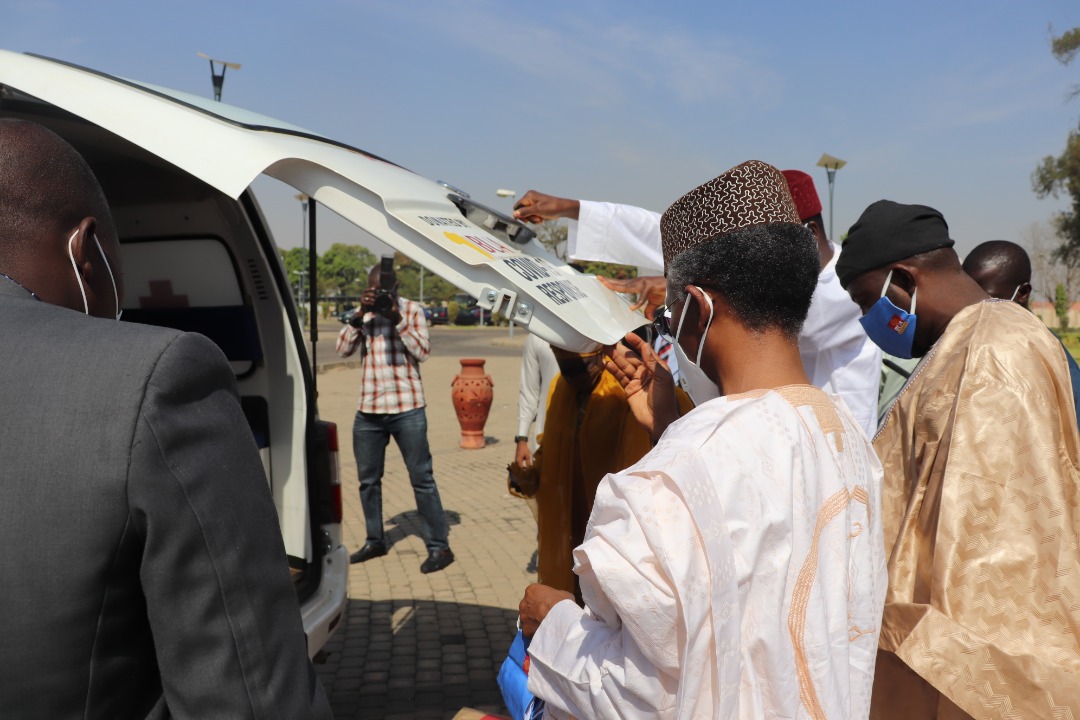
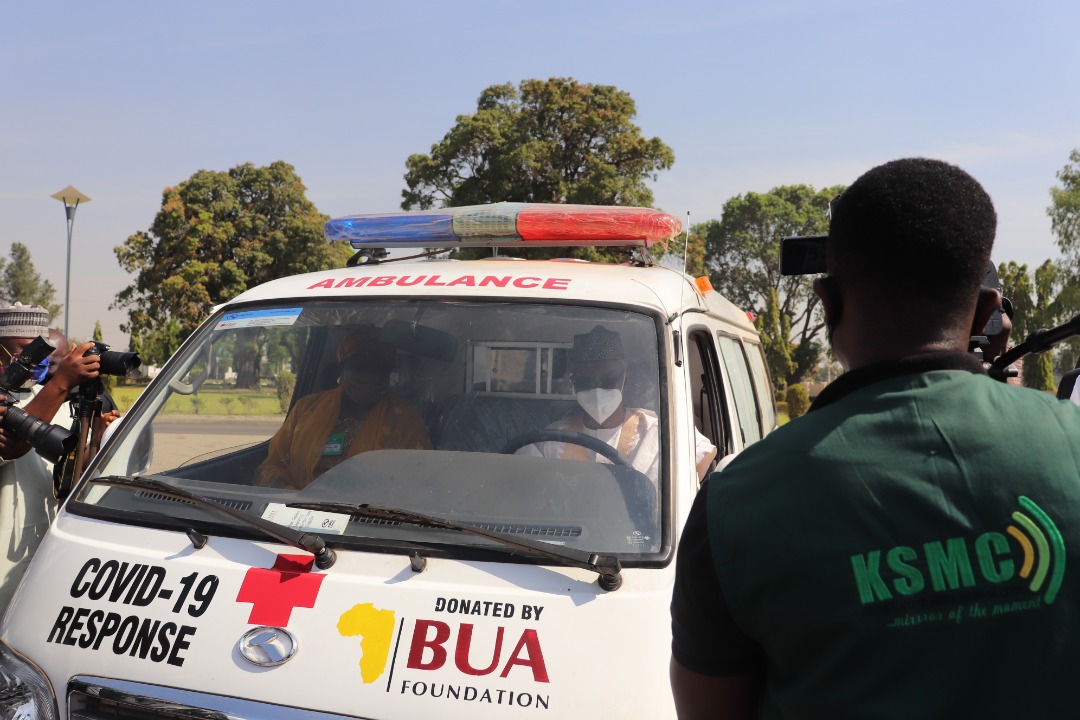
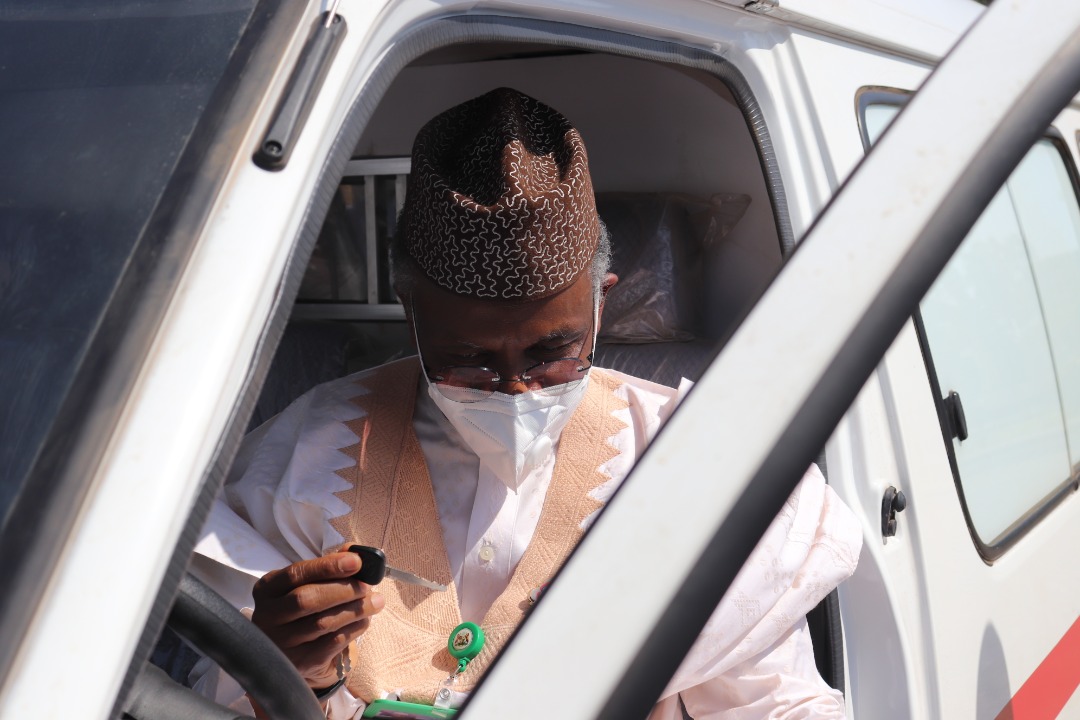
Barely 48 hours after Bauchi and Gombe State governments received 3 ambulances and 50,000 facemasks each from BUA Group to combat the rising cases of COVID-19 pandemic, another 3 fully equipped ambulances and 50,000 reusable facemasks have been donated to the Kaduna State Government. This is in addition to a N100million donation given by BUA to the state government at the height of the pandemic.
While handing over the donations to Governor Nasir El Rufai of Kaduna State, Aliyu Idi Hong, the Government Relations Director of BUA Group, who represented Abdul Samad Rabiu, Founder & Chairman of BUA, expressed worry over the recent rise in cases of Covid-19 especially in Africa.
Hong who commended the Kaduna government for its untiring effort in curbing the spread of the virus in the state added that BUA as an indigenous conglomerate will keep committing resources towards ensuring that citizens of Nigeria are protected against the COVID-19.
He said the fully equipped ambulances will assist in the conveyance of patients, specifically for COVID-19 and other medical emergencies
Receiving the donations, Governor Nasir El Rufai noted that BUA had earlier donated one hundred million naira to boost the COVID-19 fight in the state and thanked the BUA Chairman, Abdul Samad Rabiu for the kind gesture.
“I thank the management of BUA for this generous gesture. It is not the first time Abdul Samad Rabiu has assisted Kaduna State. He gave us one hundred million naira and other donations in kind. I am not only pleased to receive these donations but to hear that more help is on the way.
“This pandemic is still with us, it is still infecting people at a very rapid rate particular here in Kaduna state. So we are very concerned and every assistance we get, we appreciate”.
Since the start of the pandemic, BUA has so far committed over N8billion in cash donations, food stuff, infrastructure, medical supplies and equipment, amongst others.
The Lagos State Governor, Babajide Sanwo-Olu on Friday, November 13, 2020, unveiled the first Nigerian electric car named Hyundai Kona.
The car, which is a product of Stallion Group, was launched at the VON Automobiles Nigeria in Ojo, Lagos State where the car was manufactured.
The new Kona, an Electric car is regarded in European motoring industry as the world’s number one, with the cost, put at about N24 million
While speaking during the unveiling of the product, Sanwo-Olu observed that VON has over 40 to 50 years of vehicle manufacturing history, when they were assembling various Volkswagen products.
The governor was full of commendation for Stallion Group for the noble initiative, just as he promised that Lagos State Government will make provisions for electricity charging points for the vehicle across the state, to make it easy for users to enjoy their Electric Vehicles (EV).
Hyundai Kona
The Governor also promised the completion of the Lagos-Badagry Expressway, which was started under the administration of former governor of the state, Babatunde Fasola, in order to facilitate business activities in the state.
Sanwo-Olu said, “Lagos-Badagry Expressway which has been expanded from 2 to 10 lanes will soon be complete, we are not rushing the road; we are building a first-class road construction project.’’
The Managing Director, VON Automobiles, Mr Rohtagi Manish, while explaining the essence of the launch, pointed out that Kona will change things positively in the Nigerian auto market.
According to Manish, the changes in global temperature and weather patterns are seen today are caused by human activity. Kona, he said, is one way to respond to the global weather challenges, so as to achieve a greener environment.
This appears to be a huge boost for the promoters of more environmentally friendly automobile and subsequently promote a green environment. This will also help to drive the Federal Government’s efforts to shift focus from petrol-based automobile to vehicles with a cheaper source of energy.
BUA Cement, on Tuesday, said it never received any blanket approval to export cement through the Nigerian land borders at a time the borders were closed. The company said it was only granted a limited approval to export some cement to Niger Republic, which is 100kms from its plant, and this was disclosed in the company’s half-year results.
The clarification comes amid revelations that rival Dangote Cement got approval from the Nigerian government to export cement through some of Nigeria’s land borders at a time the borders were closed.
Earlier on Tuesday, PREMIUM TIMES reported how details emerged that despite the border closure policy put in place, the Nigerian government had allowed Dangote Cement to resume cement export across its land borders.
According to Bloomberg, President Muhammadu Buhari‘s administration gave its authorisation for Africa’s biggest producer to export cement to Niger and Togo in the third quarter for the first time in ten months.
The revelations were made by Michel Puchercos, chief executive officer of Dangote Cement, on an investor call in Lagos.
The revelation sparked outrage on social media Tuesday, as many Nigerians questioned the rationale for granting such approval to selected businesses while other businesses suffer the effect of the year-long blockade.
Stanbic IBTC founder, Atedo Peterside, questioned the rationale for granting such waivers to only a few businesses.
On Tuesday, the management of Dangote Group in its reaction described reports of the development as “misleading and mischievous”.
In a statement, Tuesday, the company said it was not the only company enjoying such privilege to move goods through the land borders.
Meanwhile, details emerged Tuesday that rival BUA Cement also received a similar waiver earlier in the year.
In an internal memo dated June 18th and signed by Dimka V.D, Custom Comptroller (Enforcement, Hqtrs) on behalf of Deputy Comptroller-General (E,I&I), the government approved the movement of BUA Cement trucks to Niger Republic.
“I am directed to forward herewith a letter from the Office of The National Security Adviser referenced NSA/227/C dates 17th June, 2020 on the above subject matter,” the memo reads.
“The trucks will exit and return through Illela Border station in Sokoto State. “Attached herewith is a list with names of drivers and truck license numbers and other relevant details for ease of reference.
“This is forwarded for information and strict compliance, please,” the memo addressed to Custom Zonal Coordinator in charge of Sokoto/Zamfara commands stated.
Reacting to reports about the memo Tuesday night, BUA Cement said the company did not enjoy express approval to export cement as reported in a section of the media.
In a telephone conversation with PREMIUM TIMES, the Group Head of Corporate Communications at BUA Group, O’tega Ogra, said the company only received “limited approval” to export.
“BUA Cement does not have any blanket approval to export and the Nigerian borders remain closed,” he said.
“BUA Cement was granted a limited approval to export some cement to Niger Republic (which is 100kms from our plant), and this was disclosed in our half-year results and presentations to the investing and general public.”
Similarly, a transcript of the company’s half-year results call made available to PREMIUM TIMES detailed how Yusuf Binji, the company’s MD/CEO, explained the export approval to investors and analysts earlier in the year.
When asked questions about the export, Mr Binji explained that during the month of June, the company received an approval for limited export to the Niger Republic from “our so-called Plant” through the Illela border which it carried out successfully.
“The Nigeria land borders still remain shut,” he said. “So this was a one-off thing we received but we hope to get more subsequently during this quarter.”
When asked if the company would get additional waivers, Mr Binji said the company was optimistic.
“For the exports, yes, we are very hopeful we are going to get more permits to carry our spares to the Niger Republic. Like I mentioned earlier, we were given a one-off thing for a limited quantity which we exhausted in June.
“But we are optimistic it’s going to continue during Q3 through the land border of Illela from Sokoto State into the Niger Republic.”
Speaking about the demand from Niger, Mr Binji said the company tried to make the Nigerian market its priority.
He said: “We have to satisfy the demand in Nigeria. What we are sending is the excess production that we have. So as long as we are not so clear about the actual demand in Nigeria, we would not be able to put a number or figure to how much we are going to export. So we will see and also we have to see when the restrictions are lifted and the borders are fully opened, because like I said, also it was a one-off thing we got and we hope to get more and with that, we cannot really say this is how much you are going to export.
“We are being given the approval in batches. Regarding the Benin Republic, no we don’t have any plans to export the Republic of Benin.” Asked to give full details of the export and approval, he said: “We exported 200 trucks. It came towards the last week of June. 200 trucks of 40 tonnes each, that is 8000 tonnes. That was the approval we got and we exported it fully.”
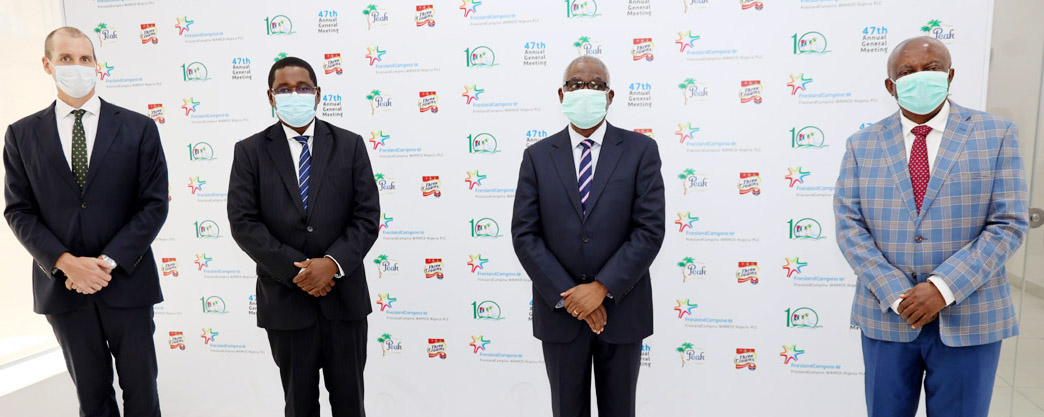
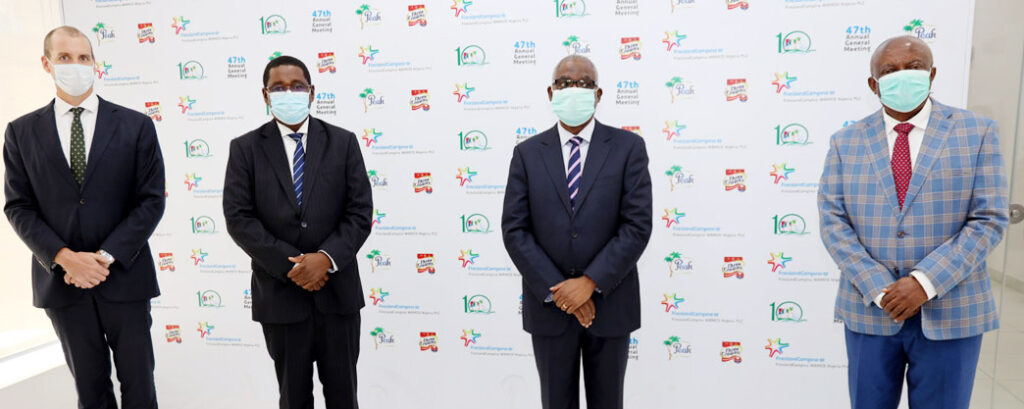
Executive Director, Finance, FrieslandCampina WAMCO Nigeria Plc, Mr. Dirk van Breen; Managing Director, Mr. Ben Langat; Chairman, Mr. Moyo Ajekigbe; and Non-Executive Director, Rev. Isaac Agoye, at the 47th Annual General Meeting of FrieslandCampina WAMCO Nigeria PLC held yesterday at the FC Academy in the Company’s Head Office, Ikeja, Lagos.
Nigeria’s foremost dairy company, FrieslandCampina WAMCO Nigeria PLC, producers of Peak and Three Crowns milk has announced a turnover of N161.8 billion at the 47th Annual General Meeting held at the FC Academy in the Company’s Head Office at Ikeja, Lagos, Thursday, 25 June 2020.
The meeting was held under strict adherence to government-approved COVID-19 protocols, including social distancing and restrictions on the maximum number of persons at a gathering.
As a result, the Annual General Meeting (AGM) was streamed live for shareholders and other relevant stakeholders to participate in the proceedings. Shareholders were earlier invited to give their proxy to representatives published on the Proxy Form contained in the Company’s 2019 Annual Report, to act on their behalf.
At the meeting, FrieslandCampina WAMCO reported a turnover of N161.8 billion representing an 8.5% increase over 2018 and a Profit Before Tax (PBT) of N18.8billion, a 15% increase over previous year.
The shareholders unanimously approved a total dividend payout of N9.49 per N0.50, having paid an interim dividend of N2.68 per N0.50 share in November 2019; and a final dividend payout of N6.81 per N0.50 share.
According to the Managing Director, Mr. Ben Langat, “In the year under review, the business environment remained challenging. In spite of the headwinds, FrieslandCampina WAMCO played a leading role in Nigeria’s backward integration initiative led by the Central Bank of Nigeria in the dairy sector.”
The company activated its Dairy Development Programme (DDP) in Bobi Grazing Reserve, modeling its 10year success of the programme on a 10,000-hectare grazing reserve in Mariga local government area of Niger State.
In line with its business plan, the Company commissioned a state-of-the-art factory for the production of yoghurt and introduced the new Peak Yoghurt Drink in three distinct flavours (Plain Sweetened, Strawberry and Orange) into the market.
Business Outlook 2020
The Board of Directors and Management of FrieslandCampina WAMCO remain positive and confident about the future of the Company despite the disruption by the current pandemic. The Company will remain focused on its purpose of providing better nutrition and advocating healthy living. FrieslandCampina WAMCO will continue to actively engage consumers and pursue its backward integration for business sustainability.
The 47th Annual General Meeting adopted the Company’s financial statement for the year under review. The report can be found on the Company’s website www.frieslandcampina.com.ng