Oshodi-Isolo LG Chairman, Otunba Oloyede Currently on Annual Leave
Contrary to rumour peddling around Oshodi/Isolo local government area about the chairman, Otunba Oloyede Almaroof been on wasteful trip to Europe, the industrious and ever-working chairman is on annual leave.
Information gathered has it that, Otunba Kendoo as the chairman is fondly refers to has been working tirelessly to ensure the entire Oshodi and its environ continue to enjoy the dividend of democracy by making sure all hands remain on desks.
“Chairman is a workaholic, despite the fact that he’s on annual leave, he still monitor and supervise all works and ensure all the contractors resume to site without excuse because all the project has a time frame and the chairman is on their necks to make sure they all delivers. For instance, if you visit Araromi Street and other street, you will confirm that men are at work.” Source in the local government disclosed
Meanwhile, since Kendoo took over the local council affairs, the Oshodi/Isolo local government chairman has replicate his business success story in governance and leadership.
From rehabilitation of roads, drainages and markets to facelifting schools and providing support for the less privileged amongst others, he left nobody in doubt that he meant serious business. These continue to endear him to the young and the old, the male and the female in the constituency who speaks glowingly of him and his fresh energy and penchant for development.
Living up to his promises, his administration has embarked on 35 roads and completed 32 and other infrastructure projects. Some of the roads completed include; Akinniku street, Ariyibi-oke street, Adeoye Street, Suwebatu street, Orona link, Macarthy street, Dosunmu street, Everett street, Trombi street, Adewunmi Ogefon street, Emmanuel street, Alh. Rufai street, Iretioluwa street, Adelaja street, Ogunlaja street,
Baderin street.
Others include Odalume street, Onikewunla street, Opo-Osun street, Liverpool Road, Araromi street, Mukadasi street, Bankojo street, Oredeyin street, Alade Street, Banjoko-Oredeyin link and hosts of others.
He has equally dug 25 boreholes in different parts of the local government in order to solve the water problem of the people. Supported business owners and less privileged people. He has given out scholarships, provided educational materials, to mention but a few.
Adron Shares Customers Christmas Gift In Lemon Friday Promo
December is the season of giving, and Adron Homes are turning up the joy with their unmissable Lemon Friday Promo! This festive offer isn’t just about slashing prices on landed properties nationwide; it’s about showering you with amazing gifts that will make your holiday season truly unforgettable.
Double the Delight: Choose Your Discount & Gift:
• 40% Discount with Flexible Payment: Spread the balance comfortably over 24 months and enjoy a 30K initial deposit or more. Plus, choose between a 5kg bag of rice or a succulent chicken to enjoy the holidays.
• 30% Discount with Extended Payment Plan: Take advantage of a 36-month balance spread and unveil amazing gift options when you pay:
o 30k: Get a 5kg rice and oil combo, or a chicken, or a mini rechargeable fan.
o 60k: Double your rice to 10kg with a chicken combo, or get an electric fan or blender.
o 100k: Feast on 25kg of rice or a festive turkey, or choose a practical 2-face gas burner or rice cooker.
o 200k: Go big with 50kg of rice or a goat, or opt for a rechargeable fan or an air fryer.
o 500k: Level up your kitchen with 50kg of rice and a goat, or choose a deep freezer or a washing machine.
o 1M: Double the rice and double the goats! Alternatively, celebrate with a smart TV or a split AC.
o 1.5M: 50kg of rice and a big cow are yours or opt for a generator or a standing fridge with a dispenser.
o 2M: Take home a double-door fridge or a cow and two 50kg bags of rice (double-double!).
Dream Homes, Elevated Living: Living in Adron Homes’ estates isn’t just about a roof over your head; they’re about elevating your lifestyle. Immerse yourself in peaceful serenity, feel secure with CCTV monitoring and 24/7 security, and enjoy the convenience of infrastructure, power supply, street lights, and 21st-century structures.
Find Your Perfect Location: With a wide range of estates across Nigeria, Adron Homes has the perfect setting for your dream home. Choose from vibrant locations like Ibeju-Lekki, Epe, or Badagry, or find your peaceful haven in Ede Osun, Ado Ekiti, or Shimawa. Whether you’re drawn to the bustling energy of Atan-Ota or Ikorodu, the charm of Shagamu or Papalanto, or the heritage of Ijebu Ode, Abeokuta, or Ibadan, Adron Homes has a property waiting for you.
Don’t miss this opportunity to turn your dream home into reality, with extra perks to make your December merry! Send a DM via any of Adron Homes’ social media pages or visit Adron Homes offices close to you today and unlock the Lemon Friday magic that awaits.
It is a season of celebration as we approach Xmas and also the New Year in a few weeks, it’s time to stop lamenting and focus on having a little win this year by getting a plot of land at Adron Homes and Property Estate named New York Park and Gardens in Keffi; Nasarawa State.
As we all know that; New York is a city in America known for its tourism potential with a gigantic buoyant economy. It is also a blend of two worlds with its massive infrastructure, sprawling skyscrapers littered across, its diversity, Lighted and colourful city, massive nightlife and an urban and cosmopolitan outlook with a touch of Renaissance, Medieval and modern contemporary outlook; with notable architectural wonderment like the Statue of Liberty among other side attractions.
If you want to see these features in Nigeria then get land at the New York Park and Gardens in Keffi the magnificent Gatehouse, perimeter fencing, recreational Centre, 24hrs Security Surveillance, police office with a Helipad on top of it, children’s playground, well-equipped gym, Olympic size swimming pool, supermarket, and a whole lot to make an estate habitable hassle-free.
The good thing is Adron Homes has drafted a very flexible payment plan to accommodate all sundry by paying as you earn with a payment structure of 12-24 months.
Leveraging on the ongoing Adron Homes Lemon Friday Promo will also give you massive discounts on not only the New York parks and gardens but also other estates littered across the country. As a new and existing customer, you can get a 40% discount and spread the balance within 24 months and get 5kg rice, Chicken which applies to as low as a 30K initial deposit or more, getting the value of two things for one payment.
You can also get a 30% discount and spread the balance within 36 months with gifts by paying 30k and get 5kg rice, oil and two chickens or a Mini Rechargeable Fan. Another category is that you can also pay 60k and get 10kg Rice and chicken or an Electric Fan or blender.
You can also pay 100k and get 25kg Rice, Turkey, 2 2-face gas Burner, Rice Cooker and many more. They can also pay 200k and get 50kg of Rice, a Goat, a Rechargeable Fan or an Air Fryer.
You can also pay 500k and get 50kg Rice and Goat or a Deep Freezer or washing Machine. You can also pay 1M and get 2 (50kg Rice) and 2 Goat or a Smart TV, Split AC or the option to pay 1.5M and get 50kg Rice and a Big Cow, Double Door Fridge or Generator.
It may also interest you to know that Adron Homes estate is also located within; Ibeju-Lekki, Epe, Badagry, Ede Osun, Ado Ekiti, Shimawa, Atan-Ota, Ikorodu, Shagamu, Papalanto, Ijebu Ode, Abeokuta, Ibadan, Abuja & Nasarawa, Niger.
What are you waiting for? Stop the procrastination by inquiring or visiting any of their offices nationwide or contact them via their social media channels on Facebook Adronhomesofficial, Twitter @adronhomes and Instagram @adronhomesofficial or visit our website at www.adronhomesproperties.com to read more. Or simply call: 07032290311, 08022122490, or 08033588328 for further enquiry and site inspection.
Adron Homes Shines At This Years 10th TM News summit And Awards 2023
The Leading Pan-African real estate Organization, Adron Homes and Properties Limited, has added yet another feather to her meritorious cap of achievements As the Most Reliable African Real Estate Company Of The Year . The Editor-In-Chief/CEO TMnews and the organiser of the event Mr Temidayo Babalola , in a press briefing explained that the “TMnews Awardees are people and brands with impressive results and have distinguished themselves in their chosen careers or sectors .
The Event Which Was Held In Ogun State Witnessed a gathering of Elites ,Top Professionals from both the private and public sectors and Practitioners from different part of Nigeria.Adron Homes was recognized based on integrity and consistency in the real estate business among her contemporaries in Nigeria and beyond.
It could be recalled that Adron Homes has successfully provided nothing less than 3000 low cost housing for Nigerians at an affordable price.They have also made land affordable and accessible for average Nigerians to become their landlords.
The company, Adron Homes and Properties Ltd is currently in eight states in Nigeria, Abuja, Nassarawa, Niger ,Ekiti, Oyo, Osun,Ogun ,Lagos state And Benin Republic ,plans of expansion into other states In Nigeria and other Countries are ongoing,All these are to further serve their customers better .
For more enquiry you are free to visit any of their offices nationwide close to you or visit their official website at www.adronhomesproperties.com ,to get your own land and luxury homes irrespective of your financial status .
FirstBank UK Adopts Bloomberg TOMS to Optimize Fixed Income Workflow
Bloomberg announced today that FirstBank UK Limited (FirstBank UK), the UK subsidiary of First Bank Nigeria Limited, the premier West African bank, has adopted Bloomberg’s Trade Order Management System (TOMS). By integrating TOMS into its workflow, FirstBank UK will have access to a comprehensive suite of data and analytics, communications, as well as order and execution management solutions, enabling it to streamline its fixed income bonds business.
FirstBank UK is a niche market-maker to its customers in Africa. The business provides market liquidity in cash bonds, primarily in Nigerian, Angolan, Egyptian and Ghanaian Eurobonds to manage risk and optimize its inventory. Thanks to Bloomberg’s coverage, TOMS enables the trading desk of FirstBank UK to support its client base and to monitor its positions, profit and loss (P&L) and Risks.
“By integrating with our existing systems, Bloomberg TOMS provides FirstBank UK with a complete end-to-end trading workflow covering African bonds in most of our home markets,” said Olukorede Adenowo, CEO-designate at FirstBank UK.“ The solution enables us to focus on expanding our footprint in the African Fixed Income landscape and deliver a first-in-kind service to our customers in Africa.”
“We are pleased to help FirstBank UK enhance operational efficiency across its enterprise with our award-winning sell-side order management solution TOMS,” said Lisa Bravo, Global Head of Sell-Side OMS at Bloomberg. “TOMS empowers firms to create a seamless workflow from their front and middle-office, through to their operations and enterprise applications, while concurrently delivering their front office users with real-time execution, risk and P&L analytics.”
FirstBank UK has further digitized its order management workflow by offering clients access to liquidity on its own Eurobond Single-Dealer Platform. The application has been integrated with Bloomberg TOMS to centralize both order handling and aggregated custom analytics and liquidity tools within a single interface, to be hosted and connected to multiple trading venues. “The integration of TOMS with our custom-built electronic trading platform, allows our customers real-time access to liquidity in our markets, something unique to the majority of our customers,” said Robert Hagenaars, Head of Markets at FirstBank UK.
For additional information about Bloomberg’s sell-side solutions, please click here
Aare Adetola Emmanuel-King Celebrates Akarigbo of Remo on 61st Birthday
The Group Managing Director of Adron Homes and Properties; Aare Adetola Emmanuel-King Has congratulated and celebrated the Akarigbo of Remo and the Paramount ruler of Remo Land, HRM Oba Babatunde Adewale Ajayi CFR (Torungbuwa II) on his 61st birthday today.
In a statement signed by his Senior Special Adviser on Media; Oladapo Sofowora, Aare Adetola described the Kabiyesi Alayeluwa Akarigbo as a King of many parts whose reign has been beneficial to all Remo sons and daughters across the globe. Aare Adetola further described him as a man of peace who is also forward-thinking and always ready to stand for what he believes in.
“Kabiyesi Alayeluwa Akarigbo of Remo is a father I hold in high esteem and I appreciate his fatherly love always. I marvelled at his approach to issues and his repertoire of knowledge in resolving crises. He is highly cerebral, cosmopolitan, peace-loving, considerate, knowledgable, and intelligent. Kabiyesi Alayeluwa Akarigbo carries the throne He occupies with so much prestige, which all sundry in Remo are proud of.”
“Under his reign, it has been from one greater height to the other. We have witnessed unprecedented success and growth rates across Remo land. I want to wish Kabiyesi Alayeluwa Akarigbo a long life in good health and wealth on the throne of his forebearers. I want to wish him more wisdom and the ability to steer the Remo Ship without sinking to the promised land. I also want to wish him hitch hitch-free reign on the throne of his ancestors. On behalf of me and my wife, Olori Aderonke Emmanuel-King, I want to wish you a happy birthday and many more years Kabiyesi Alayeluwa Akarigbo.”
Overcoming Property Ownership Fears with Adron Homes: Your Pathway to Affordable Real Estate
Embarking on the journey to becoming a property owner can be a daunting ambition. The fears of finding reliable, secure, and affordable real estate, coupled with the worry of paying a hefty lump sum and potentially missing out on your dream home, often hold people back. However, fear not! We at Adron Homes; are strategically positioned to provide solutions to these common concerns, ensuring that your path to homeownership is smooth, secure, and affordable.
Many individuals hesitate to invest in property due to financial concerns, worried about the burden of a large upfront payment. We understand the financial concerns associated with property acquisition, hence our affordable payment plans which are designed to ease this burden, making your dream property within reach without compromising your financial stability.
We understand that the real estate market can be unpredictable, causing concerns about the reliability and security of your investment. With over Eleven years of impact in the real estate industry, we at Adron Homes take pride in our reputation for reliability and security. With a diverse portfolio of estate locations across the country, we assure you that each property is carefully planned and developed to meet the highest standards. Your investment with us is backed by a track record of excellence, void of land disputes, land grabbers popularly known as Omo Oniles, encumbrances, and improper documentation.
Afraid of missing out on your preferred property or location due to the competitive nature of the real estate market? “We have got you covered!” Our extensive range of estate locations ensures that regardless of background, class, or occupation, everyone has options that cater to their dream. Whether you envision a home in the bustling city or a serene suburban retreat, Adron Homes has a property for you. With locations in Ibeju-Lekki, Epe, Badagry, Ede Osun, Ado Ekiti, Shimawa, Atan-Ota, Ikorodu, Shagamu, Papalanto, Ijebu Ode, Abeokuta, Ibadan, Abuja, Nasarawa, Jos and Niger, you’re sure to find the perfect place to buy land.
We understand that the intricacies of the real estate process can be overwhelming, sometimes leading to uncertainty. We recognize that the real estate journey can be complex, especially for first-time buyers. Our dedicated team of realtors is committed to guiding you through every step. Whether you prefer reaching out via social media platforms or a direct call via the contact numbers on our website, Adron Homes ensures personalized assistance, making the process transparent and accessible.
With our Lemon Friday Promo, it’s time to face your fears and take that step toward homeownership with confidence. Adron Homes is your trusted partner in making property dreams a reality. Don’t let fears hold you back – enjoy 30%, 40%, and 50% discounts on any of our landed properties across the country with 36 months, 24 months, and 12 months payment plans respectively.
Becoming a property owner is a significant milestone, and Adron Homes understands the fears that may accompany this journey. Through affordable payment plans, diverse locations, property options, and unwavering reliability, we are daily driven to alleviate these concerns. Trust us at Adron Homes to be your partner in turning the dream of homeownership into a seamless and enjoyable reality.
Why Adron Homes Remain The Leading Real Estate Developer In Nigeria
In the realm of real estate; Adron Homes is a pioneering force, standing out as a beacon of excellence, building cities, communities, and homes. With a commitment to innovative infrastructure and a mission to create serene and harmonious environments, Adron Homes is not just a real estate developer; we are a promise fulfilled.
Dreaming of a place where the extraordinary meets affordability? Look no further than Adron Homes. We are making dreams come true for families nationwide. https://youtu.be/tpjTc5Wnmbw?si=E8j144qL9ijXuPl2
Innovative Infrastructure: Building Tomorrow, Today ????️:
At Adron Homes, we pride ourselves on crafting estates nationwide that transcend the ordinary. The company’s commitment to innovative infrastructure is evident in every detail, from state-of-the-art buildings to meticulously designed landscapes. This dedication ensures that residents experience living spaces that are not only aesthetically pleasing but also functional; a harmonious environment for families to thrive.
“Loud Am, Na We Do Am”: A Commitment to Excellence
“Loud Am, Na We Do Am” resonates with our spirit of commitment and pride. This mantra signifies that excellence is not just a goal; it’s the standard. Every project undertaken by Adron Homes is a testament to our commitment, as the company is daily driven to exceed expectations and set new benchmarks in the real estate industry.
Nationwide Presence: Covering Every Inch of Your Dreams ????
With a variety of estate locations across the country, Adron Homes has a comprehensive reach, ensuring that they’ve got you covered on every front. Whether you dream of a tranquil suburban retreat or a bustling cityscape, Adron Homes has the perfect location for you. This nationwide presence showcases our commitment to providing diverse options to meet the unique preferences of every individual or family.
Affordability Redefined: Your Dream Property Within Reach ????️????️
At Adron Homes, the dream of owning a property is not just a vision; it’s a reality. With affordable payment plans and discount options, we make acquiring your dream property a seamless experience. We have tailored our offerings to make sure that your dream home is within reach. This commitment sets us apart in the real estate market. https://youtu.be/Z40SFptD6Q8?si=1k74uDxXpdo-yagr
Adron Homes is not just a real estate company; we are a gateway to experiencing the extraordinary in homeownership. With a nationwide presence, innovative infrastructure, affordability at its core, and a commitment to excellence, Adron Homes is making dreams come true for families across the country. If you’re ready to turn your homeownership dreams into reality, Adron Homes is the name to remember. ????????
At Adron Homes,???? we care, and proudly say, ‘Loud Am, Na We Do Am.’ ????because excellence is our standard.????
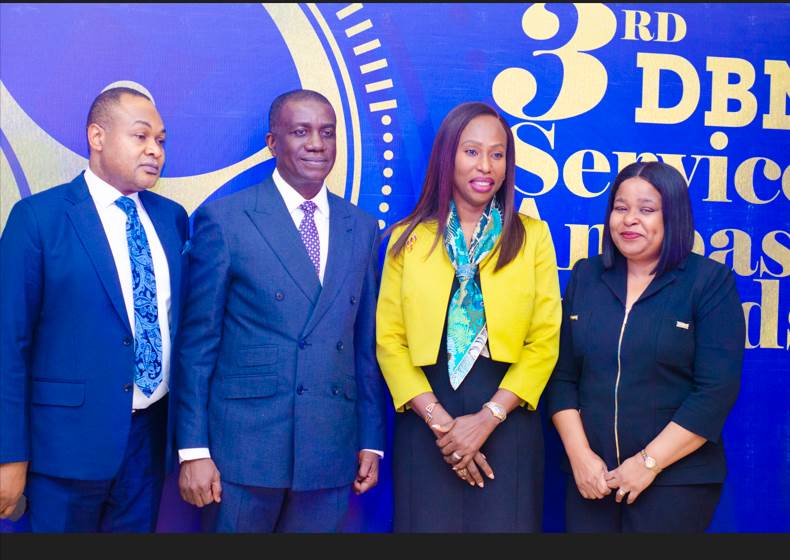
Left: Chief Operating Officer, Development Bank of Nigeria (DBN); Bonaventure Okhaimo; Managing Director, DBN, Tony Okpanachi; Carol Oyedeji, Deputy Managing Director, Ecobank Nigeria and Executive Director, Finance and Corporate Services, DBN, Ijeoma Ozulumba at the DBN Annual Service Ambassador Awards ceremony held in Lagos recently
Ecobank Nigeria won 3 prominent awards signifying its’ support for MSME’s in Nigeria at this year’s Development Bank of Nigeria (DBN) Annual Service Ambassador Awards ceremony held in Lagos recently. The Bank bagged the following strategic awards which include: Platinum Service Ambassador; Bank with the Highest impact on Women Issues, and Bank with the Highest impact on MSMEs Accessing Credit for the first time.
The DBN Ambassadors Programme was designed to increase the sense of ownership among participating financial institutions, build capacity, increase on-lending to Micro, Small and Medium-scale Enterprises (MSMEs) and ultimately deepen financial inclusion in Nigeria. Ecobank is a participating financial institution in partnership with DBN to provide credit facilities, credit guarantee and technical support to MSMEs.
Receiving the awards at the event, Deputy Managing Director, Ecobank Nigeria, Carol Oyedeji said this a testament to the bank’s commitment to supporting and empowering women owned businesses and assisting small businesses to access loans conveniently at cheaper interest rates for the development of the overall MSME subsector. Ecobank had the highest volume and value of transactions in these award categories
She reiterated that, Ecobank remains a women-friendly bank with many initiatives and innovative products targeted at empowering and sustaining female entrepreneurs in Africa such as ‘Ellevate’ and ‘Ecobank Female Entrepreneurs Initiative (EFEI)’, which are designed to empower and support female entrepreneurs.
Mrs. Oyedeji noted that Ecobank recently signed a USD200 million risk-sharing agreement with African Guarantee Fund (AGF), a specialized pan-African guarantee provider, stressing that it is aimed at catalyzing economic growth and supporting entrepreneurial ventures – including women-owned SMEs on the continent. “Through this partnership, both organisations are taking bold steps to enhance green financing and gender financing. It would eliminate the rigorous and restrictive requirements for collateral, particularly hindering women-focused businesses’ access to credit.”
According to her, “ We have both financial and social empowerment initiatives for female entrepreneurs because we recognise women as the bedrock of most families and entrepreneurship in the society. We aim to eliminate the rigorous and restrictive requirements for collateral, hindering access to credit.”
In his welcome address, Managing Director, DBN, Tony Okpanachi saluted the awardees, stating that their collaboration and commitment is impacting positively on the sustainable growth of the MSME sub-sector of the economy.
According to him, “your unwavering commitment to forging a lasting impact on the MSMEs through our collaboration is a testament to your dedication to fueling sustainable growth. The true essence of the DBN Awards shines through a celebration of sustainable triumph, where today’s aspirations evolve into tomorrow’s achievements.”
He explained that the DBN leverages its partnership with Participating Financial Institutions (PFI) to provide relatively cheaper loans as well as capacity building initiatives to small businesses.
The Development Bank of Nigeria (DBN) was conceived by the Federal Government of Nigeria (FGN) in collaboration with global development partners to address the major financing challenges facing Micro, Small and Medium Scale Enterprises (MSMEs) in Nigeria.
DBN’s objective is to alleviate financing constraints faced by MSMEs and small Corporates in Nigeria through the provision of financing and partial credit guarantees to eligible financial intermediaries on a market-conforming and fully financially sustainable basis.
ZENITH BANK TRANSFORMS AJOSE ADEOGUN STREET INTO A RESPLENDENT SPECTACLE WITH CHRISTMAS DECORATIONS
In a splendid display, Zenith Bank heralded the Christmas and Yuletide seasons with the Light-Up of Ajose Adeogun Street and Roundabout, Victoria Island, Lagos, on Saturday, 25 November 2023. The Light-Up ceremony was performed by the Group Managing Director/CEO of Zenith Bank Plc, Dr. Ebenezer Onyeagwu.
This year’s Light Up Ceremony, the 17th of its kind, is a Corporate Social Responsibility initiative by Zenith Bank. The Christmas decoration is a Corporate Social Responsibility (CSR) initiative of the bank to herald the Yuletide season through the beautification and transformation of the entire stretch of Ajose Adeogun Street (home to Zenith Bank’s Corporate Headquarters) and Roundabout into a resplendent spectacle – which has come to be recognised as an iconic tourist attraction, attracting people from all walks of life who visit with their families and friends to take pictures and make videos of the beautiful spectacle, especially at night and enjoy the ambience of the street and season.
Speaking during the ceremony, Dr. Onyeagwu expressed his delight in heralding the 2023 Yuletide season by lighting up the iconic Ajose Adeogun Street and Roundabout.He urged everyone to imbibe the message and spirit of Christmas, which is about peace, love, forgiveness and respect for humanity and prayed for peace in every home, business and country. In his words, “Today, as we turn on the Christmas light with the wife of our Founder and Chairman, Mrs. Kay Ovia, in our midst, we hope with this, we activate the spirit of Christmas in the minds of everyone. We pray that the ambience of the light brings warmth, love, joy, fulfilment, and hope to every one of us. We pray that our country will experience peace. We pray that our joy will be full in this season of joy. So, in the spirit of the Yuletide season, Zenith Bank is also demonstrating that we want to use this to continue communicating and connecting with the community.”
He lauded the efforts of Quantum Markets, who have been responsible for the annual decorations, for their outstandingly creative and beautiful work. According to him, “It is an amazing evening! First and foremost, we need to thank Quantum Markets for the incredible work they are doing. You know, every year, the theme, the style and the ambience look completely different, and today, in a few minutes, we are going to be turning on the light, and you are going to see that it is nothing compared to what you have seen anywhere in the world. I have had the privilege of seeing Christmas light in so many cities across the world, and I say without any sense of contradiction that none compares with what we have in Lagos, Nigeria.”
The bank’s sustainability and CSR initiatives are hinged on the belief that today’s business performance is not all about the financial numbers – the bank believes that an institution’s social investments, contributions to inclusive economic growth and development as well as improvements in the condition of the physical environment, all constitute a balanced scorecard.
Through its CSR initiatives, Zenith Bank has embodied the overarching objective of the 17 Sustainable Development Goals (SDGs), which provide a framework for addressing the major challenges confronting society. Its social investments are targeted at health, education, women and youth empowerment, sports development and public infrastructure enhancement. Overall, Zenith Bank’s total CSR investment in 2022 was NGN1.67 billion, representing 0.75% of its Profit After Tax (PAT).
The bank remains committed to furthering the economic, cultural and social development of host communities, particularly through community-based initiatives and philanthropy. As a good corporate citizen, it continues to deliver projects that have long-term social and economic benefits for the communities because it believes that its business is only as strong as its host communities.
To demonstrate its commitment to creating and expanding opportunities, the bank regularly makes donations towards setting up ultramodern ICT centres in several educational institutions and cities across the country. It also supports various developmental projects and healthcare delivery causes in Nigeria and contributes to the development of sports in Nigeria through its sponsorship of the Zenith Women Basketball League, Zenith Bank Delta State Principals’ Cup, and Zenith Bank Delta State Headmasters’ Cup, amongst others.
In recognition of its contributions and social investments to its host communities and the society at large, the bank was recognised as the “Most Sustainable Bank, Nigeria” in the International Banker 2023 Banking Awards and “Most Responsible Organization in Africa” at the Sustainability, Enterprise, and Responsibility (SERAS) Awards 2021.