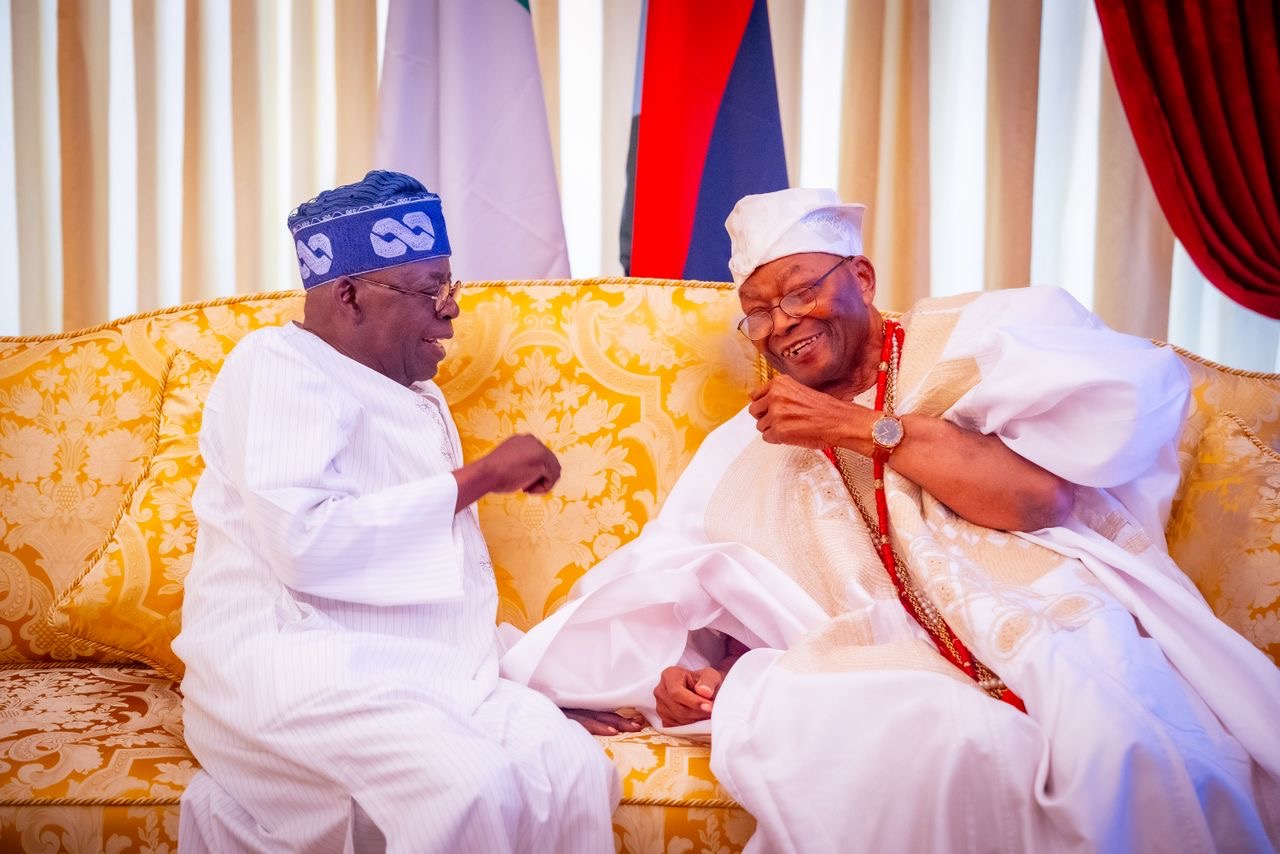
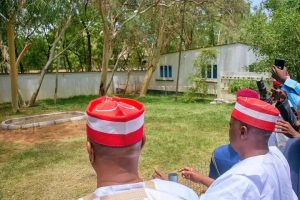
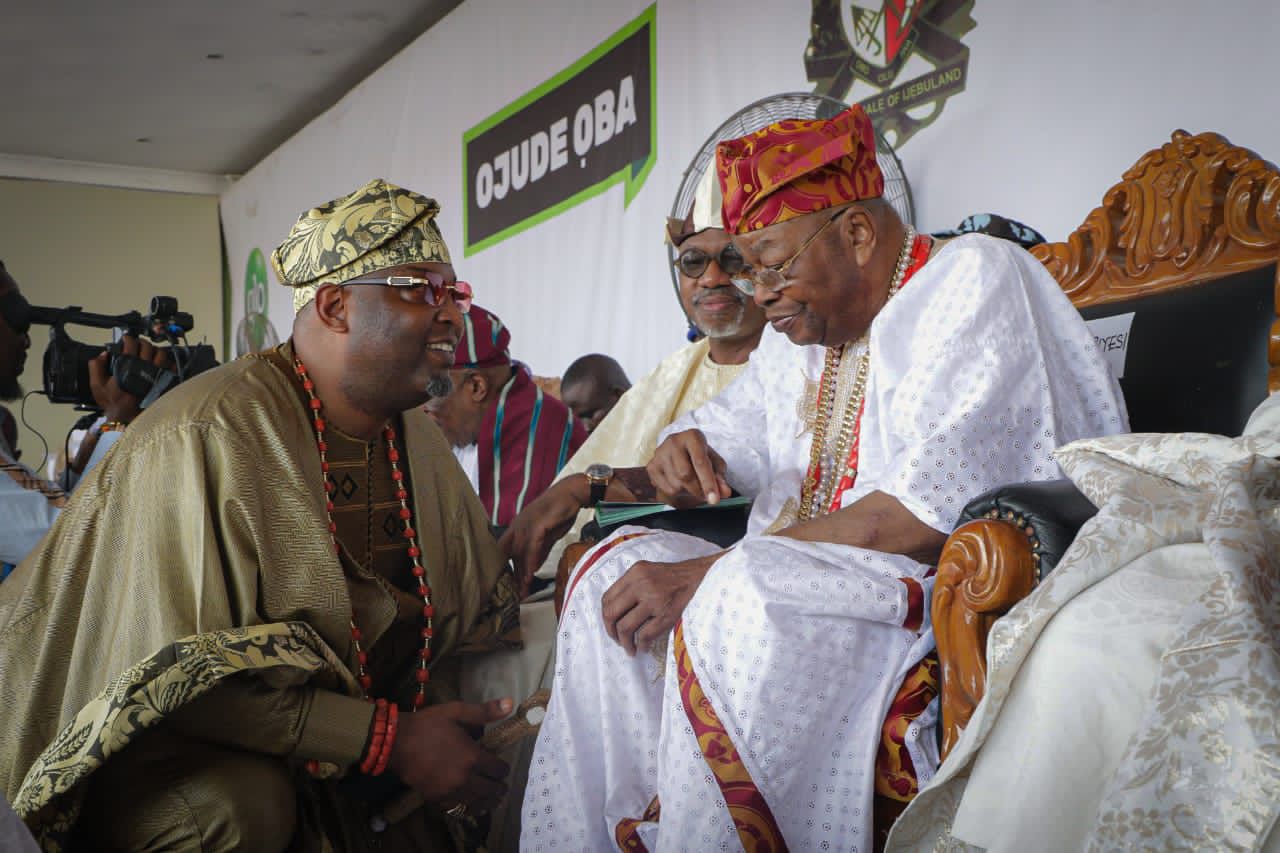
President Bola Tinubu has departed Abuja for Ijebu-Ode in Ogun State to attend the eighth-day prayer ceremony in honour of the late Awujale of Ijebuland, Oba Sikiru Adetona.
This was disclosed on Sunday in a post on X (formerly Twitter) by the Special Assistant to the President on Social Media, Dada Olusegun.
“President Bola Ahmed Tinubu has left Abuja for Ijebu-Ode to attend the eighth-day prayer ceremony for the late Awujale of Ijebuland, Oba Sikiru Kayode Adetona,” he wrote.
The revered monarch passed away on July 13 at the age of 91 and was buried the following day in Ijebu-Ode, according to Islamic rites.
His death marked the end of a 65-year reign, one of the longest in Nigerian traditional history.
Ahead of the eighth-day prayer, security has been tightened across Ijebu-Ode, particularly along roads leading to key venues such as Dipo Dina Stadium, the Awujale’s Palace, and his Igbeba private residence.
The prayer is scheduled to hold at the Dipo Dina International Stadium and will be attended by dignitaries including Ogun State Governor Dapo Abiodun and other top officials.
President Bola Tinubu has departed Abuja for Ijebu-Ode in Ogun State to attend the eighth-day prayer ceremony in honour of the late Awujale of Ijebuland, Oba… pic.twitter.com/f7ZQ89BN5D
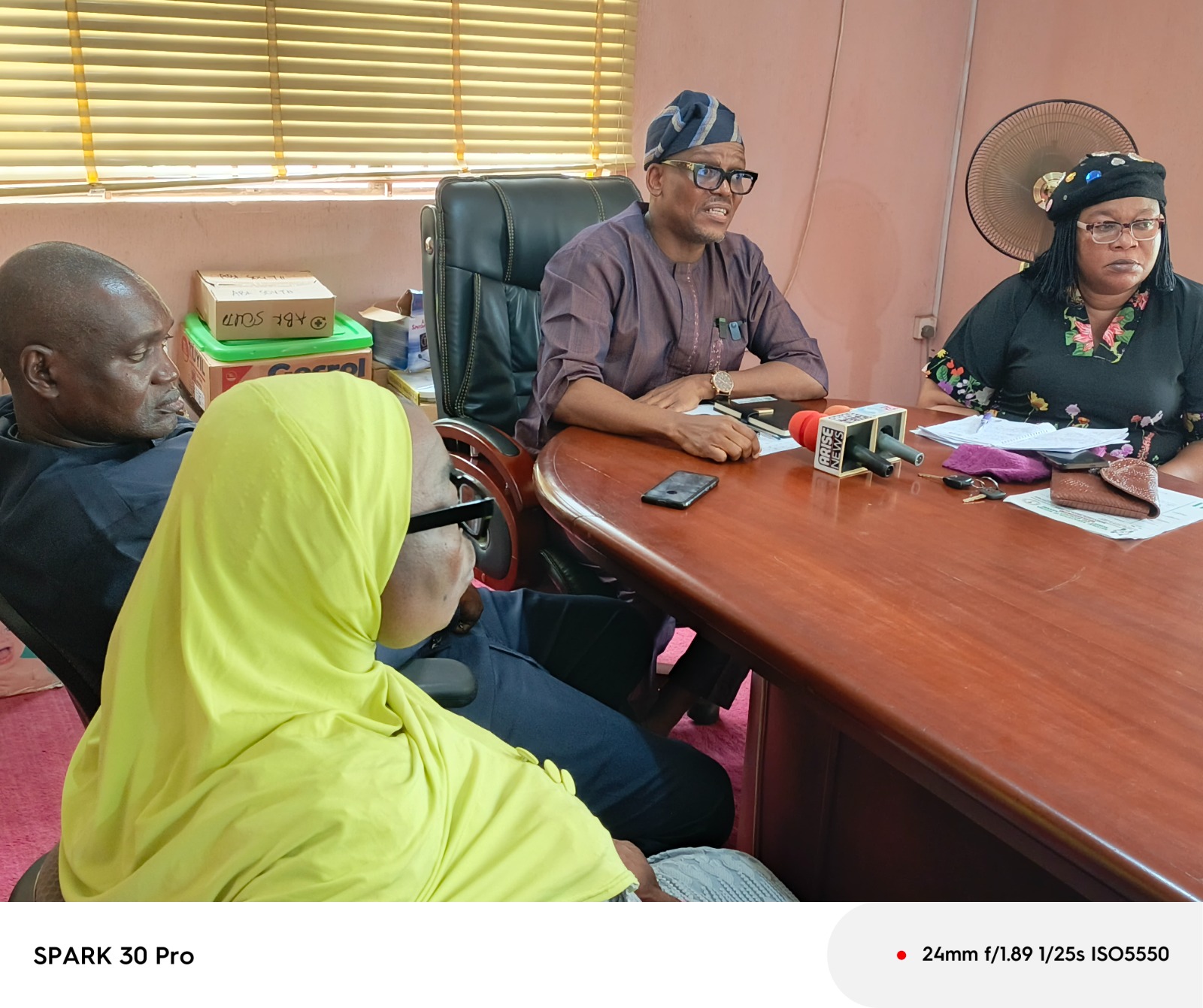
The Medical Director and Provost of Neuro Psychiatric Hospital, Abeokuta, Dr Paul Agboola, on Saturday debunked reports of injustice over an alleged case of physical and verbal assault levelled against the Head of Clinical Services of the hospital, Dr Olayinka Majekodunmi, by a Post Basic Psychiatric Nursing student, Seyi Ogunjobi.
Agboola stated that Majekodunmi has, however, been handed a strongly worded warning letter for admitting to having used foul language such as “You’re stupid, you’re a bastard” on Ogunjobi during the altercation, which reportedly occurred on June 30, 2025.
He stated that the panel that sat over the case, which he chaired, also found the student nurse very inconsistent and evasive, as he could not prove the allegation that the senior consultant hit him with a chair and also pushed him and was therefore was suspended as a corrective measure.
Agboola said that the father of the student nurse had also reached out to him, appreciating him for his fatherly approach to the matter and pleaded that the hospital management temper justice with mercy.
The Medical Director disclosed this on Saturday while addressing journalists over the alleged assault case.
Recall that the hospital chapter of the National Association of Nurses and Midwives, led by its chairman, Narcissus Oluwalegan, had led other nurses on a peaceful protest over the alleged assault of the student nurse.
Oluwalegan had stated that while Majekodunmi had been left to walk freely, Ogunjobi was suspended, claiming that the hospital management had decided to close their eyes to the injustice meted out to one of them.
He had threatened that the nurses would not hesitate to withdraw their services if the hospital management did not lift the suspension placed on the students within 24 hours, while also addressing other concerns of the health workers.
Addressing journalists on Saturday, Agboola said that having received the petition of the alleged verbal and physical assault, a panel which was chaired by him and also had as members Mrs Florence Oladeji, Head of Administration of the hospital, Dr Sunday Amosu, Head of Research and Training, Dr Taiwo Omirin, Principal of School of Psychiatric Nursing, her Vice, Mr Olorunisola, Dr Nurudeen Ibrahim, Head of Servicom and others looked into the allegation.
He explained that the incident reportedly occurred on June 30 during the ward round led by the Head of Clinical Services, Dr Majekodunmi and his team.
Agboola said, “On getting to the ward, there was said to be challenge of lack of chairs as some nursing students had already occupied the seats. The student nurse, Seyi Ogunjobi, reportedly went to get a chair but insisted on giving the chair to another student nurse and not the Head of Clinical Services.
“In the ensuing altercation, Dr Majekodunmi allegedly engaged in physical and verbal assault against Ogunjobi, hit the student and also used some foul language on him.
“During the panel sitting, Dr Majekodunmi came with 12 witnesses and also admitted that out of annoyance, he used the words ‘you’re stupid, you’re a bastard’ but denied ever hitting the student, and his witnesses also corroborated.”
He revealed further that the student nurse who came with one staff nurse as a witness was, however, unable to substantiate the allegation that he was hit because his witness also said that she could not confirm whether the senior consultant hit the student nurse or not.
Agboola continued, “For admitting to have used such foul language on the student nurse, Dr Majekodunmi had been given a strongly worded warning letter to serve as a deterrent, while the nurse was suspended for his inconsistencies and inability to substantiate his claim against the medical doctor.”
He explained that the suspension was not a punitive but a corrective measure, which is aimed at ensuring that the student prioritises integrity, which is a hallmark of nurse training
Agboola said that the suspension is just may be for one or two days and not a kind of suspension that will ensure that the student is sent out of the school for a long time, such that will jeopardise his academic pursuit, adding that “we just wanted to mould the boy to become responsible and a nurse that prioritises integrity.”
The Medical Director also said that the management has met with other unions of the hospital over the ugly incident and will meet with the nurses’ union on Monday to further resolve the crisis.
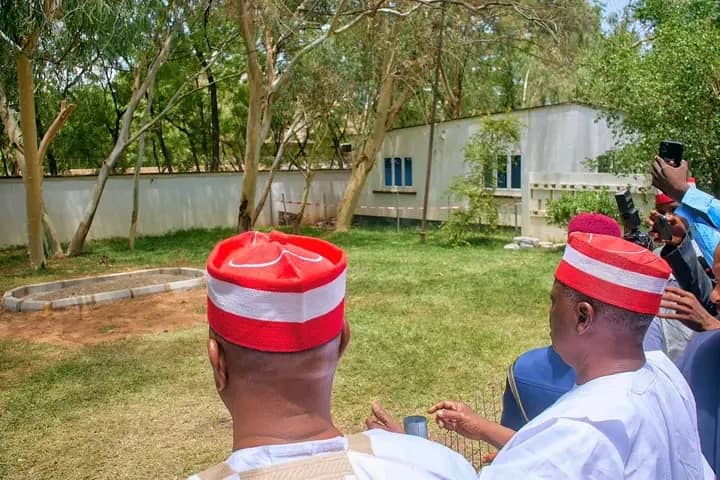
The presidential candidate of the New Nigeria People’s Party and former Kano State Governor, Senator Rabiu Kwankwaso, on Saturday, paid a condolence visit to the family of the late ex-President Muhammadu Buhari in Daura, Katsina State.
Kwankwaso also visited the Emir of Daura, Alhaji Umar Farouk Umar, where he extended his sympathies to the Daura Emirate Council over the death of the former Nigerian leader.
During the visit, Kwankwaso met with Alhaji Mamman Daura, a close confidant and nephew of the late President, to personally express his condolences.
“May the Almighty Allah grant him eternal rest,” Kwankwaso prayed during the visit.
The death of Buhari, who led Nigeria from 2015 to 2023, has drawn an outpouring of grief and tributes from political figures and citizens across the country.
Kwankwaso’s visit is part of a wave of condolence visits to Buhari’s hometown of Daura, as Nigerians continue to mourn the passing of the former military and civilian leader.
The Kano State Fire Service has confirmed the death of four people who drowned in a blocked waterway at Zangon Kaya in Dawakin Tofa Local Government Area of the state.
This is contained in a statement issued by the Public Relations Officer of the State Fire Service, Saminu Abdullahi, on Friday in Kano.
He said the incident occurred on Friday afternoon.
He said, “We received an emergency call at about 13:48 hrs from one Rabiu Yusif that four people had fallen into a waterway blocked that had accumulated due to the railway line construction.
“We immediately sent our rescue team to the scene.
“Two of the victims entered the waterway to swim when they got trapped.”
Abdullahi said that another person entered the blocked drain to rescue them, but also got stuck, while the fourth person went in to help and also got trapped.
He further explained that with the arrival of the rescue team, the residents were able to pull out two of the victims, while the team recovered the other two.
Abdullahi said that the names of the victims were: Bashir Sani, 28, Nasirudden Tasi’u, 25, Usman Ubale, 26 and Yakubu Muhammed, 22.
“All the victims were rescued unconscious and were later confirmed dead.
“Their corpses were handed over to SP Abdulkadir Albasu of Dawanau Police Division,” he said.
Abdullahi said that the cause of the incident was as a ‘result of local swimming in a blocked sewer’.
The Association of Licensed Telecommunications Operators of Nigeria has issued an urgent call for government and security intervention as a wave of vandalism and theft targeting critical infrastructure threatens to disrupt services nationwide.
The Chairman of ALTON, Gbenga Adebayo, said in a statement on Thursday that the surge in attacks on telecommunications facilities could lead to a nationwide network collapse if not urgently addressed.
Between May and July 2025, multiple incidents of vandalism were recorded at telecom cell sites in Rivers, Ogun, Osun, Imo, Kogi, Ekiti, Lagos, and the Federal Capital Territory, Abuja. The targeted attacks, according to operators, have disrupted services, caused prolonged network blackouts, and led to severe congestion, leaving millions of Nigerians without reliable connectivity.
“Since the Federal Government’s decisive interventions earlier this year to support industry sustainability, our members have made unprecedented investments in network optimisation and capacity upgrades.
“We are working tirelessly to improve service quality nationwide, but these acts of sabotage are setting us back”, the telecom executive stated.
According to ALTON, the telecommunications industry is currently undergoing its largest infrastructure expansion in recent years. Operators are modernising transmission equipment, overhauling power systems, and laying thousands of kilometres of fibre-optic cables to extend coverage and boost capacity. However, this progress is being undermined by increasing cases of theft and vandalism.
The association revealed that thieves are targeting essential telecom components, including power cables, rectifiers, fibre optic cables, feeder cables, diesel generators, batteries, and solar panels. These items, ALTON stressed, are not just ordinary materials but represent the backbone of Nigeria’s communications network, security systems, and digital economy.
“The affected infrastructure belongs to our members as well as other network operators who depend on these facilities to keep the country connected.
“When these components are stolen or vandalised, it is not only phone calls and data that are affected. Our banking systems, emergency services, healthcare, education, and national security platforms are all compromised”, operators said.
States with the highest number of reported attacks include Delta, Rivers, Cross River, Akwa Ibom, Ogun, Ondo, Edo, Lagos, Kogi, Kaduna, Niger, Osun, Kwara, and the Federal Capital Territory, Abuja.
ALTON warned of a growing black market for stolen telecom equipment. Batteries from telecom sites are reportedly being sold for home and office inverters. Solar panels stripped from telecom towers are resold to households, while diesel fuel meant for powering telecom base stations is being siphoned off and sold on the grey market.
“We urge the public to remain vigilant and avoid buying suspicious items,” the group noted. “If you purchase stolen telecom equipment, you are not just aiding criminals; you are participating in a national crime.”
Telecom infrastructure in Nigeria has been officially designated as Critical National Infrastructure under Federal Government Gazette No. 133, Volume 108, dated 17th March 2021.
According to ALTON, vandalism, sabotage, or illegal possession of telecom assets constitutes a serious criminal offence with severe legal consequences.
The operators warned that continued sabotage of telecom facilities poses a direct threat to Nigeria’s economic stability and national security, noting that mobile and broadband services support essential sectors such as banking, security, healthcare, and education.
In addition to deliberate acts of vandalism, ALTON cited frequent fibre cuts caused by uncoordinated road construction and civil works across the country. The association said road projects along highways and urban roads often destroy underground fibre optic cables, resulting in massive service outages and financial losses.
ALTON called on the Office of the National Security Adviser, the Inspector General of Police, the Director General of the Department of State Services, and the Commandant General of the Nigeria Security and Civil Defence Corps to immediately deploy security measures to protect telecom infrastructure and prevent a total collapse of communications services.
The association also commended the Nigerian Communications Commission for establishing a dedicated portal where citizens can report vandalism or suspicious activities. Nigerians are encouraged to use the portal by emailing protect@ncc.gov.ng or dialling 622.
“This is a desperate and urgent moment. The industry cannot handle this crisis alone. We need coordinated national action from security agencies, the government at all levels, regulators, the media, civil society, and the public. Our economic stability, national security, and digital future depend on it”, they said.
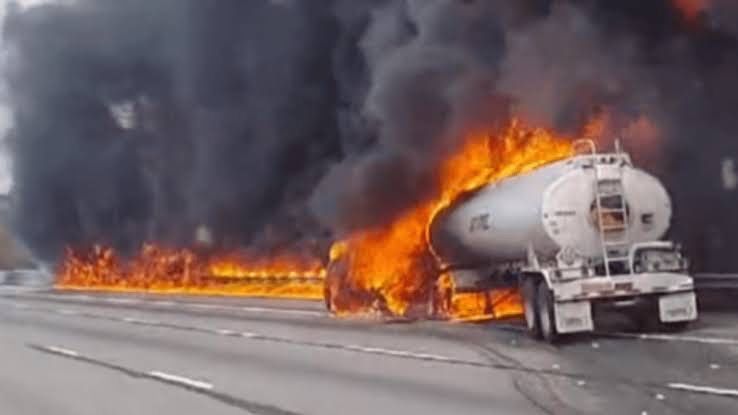
A petroleum tanker carrying 33,000 litres of Premium Motor Spirit, also known as petrol, on Thursday, exploded in Ibadan, the Oyo State capital.
PUNCH Online gathered that the incident occurred at Celica junction, on the new Ife Expressway in Ibadan.
Eyewitnesses explained that the fire incident was as a result of break failure, which made the vehicle lose control.
One of the witnesses said, “The tanker hit a Prado jeep and another car. And in the process, the tanker fell and exploded.
“Although no casualty was recorded, the fire affected the car and the Prado jeep.”
Confirming the incident in a statement in Ibadan, the state capital, the state Fire Service Chairman, Maroof Akinwande, confirmed the development to our correspondent, adding that no casualty was recorded.
He said, “The incident was reported at exactly 18.27hrs on Thursday.
“The firemen swiftly swung into action by applying chemical foam compound and restricted the fire from spreading to the nearby Nigerian National Petroleum Corporation petrol station and surrounding properties. The fire was jointly extinguished with officers from the Federal Fire Service.
“The fire incident was as a result of failure of breaking in system of the truck whist on motion which made the vehicle lose control, hit a Prado jeep and a car, then fell and caught fire.
“No casualty was recorded but the fire affected the trailer tanker and a car, while a Jeep was hit by the trailer into the nearby gutter,” he explained.
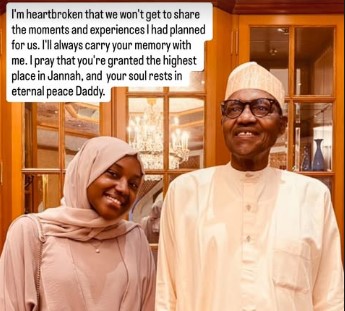
Noor, daughter of former President Muhammadu Buhari, on Tuesday shared an emotional farewell mourning her late father.
The elder statesman passed away on Saturday, July 13, at the age of 82 in a London clinic, prompting an avalanche of tributes from political leaders, religious figures, and ordinary Nigerians who revered his legacy.
Joining the chorus of mourning voices, Noor took to Instagram on Monday, July 14, to express her sorrow in a moving story post that struck a chord with many.
“I’m heartbroken that we won’t get to share the moments and experiences I had planned for us,” she wrote.
“I’ll always carry your memory with me. I pray that you’re granted the highest place in Jannah, and your soul rests in eternal peace, Daddy.”
Her tribute has resonated widely, adding a deeply personal dimension to the public mourning of the late Nigerian leader, whose life was marked by military service, civilian leadership, and a controversial but impactful legacy.
In Bauchi, a three-day prayer session was held by an Islamic school in honour of the late president, a reflection of the reverence he still commands in the northern region and beyond.
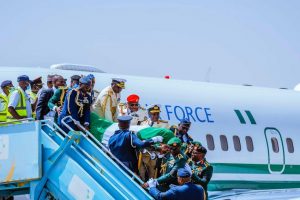
Contrary to the usual practice of placing caskets in an aircraft’s cargo hold, the body of former President Muhammadu Buhari was flown to Nigeria in the main cabin of a Nigerian Air Force jet.
The decision, it was gathered, followed the discovery that the casket could not fit into the aircraft’s cargo compartment.
Rather than resorting to the use of a body bag that would fit into the hold, handlers resolved to transport the casket in the aircraft’s cabin.
To make this possible, the front seats in the cabin were collapsed and tables unfolded to create a bed-like platform where the casket could be securely and respectfully laid.
A source said, “You would have noticed that the remains of the former President were not in the cargo hold, as is the standard procedure, but in the main cabin.
“The corpse was brought in a casket draped with the Nigerian flag. However, it could not fit into the aircraft’s hold, which isn’t designed for such items, and the British airport authorities wouldn’t budge due to safety concerns.
“So, to avoid using a body bag, it took considerable time and persuasion to properly wrap the remains and drape them in the national flag. The front seats were then collapsed and the tables unfolded to create a bed-like space for the remains to be tied down.”
As a mark of honour, a joint team of nine senior military officials served as pallbearers, laying the flag-draped casket on a trolley.
The team, coordinated by Maj Gen Mike Alechenu, included Maj Gen Mohammed Usman, Maj Gen Oluwafemi Williams, Maj Gen Shuaibu Nuhu, Rear Adm Suleiman Dahun, Rear Adm Jonathan Ajodo, Rear Adm Samuel Ngatuwa, Air Vice Marshal Adeniyi Amesinlola, Air Vice Marshal Idi Sanni, and Air Vice Marshal Obinna Obiabaka.
In a slow march synchronised with the hymn, “God Be With You Till We Meet Again,” the pallbearers wheeled the casket through a full military guard of honour comprising six officers and 96 soldiers drawn from the Nigerian Armed Forces.
President Bola Tinubu, Vice President Kashim Shettima, former Vice President Yemi Osinbajo and other dignitaries walked behind the trolley in a solemn procession.
The pallbearers then conveyed the casket into a waiting military hearse for the one-hour trip to Daura, where funeral prayers and interment took place.
The state funeral featured full military honours, including a 21-gun salute.
Earlier, Tinubu, accompanied by Vice President Shettima, received the casket at the foot of the aircraft.
Also present were President Umaro Sissoco Embaló of Guinea-Bissau; Niger Republic’s Prime Minister, Ali Mahaman Lamine Zeine; former Nigerien President Issoufou Mahamadou; and Buhari’s immediate past Vice President, Prof Osinbajo.
Tinubu had arrived at the Umaru Musa Yar’Adua International Airport, Katsina, at 1:42 pm, and inspected a guard of honour before the Nigerian Air Force jet conveying Buhari’s remains landed at exactly 1:51 pm.
A large crowd flooded Daura to pay their last respects, with many youths seen climbing trees for a glimpse of Buhari as he was laid to rest at his residence.
Aare Adetola Emmanuelking Mourns the Passing of the Awujale of Ijebulan
The Group Chairman of Adron Group, Sir Aare Adetola Emmanuelking KOF, has paid glowing tribute to the late Awujale and Paramount Ruler of Ijebuland, His Royal Majesty, Oba Sikiru Kayode Adetona. He described his passing as the end of an era and the ascent of a legend into the realms of the immortals.
In a solemn and emotionally resonant message, he extolled the virtues of the late monarch, whom he described as a towering symbol of identity, unity, and pride for the Ijebu people and the Yoruba nation.
Oba Adetona, who died at the age of 91, reigned for an extraordinary 65 years, making him one of the longest-reigning monarchs in Nigerian history. His reign, according to Aare Adetola Emmanuelking, was not only notable for its longevity but for its profound impact on the cultural, social, and economic transformation of Ijebuland.
“His Royal Majesty reigned not merely by the sceptre, but by the rare power of vision, intellect, and integrity,” Aare Adetola stated. “He embodied royalty in its purest form, not as a relic of the past, but as a living force that shaped the present and laid the foundations of the future.”
Reflecting on the monarch’s legacy, the real estate mogul highlighted Oba Adetona’s role as a custodian of heritage, a voice of wisdom during national turbulence, and a bridge across generations. “He was not just a king, but a colossus, a living oracle whose words stirred minds and moved mountains,” he added.
Aare Adetola Emmanuelking further acknowledged the transformation of Ijebuland under the late monarch’s watch, noting that the ancient kingdom became a beacon of cultural pride, economic vibrancy, and progressive unity. “To be Ijebu was to be proud. To serve Ijebu was to be honourable. To be under his reign was to witness greatness firsthand,” he said.
Aare Adetola Emmanuelking expressed deep condolences to the royal family and the people of Ijebuland, urging them to lift their chins in pride, having been ruled by a legend. “Now, the lion sleeps, but his roar shall echo in eternity”, he added.
He prayed for the peaceful repose of the king’s soul and for his enduring legacy to continue inspiring generations to come.
The passing of HRM Oba Sikiru Kayode Adetona marks the close of a remarkable chapter in Yoruba history, but as Aare Adetola Emmanuelking reminds the world, the light of the monarch’s legacy will forever illuminate the path ahead.
The Enugu State Government has embarked on developing Annual Operational Plans that would be integrated into the state’s 2026 health sector budget.
This initiative is part of the Nigeria Health Sector Renewal Investment Initiative, a comprehensive program aimed at transforming Nigeria’s health system by improving healthcare infrastructure and expanding health insurance coverage.
Speaking at a Four-day training workshop on NHSRII Leadership and Health Systems Strengthening for Managers, which began on Monday in Enugu, the State Commissioner for Health, Emmanuel Obi, said the NHSRII is a sector-wide programme that seeks to bring together every single player in the health sector under one coordinating umbrella to monitor the sector indices across the board.
The training is themed, “Towards Rational, Realistic, Pragmatic and Comprehensive Plan that informs Health Budget for the People of Enugu State”.
According to Obi, “Through the State-Wide Approach (SWAp) reform, the Federal Ministry of Health is trying to bring together every single player in the health sector under one coordinating umbrella to monitor the sector indices across board.”
He explained that the SWAp approach will give the country’s health sector one plan, monitoring and evaluation, and a coordinated network.
“This workshop is the beginning of the step down of a capacity building for master trainers who are involved in the entire health sector of Enugu State towards producing a one-sector annual operational plan that will be integrated into the 2026 health sector budget for Enugu State,” Obi added.
The participants in the training are made up of senior and programme managers, officials of different agencies, and health sector stakeholders in Enugu State.
Obi expects a high level of seriousness from the participants, as they work towards producing a comprehensive plan that will inform the state’s health budget.
Francisca Ewoh, SWAp Desk Officer, Enugu State, explained that the essence of SWAp programme is to ensure coordination and uniformity in the health system in Nigeria.
“What is happening in the health sector, unlike before, is no longer business as usual, whereby the partners come in with their own activities. SWAp wants to ensure that states prioritise activities based on evidence-based,” she said.
The Head of Health Planning, Research and Statistics, Enugu State Ministry of Health, Mrs. Ann Oguejioffor, said the training would streamline the state’s planning process towards the 2026 health sector budget.
“With the SWAp programme, the state is going to have one plan in the sense that what the partners are offering should not duplicate with what the state government is doing,” she added.
The development of Annual Operational Plans is expected to improve the state’s health sector by ensuring that all stakeholders work together towards a common goal.
It was learnt that the plan will also help to avoid fragmentation and duplication in the health system, and ensure that resources are allocated effectively.