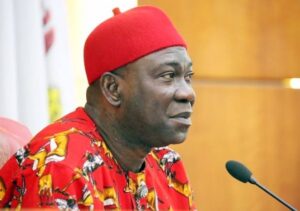
PDP Denies Suspension Of National Chairman Ayu As Party Manages Crisis


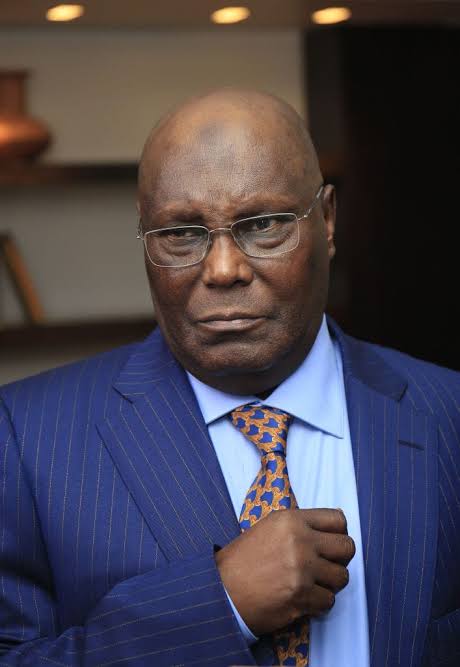
The Peoples Democratic Party, PDP, may be sinking into deeper crisis following revelation that, Iyorchia Ayu, its National Chairman, has been suspended.

But in a quick response, the party in a statement signed by Debo Ologunagba, its spokesman, said it’s “fake news.”

The statement said, “The attention of the National Working Committee (NWC) of the Peoples Democratic Party (PDP) has been drawn to a fictitious report being circulated in a section of the social media suggesting that the National Chairman of our great party, His Excellency Sen Dr lyorchia Ayu, has been suspended by the NWC

“Such report is completely false and a product of the imagination of mischief makers with the intent to destabilize our Party, create an impression of crisis within our ranks and mislead the unsuspecting members of the public.”

It added, “It is clear that the false report is the handiwork of vicious anti-people forces who are agitated by the stability, unity and soaring popularity of our Party under the cohesive Sen Dr. Ayu led National Working Committee as well as the intimidating statures of our Presidential and Vice Presidential Candidates His Excellency, Atiku Abubakar and His Excellency, Sen Dr.Ifeanyi Okowa respectively.”

Clarifying, the statement said, “Our National Chainman Sen Dr lyarchia Ayu is on a short vacation outside of the country and he officially transmitted power to the Deputy National Chairman (North) His Excellency Amb. Umar Iliya Damagum, to perform his duties in Acting Capacity pending his return in line with the provision of the Comititution of the PDP 2017 (amended).

The statement said the Independent National Electoral Commission (INEC) was duly informed on the absence of our National Chairman and that Damagun will be performing the duties of the National Chairman in Acting capacity pending Ayu’s return.

While stating that Ayu remains the National Chairman of the party, it urged all members and supporters to disregard the said report as “fake news.”

The uneasy calm in the party since the conclusion of its presidential primary and the selection of the party’s running mate has given way to open display of hostility as 2023 elections drag closer.

On Wednesday, Benue State Governor, Samuel Ortom, accused the party’s presidential candidate, Atiku Abubakar, of treating Nyesom Wike unfairly, and urged him to personally visit the Rivers State governor to mend fences after bypassing him as running mate despite the party’s selection committee’s recommendation.

Although Atiku had visited Wike after the conclusion of the party’s presidential primary, both men have not met or spoken since the selection of the party’s presidential running mate.

Instead of Wike, Atiku picked Delta State Governor, Ifeanyi Okowa as his running mate.

Meanwhile, former Ekiti State Governor, Ayo Fayose, on Wednesday also hinted that some aggrieved stakeholders of the party may head to court to seek the removal of Atiku as the party’s presidential candidate.

He said the PDP’s constitution provides for rotational presidency just like the Nigerian Constitution.


Alleged Kidnap: Court Places Ameerah On 1 Year Psychiatric Care


One Amira Safiyanu will spend one year in psychiatric care after pleading guilty on Wednesday to posting false information about her kidnap thereby misleading the public and the police.

She admitted to the offence on Wednesday upon her arraignment by the Nigeria police, before the Magistrate court Wuse, Abuja.

After pleading guilty, the Police counsel, James Idachaba, urged the court to give the suspect non-custodial imprisonment, in line with Section 44 of the Administration of Criminal Justice Act.

Idachaba held that a medical report obtained by the police showed she had a mental illness as at the time she shared her fake kidnap story on June 14 through her Twitter page.

The prosecution counsel further prayed the court to put the lady under police supervision for now.

Her lawyer did not oppose the submission of the prosecution.

Subsequently, Magistrate Chukwuemeka Nweke ordered that she should be released conditionally to a probation officer, Deputy Commissioner of Police Hauwa Ibrahim, for 12-month psychiatric care.

Recall that Sufiyanu on June 14 tweeted about her alleged kidnap, and gave live coordinates suggesting the movement of her captors.

She was subsequently found in Lagos by security operatives, and detained by the Federal Capital Territory (FCT) police command for proper investigation.

The police said Sufiyanu while in custody had access to medical examinations.

The ruling of the court, however, further confirms the report by this website that Safiyanu may have misled the public due to her mental challenge.

THE WHISTLER had observed that a month before the false alarm, her tweets suggested that she may have been grappling with her mental health.

This is despite describing herself on her Twitter handle , @Ameera_Sufyan, as a psychotherapist.

Meanwhile, the FCT Police on Wednesday said the outcome of her medical evaluation will be made available to the public.


Fitch Upgrades Fidelity Bank’s issuer default rating from ‘B-’ to ‘B’

Fitch Upgrades Fidelity Bank’s issuer default rating from ‘B-’ to ‘B’

Fitch Ratings has upgraded Fidelity Bank Plc’s long-term issuer default rating (IDR) from ‘B-’ to ‘B’, reflecting the bank’s increased creditworthiness. The rating agency also upgraded Fidelity’s National Long-Term Rating to ‘A(nga)’ from ‘BBB+(nga)’.

According to the global rating agency, the upgrade is a result of the Bank’s improving business profile and resilient financial metrics. The agency added that the improved rating reflected the bank’s increased creditworthiness relative to other issuers in Nigeria, emphasizing that, “Fidelity’s Long- and Short-Term IDRs are driven by its standalone creditworthiness, as expressed by its Viability Rating (VR) of ‘b’ ’’.

The agency further stated that the VR reflects healthy asset quality, good business profile and reasonable capitalisation and liquidity. These are balanced against high sensitivity to Nigeria’s challenging operating environment as well as higher credit concentration as a percentage of equity and weaker profitability than larger domestic-rated peers.

Commenting on the upgraded rating, Nneka Onyeali-Ikpe, Managing Director/CEO, Fidelity Bank Plc, stated, “Receiving this upgrade at a time when the global economy is faced with a myriad of challenges, speaks to the strength of our business model, the efficacy of our risk management culture and the commitment of our staff towards creating sustainable value for all stakeholders.  As a bank, we will continue to execute our growth strategy in a prudent manner that allows us to take advantage of emerging opportunities in our various markets”.

Fidelity Bank is a full-fledged commercial bank operating in Nigeria with over 6.5 million customers serviced across its 250 business offices and digital banking channels. The bank was recently recognized as the Best SME Bank Nigeria 2022 by the Global Banking & Finance Awards. The bank has also won awards for the “Fastest Growing Bank” and “MSME & Entrepreneurship Financing Bank of the Year” at the 2021 BusinessDay Banks and Other Financial Institutions (BAFI) Awards.

Micro businesses overcoming the challenges of doing business in rural areas

Micro businesses overcoming the challenges of doing business in rural areas

Contrary to the erroneous belief in some quarters that doing business in rural areas is immune from the common challenges that businesses generally face, reality is that micro business owners in underserved areas also have peculiar challenges they go through.
Some of these challenges include difficulty in accessing goods on time. Dearth of infrastructure such as good road network, long distance to the market and lack of adequate transportation system to move purchased goods are among the factors that constitute access barriers to goods and commodities.
As a result, many micro business owners spend longer time or wait for days and weeks to receive inventory or restock, while oftentimes they experience supply shortages. The delay or disruption in supply also affects the end-users/consumers, who are unable to purchase things they need as at when due.
Painfully, micro retailers lose sales, and ultimately money whenever they have stocks-out due to inefficient supply cycles.
However, the increasing impact of digital technology that is rapidly transforming every segment of our socio-economic ecosystem is also changing the narrative positively for businesses including retail trade.
The digitalisation of the economy, which is enabling e-commerce platforms in the B2C segment and lately the B2B segment, has had and continues to have great impact on the manufacturing, distribution and retail value chains.
With B2B e-commerce, tech-driven digital solutions including warehousing and logistics infrastructure and fulfilment solutions are making micro businesses more efficient and better organised in their day-to-day operations, especially those in the underserved remote or rural areas.
So, unlike the past years when micro business owners in underserved areas faced supply hurdles, most of them today can testify of better and faster access to goods and commodities due to B2B e-commerce revolution.
This positive development is not without the efforts of B2B e-commerce platforms like Alerzo whose strong presence in rural areas and commitment to the underserved micro businesses is boosting access to extensive catalogue of products and logistics.
Through SMS, WhatsApp, phone calls or log-in onto its site where applicable, customers now easily place orders and get the goods delivered swiftly without being charged for delivery.
Alerzo’s CEO, Adewale Opaleye stated, “Our strong presence in the South-West, and continued expansion to the North-West and Central consolidate our desire to grow in a sustainable manner and continue to serve those that are underserved.
“On our Alerzoshop retail app, we have a vast assortment available to our customers to choose from, and we offer free delivery in all the over 13 cities we’re currently operational. We change the landscape for them (retailers) through on time delivery.’’
Opaleye added that, ‘‘For the past two years, we have delivered to informal retailers at no cost. With our delivery services, retailers save time, energy, and resources that they would have otherwise expended in restocking. These benefits have resulted in 85% of our retailers reducing their two to four times a week restock trips to zero.”
As digital technology makes deeper impressions on more people, it is also anticipated that the rural communities would also open up. Hence, there is a bigger role e-commerce platforms will play in reaching the underserved in light of government’s focus on leveraging micro, small and medium enterprises (MSMEs) and digital economy as critical enablers of national economic growth.
As the engine of national economic growth, the MSMEs segment is reported to contribute 50 per cent to the Nigeria’s GDP and make up 80 per cent of the country’s total employment, while the informal retail segment is worth $100 billion. E-commerce platforms, in particular the B2B segment would ultimately be needed to bridge the potential supply-demand gap that could arise.

Senate In Closed-Door Session Over Ekweremadu, Despatches Delegation To UK


The Nigerian Senate on Wednesday went into a closed-door session over the organ harvest controversy involving the erstwhile deputy senate president, Ike Ekweremadu.

While the Federal Government has defended the issuance of visa and other required documents to the alleged victim, David Ukpo, the Senate has moved a stepped further to identify with one of its own.

Ekweremadu, who is serving a fourth time in the Senate, was incarcerated in the UK last week on allegation of trying to illegally obtained body organ from David, who has been deemed to be underaged.

Announcing the decision of the Senate after emerging from the closed-door session, President of the Senate, Ahmad Lawan, disclosed that the delegation comprised of members of the Senate Committee on Foreign Affairs.

The delegation, according to him, will leave for London on Friday.

He mandated the committee to engage the British High Commission in Nigeria to get more details on the case before jetting out.

Lawan revealed that the Nigerian Minister of Foreign Affairs, Geoffrey Onyeama, has been engaged for necessary diplomatic support to Ekweremadu and his wife, Beatrice.

He however said not much could be discussed on the matter as it was already in court, assuring Ekweremadu’s family and Nigerians that the Senate will continue to engage the Foreign ministry and Nigerian High Commission in London on the case.

While urging all relevant government institutions, including the foreign ministry, to continue to provide the required support to the former Deputy Senate President and his wife, he promised that there will be justice and fairness in the end.

Ekweremadu and his wife have been remanded till July 7, their next day to appear in court while David has been placed in protective custody.


Fidelity Partners ImpactHER to Empower 1,052 Female Entrepreneurs with Sales Skills

Fidelity Partners ImpactHER to Empower 1,052 Female Entrepreneurs with Sales Skills

Fidelity Bank, a leading financial institution in Nigeria, has collaborated with ImpactHER to support 1,052 female entrepreneurs across the 36 states of Nigeria in addressing the challenges they face in their small and medium-sized businesses.  Through diverse training on digital skills and direct business support, beneficiaries from two cohorts have been able to improve visibility for their businesses and consequently, increase sales.

The training, which commenced in January 2022, has had two cohorts that lasted for four weeks each, covering a myriad of topics such as Digital  marketing, building your brand and selling online, etc. The participants were also assisted in putting their businesses on Google Maps, thus allowing customers and the global market to easily find and transact business with them.

Commenting on the partnership, Osita Ede, Divisional Head, Product Development at Fidelity Bank Plc said, “It has become  imperative that female entrepreneurs in Africa are empowered to  overcome the lack of digital literacy which impedes them from fully  reaping the benefits of the digital transformation underway across  Africa, and the world. We believe providing them this access will help them to thrive in their different businesses.”

According to Efe Ukala, Founder of ImpactHER, “Statistically, women  and girls are 25 per cent less likely to leverage digital technology for  basic purposes, 4 times less likely to know how to programme  computers and 13 times less likely to file for technology patents. This  therefore highlights the importance of equipping African women with  digital skills that could be leveraged to scale their businesses. Let’s not  forget that data shows that Africa can add 180 billion Dollars to its  GDP by 2025 if we close the e-commerce digital gap.”

This intervention is critical as the Global Entrepreneurship Monitor for  2019/2020 highlighted that millions of women worldwide have started businesses over the last five years alone: the highest percentage of  these women live in Africa, with approximately 26% of female adults  engaged in entrepreneurial activity yet the World Bank confirms  through data collected in ten African countries that on average,  male-owned companies have six times more capital than female owned enterprises, resulting in monthly profits of female-owned  enterprises that are, on average, 38% lower than male-owned  businesses.

Fidelity Bank is a full-fledged commercial bank operating in Nigeria with over 6.5 million customers serviced across its 250 business offices and digital banking channels. The bank was recently recognized as the Best SME Bank Nigeria 2022 by the Global Banking & Finance Awards. The bank has also won awards for the “Fastest Growing Bank” and “MSME & Entrepreneurship Financing Bank of the Year” at the 2021 BusinessDay Banks and Other Financial Institutions (BAFI) Awards.

The bank boasts of a robust bouquet of products designed to help female-led small businesses run successfully including digital loans and HerFidelity -a proposition comprising exciting features such as capacity development initiatives, access to finance, recognition and networking events, health and wellness programmes, etc, all designed to speak to the yearnings of women.

Clementina Uzogor, the Programs Director at ImpactHER, highlighted  the importance of helping women with skills like this to take their  businesses to the next level. “At ImpactHER, it is our mission to ensure  that we equip these women with tools for their businesses to thrive”,  she explained.

She also appreciated Fidelity Bank for working with them to ensure the  programme was successful and impactful. “It is important to let you  know that this is not the end of this training. We will be deepening our  partnership with Fidelity to train and support 5,000 more women-led  small and medium sized businesses in the country before the year runs  out”, she divulged.

An excited participant from the second cohort, Ms Akinyemi  Oluronke, a fashion designer from Lagos underscored the benefits of  joining the training for her business, “I’ve been able to build an online  presence, people now know my business exists and I get a lot of calls  from people who found my business online. I am very grateful for this  platform and the overall increase in sales I now enjoy.”

According to Carine Nneka Achokwu, another participant from the  January 2022 cohort and CEO of Carine Bakery, a company that  produces pastries and cakes in Lagos, Nigeria, “I have been able to  increase sales by 40% after using the tools that was provided to me  such as “Google My Business” and people have been calling to order  from me and I’ve also been able to reach more customers. I am  thankful that I can get people to patronize my business just by tapping  my phone based on the knowledge I acquired at this training.”

ImpactHER is an impact-driven nonprofit organization that empowers  African female entrepreneurs by bridging the gender business  financing gap so as to assist them in realizing their full economic  potential. ImpactHER has since its inception trained, directly supported with investor-readiness and  business scalability skills & tools to over 44, 275 women across 53 countries in Africa.

This partnership also provides follow-up training and support for the  participants and is one of the ways ImpactHER and Fidelity Bank help  these women scale up their offerings.

Sterling Bank, NHEA recognize Nigeria’s Healthcare Champions 

Sterling Bank, NHEA recognize Nigeria’s Healthcare Champions 

L-R : Head, Health Sector Finance, Sterling Bank Plc, Adewale Adebowale; Project Director, Nigerian Healthcare Excellence Awards 2022, Dr. Wale Alabi and Group Head, Health Finance, Sterling Bank Plc, Ibironke Akinmade at the 8th Annual Nigerian Healthcare Excellence Awards in Lagos over the weekend.

Sterling Bank Plc, Nigeria’s leading commercial bank, has given special recognition awards to healthcare providers who played leading roles in the fight against the COVID-19 pandemic.

The awards were given to selected recipients at the 8th annual Nigeria Healthcare Excellence Awards (NHEA), which held in Lagos over the weekend under the theme of: Innovative Healthcare Services in the Era of Change.
NHEA is an initiative of Global Health Projects and Resources in collaboration with Anadach Group of the United States of America. It is a yearly event where individuals and organisations are recognized and celebrated for their exceptional contributions to the healthcare sector.
Special recognition awards were given to Medbury Medical Services as the Most Responsive COVID-19 Testing Company of the Year and Seven-UP Bottling Company Plc as the Most Outstanding COVID-19 Consumables Manufacturer of the Year. Other recipients were African Centre of Excellence for Genomics of Infectious Diseases (ACEGID), Redeemers University in Ede, Osun State as the Most Outstanding Genomic Laboratory of the Year and Nassarawa State as the Most Outstanding State for COVID-19 Vaccination.
Speaking on the awards, Group Head, Health Finance with Sterling Bank, Ibironke Akinmade said the bank recognized and honored the champions of COVID-19 pandemic because of the excellent services they rendered while the pandemic was raging in a bid to spur them to do more.
She said, “Sterling Bank is committed to improving access to healthcare for every Nigerian and our flagship offering – digitisation of State Health Insurance Platform – prefers 360-degree solution to help states bring healthcare to every citizen as well as provide wealth of data to inform policies, planning and strategy, at no initial investment.”
Also speaking, the Minister of Health, Professor Ehanire Osagie, commended the organizers of the awards which held post the different variants of the COVID-19 pandemic and the restoration of the economy to normalcy again.
The minister who was represented by Managing Director of the Federal Medical Centre, Yaba, Lagos, Dr. Adedamola Dada, remarked that the purpose of recognizing and rewarding healthcare professionals that contributed to efficient and quality healthcare services is to foster excellence and sustain the quality.“Good healthcare delivery is a key objective of this present administration,” Professor Osagie said.
Chairman of the Advisory Board of NHEA, Dr. Anthony Omolola said, “Over the years, NHEA has continued to strive to deliver new and creative ways to honor excellence across the healthcare space. This year’s is not different at all. At these awards, we are paying attention to those who pioneered innovative healthcare services in the era of change.”
Sterling Bank’s Divisional Head, Business Growth and Transaction Banking, Mr. Obinna Ukachukwu, had observed that the bank recognized the role that NHEA is playing in the health sector by rewarding excellence and promoting positive outcomes in the sector.
He noted that Sterling Bank, a leading player in the financing of the health sector, decided to come on board to further support excellence and growth of the sector.
NHEA Executive Secretary, Vivian Alkali, expressed the confidence that with Sterling Bank’s partnership and support, subsequent editions of NHEA will meet with greater success.
The NHEA initiative, through its eminent team’s research and innovation, has continued to encourage improvements and focus on the quality and standard of service provided by various stakeholders in the industry.

Sekibo, Obi, others harp on security, leadership for economic prosperity

Sekibo, Obi, others harp on security, leadership for economic prosperity

L-R: Prof. Oyelowo Oyewo; Coordinator of the Nigerian Association of Constitutional Law (NACL); Dr. Oruene Finebone – Secretary, Mediacal Women Association of Nigeria, Rivers State Branch; Barrister Sotonye Inyeinengi-Etomi, President of the Men’s League of Christ Church Port Harcourt; Very Rev. (Dr), Ivan Ekong, Asst. Resident Minister, Christ Church Port Harcourt; Figbene Briggs, Regional Head, South South 1 & 2 Zone; Dr. (Amb.) Victoria Ekhomu, Group MD/CEO of Trans-World Security Systems Ltd.; Very Rev. Jonathan Udofia; Pastor Ituah Ighodalo, Trinity House, International Christian Worship Center; Elder (Engr.) Stanford Tassie and Alabo (Arc) Duboye Donald Graham-Douglas, during the 2nd Edition 2022 Forum, one-day International Colloquium organized by The Men’s League of Christ Church Port Harcourt, tagged, “What do Nigerians Want?”, held in Port Harcourt.

The MD/CEO of Heritage Bank Plc, Ifie Sekibo and other notable Nigerians have affirmed that the apt way to boost economic prosperity and peace in the country is to start addressing leadership challenges and insecurity.

Sekibo and other notable Nigerians like the Presidential aspirant of Labour Party, Peter Obi, Pastor Ituah Ighodalo, Prof. Oyelowo Oyewo, Dr. Victoria Ekhomu and Barrister Sotonye Inyeinengi-Etomi, during the 2nd Edition 2022 Forum, one-day International

Colloquium organized by The Men’s League of Christ Church Port Harcourt, tagged, “What do Nigerians Want?”, extensively brainstormed on the kind of leadership the country needs and how to rescue the country from its current debacle.

Speaking on the topic, “The Economy Nigeria Needs to Break Forth,” Sekibo stressed that of important to achieving the transformation the country needs, there was urgent need to address insecurity, which according to him, is the foundation of prosperity, as no nation can achieve much where the is no peace.

Sekibo, represented by the Divisional Head, Strategy & Business Solutions, Segun Akanji emphasized that for security purposes, there must be an established functional and value adding identity system in place.

“On a higher note, I think one of the things that we need to achieve as a country is the issue of functional and value adding identity management, which is still far away from us, although, some people know that we have BVN, NIMC and a few other identity capture systems but they have not been as functional and value adding, like the social security number that most people in advanced economies carry,” he stated.

Sekibo further explained that to achieve a prosperous economy, Nigeria needs to find ways and means by policies to build dual circulation economy which thrives on three pillars.

According to him, we need to focus on building dual circulation economy where we can expand domestic production and demand by making sure that the masses are employed.

“We need to make our people are productive and stop putting subsidy in unproductive zones. When you give subsidy to people with inadequate or no income, they really cannot add value to the economy, and money has a way of flowing away due to import of consumables from other countries and because of this, a larger portion of every consumption or cash given as subsidy gets out of the country,” said Sekibo.

The bank’s helmsman further explained that to expand the domestic production, government must give the private sector support to drive employment creation, technology, which is riding on innovation and manufacturing must be in place and, the population which is an added advantage must be well educated.

He highlighted the need to examine how the country could add value to primary production for global export, emphasizing on reduction of over dependence on foreign markets but rather increase local production for export, whilst also increasing demand on local products.

Sekibo further affirmed that if states could function as proper federating units and take the lead of the competitive comparative advantages therein, wealth creation would be achieved that would bring about the desired changes.

The former governor of Anambra state and presidential aspirant, Peter Obi lamented the huge indebtedness of the country, which he blamed on unproductivity due to the inimical situation of high unemployment rate resulting to over 80million Nigerians being jobless.

He blamed the cumulative failure of government over the years on insecurity, failure to migrate from sharing formula to production formula and lack of will to transform the power sector and the need to focus and support the micro, small and medium enterprises (MSMEs).

In his paper titled, “The President Nigeria Needs”, Pastor Ighodalo harped on the need for leadership change.

He argued that what the country needs now are leaders who have vision and are ready to sacrifice for the common man, stating, “things must be done differently”.

Ighodalo believed leadership remains the bane of Nigeria’s transformation, stressing that once we get good leadership other things will fall in place.

Prof. Oyewo while speaking on the topic “Restructuring and True Federalism” was of the view that some responsibilities need to be decentralized like the police, power provision and railway.

Once there is decentralization, he believes that the state will have less dependence on the centre, “rebalancing of the constitution in terms of power and security. So, there is reason for state police.”

Oyewo maintained that regions are closer to the people, thus it will boost security, the economy and sense of belonging by the populace.

He also identified data and planning as key factors in ensuring that programmes are tailored towards the people.

Fitch Reaffirms Ecobank Nigeria’s Stable Outlook

Fitch Reaffirms Ecobank Nigeria’s Stable Outlook

Fitch Ratings has affirmed Ecobank Nigeria Limited’s (ENG) Long-Term Issuer Default Rating (IDR) at ‘B-‘ with a Stable Outlook. Fitch also affirmed the Bank’s Viability Rating (VR) at ‘b-‘ and National Long-Term Rating at ‘BBB (nga)’. The rating agency released this rating last week, stating that the Bank’s IDRs are driven by its standalone creditworthiness, as expressed by its Viability Rating.  Fitch had in January also rated Ecobank Nigeria Limited’s (ENG) Long-Term Issuer Default Rating (IDR) at ‘B-‘ with a Stable Outlook.

According to the report, though “ENG has a moderate market share of Nigeria’s banking sector assets (3.9% at end of 2021), its franchise gets an edge and benefits from being a subsidiary of Ecobank Transnational Incorporated (ETI; B-/Stable), a large pan-African banking group with operations spanning 33 countries across Sub-Saharan Africa (SSA)”.

The report stated “rising global risks will weaken domestic operating conditions as any downside to operating conditions, “Inflation (17.7% in May 2022) is expected to remain stubbornly high, posing downside risks to real GDP growth forecasts of 3.1% and 3.3% in 2022 and 2023, respectively. However, downside risks are somewhat mitigated by strong oil prices, which should also underpin growth in non-oil sectors and banks’ asset quality”. It stated.

It reiterated that the Viability Rating of Ecobank Nigeria reflects its standalone creditworthiness despite the concentration of its operations within Nigeria’s challenging operating environment, high credit concentrations, asset-quality weaknesses, modest profitability, and weak capitalisation in the context of these risks. It also reflects a sizeable franchise and a healthy funding and liquidity profile.

“Ecobank Nigeria ENG has a Shareholder Support Rating (SSR) of ‘ccc+’. Fitch sees a high propensity in ETI to provide support given ENG’s importance to the parent’s pan-African strategy as its largest subsidiary (22% of group assets at end of 2021) and its presence in SSA’s largest economy.  Fitch observed that rising global risks will weaken domestic operating conditions. Inflation (17.7% in May 2022) is expected to remain stubbornly high, posing downside risks to real GDP growth forecasts of 3.1% and 3.3% in 2022 and 2023, respectively. However, downside risks are somewhat mitigated by strong oil prices, which should also underpin growth in non-oil sectors and banks’ asset quality”. it stated.

Technology firms provide more opportunities for micro businesses in rural areas

Technology firms provide more opportunities for micro businesses in rural areas

B2B e-commerce platforms continue to provide increased access to products, for micro businesses in underserved areas as they expand their  e-commerce services, reaching the retail market end in the underserved rural communities across Nigeria.
Alerzo’s Founder/Chief Executive Officer, Adewale Opaleye, said the B2B e-commerce firm was revving up its market presence with an ambitious expansion drive to bring the benefits of digital solutions closer to Nigerians irrespective of their locations, especially micro businesses operating in the underserved rural communities.
“Our strong presence in the South-West and continued expansion to the North-West and Central consolidate our desire to grow in a sustainable manner and continue to serve those that are underserved,’’ he said.
Speaking against the backdrop of the impact of e-commerce on the national economy, Opaleye stated that e-commerce players in the country were offering digital solutions that enabled informal retailers to access a vast assortment of goods and commodities with ease and faster, thereby saving them lot of time, energy and resources, and ultimately bring down their operating cost.
“On our Alerzoshop retail app, we have a vast assortment available to our customers to choose from, and we offer free delivery in all the over 13 cities we’re currently operating in. We change the landscape for the retailers through our one delivery at a time model,’’ he stated.
Opaleye added that, ‘‘for the past two years, we have delivered to informal retailers at no cost. With our delivery services, retailers save time, energy, and resources that they would have otherwise expended in restocking. These benefits have resulted in 85 per cent of our retailers reducing their two to four times a week restock trips to zero.”
He noted that Alerzo was committed to alleviating the peculiar challenges which micro business owners in underserved areas go through. According to him, some of the challenges include difficulty in accessing goods on time occasioned by dearth of infrastructure such as good road network, long distance to the market and lack of adequate transportation system to move purchased goods to the stores.

There is need for more intervention of e-commerce platforms to reach the underserved, and to further boost the national gross domestic product (GDP) of which the informal retailers are critical. The informal retail segment makes up the micro, small and medium enterprises (MSMEs) bloc which serves as the engine of economic growth contributing 50 per cent to the GDP and 80 per cent of the country’s total employment.

B2B e-commerce platforms have significantly impacted the manufacturing, distribution and retail value chains by supporting them with tech-driven digital solutions including warehousing and logistics infrastructure, and fulfilment solutions. B2B e-commerce platforms like Alerzo have their presence in rural areas and are reaching the underserved with access to extensive catalogue of products and logistics. Through texts, phone calls and logging on to the site where applicable, customers now easily place orders and get the goods delivered swiftly without being charged for delivery. So, unlike the deprivation of past years which micro business owners in underserved areas faced, most of them today can boast of better and faster access to goods and commodities.

Exit mobile version