IAJ has been equipping thousands of journalists across the continent of Africa! In a very recent development – IAJ is set again to increase its milage in the world’s most populous black country – NIGERIA.
Demonstrated through series of social media messages and pictures released by Adeniyi IFETAYO – the Publisher of Megastar Magazine; Senior Correspondent at BEN TV London, IAJ is consummating an ‘International Journalist Training Partnership and Professional Collaboration’ via an ‘MOU’ with Nigeria’s award-winning celebrity journalist – Adeniyi Ifetayo Moses.
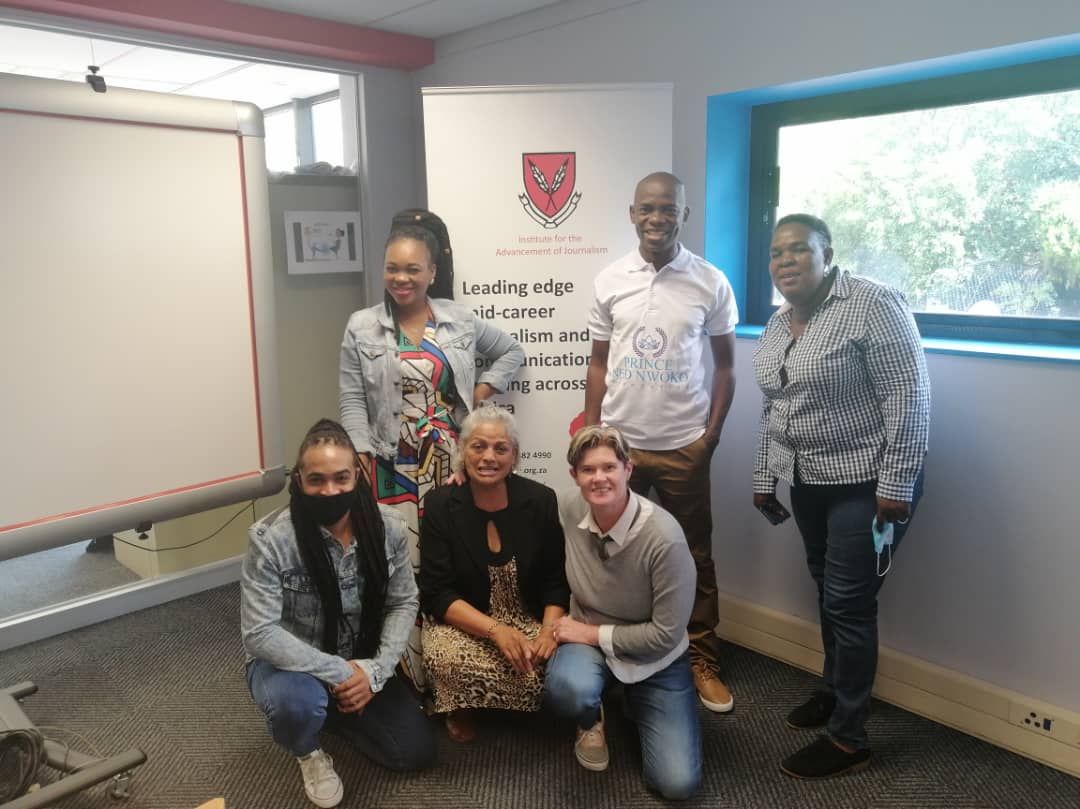
Handing over the Memorandum of Understanding (MOU), the Project Coordinator – Dimakatso Mathe expressed deep belief that Africa is indeed set for another journalism boost through this fete with the 28year old institution – ‘IAJ’!
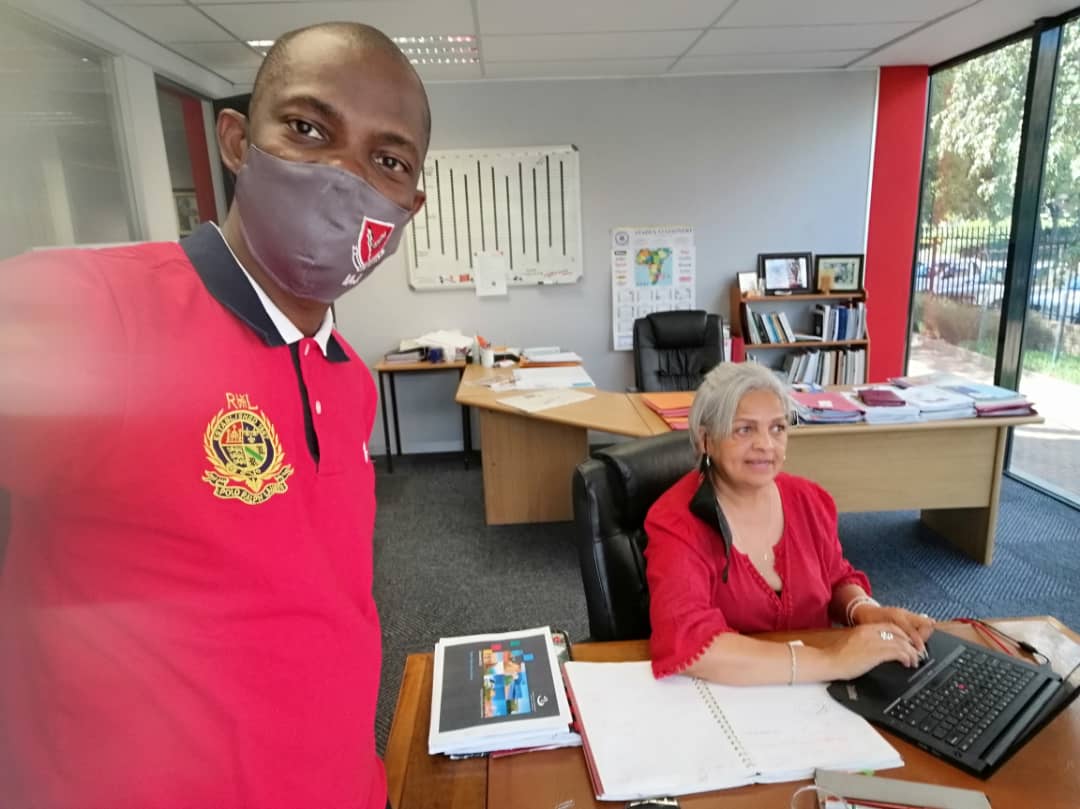
Recently at the institute’s headquarters in Johannesburg, South Africa –
Niyi (as he’s fondly called by his numerous clients and admirers) was commissioned to promote the institution in Nigeria and coordinate the activities of other journalists, writers and communications experts who will like to sharpen their skills in journalism by exploring new strategies in Media, Publications and Journalism at the Institute for Advancement of Journalism in South Africa.
According to the 1st Secretary – Political of the South African Embassy Abuja – Boipelo Lefatshe, aside other undisclosed commitments of the collaboration – the bilateral relationship between the two biggest economies in Africa would definitely culminate into a unique professional integration of the two nations so soon. Through ‘SMS’ – Lefotshe said – ‘the MOU is a great news which will entrench deeper cooperation in the educational sectors of the two countries respectively. She also affirm that ‘both the beneficiaries and benefactors of this journalistic initiative would definitely be better for it very soon’
Stakeholders in faith-based organisations and education sector have endorsed the two new products recently introduced into the financial market by Ecobank Nigeria, saying they can provide solutions to their needs. The products Ecobank Stewardship Pack and the Ecobank School Bundle are targeted at religious and educational institutions at all levels respectively. The Ecobank School bundle is designed to help educational institutions manage their banking needs more effectively so they can concentrate on providing world-class education. It comprised a bouquet of digital offerings that includes Omniplus/Omnilite, Collegepay, Ecobankpay, Web collections Paydirect, Point of Sale Terminals (POS), NIBBS platforms, EBILLS PAY, Asset Finance and Ecobank School Loan. The Ecobank Stewardship Account on the other hand is designed to help religious organizations run their daily operations smoothly and earn interest at the same time. Also referred to as The Good Steward Pack, its features include: zero monthly maintenance charge and interest rate payable on average monthly balance amongst others.
Speaking at the virtual launch, Prof. Humphrey Adebayo, Vice Chancellor, Covenant University, Ota, commended Ecobank Nigeria for taking the initiative to create the innovative products, stressing that they would add value to the operations of the various target groups. He lauded Ecobank for rising to the challenges of covid 19 pandemic by providing services to the banking public through its various digital offerings, stating that the new products would further free time for them to focus on core roles.
According to him, “The pandemic has disrupted human activities, and changed the perspective of the world thereby increasing the need for more digital and innovative solutions to the problems it created, which will further facilitate the ease of doing of business. Education and religious institutions were highly affected by the lock down, creating a gap in the system. Digital solutions become extremely important for online learning and services with digital financial solutions being helpful with collection. This has helped in freeing these institutions to focus on their core activities. The digital platform provided by Ecobank is efficient and guarantees a high level of security and allow for real time banking services and with minimal downtime. The new Ecobank products will undoubtedly add value to these institutions.”
Alhaji Mohammed Balarabe, a seasoned Banker and chief launcher at the event said the target group would find them useful as they embark on their conventional activities. According to him, “The new normal presents a lot of challenges in almost all aspects of our life in particular, the faith-based organizations and educational institutions because of their conventional way of carrying out activities. In a bid to address these challenges, Ecobank introduced these targeted products that will help tackle them. I believe more will come our way from the Ecobank platform.”
At the launch which doubled as Ecobank Public Sector Stakeholder Engagement Webinar titled “Digital enablementof education and faith: Winning tools for new normal lifestyle”, the products also received endorsement from Mrs. Olabimpe Aderiye, Hon. Commissioner of Education, Ekiti State, Chief ‘Yomi Otubela, National President, National Association of Proprietors of Private Schools (NAPPS) and host of others.
Carol Oyedeji, Executive Director, Commercial Banking, Ecobank Nigeria while welcoming guests at the virtual launch was optimistic that the products can effectively assist educational institutions and faith-based organizations through tailor made digital offerings against the backdrop of the new normal lifestyle occasioned by the covid 19 pandemic. She added that “At Ecobank, we are using digital technology to assist businesses for payments and collections, financially include many millions into formal financial systems, and therefore improve lives across Africa. We are indeed making banking easier, more accessible and more affordable across the continent than ever before.”
Moji Oguntoyinbo, Segment Head, Public Sector and Agribusiness, Ecobank Nigeria, said “Ecobank products are designed to bridge the gap and meet funding and other financial needs quickly and efficiently. Education and religion are interwoven right from the onset. Religion institutions have been huge investors in Education. These products are designed to provide secured savings and collection channels especially in the post covid 19 era where digitization is highly helpful to limit the spread of the virus.”.
First Bank of Nigeria Limited is supporting schools with an array of educational based products and solutions targeted at enabling the acquisition of various facilities to boost the continuous expansion and improvement of the educational sector. Parents are not left out, as the Bank has bespoke products which empowers parents and guardians to meet the educational needs of their children.
The Bank’s educational products and solutions include the FirstEdu Loan, Operational Vehicle Loan, Term Loans for constructing new sites and extension of existing sites, Personal Loan Against Salary (PLAS) and FirstAdvance which enhances Parents/Guardians’ capacity to pay their wards’ school fees.
The FirstEdu loan offers short-term finance to private pre-primary, primary and secondary schools/ registered A level educational institutions with steady flow of income. The product offers opportunity for private schools to access flexible funding to meet urgent cash flow needs, replace old furniture and equipment or assets, purchase of fairly-used school buses, as well as refurbishing dilapidated buildings and classroom blocks. This product helps school owners/proprietors in bridging the “no-income” gap between school terms, and to enhance diverse assets acquisition. It allows schools access up to N20 million with no tangible collateral required apart from the domiciliation of school fees with the Bank. Schools with CAC registration that are yet to get Ministry of Education approval can access up to N2million without collateral for up to 90days. In a bid to cushion the effect of covid-19 pandemic, the Bank is in partnership with Lagos State Employment Trust Fund (LSETF) to finance low-cost private schools at a single digit interest rate where schools can access up to N5million.
The Bank is also in partnership with the apex association of private school owners in Nigeria, National Association of Proprietors of Private Schools (NAPPS) to finance member schools at a highly competitive rate. This reduces the cost of borrowing to the customer and eliminates the challenges posed by the provision of additional demanding collaterals.
The Operational Vehicle Loan is targeted at registered businesses. It allows the entrepreneur to acquire brand new vehicles for the day to day operation of the business. Organisations can take advantage of this facility to purchase school buses in the case of school proprietors and even upscale their staff welfare schemes through provision of staff buses. The product terms and conditions is competitive.
Personal Loan against Salary (PLAS) offers customers in paid employment access to cash to meet immediate financial needs such as payment of school fees, medical treatment, holiday expenses, etc. PLAS has a flexible repayment plan spread up to 48 months for our customers’ convenience. There is no equity contribution or collateral requirement.
FirstAdvance is a 30days tenured digital loan also available to salary customers who are in need of assistance to meet immediate financial needs. It empowers customers to access upto 50% of their net monthly salary in less than a minute at any desired time by dialing *894*11# or through our FirstMobile App. Only a salary account domiciled with FirstBank will qualify you for PLAS and FirstAdvance.
Beyond these, FirstBank is at the forefront of promoting virtual learning, whilst exposing not just school children but individuals of all ages to various e-learning initiatives, designed to promote innovation and skills development on emerging technologies through focus areas such as Artificial Intelligence, Coding, Cloud, Internet of Things, Blockchain, Data Science and Analytics, and Cybersecurity.
In achieving this, the Bank has collaborated with Lagos State government, IBM and Curious Learning to ensure the e-learning initiative swiftly moves across the country to school children and individuals with the need to promote the pursuit of knowledge, irrespective of age.
Speaking on the Bank’s support for schools, Mr. Chuma Ezirim, FirstBank’s Group Executive, e-Business & Retail Products, said “at FirstBank, we recognize the indelible roles the educational sector plays in promoting national economic development and we are delighted to support schools with collateral free educational solutions to meet various needs and projects to advance to the next level.”
“As schools proceed with the new term, we enjoin interested schools to visit the nearest branch or the Bank’s website for more information and encourage everyone to access our e-learning driven initiatives to keep learning and get exposed to various opportunities to stay ahead in today’s technologically advanced world.”
The UBA Foundation, the CSR arm of the United Bank for Africa, today, held its tenth annual National Essay Competition(NEC) in a virtual ceremony that was attended by high school students from across the nation. The UBA Foundation’s Education initiative has been changing lives for a decade as the tertiary education scholarship programme continues to impact the lives of many students and their communities.
For the fourth consecutive year, the females have been leading this competition with14 year-old Eshiet Abasiekeme of Bright Stars Model Secondary School from Akwa-Ibom state taking home this year’s winning prize. Eshiet received an educational grant of N2,500,000.00 to study in any African university of her choice. She will also be supported throughout her educational career and beyond with constant mentoring by the UBA Foundation.
Abasiekeme who had joined the virtual event from her base in Akwa Ibom state in Nigeria, could not contain her excitement as she heard the announcement that she had won the first prize of the NEC 2020. “I feel honoured to be the winner of this year’s NEC, and I want to appreciate UBA and UBA Foundation as this will help towards my dream of becoming a lawyer,” she said proudly, expressing that she would like to go to university in Uyo in her home state.
The second prize was awarded to 14 year old Mofoluwake Adesanya of Spring Forte-Lead College Lagos State, who won a N2,000,000 educational grant, whilst the third prize of N1,500,000 went to Abdulganiyy Habeebah, 16 years old. Abdulganiyy attends the International School, University of Lagos.
Eshiet and the 11 other finalists, took home their brand new lap top computers to enable them continue to work competitively in a world that is rapidly becoming fully digitalised.
Congratulating all the winners at the final event of the competition, the Managing Director/CEO of UBA Foundation, Bola Atta, applauded all the participants for their exceptional brilliance. She explained that the Foundation had taken into consideration the effect that the Covid-19 pandemic has had on lives and incomes across board and had increased the prize money by 33 per cent this year to help cushion any negative or inflationary effects.
Emphasising the driving force behind the annual competition, she said, “We are passionate about the annual NEC because it changes lives and helps to improve the quality of lives of students and their families. The NEC helps to improve the quality of writing and competitiveness amongst students. We have launched in more African countries this year and would have launched the initiative in 20 countries by the end of 2021. It is not just about writing essays, the ripple effect is really quite enormous, and we are glad that it is cascading to other countries where we operate.’ she said.
Also speaking at the opening of the event, the Group Managing Director/Chief Executive Officer of UBA Plc, Mr. Kennedy Uzoka, commended all 12 finalists, expressing that UBA was happy to be touching lives and making a solid impact through its National Essay Competition, which is now in its 10th edition. He was very pleased about the fact that more females again came out tops this year, adding that notwithstanding the constraints and challenges of 2020, the Foundation received the highest number of entries ever, at over 12,000 digital submissions’.
Uzoka who is also the Chairman, UBA Foundation said, “The NEC has been changing lives positively for 10 years, and we have awarded scholarships to students not just in Nigeria but in other parts of Africa like Ghana, Sierra Leone and Senegal. Some of these students are already graduates and contributing meaningfully to their communities’.
To all 12 of you that have emerged finalists, I would like to congratulate you. If out of 12,000 entries you were able to make it to the top 12, that represents about 0.12% of the entries. You are no doubt, already a winner,” he continued.
UBA Foundation’s National Essay Competition is an initiative under the Education pillar of the Foundation. Now in its tenth year, the aim of the NEC is to ensure that more African youths have access to education. The programme also highlights the good quality of education that exists on the continent as it stresses that the grant must be used in any university of the winners’ choice on the African continent.
First Bank of Nigeria Limited, Nigeria’s premier and leading financial inclusion services provider has announced its variant account products – KidsFirst and MeFirst – created to encourage the right savings culture among children from 0 – 17 years. The offerings have relevant enhancements including appropriate parental guidance and financial discipline for children as they grow into adulthood. Both accounts can be opened with zero balance and operated with a minimum balance of N100.00.
KidsFirst Account is designed for children between the ages of 0 and 12 years to sensitise them on how exciting saving can be. The account comes with a trendy gift item for the child when the account is opened with a minimum of N10,000.00. The account is automatically transited to MeFirst account when the child is 13 years old.
MeFirst account, on the other hand, is designed for teenagers between the ages of 13 and 17. This account is created in recognition of the need to help teenagers embrace the culture of financial responsibility and cashless payment as they develop into young adults. They have access to attractive and trendy pre-paid cards through which parents/guardians can credit weekly/monthly allowance and monetary gifts. MeFirst account holders can select from 5 exciting card design options that suites their trendy style.
The Mefirst cards are enabled to pay for micro online shopping as desired – mobile games, apple music, Spotify and local POS transactions as well. Teens are thereby exposed to the cashless culture and electronic payment activities early in life, which is expedient in today’s digital age. Parents and guardians of the child are granted access to track and control the spend pattern.
Speaking on the accounts, Gbenga Shobo, FirstBank’s Deputy Managing Director said, “we are delighted with the role we play in promoting financial literacy amongst children and teenagers in the country. Our KidsFirst and MeFirst accounts are designed to ensure that parents and guardians are able to have their wards exposed to the right savings culture and financial discipline as they evolve to adulthood.”
“With these accounts, parents are able to save and strengthen their preparedness for various financial obligations of their children like paying for school fees as they progress with their academic pursuit which is pivotal to securing the future of the children. MeFirst and KidsFirst accounts are essential gifts from parents to their children”.
Mrs Bolaji Oke Fajaso is no doubt one of the Old Students making Ojodu Grammar School proud. Since graduating from the school 25 years ago, she has successfully proceeded to conquer other grounds professionally. This beautiful woman of substance is the Publisher/Editor-in-Chief of Elite Magazine. She is also an event planner and a motivational speaker. In this interview, the hardworking and honest lady talks about her Alma Mater and developmental plans…
How does it feel to be an old student of Ojodu Grammar School?
It’s a thing of pride, the school has really transformed over time. You cannot but identify with the reformation going on in the school.
Can you share an unforgettable experience as a student of the school?
There are many unforgettable experiences but the one that readily comes to mind was when our school took 1st position in Jet Competition. It was a popular Science competition then and Ojodu Grammar School came all the way from 7th position to 1st.
How did your experience in the school prepared you for the challenges and life ahead?
Having gone through vibrant teachers whose tutelage has kept me going, one cannot but be resilient for whatever challenges the future has brought on us.
In what areas have you tried to inspire current students of the school, considering your wealth of experience?
During the last valenditory service, I was physically present as a product of the school and I was able to impact the young ones on how they need to be focused on their academic and get prepared for any challenges ahead.
Your 1995 Set wing of the Old Students Association is celebrating Silver Jubilee this year. What is so spectacular about the event?
Wow, many things. Number one is; the school is getting her first ever e-Library, donated by one us, Abayomi Isaac to be precise. Some past teachers will be receiving cash gifts, and most importantly we are celebrating the gift of one another. There are many our paths have not crossed since we left secondary school, so this is an opportunity for us to see and appreciate one another.
What is the bond between your set and other old sets?
Very cordial. They love and respect us and vice versa.
How has the Old Students Association contributed to the development of the school so far?
The old students association has been actively involved in the activities of the school, supporting the school morally and financially as the need arises.
A member of your set, Jooda Jimoh is the VP3 of the association. How will you describe him in few words?
My ever vibrant VP3. He always take the lead in all our activities. He’s actually one of our members who is giving monetary award to one of our past teachers.
Your Set is arguably the most active among the Old Students. What’s the driving force?
One with God, they say, is a majority. God has blessed our set with people who irrespective of their individual financial commitment are always ready to shoulder responsibilities. During the last valenditory service, the school called on one of our members (I know he wouldn’t want me to say this, but it’s highly commendable) and he single handedly dropped a total cash of N250,000 for the three best graduating students and best teacher. So we are always ready.
After the Silver Jubilee, what should we expect?
A more robust cooperation among us and increased urge to help our Alma Mater.
The rabbit hole of uncertainty, confusion and fear that pupils and their parents fell into in the dying days of March when the country was in lockdown was best captured in a Saturday Sun feature of May 16, titled, “COVID-19: Troubles of e-Learning.”
The story catalogues the challenges that erupted out of the disruption caused by the coronavirus pandemic, the fears and frustrations brewed by the new abnormality foisted on the world, the pessimism that pervaded the globe from developed to underdeveloped countries and the possibilities that blew up in the aftermath in the education stratosphere.
With the new order of social distancing, self-isolation, government-enforced quarantine and the ubiquitous lockdown, the prospect of indefinite stay at home until at least an elusive vaccine is found, loomed. This precipitated a distress as never seen before in the education space.
Yet, a panacea was at hand: Digital learning, though hitherto given scant attention. But crossing into that nirvana was an uphill task, especially, in this part of the world. Why: The existence of a huge digital deficit both in infrastructure and the requisite skill. The dilemma confronting parents, pupils and tutors are multi-dimensional as illustrated by these three vignettes from the story:.
Leadership Newspaper
The rabbit hole of uncertainty, confusion and fear that pupils and their parents fell into in the dying days of March when the country was in lockdown was best captured in a Saturday Sun feature of May 16, titled, “COVID-19: Troubles of e-Learning.”
The story catalogues the challenges that erupted out of the disruption caused by the coronavirus pandemic, the fears and frustrations brewed by the new abnormality foisted on the world, the pessimism that pervaded the globe from developed to underdeveloped countries and the possibilities that blew up in the aftermath in the education stratosphere.
With the new order of social distancing, self-isolation, government-enforced quarantine and the ubiquitous lockdown, the prospect of indefinite stay at home until at least an elusive vaccine is found, loomed. This precipitated a distress as never seen before in the education space.
Yet, a panacea was at hand: Digital learning, though hitherto given scant attention. But crossing into that nirvana was an uphill task, especially, in this part of the world. Why: The existence of a huge digital deficit both in infrastructure and the requisite skill.
The dilemma confronting parents, pupils and tutors are multi-dimensional as illustrated by these three vignettes from the story:
Oko Odinakachi, a student of Abia State University, faced frustration on two fronts: her institutions dillydallying about adopting the e-learning strategy on the one hand; her little faith in digital learning, on the other hand. “I was on the verge of writing my first-semester examination. How possible can we do that digitally when there are issues with even JAMB CBT here in our country?”
A father whose daughter, a student of Federal Government College Shagamu preparing for her Senior School Certificate Exam, was compelled to seek a suitable e-learning portal because WAEC advised students to be studious during the lockdown as they’d be going straight into the exam hall at short notice as soon as the pandemic is over. The search led him to an online WAEC Preparatory Class that demanded payment for requisite online resources. “One subject is N1, 500, four subjects N4, 500 and six subjects cost at N6, 500. I didn’t go further because of the fee, which I think is exorbitant, given the current state of the country,” he complained. He joined the rank of other parents who raised concerns over exploitation by mercenaries masquerading as e-learning groups.
Abolade Kunle, a JSS3 student was aware of the government-sponsored tutorial on the radio but he was unable to enjoy the benefits: “We don’t have a radio set in the house. I use my dad’s phone once in a while but he doesn’t allow me to use it all the time,” he railed. A related drawback was cited by one of his teachers at the public school in Mushin: “In the past five weeks, we have had barely three days of electricity supply. It is not every parent that can afford a generator. Is it not when you have electricity supply that the children can watch [government educational programme on] the television?”
The absence of curative or prophylactic breakthrough against the virus meant that academic activities would remain in limbo, while pupils and their parents are faced with the undaunted possibility of a long spell at home. The prospect of a long lull of academic inactivity struck a palpable fear that fueled the scramble unto digital learning platforms as educationists and institutions across the country experimented with remote learning, albeit on a trial-and-error basis. The efforts were at best tangled; the process muddled; the result ineffective. Even, for students of tertiary institutions, the online class was to many a Lala-land.
With the option inevitably narrowed down to digital learning, a Catch-22 situation evolved. Who’s going to make it happen? How? When?
Best foot forward
Eventually, the first foot forward––and indeed the best one––came and it was from First Bank Nigeria Limited.
The bank, a leading financial inclusion services provider, announced its intention to roll out an innovative e-learning initiative on the heels of its philanthropic contribution of the sum of one billion naira to the Coalition Against COVID-19 (CACOVID), a private-sector task force that partners the Federal Government, the Nigeria Centre for Disease Control (NCDC) and the World Health Organisation (WHO) to combat the coronavirus in Nigeria.
In the months to come, the bank’s effort would resonate forcefully in the education space. The reason for this was not farfetched. Since responsiveness remains a cornerstone of Corporate Social Responsibility, when it is timely, it becomes a major coup. The severity of the pandemic required “uncomfortable, transformative responsiveness,” not the usual CSR response where organisations choose and design responsiveness on their own terms, described by Wayne Visser in Evolution and Revolution of Corporate Social Responsibility, as “when giving is easy and cheque-writing does nothing to upset their commercial applecart.”
Taking on the e-learning challenge head-on was an self-assigned project for which the bank was not under any compulsion to undertake. That it volunteered to tackle the challenge is an indication of the largeness of its CSR aorta.
Suffice to say that a handful of digital learning initiatives exist before the advent of the Covid-19 lockdown; the First Bank effort, however, resonates louder because it has a measurable stated goal: Moving one million pupils into e-learning platform.
A response apt and adequate Lagos State’s prompt response to the pandemic included the immediate shutdown of schools. By March 25 (four days before Lagos State went into total lockdown on the order of the President), the First Bank initiative was rolled out, and it inalienably took the optics of “the” response to the glitch caused to the education system by the coronavirus pandemic.
First Bank went into collaboration with Lagos State Government and an indigenous mobile learning platform, Robert and John Limited, whose trademark Roducate e-solution, a comprehensive curriculum-based education, is a cornucopia for a broad spectrum of students.
Having powered similar projects in the past, Robert and John was an obvious best in the e-learning business, a fact reinforced by First Bank CEO, Adesola Adeduntan: “In searching for the best fit solution, several options were considered by educators and teachers from the state and First Bank over the last couple of weeks before adjudging Roducate the offering from Robert and John, an innovative technology firm, to be the best of all reviewed.”
Is Roducate the Rosette stone of online learning? The facts were in its favour. Its claim of being the “most comprehensive e-learning platform in Nigeria and indeed Africa” is justified on its curriculum-based education for primary, secondary, and tertiary students. Moreover, ;it has been active in the e-learning space as far back as 2014 and has perfected the mechanics of effective digital learning, winning endorsements along the way from NUC, NERDC, JAMB and Lagos State Ministry of Education.
And by tweaking its blueprint, it came up with an e-learning mother lode––lecture notes, assignments, mock exams, videos, podcasts, and educational games––a rich vein of contents for primary, secondary and tertiary institutions, structured in consonance with the government-accredited curriculum. From the interactive tutorial videos to the innovative feature that enables the learner to take notes for quick reference, it was a whole new experience and an enjoyable learning process.
Suffice to reiterate that the First Bank/LASG Roducate is not the first of its kind; before it, there was Glo Mobile Tutor (since 2014) and UBA LEARN (unveiled in 2018) amongst others. However, certain factors gave it an edge.
The comparative advantage
The CSR takeaways from the initiative are writ large in what makes it different from others––in other words, its comparative advantages.
On the first count, the effort surfaced at a time of need, a time when there was an urgent need to close the gap caused by the disruption in children education due to schools closure following the Covid-19 lockdown. In one fell swoop, a solution materialised that provided succour for all, from kindergartens kids to grad-year students of tertiary institutions.
Secondly, while it is indeed a rolling scheme, it nevertheless came with specific number goal of one million pupils to be empowered with digital learning; this calibrated objective makes the intervention easy to evaluate, compared to other similar initiatives.
Thirdly, the biggest boon: subscription-free.
Consider what this means to parents such as the one cited in Sun story who had to shell out approximately N6, 000 for his daughter to access the needed resources. With the First Bank initiative, students simply get on the platform by registering free at https://www.firstbanknigeria.com/e-learning/.
And then the masterstroke: the enhanced offline feature of the initiative. It means students can study offline without having to bear the burden of buying data. What’s more, First Bank gave further impetus by providing 20, 000 devices that came preloaded with the curriculum.
Elaborating on the low-end devices preloaded with Roducate offline content, Adeduntan disclosed that “the phones have SIMs and limited data tied, only, to the Roducate learning product.”
Kayode Abayomi, the spokesperson for Lagos State Ministry of Education, further hit the nail on the head.
“The devices are efficient and fit for purposes for all students especially indigent students given the fact that data consumption of most e-learning solutions has been a major stumbling block for the majority of students and teachers alike,” he said.
Its fourth edge is from its collaborative nature. One of First Bank’s collaborators on the project is a partner with leverage in the education space: the Lagos State Government. That made a big difference, as it gave the initiative authority and legitimacy that immediately gained traction.
In return, the initiative was well-appreciated by Lagos State Governor Sanwo-Olu: “It is not out of place that we are witnessing more infusion of technology in learning and this intervention by First Bank could not have come at a better time.”
Lastly, the First Bank e-learning project took care of both the short-term and the long-term interest of Nigeria in the digital race. Beyond the exigency of the moment, which was to get the children into learning mode, the intervention took on the imperative of helping young Nigerians develop relevant skills in emerging technologies, thereby enhancing their competitiveness in the interconnected world of today.
How? Via two other initiatives, both partnerships with IBM (that schooled youths in coding Artificial Intelligence, cloud, internet of things, blockchain, data science, analytics and cybersecurity) and Curious Learning (which offers academic contents for pre-learning and early-stage children aged 3-8 through self-guided learning apps). These two threw open the door of digital technology and made available for free the opportunities to transform them into tech geeks.
Taking responsibilities
For organisations with a sense of CSR, Covid-19 was an opportunity that was too good to miss. Where and how they responded depend on their preexisting corporate responsibility culture, their focus, the heft of their commitment.
Adeduntan said of the First Bank initiative: “We are warmed by the fact that different organisations have risen to the various challenges and are supporting in areas such as health and welfare, and we feel the peculiar needs of our children and youth must not be left out and have therefore elected to focus on contributing to solving the current education challenge.”
He said further: “It is a responsible approach to empower them, given that they are our future and the foundation to build our country to greatness. By partnering on this, we are solving a problem for families and our future.”
In September, schools re-opened, and education activity, deflated for months, gradually regains shape and gathers momentum. The number of students enrolled on the platform has increased significantly. The big question: is it going to be one of those projects that got abandoned after the ovation died down? Or is it likely to be sustained?
The cue is in the stated goal of the initiative. FirstBank has placed on itself the onus to continue to build on the effort and to give the needed impetus that will accelerate the achievement of the set goal of 1,000, 000 registered children in record time. It is expected that First Bank will sustain the race to the finishing line.
Daring the Odds. 2020 will go down as one year that shocked everyone. It didn’t matter what plans you had hatched prior to the year or the thoughts you have penned down in your diary; 2020 surprised everyone. It took a lot for many to come to terms and the year took flight and seemed like nothing will work.
Many would argue that the things we adopted during the peak of the pandemic weren’t new things, they only got prominence. Such is the story of business, innovation and principles.
As it has been widely acknowledged, principles are global and can be adopted/adapted, so is the fact that nothing is new in business – if you are toying with an idea in your head, and delaying execution, someone else will spring same idea even in better forms.
With the effects of the pandemic biting hard on lives of individuals and their businesses, Thinking School Nigeria stepped into the arena where the giants feared to walk. The team designed programmes and products to help Nigerians mitigate the effects of covid19 on their businesses. It wasn’t the first time Thinking School dared the odds.
In 2016, Thinking School took a risk on entrepreneurial virgins and incubated them, today they’re doing fine with quality service and unique customer care service in agriculture, confectioneries, fashion and agro allied industries. In the words of the founder, Michael Olaniyan, “Our knack for asking the right questions and ignoring sentiment is what pushes us to be better – and when we dare the odds, it is not for show off. We interrogate our situations analytically and tow the path with the highest possible return.”
When their free online classes took full force in March, it looked like it won’t go far but here we’re today. The class held every week for 7 months and counting, bringing to bare the team’s wealth of experience and technical ability to deliver time worthy and future proof steps to business and career development.
The Project manager, Abayomi Sarumi says, “We dare the odds and we question the status quo but we never lose sight of our realities. We are not bent on dishing contents and forgetting the core of our message. This is what sets us apart – our message keys into the reality of Nigerians and it’s why we can easily help individuals and businesses.”
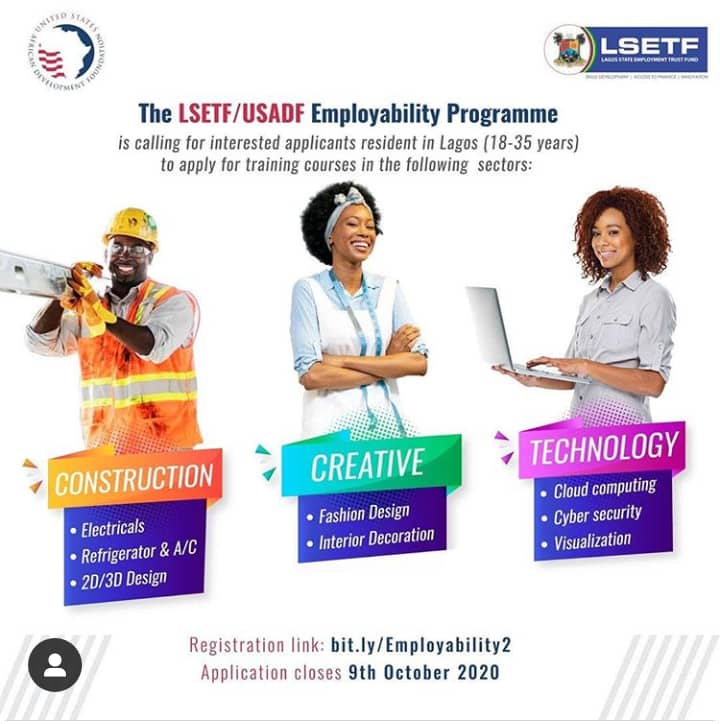
The Lagos Employment Trust Fund in partnership with the United State African Development Foundation have opened application portal where Lagosians desiring to acquire skills in Construction and other Vocational trades under various sectors can apply to attend the sponsored training that will arm them with sellable skills.
Deadline for application is Friday, October 9th, 2020.
Hurry now to register, and tell your loved ones who might have these desires.
Construction courses in focus:
1.Electrical Installation and wiring/ Alternative energy.
2. Plumbing and Fitting Installation
3. Painting and Decorative work.
4. Masonry and Tile Installation.
5. Carpentry and Joinery.
Also note that Honeytreat Trade Academy has been positioned as one of the training partner for construction skills under LSETF/USADF Employability Support program.
His Excellency, Mr. Babajide Sanwo-Olu, Executive Governor, Lagos State; (Middle); Dr. Adesola Adeduntan, Chief Executive Officer, First Bank of Nigeria Limited (second right); Honorable Jude Emeka Idimogu, Chairman, House Committee on Wealth Creation, Lagos State House of Assembly (right); Mrs Yetunde Arobieke, Honourable Commissioner, Wealth Creation, Lagos State (second left) and Mrs Tatiana Monsalli-Nouri, member, Board of Trustees, Lagos State Employment Trust Fund (LSETF) – represented Mrs Bola Adesola, Chairperson, Board of Trustees (BoT), LSETF (left) at the launch of the LSETF-FirstEdu Loan, to cushion the impact of COVID-19 pandemic on low-cost private schools, held today at the Banquet Hall, Lagos House, Alausa, Ikeja, Lagos State.
First Bank of Nigeria Limited, Nigeria’s premier and leading financial inclusion services provider, has announced its partnership with Lagos State Employment Trust Fund (LSETF) in a matching fund scheme. The scheme aims to cushion the impact of COVID-19 pandemic on low-cost private schools by ensuring lending at an attractive interest rate.
The programme will provide access to finance where participating schools can each be availed up to N5 million as well as capacity development, business and financial advisory. There will be monitoring and evaluation to ensure prompt loan repayment.
To enjoy this funding opportunity, applications will be submitted via the LSETF portal for screening while successful applicants will be passed on to FirstBank for the loan appraisal and disbursement process. The loan is meant for working capital and asset finance to enable schools resuscitate their practice, acquire needed materials, upgrade their facilities, as well as pay staff salaries in order to bounce back, especially after the lockdown.
This scheme promotes entrepreneurship in Lagos State which is in tandem with the vision of LSETF to create employment and entrepreneurship opportunities for Lagos residents. It has provisions for Micro Enterprises (ME) and Small and Medium Enterprises (SMEs) across all the 57 LCDAs in the 20 LGAs in Lagos State.
Sanwo-Olu, the Executive Governor of Lagos State said the N5 billion Education Loan Programme was a precursor to many more human development sector-specific support programmes that would be unveiled by the LSETF on behalf of the State Government next month.
R – L: His Excellency, Mr. Babajide Sanwo-Olu, Executive Governor, Lagos State and Dr. Adesola Adeduntan, Chief Executive Officer, First Bank of Nigeria Limited at the launch of the LSETF-FirstEdu Loan, to cushion the impact of COVID-19 pandemic on low-cost private schools, held today at the Banquet Hall, Lagos House, Alausa, Ikeja, Lagos State.
The Governor explained that the intervention was necessary, given the importance of education to building human capital. He said his administration took education as critical building 21st century economy and realising objectives set out in the T.H.E.M.E.S. agenda.
The beneficiaries, Sanwo-Olu said, will have access to single-digit loan facilities to fund the provision of the amenities and services needed to aid learning.
He said: “It is thus heart-warming to have First Bank of Nigeria electing to be our exemplary partner for this intervention. With their support, players in the education sector would be getting the financial support they need to boost learning at a single-digit interest rate.
“I also commend the Board of LSETF and the management for this significant accomplishment. They have helped the Lagos State Government build an institution that has engendered public trust and elevated the hope of small businesses and young people, irrespective of challenges faced.”
According to Dr. Adesola Adeduntan, Chief Executive Officer, First Bank of Nigeria Limited, “at FirstBank we recognise the indelible role played by the education sector in the growth of any economy and this underscores our partnership with Lagos State Government for continuous development of the education services in Lagos State and the nation as a whole. The commitment by the Lagos State Government – including this partnership – to enable schools is quite commendable as this will mitigate the challenges caused by the lockdown on the education sector following the COVID-19 pandemic.”
“With the single-digit funding targeted at about 2,000 low-cost private schools in the State, we are delighted at this opportunity to demonstrate our commitment to the development of education in Lagos State, thereby contributing our quota to further the mandate of the Lagos State Government – in partnership with LSETF – on economic growth, enhanced opportunities for employment and bridging societal gaps in education,” he concluded.
Commenting on the Eduloan programme, Mrs Bola Adesola, Chairperson, Board of Trustees, Lagos State Employment Trust Fund (LSETF) stated that; “According to the NESG the Education Sector remains a growth area for job creation and a report on job creation by the NBS states that the Education Sector is one of the top 5 sectors that created over 59m jobs in 2017. This fact is buttressed by the data collected by LSETF in previous loan programmes. The objective of the LSETF-FirstEdu loan is to create employment, improve the quality of education for our youth by providing access to affordable finance to low-cost private schools and vocational training centres
“We are confident that this intervention fund, which is complemented by our free professional and institutional support structures, will ensure that the education ecosystem in Lagos State will witness an improvement in the overall learning outcomes for our children, while positively impacting on the Lagos local economy through wealth and job creation.,” she stated.
Only recently, FirstBank partnered with the Lagos State government, Robert & John, IBM and Curious Learning with a resolve to enable the education of 1 million Nigerian students through innovative eLearning solutions that will drive sustainable efforts towards improving education for all. As part of the partnership, the Bank donated 20,000 units of e-learning devices to the Lagos State government.
These partnerships reinforce FirstBank’s “You First” brand promise of putting not just its customers first but the economy of its host communities.