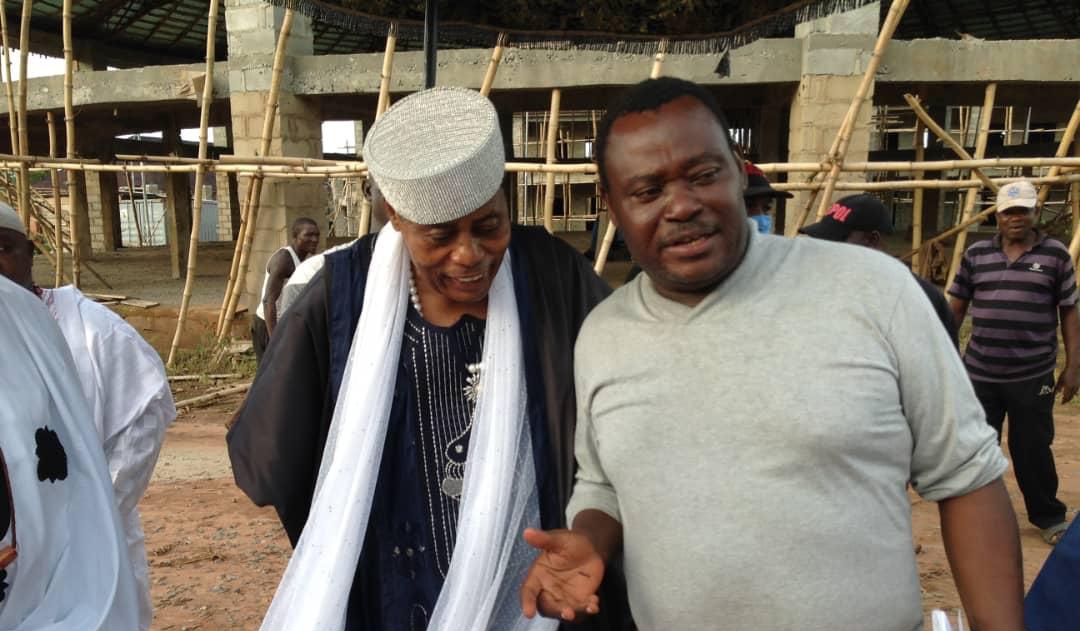
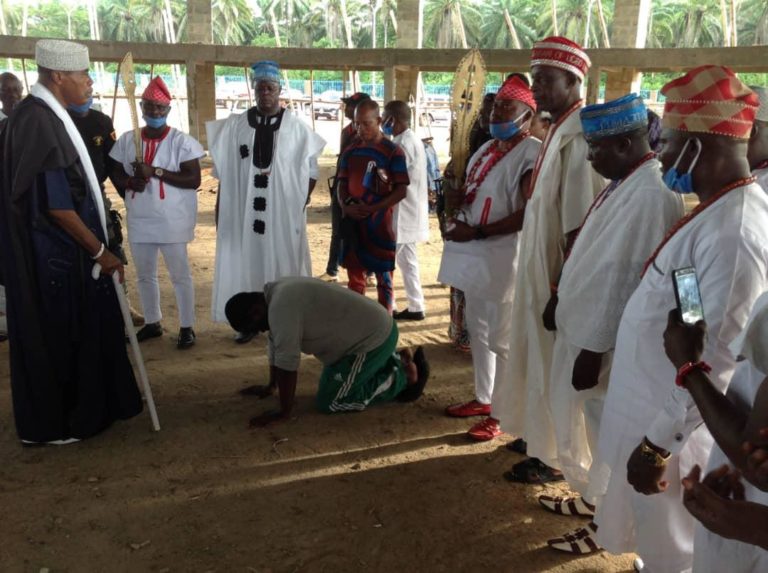
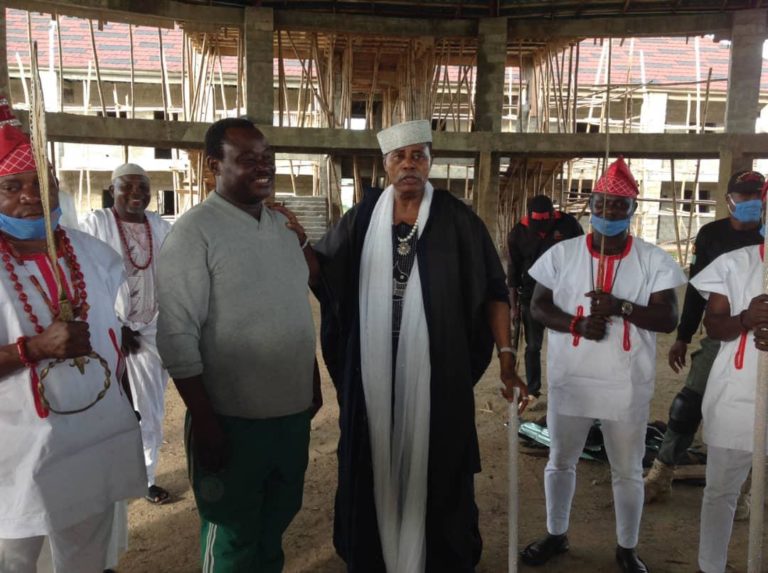
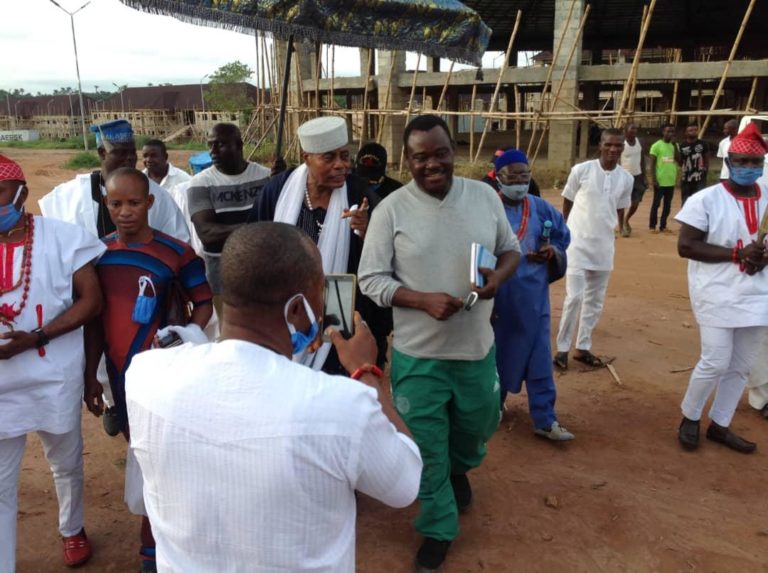
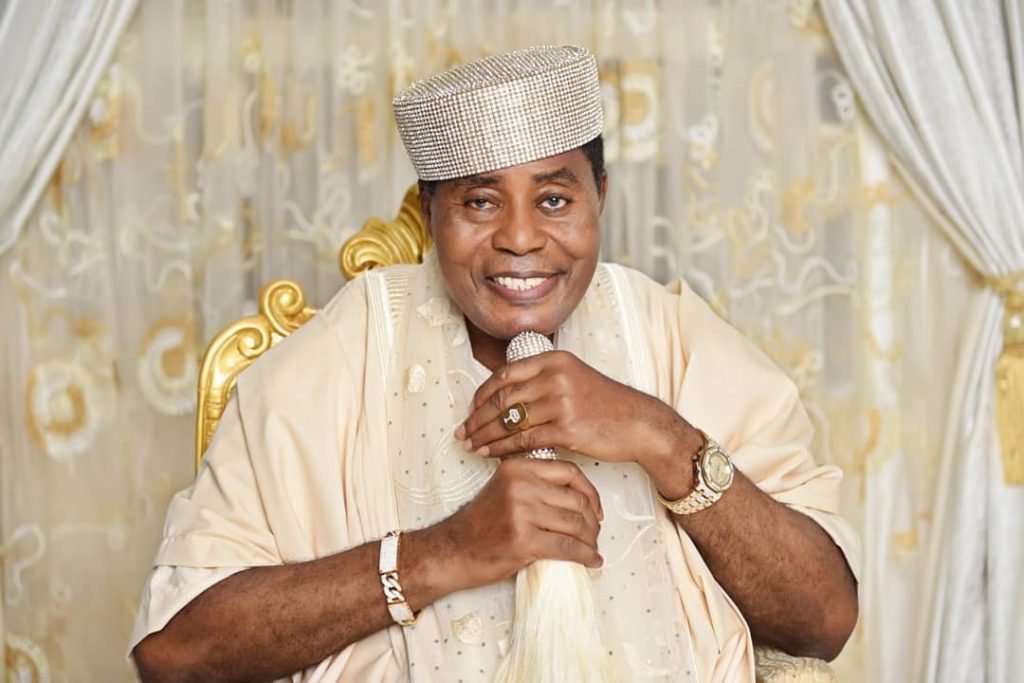
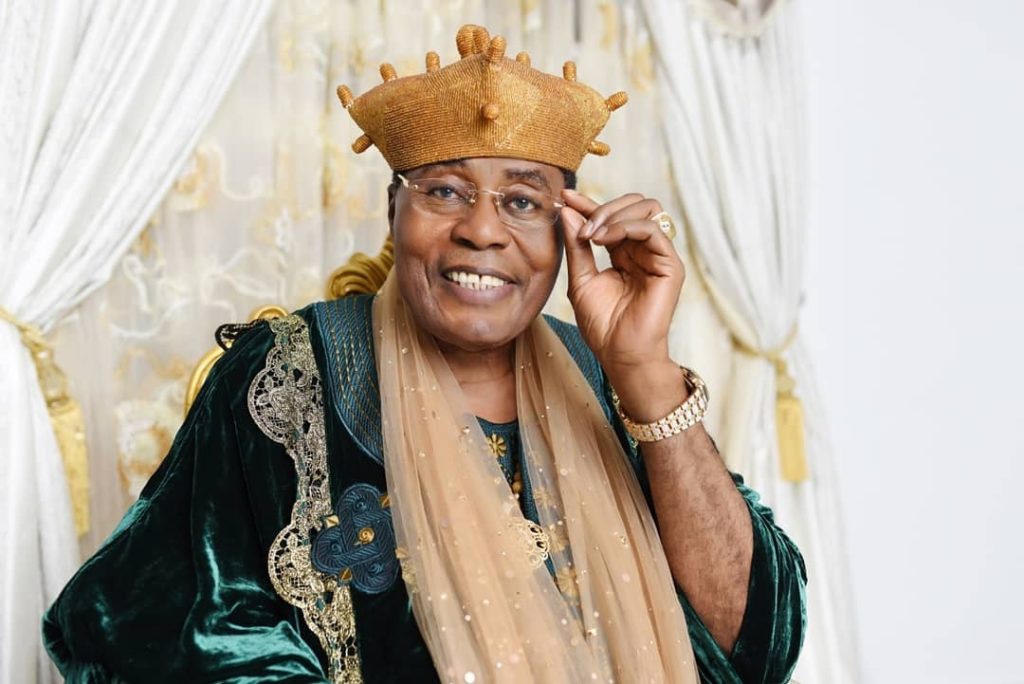
His Imperial Majesty, Paramount ruler and prescribed authority, Olugbo of Ugbo kingdom, Oba (Dr.) Frederick Enitiolorunda Obateru Akinruntan, CON, paid a scheduled visit to billionaire business mogul and politician, Barr. (Dr.) Jimoh Ibrahim (CFR) at his country home, Igbotako in Okitipupa Local government area of Ondo State.
Oba Akinruntan was accompanied by his High Chiefs on the visit.
The first class monarch and Chairman, Ondo state council of Obas, also used the opportunity to inspect ongoing works at the site of the University of Fortune, the pet project of Barr. Jimoh Ibrahim is currently embarking on, which would open up the serene and agrarian Igbotako community to unprecedented infrastructural development.
At the palatial residence of Ibrahim, Oba Akinruntan congratulated him for deeming it fit to bring closer to his people such a noble and laudable project as a university of higher learning, adding that when people are knowledgeable they have been saved from the agony of illiteracy which berths poverty and lack. “There is need for our people to become knowledgeable about their history and culture. We need to correct some wrong impression about skewed history of Yoruba Land. This has prompted me to write a book about the proper place of Ugbo in Yoruba connectivity, which propagandists had attempted to sweep under the carpet.”
While presenting his books to Ibrahim, Oba Akinruntan said Ugbo people to all intent and purpose are the owners of Ife as the reign of Obamakin Ugbomokun preceded the arrival of Oduduwa at Ile Ife, adding that it takes a fair and Correct knowledge of traditional history of Yoruba Land and culture to unravel this sacred fact.
At the inspection of the University, Oba Akinruntan patted Barr. Jimoh Ibrahim at the back for the thoughtful project, stating that; Ibrahim is investing huge capital not just in mere edifices or cash crow business this time round, but in a citadel of learning that will put Igbotako and Ikale Land and even the entire Ondo state on the world map.
In his reaction, Barr. Ibrahim thanked the royal father for the August visit, maintaining that he felt highly honoured by the visit of such an eminent royal father of international repute. Jimoh Ibrahim who has his hand tied across many pies of business chain ranging from; finance, hospitality and real estate consortia among others, told his guest that the University of Fortune at its completion shall attract the best hands in the world of academics. He said; “The university shall produce graduates that will have not just a paper certificate but quality potentials that will make them problem solvers and educated people that will impact very positively on the economy of Nigeria.”
Advocate Partnerships between Private Sector and Government
African thought leaders and great minds have noted that the development of homegrown solutions and adequate investment in human capacity building and agricultural expansion are key steps that will help to rebuild Africa and put the continent on a stronger footing post Covid-19.
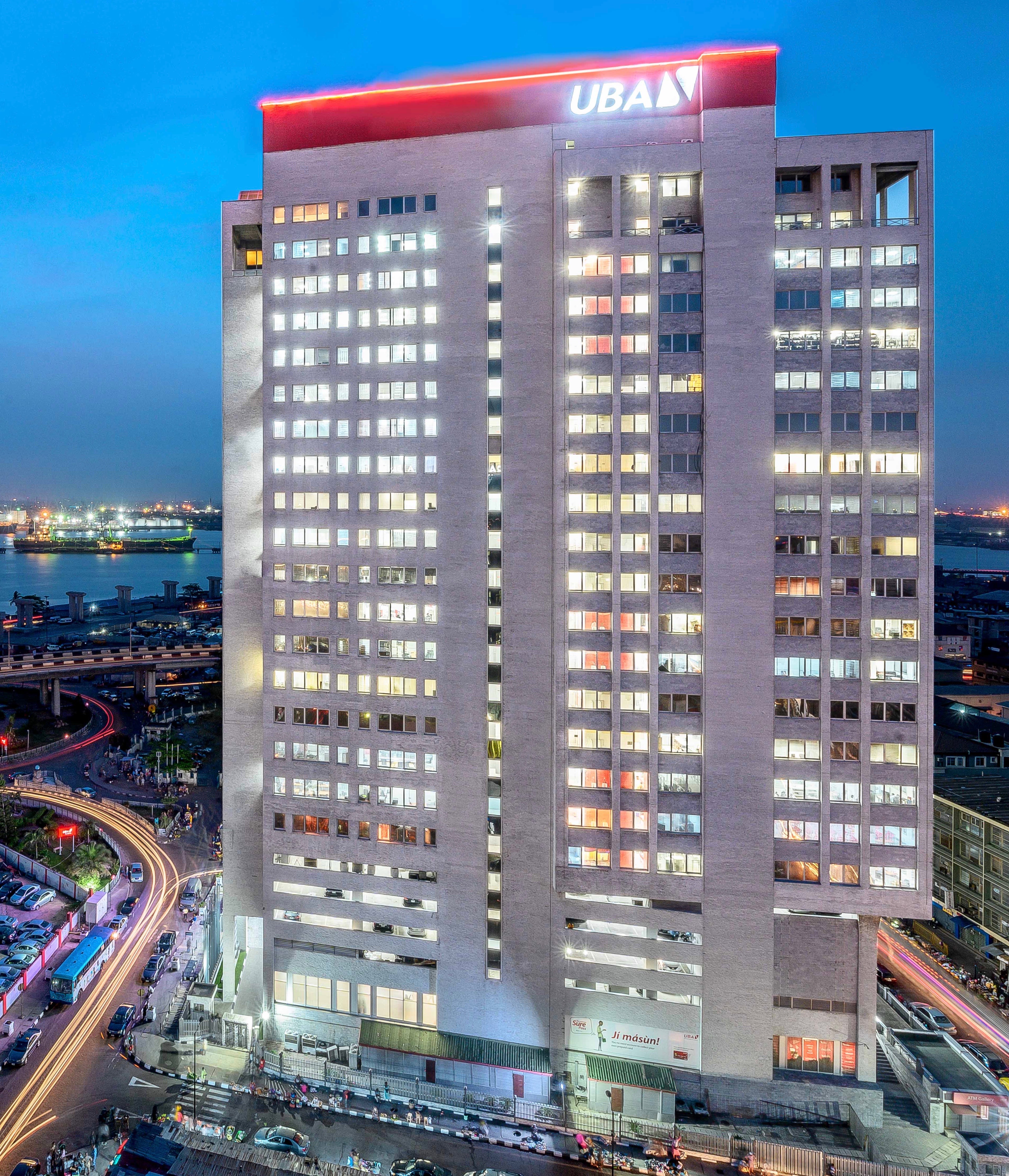
Analysing the theme ‘Domestic Policies, Regional Development and a Global Agenda: SDGs and African Development at Crossroads; the speakers collectively gave this submission during the second panel session of the 2020 edition of United Bank for Africa (UBA) African Day Conversations.
The virtual session, which was moderated by Veteran Journalist and Media Consultant, Eugenia Abu, was made up of thought leaders from across Africa, including the Regional CEO, UBA West Africa, Abiola Bawuah (Ghana); Senior Program Coordinator, Regional Network of Agricultural Policy Research Institutes, Dr Nalishebo Meebelo (Zambia); Leadership Coach and Chairman, Go Ahead Africa Ltd, Roland Kwemain (Cameroon); Founder and Executive Director, Social Change Factory, Sobel Aziz Ngom (Senegal); Special Assistant to the President Muhammadu Buhari on Digital and New Media, Tolu Ogunlesi (Nigeria); and Social Entrepreneur and Founder, LEAP Africa, Ndidi Nwuneli (Nigeria).
Abiola Bauwah who emphasised how Africa should rely less on foreign donors, said, “There are five areas we should work on more for us to reach the SDG goals; the private sector; rapid industrialization; institutions and the rule of law; develop our human capital; remove the barriers across Africa. We should institute Africapitalism which is an economic philosophy that says that the human and capital resources of Africa are the only ways in which we can develop Africa.”
Nalishebo Meebelo noted that there’s a lot that young people can do along the value chain of manufacturing, transporting, technology and marketing, adding that, “Government cannot do it alone, they need to work with other stakeholders. Cut and paste solutions do not work for us here in Africa, we need to have our own homegrown solutions to fight this pandemic.”
Eugenia Abu, who focused on the huge role that women and youth must play in rebuilding the continent, said that Africa had to work together to provide solutions to its numerous challenges. “Women, entrepreneurial champions, young people and collaborations between African countries are very key to developing Africa,” she stated.
Ndidi Nwuneli who was saddened that the agricultural sector remained hugely untapped, emphasised the need for a change of mindset where people usually equated agriculture to poverty. “This is a $1 trillion industry and we are neglecting it; therefore my charge to you is that we invest in the agricultural sector, prioritize it, leverage it, transform our educational system to prepare our young people for this sector, change the mindset and trade with each other,” she explained.
Sobel Aziz Ngom pointed out the need for the youth to take charge in Africa. “It is time to not just serve young people, but to trust them to lead. The challenge that we have at the domestic and continental level is making the change in our structure and in the political system that give the place to young people to be 100% engaged,” Ngom stated.
In his own submission, Tolu Ogunlesi, said, “All over the countries young people are seizing opportunities, and we need to start thinking about how to make sure that this is not just for the age of COVID but for now and beyond COVID-19. Even if the pandemic was to disappear today, I hope that the lessons we’re learning, we’re not going to forget them and go back to where we used to be.”
For Roland Kwemain, more institutions need to tow the line of UBA in events such as UBA Africa Conversations. “If 100 multinationals in Africa were doing that UBA is doing, we would go far because CSR is an amazing leverage not just for the brand but also for supporting people & women in terms of activities. The truth is that we need partnership between the government, corporates and the civil society,” he said.
The United Bank for Africa is a leading pan-African financial institution offering banking services to more than twenty million customers globally. With footprint in 20 African countries and presence globally in the United Kingdom, the USA and France, UBA is connecting people and businesses across Africa through retail, commercial and corporate banking, innovative cross border payments and remittances, trade finance and ancillary banking services.
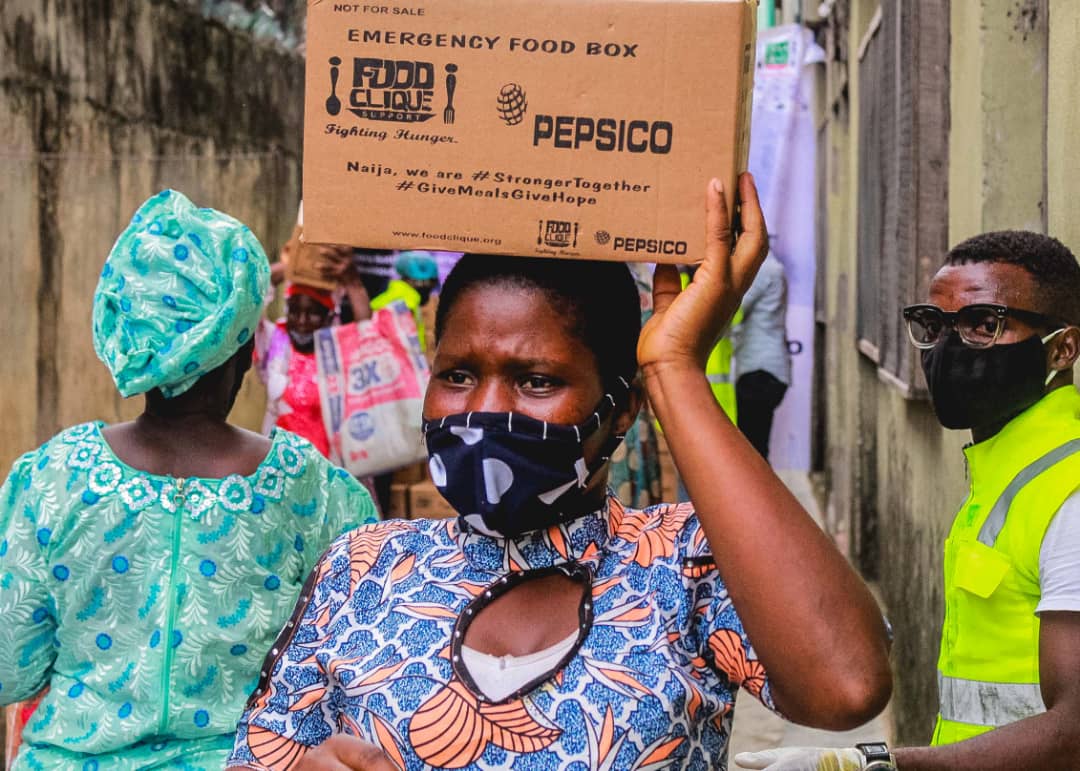
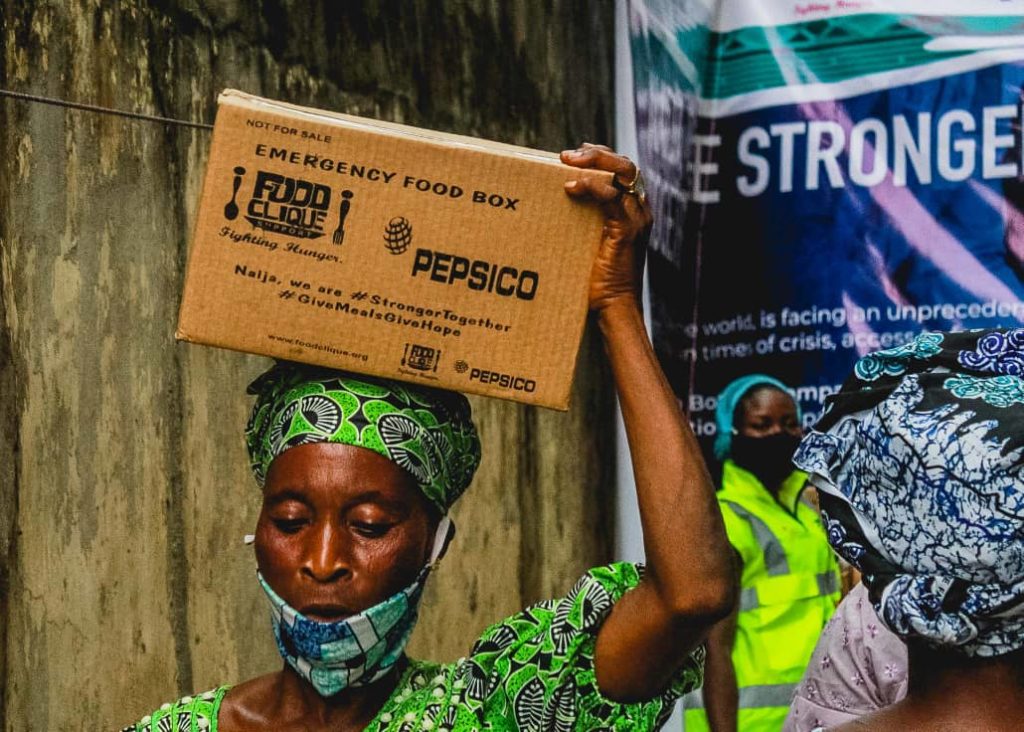
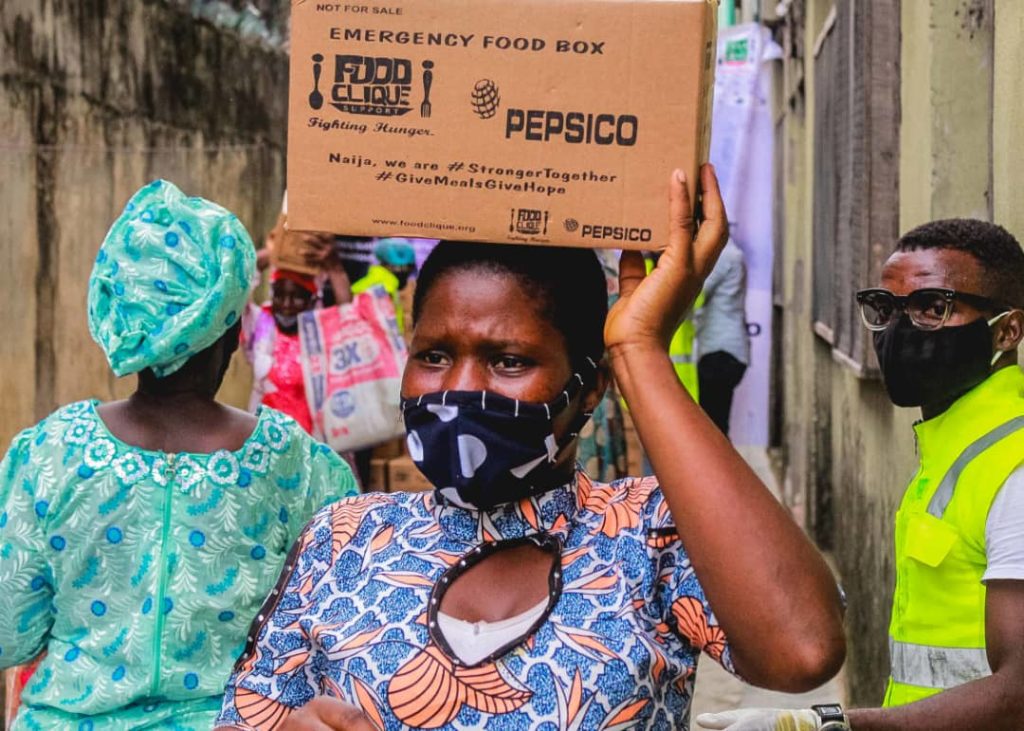
PepsiCo Nigeria has unveiled its one million meals initiative hashtag #GiveMealsGiveHope to feed vulnerable communities amidst the COVID-19 crisis. Enabled by the PepsiCo Foundation, the meals will be packaged and distributed by FoodClique Support Initiative, an NGO with proven reputation in fighting hunger, identifying the most vulnerable communities through their volunteer network and working with community leaders.
PepsiCo’s Sergio Paya, General Manager Sub-Saharan Africa Beverages said, “We launched the Give Meals, Give Hope program to meet the basic needs of the most impacted segments of the Nigerian population, as food is at the heart of what PepsiCo does. As one of the leading food and beverages companies in Nigeria and across the African continent, we believe that we have a responsibility to focus on providing essential food items to those affected by this pandemic.”
FoodClique’s Founder and CEO, Bolajoko Fadipe explains, “We are at the forefront of the fight against hunger in Nigeria. The current pandemic has exacerbated the need to provide food across the country. Through our #GiveMealsGiveHope partnership with PepsiCo, we will organize food boxes and leverage on our network to distribute to those who need support the most.”
The #GiveMealsGiveHope relief initiative is part of a US$45 million global initiative launched by PepsiCo and The PepsiCo Foundation, focused on helping people and communities most affected by this devastating virus.
The company is funding vital support including protective gear for healthcare workers, testing and screening services, and is already in the process of distributing more than 50 million nutritious meals to at-risk populations by supporting Food Banks and other partners around the world.
…Global co-operation needed to stem global depression
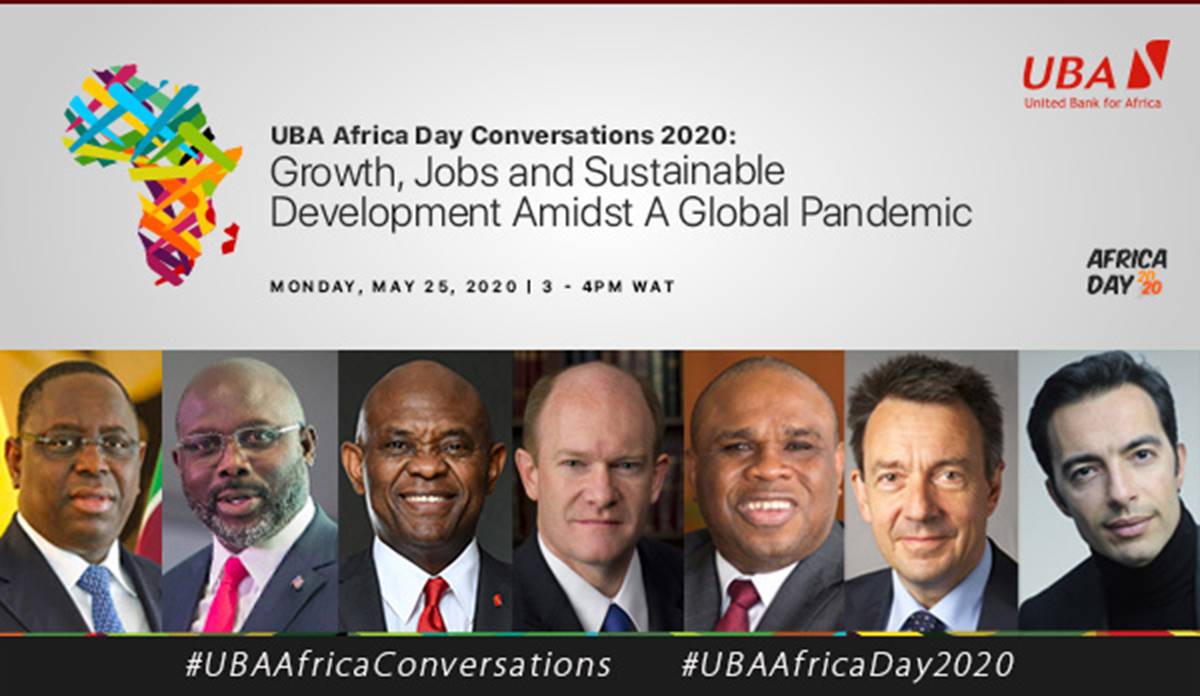
Global leaders at the second edition of United Bank for Africa (UBA) African Day Conversations, have emphasised the need for meaningful collaborations between governments and the private sector as a panacea for the quick recovery of the economy of the African continent post Covid-19.
The leaders which included the President of Liberia, H.E George Weah; United States Senator Chris Coons; the President & Chairman of the Board of Directors of the African Export–Import Bank (AFREXIMBANK), Professor Benedict Okey Oramah; President, International Committee of the Red Cross (ICRC), Peter Maurer; President spoke on Monday at the virtual Leadership Panel which was moderated by the Chairman, UBA Plc, Tony Elumelu.
Other leading voices who made up the panel were the Founder, Africa CEO Forum, Amir Ben Yahmed; the Secretary-General of the African Caribbean and Pacific Group of States (ACP), H.E George Chikoti; Administrator, United Nations Development Program (UNDP), Achim Steiner and Donald Kaberuka.
While moderating, Elumelu, who is also the Founder of the Tony Elumelu Foundation, spoke on the need to mobilise everyone and explained the necessity to discover a more fundamental solution to Africa’s challenges through collaborative efforts.
“This is the time for us to deal with the situation we have and also forge a better situation for everyone, acting again collectively,” he said. “This is not the time for finger pointing but for collaborative effort by governments and organizations to fight the pandemic globally.”
Continuing, Elumelu pointed out that all hands must be on deck if the African continent is to have a quick recovery from the pandemic, adding “There is need to flatten the curve, we need global co-operation to stem global depression. Africa requires a large stimulus package, and we need long-term solutions to prevent a cycle of debt.”
In his submission, the Liberian President, George Weah, established how collaborations worked in his government in an attempt to stem the sufferings brought about the coronavirus pandemic.
“In Liberia we have taken measures to ease the financial burden on vulnerable business in the informal sector by providing small loan assistance to SMEs and traders. In addition, we are working with commercial banks to manage the repayment of loans as well as to create stimulus packages for citizens.”
On his part, US, Senator Chris Coons, said, “It is important to take a moment to look at how African leaders have reacted to the pandemic. In order for us to recover from this pandemic, we must develop a vaccine that is free and affordable and freely distributed so that full economic activities can return. There are ways we can invest in debt relief, invest in infrastructure and human development. This is no time to be looking backwards. We recognise the power of collective collaboration on the continent.
While pointing out that the pandemic poses an opportunity for Africa to be independent and promote its growth and development as a people without external help; Prof. Benedict Okey Oramah, on his part, said COVID 19 has taught Africa that there comes a time when every group of people will fend for themselves.
He called for the swift implementation of the African Continental Free Trade Area (AfCFTA) agreement, adding, “The priority of government should be to make sure that the AfCFTA gets implemented without delay. If there was any doubt about the importance of that agreement, this pandemic has told us that this is the way to go.
Continuing, Oramah said, “The pandemic has shown so many weaknesses we have across our continent. We know that hunger is looming if we do not do anything. If we allow hunger to take over from the COVID 19 pandemic, we will begin to see political problems filling in. For Africa the problems go beyond health challenges to other areas such as food supply. Hunger is looming and if action is not taken, Africa will see political problem. Africa has become the epicenter of the economic devastation that this pandemic has unleashed upon us.”
While disclosing that Afrexim has made available $200million to supply fertilizers and grains amongst others across Africa, the Afrexim boss added that “If Africa allows hunger takeover the people, it will see an increase in insecurity, which will take a long time to overcome.”
George Chikoti of ACP, said that the huge task of economic recovery on the continent, rests on both the government and the private sector. “The responsibility of COVID-19 does not rest on the government alone, the private sector needs to play a big role in lifting the burden of the pandemic. African governments need to accept the support of the Private Sector in alleviating the impact of the COVID-19 pandemic in Africa,” he said.
“We have been able to release $25m to all member states. One of the major challenges is to make sure that in all countries, we have agricultural activity and high productivity. What we should learn from the impact of this pandemic is that the international community can look at how well they can fund all these initiatives that come from our countries, Chikoti added.
Achim Steiner of the UNDP noted that Digital connectivity is very essential as it is a crucial opportunity to connect all schools across the continent, adding that emphasis on Healthcare is also very important. “Digital connectivity is very crucial to connect schools to the internet. We need to address inequality; also, the virus has put a spotlight on Africa’s healthcare system. Africa needs to look at intermediate strategies like micro-insurance to ramp up this sector. Healthcare has the ability to make a large percentage of the occupation fall into extreme poverty.
“What we need to look at is to find a way for government as a regulator and also as an investor, to leverage private sector investment into these areas” Steiner said.
Peter Maurer, President, ICRC, said there is the need to look at pandemics as part of a broader health system which needs stabilisation; A lot of vulnerable populations in Africa have been heavily infected by the pandemic. “We must do more than life-saving. This pandemic has illustrated the weakness of health, water, sanitation and social systems, and we have to heavily invest into the stabilization of these systems.
Throwing more light on this, Maurer said, “Two things need to follow after live saving during the pandemic. First, the pandemic has illustrated the weak situation of health, water and food systems and we need to heavily invest both by the public and private sectors to stabilize the health sector. Secondly, investment has always gone into the more developed parts of Africa and not the fragile parts. We need Private Public Partnerships and investments by multi-corporate institutions to develop these areas’ he noted.
Amir Yahmed said the crisis is going to be a super accelerator of already existing trends. “We have to get away from the commodity driven model which has failed in creating prosperity. Secondly, self-reliance should be one of the major objectives. The pandemic is wake up call for Africa – Creating new streams of revenue and self-reliance by the African continent”
“We need to use this crisis to take Africa to the next level. This crisis is going to be a super accelerator of already existing trends. I think it has to be a wake-up call for us to attain goals we haven’t reached. Create new revenues for the economy. We also need to attain self-reliance. Self reliance is an important goal. Africa manufactures [only] 2% of what it produces. We need to use this crisis to take Africa to the next level. Invest in digital infrastructure, digital education, agriculture is another opportunity we need to grab. We need to get the AFCTA working,” Yamed said.
Donald Kaberuka on his part opined that “What we need (for this crisis) is something unusual, it is not business as usual. It is not marginal action, it is radical action.”
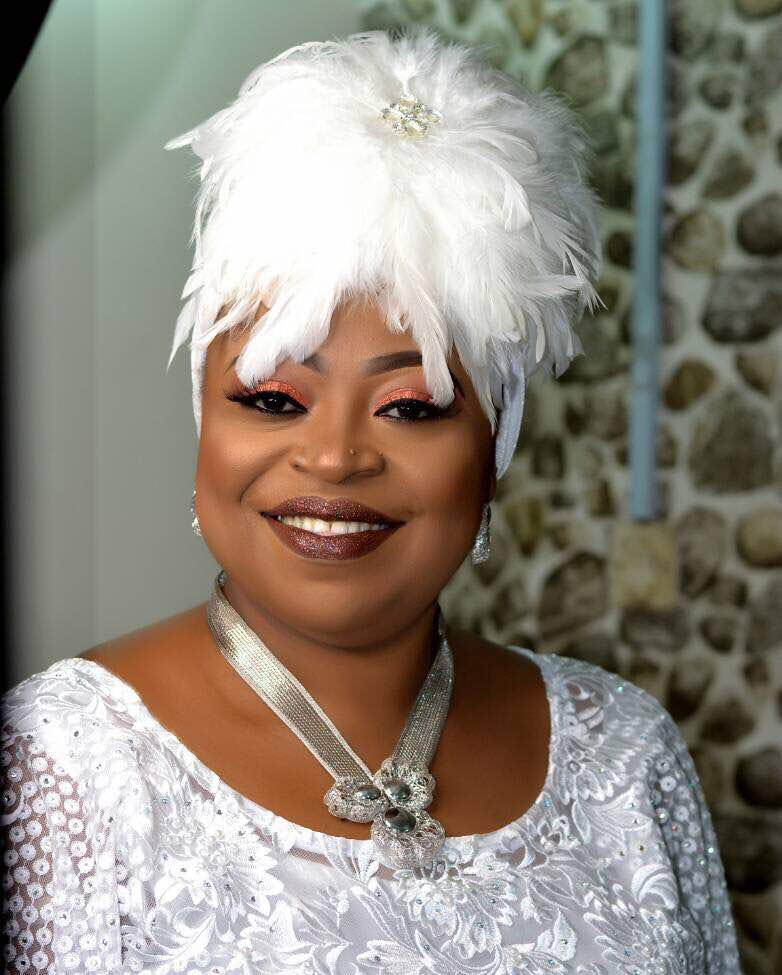
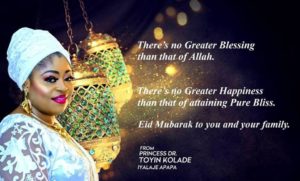
Top business amazon and the Iyalaje of the Source and Apapa at large, Princess Dr. Toyin Kolade has expressed her joy for all Muslims on the celebration of the 2020 Eid-il-Fitri. The sultry and workaholic Chairman/CEO of Fisolak Global Ventures took time out to felicitates with Muslim brothers and sisters who have the rare opportunity of witnessing this year’s fasting period successfully.
She urged then to be grateful to go for the uncommon achievement adding that it is the time for Muslims to be more closer to the Almighty Allah and also be more prayerful and helpful to the needy.
Princess Dr. Toyin Kolade, the royal apparel who has been a constant helper of the poor masses and a woman of great philanthropic gestures then called on all Nigerians to be wary about the presence of the corona virus disease, urging all and sundry to be protective and obey the rules guiding the spread of the dangerous killer virus. She also prayed that the Almighty Allah shall intervene as soon as possible in eradicating the pandemic from the surface of the entire universe. Princess Kolade on behalf of her husband the indomitable Customs topshot, Prince Kayode Kolade and their children wishes all Muslims brethren more Eid-il-Fitri to be celebrated.
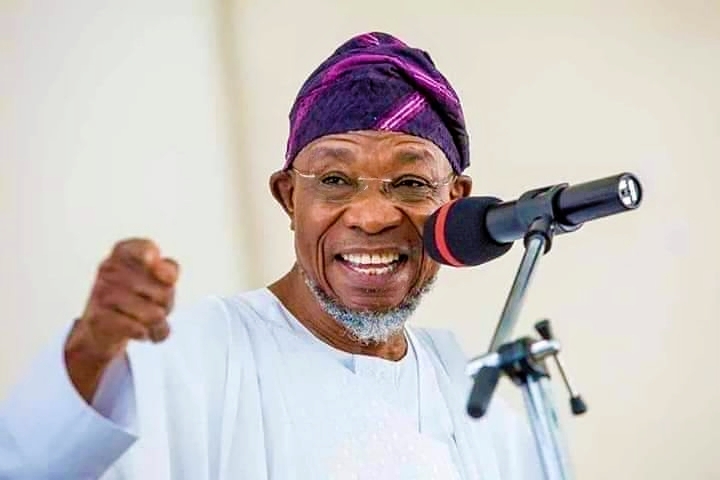
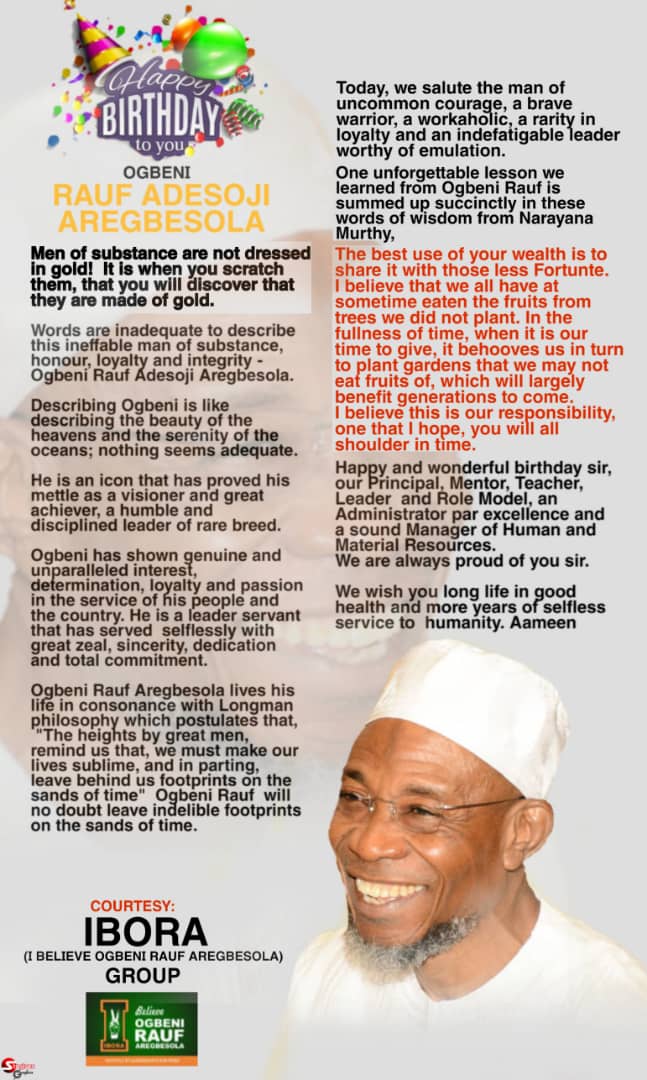
I Believe Ogbeni Rauf Aregbesola ( I.B.O.R.A) celebrates one of Nigeria’s most influential politician, Ogbeni Rauf Adesoji Aregbesola, as he clocks 63.
According to a press release by the group, he is a man of uncommon courage, a brave warrior, a workaholic, a rarity in loyalty and an indefatigable leader worthy of emulation.
The group noted that he Is an icon who has proved his metro as a visioner, a humble and disciplined leader of a rare breed.
Also, the group asserted that he has shown genuine interested and unparrelled interest, determination, loyalty and passion and service of his people and the country.
Similarly, one of the core value learned from him, according to the group, is giving cheerfully to the less fortunate and lifting those who are struggling to reach the top.
They further asked that God gives him long life in good health and more years of selfless service to humanity.
The world is set to witness a massive worship concert tagged “Worship Without Walls”.
The programme is a 12 hour worship session that will hold online with over 50 gospel artistes participating from across the globe.
Slatted to hold on from 9: AM on Saturday, May 31, via http://www.WorshipWithoutWalls.online, the concert will see worship leaders from over forty countries taking part in the one day of total praise and worship.
Headlining artistes for the worship programme include Mike Abdul,
Monique, Mike Aremu, Essence, KSB and Righteousman.
Others are Tosin Bee, Folake Umosen, Evang Chucks Praise Channel, A’Dam, Nene Olayide, Bola Udom, Jerry K, Adam, Minister Ighosa,TY Classical, Minister Anny, lIbitayo Jeje, Noble G and Ayo Vincent, Joseph Emmanuel, Sameodagospel, Fred Maha, TY Phoebe, Frank Jonah, Debby Ugochinyere, Igwe Sax, Yomi Ikuesan, Latoya Okunbor.
During the show, artistes will worship God on an international stage in their unique style.
Sermonettes and Interviews of top gospel artistes and Pastors from across the world will also be available, while up and coming acts can be assured of global exposure to more than 100,000,000 million people on different social media globally.
There will also be promotion of the musical performance for one month to a global audience of over 10 million people over 30 days through paid adverts before, during and after the concert.
The top ten performing artistes in the concert will win cash prizes based on the decision reached via voting from worshippers all over the world through voting after the event.
Gospo Digital, the exclusively online distribution company of the organisers will help in promoting the album of performing artistes on 100s of digital sites for online streaming, downloading and ongoing royalties without an upfront payment for the service.
“Worship Without Walls” is an initiative of The Cyber Embassy Of Christ (http://www.thecyberembassy.org/), a
full-fledged 100 percent online church flowing in all five purposes of the church exclusively online.
Founded by Ope Banwo, The Cyber Embassy Of Christ is the most successful internet church with over 35,000 members of which over 800 have actually attended a one-week full members’ class and joined our private church Cybertorium group on Facebook.
Some of the church services are streamed by over 600,000 people each week with some little adverts.
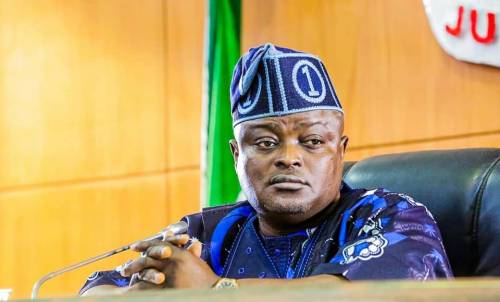
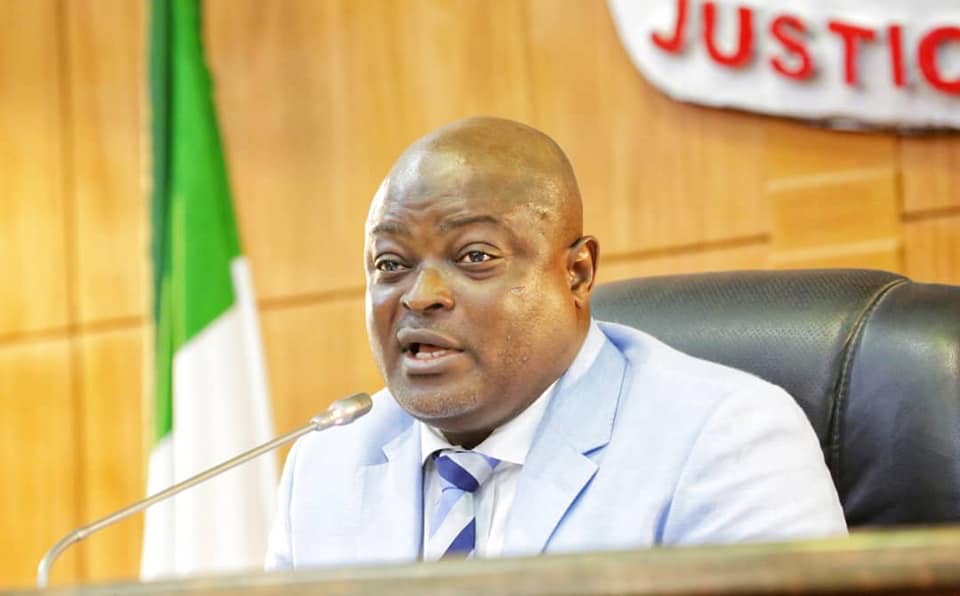
RT. HON. MUDASHIRU AJAYI OBASA, Speaker Lagos State House of Assembly
An interim report heard on the floor of the Lagos State House of Assembly on Monday detailed how dredging companies in the state have consistently defrauded the government to the tune of several hundreds of millions.
The report was read on the floor by Hon. Victor Akande, chairman of a seven-man committee set up to look into the activities of alleged illegal dredgers in the state.
The report named NIMCO dredging company among the ones that have carried on defrauding the state by failing to pay taxes and make returns.
The report shows that the state has 55 registered ‘Category A’ dredging companies out of which only three have operational permit. Out of these three, only one of the companies has been making returns to the government.
Akande said the report was the result of the committee’s finding through documents and evidence provided by officials of the state government and investigation.
In the course of the investigation, the committee had invited the Ministries of Waterfront and Infrastructure Development, Lands, The Environment, Physical Planning, the Surveyor-General, other government agencies and the commissioner of police in the state.
Some of the dredgers, it was learnt, engage in reclamation of land and these include NIMCO, linked to a top serving politician in the state, and another company that operate around the Eti-Osa area of Lagos State.
The Committee discovered that after reclaiming land, the companies then sell at very exorbitant prices. A member of the committee cited the case of reclaimed land sold for at least N120 million in places like Banana Island without paying government its due.
It was further learnt that another set of 74 Category A dredgers have been operating illegally in the state.
The report also showed that only 12 of the 69 recognised Category B dredgers and piling companies in the state had been making payments to the government.
It was also discovered that the state has another set of 109 illegal Category B dredgers.
The report shows that the state has 11 areas of reclamation of land with eight in Eti-Osa, one in Mainland, one in Ikorodu, and one in Kosofe.
Even though the companies have areas they are supposed to cover, many of them beat the state directive by dredging beyond the requirement, make money and defraud the government.
During deliberation on the floor of the House, Akande disclosed that all manner of people including foreigners, especially Chinese were also engaged in dredging activities enriching themselves at the expense of the state.
Many other lawmakers spoke against the activities of these dredgers.
On his part, Olowo said the dredgers were operating indiscriminately adding that some with Category C approvals operate in Category A without regard to the laws.
Akande also urged the House to give the committee additional two weeks to complete its work as it wants to embark on inspection tour of the sites.
Speaker Mudashiru Obasa directed the Clerk of the House, Azeez Sanni, to write the governor and intimate him of the preliminary findings of the committee.
Obasa also directed the Clerk to write to the state commissioner of police to provide security for the committee members when they embark on inspection of the dredging sites.
Oba Dr. Fredrick Obateru Akinruntan is the traditional ruler of Ugbo Kingdom, an ancient riverine town in Ilaje Local Government, Ondo State, South-West Nigeria.
Rated by financial magazine, Forbes, as the richest monarch in Nigeria and second richest on the African soil. With a net-worth and conglomerate spanning into billions of dollars, Olugbo has his hands litters across many pies of business littered across the the world with choice properties at highbrow areas across the world.
Oba Akinruntan is currently the Chairman of Ondo state Council of Obas, the Chairman of Yoruba Obas Conflicts Resolution Council. He also shoulders an academic title as the Chancellor, Olusegun Agagu University of Science & Technology, Okitipupa, Ondo State.
The reputable philanthropist blessed with a large heart of Gold is also a recipient of National Honours, Commander of the Order of Niger (CON).
In this interview, the Okoro Ajiga 1, Paramount Ruler and Prescribed Authority of Ugboland, revealed some mind blowing information affecting the Yoruba race. He addressed other salient issues by setting the records straight, correcting distorted history connecting Ile-Ife and Ugbo….
Excerpts….
What’s the position of Ugbo in Yoruba connectivity?
The position of Ugbo in Yoruba connectivity still remains what it is. It is an historical fact that cannot be affected by the passage of time or circumstances. Nobody can change it! I am the first, the oldest throne in Yoruba Land. The position of Ugbo in Yoruba history cannot be contradicted by anybody. Nobody can say no to that sacrosanct position of Ugbo in Yoruba oral or written history because it is there for all to see. A lot of people are grumbling and murmuring; I see them as cowards. They are very cowardly and are not even coherent in their stuttering cowardly counter claims that to all intent and purpose stand logic on its head because my father, Oranfe is the progenitor of Yoruba Land. Oranfe, a half man, half spirit being is the father of Obamakin who is my ancestral father and whose dynasty founded Ile Ife and he reigned as the aboriginal Paramount ruler of Ile Ife. Ife was known at that time as Ugbomokun; so I am claiming it as the owner of Ile Ife and that claim i lay claim to is not just narratively pure but historically correct! I am still claiming it up till tomorrow.
Who exactly is Obamakin Osangan gan?
Osangangan Obamakin is the son of Oranfe. They are the owner of Ile-Ife. His father, Oranfe is the owner of Ife; Obamakin is the owner of Ife, thus, myself, I am the owner of Ife. We are still claiming it up till tomorrow! That’s the fact! Let me tell you one thing: in Ife today, if they want to get anything from god, they will say,” haa baba mi Oranfe, Iwo loni Ile Ife, Joo je ki ohun ti mo n wa temi lowo…( My father Oranfe, you are our progenitor; let our heart desires be granted!) That’s how they pray up till today. They won’t mention the name of any particular Oba, but they always remember the name of their forefather, Oranfe. That’s it!
In your book,” A history of the oldest throne in Yoruba Land” which you published in 2016, you talked about pre dynastic struggles that existed in the time line of Yoruba history. Can you shed more light on that?
Now in Ife, we are the owners of that place. We have 16 communities in Ile Ife. A lot of scholars testified to the existence of these sixteen communities and acknowledged them in their scholarly work. A Professor of the Obafemi Awolowo University, Ile Ife, Prof. Wande Abimbola acknowledged it that the Olugbo and his ancestors are the owners of Ife. He also said before we left Ife, nobody asked us to leave. We left on our own volition. He noted that Olugbo left Ife to his new place on his own free will. Part of the evidence we have to show the whole world is the fact that we are the husband of Moremi Ajasoro. She is our wife. You can see that we have it here to show the whole world. You see, the fact is there, nobody can contradict it. Look at my book since 2016, nobody has been able to fault or contradict it till date. So, what are we saying? Historical fact speaks for themselves. Not only that book, OAU, Ile Ife acknowledged this fact too in their ‘Odu: a journal of West African Studies – New series No 46’. If my book is not authentic they won’t acknowledge my historical view point; you know OAU for that. So anybody can say anything they like but they can’t confront me because I guard my loins with the truth, fact, incontrovertible fact of history of the significance of Ugbo in Yoruba historical relevance.
You are the Chairman of Peace and conflict resolution council among Yoruba royal fathers. What can you say about unity among Yoruba Obas?
Yes, we have been doing that, trying to reconcile Yoruba royal fathers in order to foster unity amongst us. Don’t forget Yoruba is a difficult race. Let me be sincere to you and to myself, Yoruba is really a very difficult race. There is one thing we call egoism; that’s the major problem affecting us. Some of the conflict issues we have among the royal fathers boil down to egoism and complex. To make the matter worse, a lot of people without the royal blue blood assume the royal stool. So we have challenges curbing and reining in egoistic proclivities and tendencies. In those days before you can become an Oba, you must not be a south paw, you must not be bald headed or hunch backed; if your father is still alive, you can’t assume the royal stool. It wasn’t possible in ancient Yoruba Land! You are getting me? If you are nine fingered or nine toed, meaning you are not complete, you can’t become an Oba. If you are a stammerer or you are a twin, you can’t be an Oba. If you are a female or child of a female kindred to the throne, you can’t be an Oba. The problem we face now is that our tradition has been bastardised, a lot of the things we held dear in our culture had been watered down and have become severely tinkered with and adulterated. My dear brother, those are the kind of challenges we are facing that we are taking our time to correct. The second one is if there is conflict between two royal fathers, we try to settle it amicably between them and we settle a lot of cases. One thing is I don’t do any of these things for anyone to praise me. I can call my colleague royal father who has an issue with another and try to settle the issue and no one else needs to know.
Let’s talk about Ode Ugbo, your kingdom. How far have you developed this great land of your great ancestors?
Beautiful question! You see, I am not trying to be boastful, but the truth be told, this palace is one of the best in the world. I have 25 bedrooms and 14 palatial living rooms in this sprawling palace. If the United States of America’s President visits, he will be conveniently hosted in this palace; I think that’s worthwhile enough! This monument wasn’t here until I ascended the throne of my fathers in 2009. I have changed a lot of things and given this kingdom a facelift. I have restructured the architecture of this terrain. The new things you can see around are the things I changed when I became the Olugbo. Of course, I have empowered my people who are fishermen with modern boats; I have offered innumerable scholarships to our young ones from secondary school to university level, among other notable things I have done to contribute to the well-being of my people. Opposite my palace here, we are planning to build one of the best hospitals in Nigeria. It’s in the pipeline and it’s coming up very soon. I am a private individual, but in my capacity, I have contributed a lot to this land. Before I ascended this throne, Ugbo was a no go area for so many people because of the fear of communal insecurity and threat to life. All that have stopped now! When I came, I told them anyone who tries nonsense, constitutes nuisance or dares to turn my kingdom to a canvas of blood where people are killed would be summarily dealt with and would wind up in jail. I told them all the wanton killing must stop; anyone who tries it is going to jail. And all the insecurity to life stopped! I am glad to say that peace, once alien to Ugbo, has returned to the land since I assumed the throne in 2009. I thank God for that. I have sent all the criminal elements bolting out of Ugbo and my people are enjoying peace and tranquility. I am a peacemaker in the mold of Henry Kissinger of the US White House way back whose name was synonymous to peace in the White House.
Kabiesi, do you think your tenants, the oil companies have done enough for the oil rich Ilaje nation?
No! They haven’t. They always promise to do this and that; I haven’t seen them do anything except for the promises. I am going to 11 years on the throne now, all they have been doing is promises, promises and promises.
How far have you been able to cope with life as a royal father?
Well, I am enjoying it. I am on the throne of my forefathers, so it’s for me a great pleasure. Before I became the Olugbo, I have been a successful business man by all standard. So, I have been a moderately excellent dresser all the way. Now that I am an imperial royal father, I am always in tune with royal fad and fashion , always very careful with what I wear because I always make statement with my outfit: my cloth, my shoe, my crown, my royal staff, even my car , they always rhyme. I am very stylish person with my royal Vogue and this has come a long way. I could remember vividly as a business man, I went to the US in 2007; I was invited by President Bill Clinton to the White House for an award. I could still recall my dapper blazers and all. I bought my outfit at Rosiny in London. The shoe I wore too, I bought the pair at Rosiny also in London. My tie alone was fifty thousand pounds! So, when they saw me, they marveled at my dress sense. After the whole event and the photo-op’ and we had shaken hands, Bill Clinton told me I am an admirable man, an outstanding Nigerian with an admirable sense of dressing. I asked him there and then, Mr. President, how did you single me out of so many business elite corps in Nigeria for the honor and award? Bill said they profiled me and my business concern and concluded I have made an impact in my business life deserving of mention and global recognition. He said, how many Nigerians can give account of their grass to grace rise in the business world in my country? Only a few! He said my background and integrity accounted for the honor the White House has bestowed on me. If you look at my profile, I put it there that I started my oil business from bottle to gallon, to Jerry can, to drum , to dispensing pump before I could have a fueling station. That is my grass to grace story. America wants to know how you started your business, so, my profile really impressed them. My background is transparent and my business is transparent as well, strong enough to pass the test of integrity and due process. So, all along I have been taken things in my stride and I have been enjoying every bit of it. I have coped well so far and I have no course to regret my decision to occupy the stool of Olugbo.
What is responsible for your daring courage?
(Smiles) You see my courage is the function of my mindset. A clear conscience doesn’t fear accusation. I am always daring because I have nothing to fear. It’s God who has given me a lion heart o! You don’t dare he whom God himself has specially made and not regret it! Yet, I don’t have or use anything; it’s God!
What do you have to tell people about Coronavirus pandemic ravaging the country?
Well thank you for that. Coronavirus is real! Coronavirus is real; coronavirus is real. Our people are encouraged to please note that this virus is a novel virus which cure has not been found and it kills within days. I want to appeal to my people in Ilaje, Ondo state and Nigeria to adhere to all the COVID-19 safety protocols as prescribed by the COVID-19 Presidential Task Force. Watch your hands regularly, use hand sanitizer, wear your face masks if you are going out and if it’s not essential, stay indoor! I want to thank our Governor, Oluwarotimi Akeredolu for his sustained campaign for safety across Ondo state concerning the deadly coronavirus. The Governor is concerned about our safety, so each person should please take responsibility for a healthy living so that we all can survive the pestilence.
How about palliatives. Have you thought of giving your people palliatives?
Most definitely, yes. I was the first in this country to give palliatives to my people. I gave them food items and money and it cut across the kingdom. I told you earlier that the well-being of my people is my concern. I have given them palliatives and I will still give them again and again until this COVID-19 challenge clears off. Ondo state government in the able leadership of our Governor, Oluwarotimi Akeredolu (SAN) had also presented Ondo state people with palliatives. I thank him for that too.
Finally your Imperial Majesty, your advice to your people?
Thank you very much. I preach peace among the people of Ode Ugbo. Without peace there can’t be development. I preach contentment because when people are not contented with what they have, their activities brew trouble and unrest. I preach love among my people. Let’s love ourselves so that together we can work for the growth of our kingdom.
I want to tell my people to be patient with the Ondo state government because Gov. Akeredolu meant well for us. He has promised us the Deep sea project; he has promised us Ugbo / Ilaje free trade zone. If we have these two alone, even me, I don’t have to go to Lagos again. That’s why we all need to support Governor Oluwarotimi Akeredolu’s second term bid because he is a man of his words.
I want to appeal to our youths to run away from crime. They should not do “Yahoo yahoo” because it doesn’t last. Our young ones who are ladies should not go into prostitution. It’s not a way of life.
And above all, let’s all us learn how to trust God because He knows what is best for us.
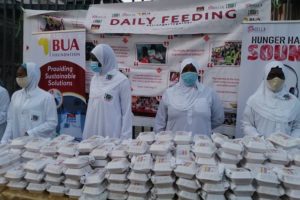
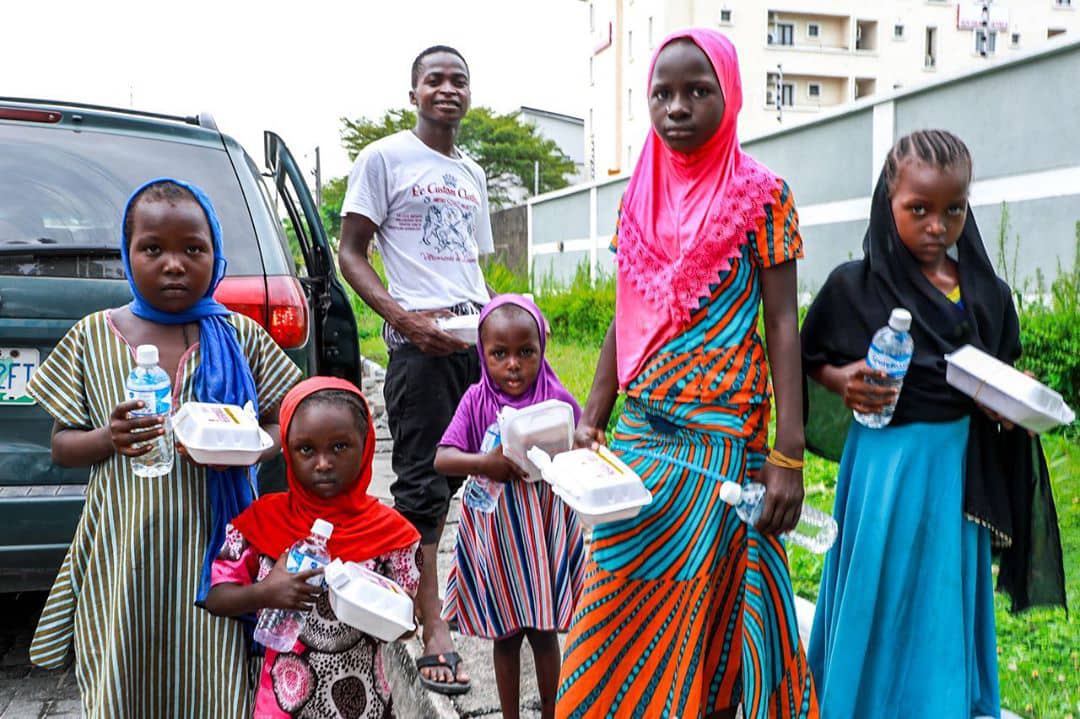
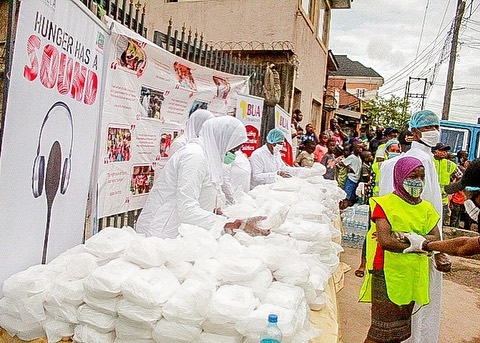
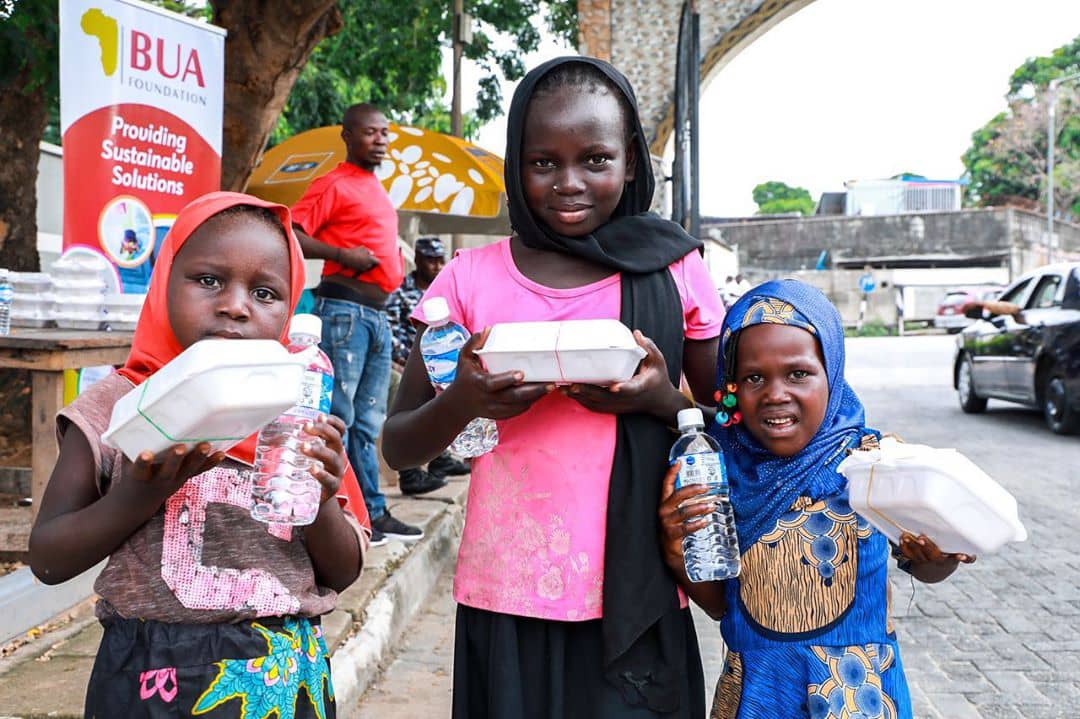
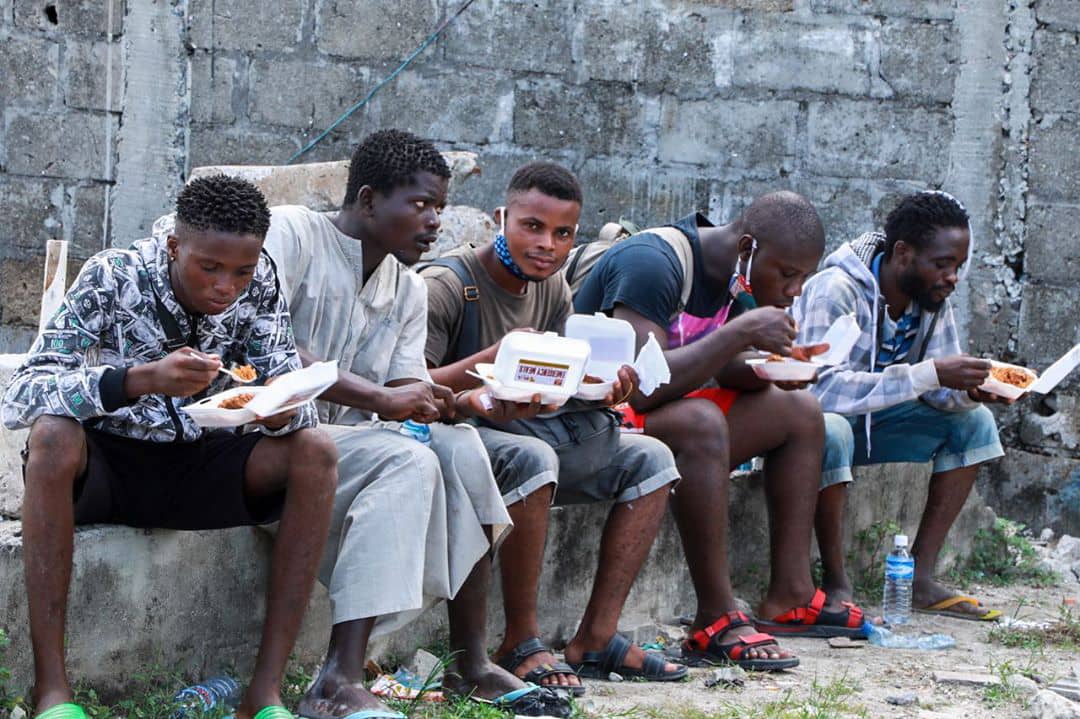
Ramadan fasting month was relatively made easy for many in Lagos because Seyi and Layal Tinubu founded Noella Foundation in partnership with Bolajoko Fadipe owned Food Clique and BUA group are doing a wonderful job. The team is helping in no small way the their collaboration which has gone a long way in reducing the impact of the hardship in town on those fasting by lessening the burden of looking for what to break with on faithfuls by providing free daily Iftar meals (the evening meal with which Muslims end daily Ramadan fast at sunset) at selected locations across the State.
The idea which was announced by Noella Foundation in partnership with Food Clique at the beginning of the fast was later supported by Abdul-Samad Rabiu owned BUA Group is currently at the last count feeding over 6,000 faithful who are likely to have been finding it difficult to conveniently provide both Sahur (the meal consumed daily early in the morning by Muslims before fasting, during the Islamic month of Ramadan. The meal is eaten before fajr prayer) and Iftar because of the effect of COVID-19 forced lockdown on individuals’ economy.
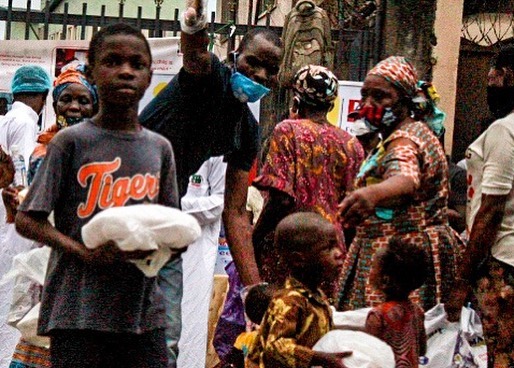
At the moment processed daily Iftar meals being distributed by the team is in excess of 6,000 in different locations across Lagos State. This is also not stopping the continuous distribution of the COVID-19 Emergency FoodBox Initiative support which is to give palliatives to those who are finding it difficult during the Corona Virus forced lockdown and are still not on the list of essential service providers the later partial lockdown opening order of the government granted right to go back to work. They have till date been able to give more than 700,000 meals to more than 23,000 persons across the State.
It is also important to know that Noella Foundation’s relationship with Food Clique has been dated back to late 2018 when the Bolajoko Fadipe owned NGO won Seyi Tinubu’s Christmas Cash Prize giveaway for their effort towards eradicating hunger and they has since then work together on several activities long before their recent one on the Covid-19 ordered lockdown which has increased the numbers of residents of Lagos State exposed to the pang of hunger. The team had worked and likely still working together on the monthly community kitchen project. The idea which will see their team visit various communities in Lagos State every last Saturday of the month to erect a their kitchen where they feeds the needy in the area good, sumptuous and nutritious food in hygiene and clean environments.
The daily Iftar meal project is however a month specialized project aimed to cushion the effect of the economic hardship caused by the outbreak of the pandemic on the fasting faithful during this Ramadan period and it is currently restricted to people in Èbúté Mẹtta, Oshodi, Surulere, Awoyokun community of Onipanu, Onikoyi Road Ikoyi, and Parkview, with the possibility of extending it to other areas before the fasting ends.