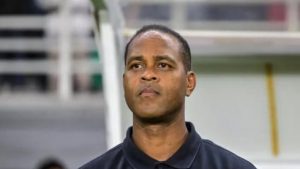
Cole Palmer has been ruled out of action for six more weeks, Chelsea manager Enzo Maresca said on Friday.
The England midfielder has not played since Chelsea’s 2-1 defeat at Manchester United on September 20 — when he came off midway through the first half.
Maresca initially said he hoped Palmer, 23, would be back after this month’s international break.
“I was wrong. Unfortunately, he needs to be out for probably six more weeks. So, yes, this is the update,” he said.
The Italian said he was confident that the forward would not require surgery.
“We try just to protect Cole as much as we can, and the most important thing is that when he comes back, he’s fully recovered,” he added.
Maresca, whose team faces Nottingham Forest on Saturday, said replacing “one of the best players in the Premier League” was difficult.
“For sure, we need to find a different solution, we need to find different skills, because we don’t have another player like Cole,” he said. “Because Cole is unique.”
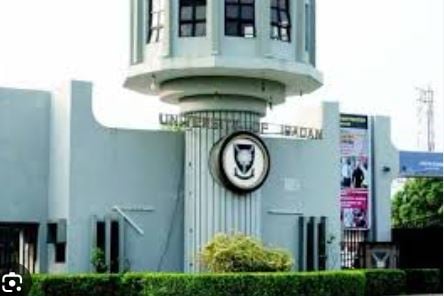
Nigeria has taken the top spot in Sub-Saharan Africa’s higher education rankings, with 24 universities listed in the 2026 Times Higher Education World University Rankings.
This makes Nigeria the most represented country in the region, ahead of South Africa, which has 13 universities on the list.
The Times Higher Education Sub-Saharan Africa Insights 2026 report, released on Thursday on THE’s website, shows that the region now has a record 55 universities from 14 countries in the global rankings, which is a significant rise from just 10 universities less than ten years ago.
The report described this as a “moment of celebration” for African higher education, noting that universities are improving not only in number but also in quality and global visibility.
South Africa still leads in performance, with four universities ranked among the world’s top 500. The University of Cape Town is Africa’s highest-ranked institution at 164th globally, its best-ever position.
The University of Johannesburg also reached a major milestone by entering the global top 400 for the first time, while the University of Pretoria returned to the 501–600 range after some years.
For Nigeria, the University of Ibadan and the University of Lagos both entered the world’s top 1,000 universities for the first time.
Ghana’s University of Cape Coast and Uganda’s Makerere University also featured in the same range, marking steady progress for West and East Africa.
Other countries also improved their presence. Ghana now has four ranked universities, while Botswana has two. Kenya and Tanzania maintained two each.
Senegal made a debut in the rankings through Université Cheikh Anta Diop de Dakar marking a new era for Francophone Africa.
The report showed how fast the region has grown in the rankings over time. From just 12 universities in 2017, the number has grown steadily to 18 in 2020, 25 in 2022, 43 in 2024, and now 55 in 2026, the highest ever.
Times Higher Education’s Chief Global Affairs Officer, Phil Baty, said Africa’s progress is not just about numbers but quality.
“We are not just seeing improvements in representation; we are seeing improvements in quality too… a great opportunity to build on the momentum and make sure Africa’s universities are ready to drive innovation and development,” he said.
The top 10 universities in Sub-Saharan Africa, according to The Times Higher Education Sub-Saharan Africa Insights 2026 report include:
1. University of Cape Town (=164 globally)
2. Stellenbosch University (301–350)
3. University of the Witwatersrand (301–350)
4. University of Johannesburg (351–400)
5. University of KwaZulu-Natal (501–600)
6. University of Pretoria (501–600)
7. University of the Western Cape (601–800)
8. Makerere University (801–1,000)
9. University of Cape Coast (801–1,000)
10. University of Ibadan / University of Lagos (801–1,000)
The report also noted that the global higher education system is changing. Some of Asia’s top universities, such as Tsinghua University and the National University of Singapore, have slowed in growth, while many US and European universities are facing challenges from funding cuts and political pressure.
These changes, the report said, create a new opportunity for Africa to rise further by focusing on research, innovation, and strong international partnerships.
PUNCH Online reported that the University of Ibadan also topped Nigeria’s domestic rankings for 2026, moving up from fourth position in the previous year to become the nation’s best university.
According to the PUNCH Online report, the Times Higher Education World University Rankings 2026 noted that UI and the University of Lagos share the same global ranking band (801–1,000), followed by Bayero University, Covenant University, and Landmark University in the 1001–1200 range.
The PUNCH Online report also highlighted that Nigerian universities performed differently across the five indicators used by THE: teaching, research environment, research quality, international outlook, and industry impact.
The University of Lagos scored highest among Nigerian institutions for research quality, Bayero University topped the list for international outlook, while Covenant University led in industry engagement.
The Lutheran Church of Norway on Thursday apologised to the country’s LGBTQ community, at a gay pub in Oslo, for the discrimination and harassment it subjected them to in the past.
“The Church of Norway inflicted shame, serious harm and pain on gay people,” said Olav Fykse Tveit, presiding bishop of the Church of Norway, in a speech at the London Pub, a prominent venue for the gay community.
“It should never have happened and to them I say today: I’m sorry,” he said, acknowledging that the “discrimination, unequal treatment and harassment” caused some to lose their faith.
In the 1950s, the church said gay people were a “global social danger” and qualified their acts as “perverse and despicable.”
Over time, the Church of Norway — which has 3.4 million members, representing over 60 percent of the Norwegian population — has adopted a more liberal approach.
It has allowed gay pastors since 2007 and religious unions for same-sex couples since 2017.
Thursday’s apology was “strong and important” but comes “too late for those of us who died of AIDS … with hearts filled with anguish because the church considered the epidemic to be God’s punishment,” said Stephen Adom, leader of Norway’s Association for Gender and Sexual Diversity.
“We are seeing a populist and conservative Christian wave sweeping across country after country. In the United States, in Hungary, but also in Norway, it is becoming increasingly accepted among religious and political leaders to denigrate the human diversity of identities and bodies,” he lamented.
The London Pub was one of two bars targeted in a shooting that left two dead and nine injured during Oslo’s Pride parade on June 25, 2022.
The perpetrator, Zaniar Matapour, a Norwegian of Iranian origin who had pledged allegiance to the Islamic State group, was sentenced to the maximum penalty, 30 years in prison which can be extended indefinitely, for committing an “aggravated terrorist act.”
In 2023, Tveit himself participated in the Pride parade, a first for a Church of Norway presiding bishop.
According to a survey conducted by the Opinion Institute for the Church of Norway, 65 percent of respondents said it was “high time” for the institution to apologise to gay people.
Other Protestant churches in England and Canada have issued similar apologies in recent years.
The Federal Government has clarified that no inmate has been released under the recent Presidential Prerogative of Mercy exercise, noting that the process is still undergoing final administrative review.
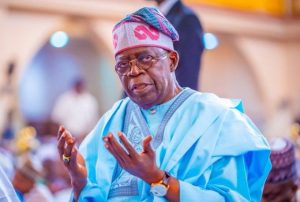
PUNCH Online reported that President Bola Tinubu recently granted a pardon to Sir Herbert Macaulay, as well as 174 others, following approval by the Council of State.
Among the beneficiaries are notable figures such as Ken Saro-Wiwa, the environmental activist, and Major General Mamman Vatsa, who was executed in 1986 for alleged coup plotting.
The pardon list also includes Maryam Sanda, who was sentenced to death in 2020 for killing her husband, and other inmates whose sentences were commuted or reduced, and ex-convicts deemed eligible by the Presidential Advisory Committee on the Prerogative of Mercy.
However, in a statement on Thursday, the Attorney-General of the Federation and Minister of Justice, Lateef Fagbemi (SAN), said the exercise remains at the stage of verifying and reviewing the list of beneficiaries before the issuance of formal instruments of release.
Fagbemi explained that although the Council of State had approved recommendations for clemency, the final stage requires a detailed review to ensure all names comply with legal and procedural standards.
“The Office of the Attorney-General of the Federation and Minister of Justice wishes to clarify that no inmate approved for clemency under the recent exercise of the President’s power of prerogative of mercy has been released from custody.
“The process remains at the final administrative stage, which includes a standard review to ensure that all names and recommendations fully comply with established legal and procedural requirements before any instrument of release is issued,” the statement read.
He noted that the issuance of the instrument of implementation marks the last phase of the process, after which the Controller-General of the Nigerian Correctional Service will be authorised to act.
According to the AGF, the review phase is part of standard protocol and demonstrates the government’s commitment to transparency, due diligence, and the rule of law.
Fagbemi commended the public for its interest and scrutiny of the exercise, describing such engagement as evidence of Nigerians’ commitment to justice and good governance.
“There is no delay in the process; it is simply following the law to the letter to ensure that only those duly qualified benefit from the President’s mercy,” he said.
The minister assured that the public would be duly informed once all legal and procedural checks are completed.
“As soon as all legal and procedural checks are concluded, the public will be duly informed. The rule of law does not rush; it ensures fairness,” he added.
The Independent National Electoral Commission has clarified the rationale behind the ₦1.5bn fee charged for fulfilling a Freedom of Information request for certified copies of the National Register of Voters and polling unit details across the country.
The request, submitted by Messrs V.C. Ottaokpukpu & Associates on October 8, 2025, sought access to the National Register of Voters for all 36 states and the Federal Capital Territory, as well as records of polling units nationwide.
INEC responded on October 13, 2025, approving the request and outlining the cost involved. The quoted fee of ₦1,505,901,750 has since generated widespread public interest.
In a statement issued on Thursday, INEC’s Director of Voter Education and Publicity, Victoria Eta-Messi, explained that the fee was determined in line with the provisions of the Freedom of Information Act 2011.
“Where access to information is to be given under this Act, the public institution may charge an amount representing the actual cost of document duplication and transcription,” the commission stated, citing Section 8(1) of the Act.
INEC further clarified that the cost was calculated based on its guidelines for processing and issuing Certified True Copies of documents, derived from Section 15 of the Electoral Act 2022. According to the commission, “the applicable charge is ₦250 per page.”
“For clarity, the National Register of Voters for all 36 states and the FCT contains 93,469,008 registered voters, with 16 voters per page, requiring 6,018,661 pages.
“Additionally, printing the existing polling units in the electoral wards across the country, covering 176,848 polling units, will require 4,946 pages.
“The total number of pages to be printed for both requests is therefore 6,023,607, at a unit cost of ₦250 per page, resulting in the total sum of ₦1,505,901,750,” INEC stated.
The commission added that “this amount reflects only the actual costs for document duplication and transcription and does not include any other charges.”
INEC reaffirmed its commitment to “transparency, accountability, and responsible management of public resources.”
The clarification followed public criticism after the disclosure of the fee. The approval for the release of the data was first made public in a letter signed by INEC Secretary, Rose Oriaran-Anthony, and widely shared on X (formerly Twitter) on Wednesday night.
In the letter dated October 13, INEC confirmed that the request had been approved, stating, “You are hereby requested to pay the sum of One Billion, Five Hundred and Five Million, Nine Hundred and One Thousand, Seven Hundred and Fifty Naira only (₦1,505,901,750), being the cost of production of the above.”
The letter further directed the requesters to make payment through the INEC Remita Retrieval Reference system and submit proof of payment to proceed with the request.
The fee has sparked debate online, with many questioning its fairness, especially in an era of digital document management. Some users expressed disbelief at the cost, while others speculated that the charge was designed to discourage such requests.
However, some observers defended INEC’s position, noting that the request was for Certified True Copies, which legally requires the printing and certification of physical documents, as stipulated by the FOI Act.
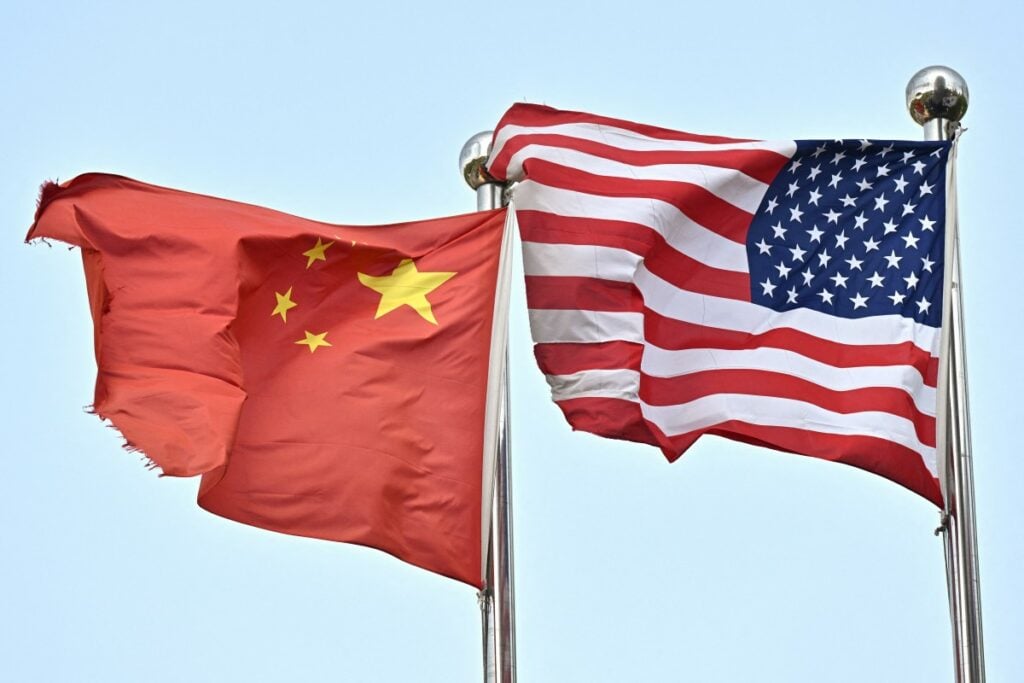
China said Thursday that its purchases of Russian oil were “legitimate” and decried recent “unilateral bullying” measures by the United States as the trade row between the two countries continues to intensify.
Trump said Wednesday that Indian Prime Minister Narendra Modi had promised him New Delhi would stop buying Russian oil, and that he would get China to follow suit.
Trump has accused both China and India of funding the three-year Ukraine war through the purchases, and has also demanded that European allies immediately stop buying oil from Russia.
India neither confirmed or denied it was shifting its policy.
Asked on Thursday about Trump’s intention to pressure China further, Beijing’s foreign ministry defended its “normal, legitimate economic, trade, and energy cooperation with countries around the world, including Russia”.
“The actions of the United States are a typical example of unilateral bullying and economic coercion,” ministry spokesman Lin Jian said at a press briefing.
If China’s interests are harmed, it will “take firm countermeasures and resolutely safeguard its sovereignty”, he warned.
Beijing and Moscow are key trading partners, and China has never denounced Russia’s war, nor called for it to withdraw its troops.
Kyiv and Western governments have long accused Beijing of providing political and economic support for Moscow.
– ‘Profoundly detrimental’ –
Beijing on Thursday also criticised recent US moves to expand export controls and impose new port fees on Chinese ships, saying the measures had a “profoundly detrimental” impact on trade talks between the two superpowers.
While tensions between Washington and Beijing have de-escalated from their peak, the truce remains shaky.
After Beijing imposed fresh controls on the export of rare earth technologies and items, Trump said he would roll out an additional 100 per cent tariff on the country’s goods from November 1.
The United States announced in April it would begin applying fees to all arriving Chinese-built and operated ships after a “Section 301” investigation found Beijing’s dominance in the industry was unreasonable.
Section 301 of the US Trade Act of 1974 enables Washington to impose trade penalties on countries whose practices are deemed unfair or harmful to American commerce.
Beijing responded last week by announcing “special port fees” on American ships arriving at Chinese ports. Both sets of fees took effect Tuesday.
Commerce ministry spokeswoman He Yongqian said Thursday the US moved ahead with the measures while “disregarding China’s sincerity in consultations”, causing “severe damage to China’s interests… (and) a profoundly detrimental impact”.
“The Chinese side expresses strong dissatisfaction with and resolutely opposes the series of actions taken by the US side,” He Yongqian said.
She urged Washington to “immediately rectify its erroneous practices” and respect the outcomes of recent trade talks.
As Nigeria moves to strengthen renewable energy manufacturing and champion local content, the European Union on Thursday said that creative partnerships between the public and private sectors, including research and innovation ecosystems, are key to achieving the country’s clean energy goals.
Describing how innovative breakthroughs are reshaping the global energy landscape, the EU praised Nigeria’s abundant and exceptional human talent and natural resources, describing them as critical ingredients for building innovation ecosystems.
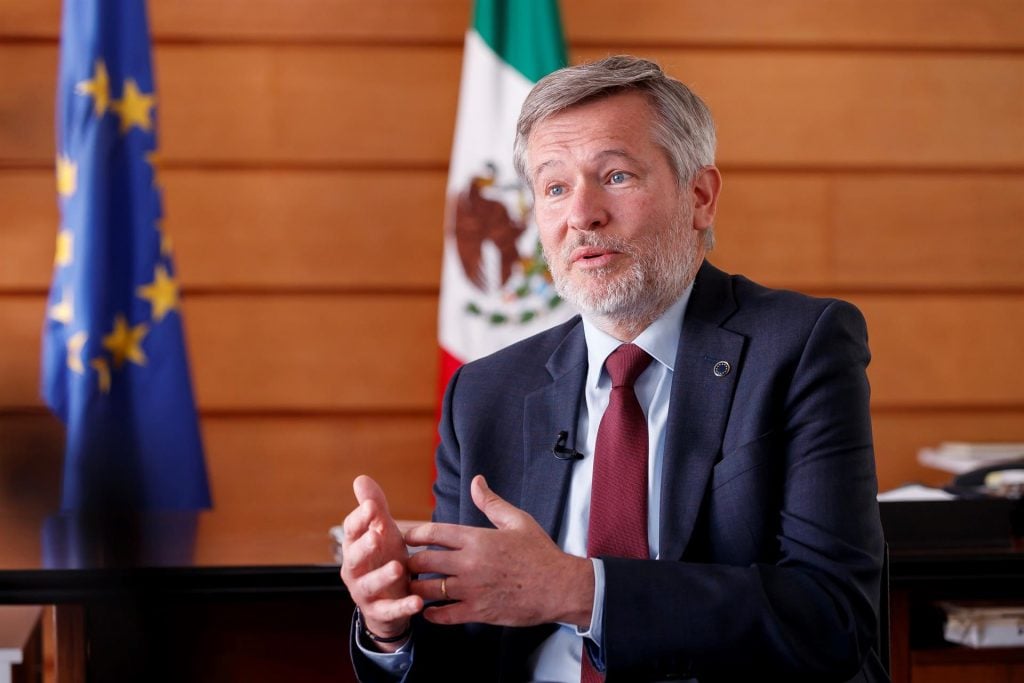
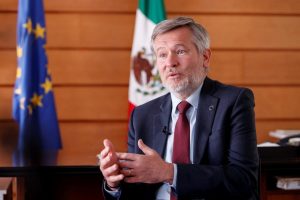
The EU Ambassador to Nigeria and ECOWAS, Gautier Mignot, who was represented by the Deputy Ambassador, EU Delegation to Nigeria and ECOWAS, Zissimos Vergos, disclosed this during the Nigeria Renewable Energy Innovation Forum in Abuja, according to a statement by the EU.
He highlighted how over €200 million in grants from the EU has continued to strengthen the country’s power sector since 2008.
He said, “Our most recent energy sector programme, launched in 2021 with a €100 million (₦175 billion) budget, is aimed at adding 400 megawatts of new renewable capacity by 2027, directly benefitting more than five million Nigerians.”
Mignot noted that innovation that accelerates inclusive energy and digital transformation processes has become an essential intergenerational process and an integral part of political legacies that will be duly recognised by future generations.
Explaining how proper synergy between the public and private sectors and research and innovation ecosystems works, he said, “The public sector brings the policy frameworks; the private sector brings agility and technical expertise; research institutions bring insight and innovation.”
Further stating that effective policies and regulations, together with strengthened capacity building, are essential to scale energy solutions sustainably, he added, “Across rural Nigeria, off-grid renewable solutions are transforming lives. Mini-grids and solar home systems, powered by creative public–private partnerships, are lighting homes, energising small businesses, and expanding opportunity.
“Research institutions must continue providing evidence-based insights on energy demand, consumer behaviour, and resilient business models to ensure that innovation truly serves local communities.”
Reiterating the EU’s commitment to Nigeria’s energy security and economic resilience, especially through programmes like GET.invest Nigeria and the EU’s Global Gateway, he said, “The EU remains deeply committed to supporting these efforts through direct research grants, local capacity development, and mobilising private investment, demonstrating a shared vision for sustainable energy access, clean industry, and inclusive growth.
“Whether for large grid-connected solar farms or small decentralised systems, our shared path depends on harnessing Nigerian ingenuity, industrial potential, and entrepreneurial spirit.”
Hailing Nigeria’s advancement in the era of the green and circular economy, Amb. Mignot added, “The pace of this journey toward sustainable, accessible energy will depend on how successfully the public sector, private sector, and innovation ecosystem work together.”
PUNCH Online reports that Nigeria is currently working towards making significant strides in renewable energy, driven by government initiatives and international investments. The country aims to become Africa’s renewable energy hub, with a projected investment of over $410 billion by 2060.
Nigeria’s energy transition plan includes developing nearly 4 GW of local solar factory capacity, reducing reliance on imports, and creating jobs. The government has signed agreements worth over $400 million for renewable energy manufacturing and infrastructure deals, including solar panels, smart meters, and battery storage.
Additionally, Nigeria is promoting distributed renewable energy, with projects like mini-grids expected to reach 1.5-2 million rural customers.
The country has significant potential for solar and wind energy, with notable projects like the 140 MW Qua Iboe Power Plant and the 10 MW Katsina Wind Farm. Despite challenges like inadequate infrastructure and high costs, Nigeria’s renewable energy capacity is expected to grow, with projections indicating a compound annual growth of 9.88% from 2024 to 2034.
Former President Goodluck Jonathan has mourned the passing of former Kenyan Prime Minister, Raila Odinga, describing him as a true African patriot and a symbol of democratic struggle on the continent.
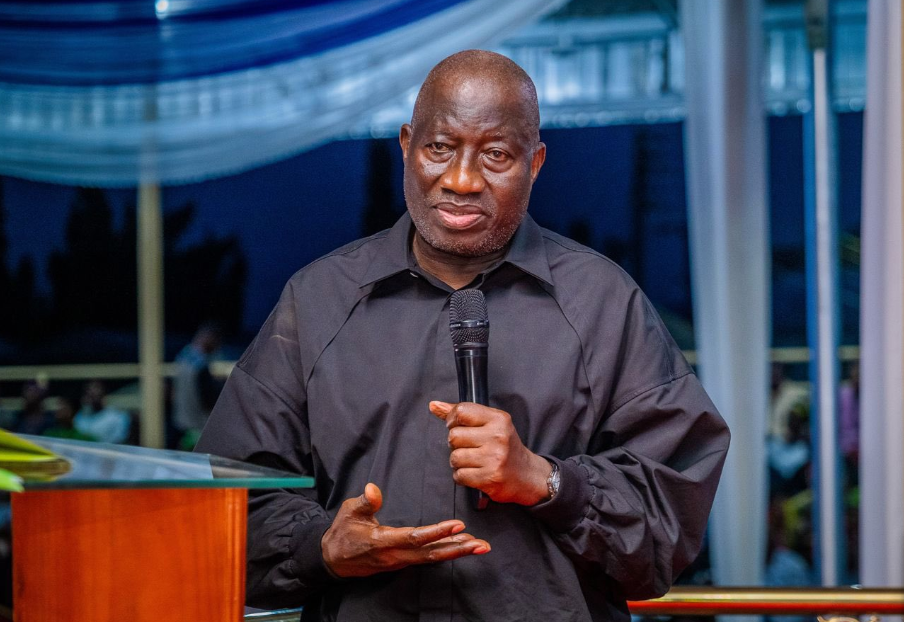
Jonathan, in a statement titled “Adieu H.E. Raila Odinga” shared on his official X account on Thursday, paid glowing tribute to the late Kenyan statesman, whom he hailed for his courage, resilience and unwavering commitment to democracy in Africa.
PUNCH Online, in an agency report titled “Kenyan opposition leader Raila Odinga dies in India”, reported that Odinga, 80, died in India after collapsing during a morning walk, leading to widespread mourning across Kenya and the continent.
Reflecting on Odinga’s legacy, Jonathan described him as a leader who placed service above self and who embodied the hope of a united, progressive Africa.
“I am saddened by the news of the passing of H.E. Raila Odinga, former Prime Minister of Kenya and a distinguished African statesman whose life symbolised resilience, courage, and democratic struggle in Africa.
“Kenya has lost a patriot, and our continent has lost a great leader, one who understood that leadership is not about self, but about service; who believed and looked forward to Africa’s greatness and ascendancy”, the statement partly read.
The former Nigerian president further celebrated Odinga as a fellow advocate of democracy and a devoted pan-Africanist whose impact would continue to resonate across generations.
He prayed for history to remember Odinga kindly and for Africa to draw continued inspiration from his legacy.
“I honour him not just as a brother in the cause of democracy, but as a committed pan-Africanist whose light will continue to shine.
“May history remember him kindly, and may Africa continue to be blessed by his hope, wisdom and sacrifice”, Jonathan’s statement concluded.
Patrick Kluivert’s stint as Indonesia coach is over after they “mutually” agreed to part ways Thursday following a failed bid to reach the World Cup.
Indonesia’s hopes of qualifying for the tournament in North America next year ended with defeats to Iraq and Saudi Arabia in the past week.
The 49-year-old Netherlands and Barcelona great, who was only appointed in January, was in charge for just eight matches.
He won three of his games in charge, losing four and drawing one.
Writing on Instagram, Kluivert called it “an unforgettable journey”.
He added: “Even though I’m deeply disappointed and sorry for the fact that we didn’t make it to the World Cup, I’ll always be proud of what we built together.”
The Dutchman took over following the controversial sacking of South Korean Shin Tae-yong.
The former striker signed a two-year contract at the start of the year, tasked with taking Indonesia to their first World Cup since gaining independence in 1945.
The Football Association of Indonesia, PSSI, said Kluivert’s departure was “through mutual termination”.
“This step was taken as part of a comprehensive evaluation of the national football coaching and development programme,” it added.
The statement did not name Kluivert’s successor.
Amsterdam-born Kluivert retired as a player in 2008 after a stellar career that started at Ajax, where he won the Champions League, before moves to AC Milan and Barcelona.
Kluivert’s managerial career has not been nearly as spectacular.
His previous coaching role was in charge of Adana Demirspor in Turkey for five months in 2023.
Before that he was caretaker manager of Curacao in 2021.
He was also number two to Louis van Gaal with the Dutch national side in 2012-2014.
The Katsina State Police Command has arrested an 11-man syndicate of suspected notorious armed robbers terrorising people on Sha’iskawa-Charanchi and Katsina-Kankia-Kano roads.
The command’s Public Relations Officer, Abubakar Aliyu, told newsmen on Wednesday in Katsina that the suspects had specialised in blocking those roads, robbing unsuspecting motorists.
He listed the suspects as Dikko Maaru, Dardau Kabir, Muntari Musa, Labaran Amadu, Usman Maaru, Lawal Zubairu, Nasiru Sanusi, and Adamu Kabir.
Others were, Abdullahi Zubairu, Muhammad Usman and Sale Shehu, all between the ages of 21 and 35.
He said, “The breakthrough came on Sunday at about 10am hen a member of the syndicate was intercepted while attempting to dispose of some proceeds of their heinous act, following a credible intelligence report.
“Acting swiftly on the tip-off, our operatives were able to track down and apprehend the suspect, leading to the arrest of other members of the syndicate.”
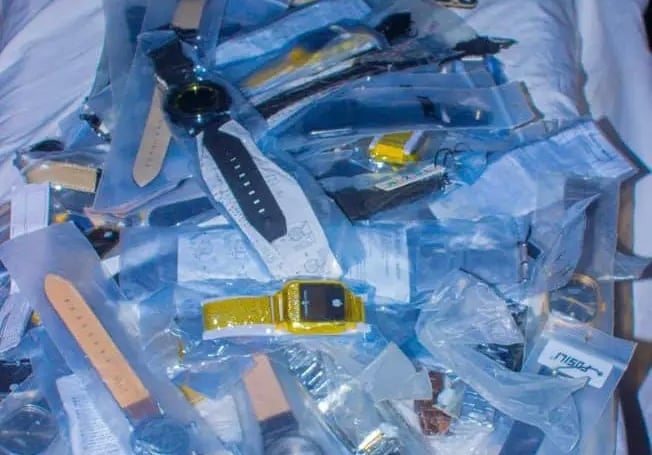
The PPRO explained that during the investigation, 80 wristwatches, nine cellphones, and a knife were recovered from the suspects as exhibits.
He further said that the state Commissioner of Police, Mr Bello Shehu, commended the operatives for a job well done and appreciated the support of the public.
Aliyu quoted the CP as urging the public to continue providing useful information that would aid in the fight against crime and criminality in the state.
He stated that the suspects would be charged in court after investigations.