
H1 2020: Fidelity Bank Posts Impressive Half Year Results

·      Profits up by 22% as Gross Earnings hit N105.8bn. 

Despite the economic challenges occasioned by the COVID-19 pandemic, Fidelity Bank has sustained the financial performance trajectory of recent years, with another set of impressive financial results. Details of the Audited Half Year results ending June 30, 2020 for the top Nigerian lender, released on the Nigerian Stock Exchange (NSE) on Thursday September 3, 2020, show strong growth in profits and other indices.

The bank recorded a surge in Profit Before Tax of N12.0bn from N9.8bn in 2019, which translated to a 22% growth. Net profits for Fidelity Bank grew by 33% from N8.5bn to N11.3bn in the reporting period. In other indices Total Assets rose by 13.7% from N2.1trillion in 2019 to N2.4trillion this year whilst Total Deposits rose by 14.8% from N1.2trillion to N1.4trillion during the same period.

Commenting on the results, Fidelity Bank CEO, Nnamdi Okonkwo said the performance for the period, reflects the resilience of the bank’s business model. “Due to the global and domestic headwinds witnessed in H1 2020, we proactively increased our cost of risk as the impact of the pandemic slowed down economic activities whilst adapting our business model to the new risks and opportunities of the new normal” he stated.

According to him, Fidelity Bank, re-stated its H1 2019 figures from N15.1bn to N9.8bn to reflect the impact of IFRIC 21- Levies, which was adopted for the first time on the H1 2020 financials. “The key impact of IFRIC 21 was that our 2020FY AMCON Cost was recognized 100% in our H1 2020 Accounts rather than been amortized over 12 months as was done previously on our financials” said the Fidelity CEO”. He further revealed that, without implementing IFRIC 21, profit for the period would have been N17.9bn compared to the N15.1bn reported in H1 2019.

Fidelity Bank has been implementing a digital-led retail strategy and digital banking gained further traction during the period with 87.3% of the bank’s customers now transacting on digital platforms. The figures are up from 82.0% in 2019FY while 51.2% of the bank’s customers are now enrolled on the bank’s mobile/internet banking products.

“Though digital banking income dropped by 29.1% due to the downward fee revisions for electronic transactions in line with the new bankers’ tariff, we have continued to receive positive reviews on our digital channels. IVY, the bank’s chat box is rated as the clear leader, among virtual assistants in the industry, just as our flagship instant banking product (*770#) was also rated in the top tier category in the recently released 2020 KPMG Digital Channels Scorecard” he explained.

Retail Banking in Fidelity Bank has continued to also deliver impressive results. Savings Deposits in H1 2020 increased by 32.2% to N363.9bn with the bank on course to achieving the 7th consecutive year of double-digit growth in savings. Savings Deposits accounted for 49.1% of the total growth in customer deposits and now represents 25.9% of total deposits compared to 22.5% in 2019FY.

In reflection of the bank’s early conservative assessment of the sectors that were affected by the COVID-19 pandemic, the bank’s Non-Performing Loans (NPL) ratio increased to 4.8% from 3.3% in 2019FY. Regulatory Ratios however remained above the required thresholds with Capital Adequacy Ratio increasing to 18.8% from 18.3% due to the capitalization of H1 2020 Audited Profits while Liquidity Ratio stood at 32.1%.

Buoyed by the H1 performance, the bank is optimistic about the remaining part of the year. “We believe the new phase of normalcy will unveil some growth opportunities. We will continue to monitor and pro-actively manage any evolving risks as the Nigerian economy gradually reopens and economic activities pick-up in key sectors” Okonkwo stated.

How Sterling Bank Staff Compromise Customers’ Security Details to Obtain Loan

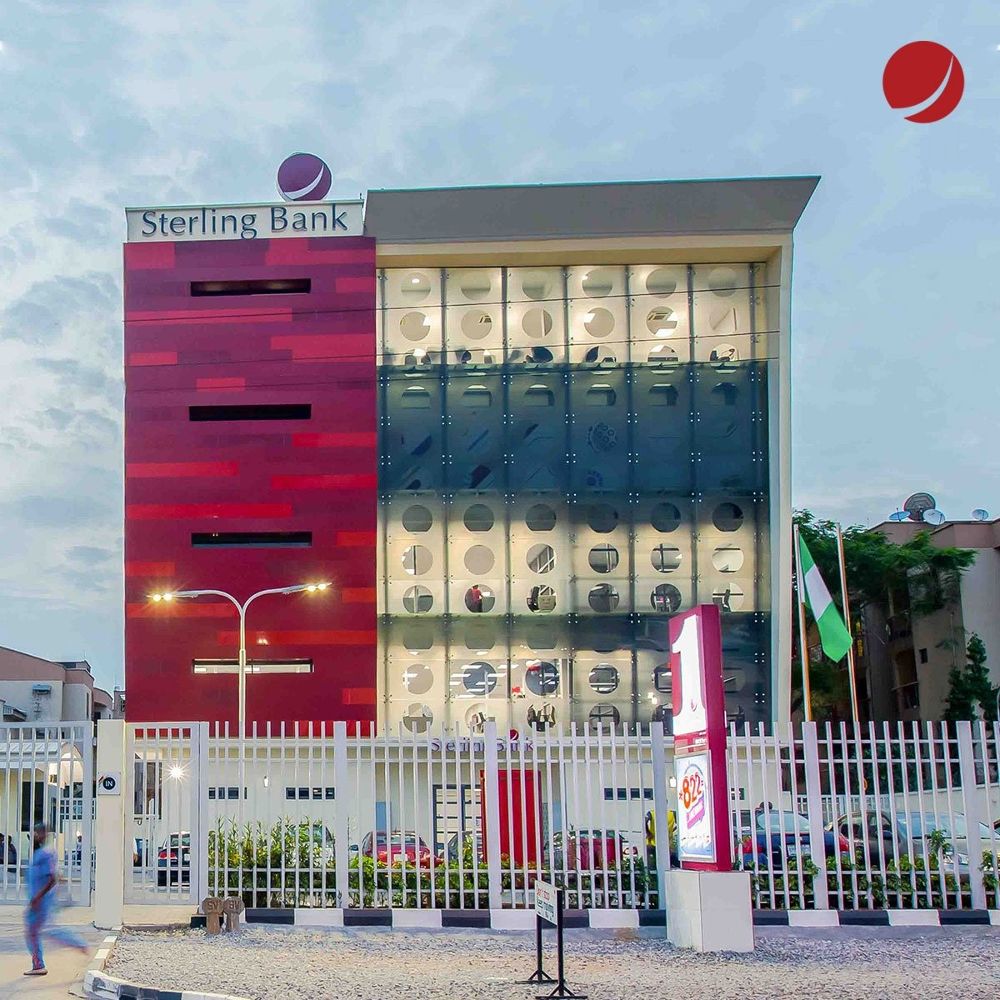
Two farmers, Umar Abubakar and Muhammad Sani-Abdul, have revealed how staff of Sterling Bank in Bauchi State fraudulently opened unauthorised accounts using their names and Bank Verification Numbers to apply for loans.

The farmers, in a petition seen by SaharaReporters, told the Consumer Protection Council that they started receiving messages in December 2017 suggesting opening of accounts with the bank without taking such step.

They said they were shocked to learn that the accounts opened on their behalf owed the Nigeria Incentive-based Risk Sharing System for Agricultural Lending N1,291,888.00 per person.

“That we opened accounts with Stanbic IBTC Bank as part of a plan to engage in wheat farming. We are pleased to attach our Bank Verification Number. That, doing so was an attempt to partially meet the conditions for getting access to loan facility to achieve the said goal under the platform of Evergreen Cooperative Society, which was said to have partnered with a certain Madaki Agro Firm.

“That, contrary to (a) above, we started receiving alarms in December 2017, suggesting opening account with Sterling bank, a deal we were unaware of. That going by frequent cyber shady deal, we dismissed the matter (stated C above) as trivial. Because to the best of our knowledge and belief, we neither opened account nor did we authorise anybody or any organisation to do so on our behalf.

“That, in the preceding months, there were transactions in the said accounts amounting to millions of naira concerning loan facility we did not apply for. Moreover, the account was said to have been controlled by a third party. We neither know nor delegated to do so on our behalf.

“That we were extremely shocked to learn that the accounts that were purported to have been opened for us owed NIRSAL worth N1,291,888.00 per person. We have thus been exposed to danger, we strongly suspect shady deal between the two banks and possibly other parties.

“We understand this is a gross violation of our fundamental and inalienable rights as provided in 1948 universal declaration of human rights, International Convention on Economic, Social and Cultural Rights (1966), Nigerian constitution (1999), Bank and other Institution Act (BOFIA), Central Bank of Nigeria Act 2007, Human and People’s Right and other enabling laws,” the petition reads.

Prophet Omale Slam 5bn Suits against Inept FCMB for EFCC Error

The General Overseer, Divine Hand of God Prophetic Ministry, Prophet Emmanuel Omale, has sued First City Monument Bank Plc for N5bn.

Omale, who claims to be the spiritual guide of the suspended acting Chairman of the Economic and Financial Crimes Commission, Ibrahim Magu, said FCMB falsely reported to the Nigerian Financial Intelligence Unit that N570m was paid into his church account, thereby, leading to accusations that the money was used in purchasing a house in Dubai for Magu.

The suit marked FCT/HC/CV/2020, was instituted by Omale; his wife, Deborah Omale; and the church, the Incorporated Trustees of the Divine Hand of God Prophetic Ministry.

The claimant stated that in 2016, the FCMB falsely reported to the NFIU that N570m was paid into the church’s bank account marked 1486743019 which caused security agents to put the account under surveillance for four years.

The statement of claim read in part, “Sometime on or about the 6th day of July 2020 the former acting Chairman of the EFCC, Mr. Ibrahim Magu, was arrested and summoned to the Presidential Villa, Abuja, to appear before the Presidential Investigation Committee on the Alleged Mismanagement of the EFCC, Federal Government Recovered Assets and Finances From May 2015 to May 2020.

“That one of the key allegations levelled at the Presidential Investigation Committee against Mr. Ibrahim Magu, was that the 2nd Claimant (Prophet Omale) fraudulently and corruptly purchased a real estate property for Mr. Ibrahim Magu in Dubai, the United Arab Emirates with the said sum of N573, 228, 04 allegedly credited as an inflow into the 1st Claimant’s (church’s) Corporate Current Account No: 1486743019 in the year 2016.”

The claimant stated that due to the investigation and negative media reports, they were exposed to public hatred and contempt and injured in their religious calling.

The cleric said he and his wife were summoned to appear on August 10, 2020, before a Presidential Investigation Committee at the Presidential Villa, Abuja.

Omale and his wife, accompanied by their lead Senior Counsel, Gordy Uche (SAN), and a team of four senior lawyers appeared before the panel on August 10, 11, and 12 and were grilled for hours on their alleged roles in respect of the sum of N573m used in fraudulently and corruptly purchasing a real estate property for Magu in Dubai.

The cleric said they paid Uche (SAN) & Co., the sum of N15m to appear and represent them for three days before the said Presidential Investigation Committee and attached a copy of the receipt to the statement of claim.

He said they all denied the allegations of fraud, adding that he never bought any property for Magu when grilled by the panel.

Omale said the Salami panel in the course of its hearing also invited the Managing Director/Chief Executive Officer of FCMB, Adam Nuru, who appeared before the committee and testified.

“That Mr. Adam Nuru in his testimony informed the Presidential Investigation Committee that the said N573M was credited to the bank account of the 1st claimant (church) in error and that the error was not discovered by the defendant for over four years,” the cleric said.

Omale said they paid the law firm of Gordy Uche (SAN) & Co., the sum of N75m to institute the suit against FCMB and attached a copy of the receipt for the said professional fees to the statement of claim. He said in all, he had lost N180.5m due to payment of legal fees and personal losses.

Omale, therefore, sought a declaration of the court that the FCMB negligently breached the fiduciary duty of care it owes the claimants by its false automated report to the NFIU of a suspicious credit inflow of N573m into the church account.

The statement of claim further read, “The sum of N5,000,000, 000.00 (Five Billion Naira) being exemplary, aggravated, special and general damages against the defendant for the negligent breach of its fiduciary duty of care to the claimants by its false automated report to the NFIU of a suspicious credit inflow of N573, 228, 040. 41 into the 1st claimant’s corporate current account number1486743019 with the defendant, which has occasioned grave damages to the claimants.” (The PUNCH)

Ecobank Announces New Date for Its ‘Africa Trade Conference 2020’

Ecobank Nigeria, a member of the pan African banking Group has concluded plans to host its first Regional Trade Conference. The virtual forum with the theme “Facilitating Regional Trade in the emerging AFCFTA era” is slated for the 22nd of September. The conference, which will feature presentations and panel discussions by highly experienced subject matter experts and thought leaders in relevant industries, will provide an opportunity for exporters and importers within Africa to engage, creating a marketplace experience.

The Ecobank Nigeria ‘Africa Trade Conference 2020’ earlier slated for March was postponed due to the lockdown restrictions following the outbreak of the COVID-19 pandemic. Announcing the new date and movement of the conference to an online platform in line with current realities, Sunday Abah, Head, Trade Finance, Ecobank Nigeria stated that due to its unrivalled footprint across Africa, Ecobank is uniquely positioned to facilitate cross border trade within the region leveraging its comprehensive trade solutions and various payment methods available across its network within Africa.  According to him, “Ecobank’s unique intra-Africa trade solutions enable settlements of international transactions and mitigation of payment risk while providing regional solutions such as issuance of payment guarantees to exporters without the need for a letter of credit and its related costs to the importer. Ecobank works closely with clients in structuring transactions, settlements, financing and risk mitigation” he noted.

 Further, he said “Our trade products and solutions are designed around two broad areas; trade finance and trade services. Trade Finance enables our customers benefit from adequate and well mitigated credit facilitation in the area of Import finance, export finance, bill discounting, trade loans, distributor finance, payables and receivables finance, structured trade and commodity finance amongst others while our trade services, offer our customers the advantage of speedy turn around and error free processing of their import letter of credits, import collections, avalised bills, Customs bonds, export collections as well as their local purchase orders and payment invoices, via our electronic trade platforms OMNI e-Trade and OMNI eFSC (electronic financial supply chain).

 The Ecobank Regional Trade Conference, which will be moderated by Mr. Tedd George, the Founder and Chief Narrative Officer of Kleos Advisory, UK is privileged to have as its Special Guest of Honour, Mr. Segun Awolowo, Executive Director/ Chief Executive, Nigeria Export Promotion Council. Notable speakers and facilitators across the globe are also expected at the event.

Ecobank Nigeria Empowers Small Businesses, As AUDA-NEPAD Partners Ecobank Group To Launch MSME Academy

Managing Director, Ecobank Nigeria, Patrick Akinwuntan has pledged the bank’s support for small businesses operating in the country, stressing that the micro, small and medium enterprises (MSMEs) sub sector remains the most affected by the COVID-19 pandemic and needs support in the revamping of the nation’s economy. Akinwuntan who was speaking at the virtual launch of the first Pan-African MSME Academy in Lagos on Thursday, maintained that MSMEs are the drivers of post COVID-19 economic recovery for Nigeria, noting that the sub sector should take advantage of technology, financial services, and support from the government to drive the survival and growth of their businesses.

Further, Mr Akinwuntan said the MSME Academy is an initiative of the African Union Development Agency – AUDA-NEPAD in partnership with the Ecobank Group. The Academy provides easy access to practical training and resources on financing opportunities in various countries, how to build a digital presence for businesses and how to adapt business operations in the era of the COVID-19 pandemic. In his words, “ as an MSME friendly bank, we have been helping them with capacity building; providing simple and easy access to loans  in various sectors including agriculture, creative industry, healthcare and commerce amongst others; access to markets via our e-commerce solutions and simple but robust digital platforms for collections and payments. We have also provided a channel to enable MSMEs open various accounts via self-service on our webpage. I encourage all MSMEs in the country to avail themselves of this opportunity to grow their business. ”

Also speaking Amine Idriss Adoum, Director, Programme Delivery & Coordination, AUDA-NEPAD explained that the MSME Academy aims to build the capacities of MSMEs across Africa through a combination of relevant content library, a network of institutions specialized in MSME support such as incubators and accelerators, and a community of peers, mentors, and advisors. He noted that  the key objectives of the academy is to radically expand access to finance by aggregating smaller financial institutions such as micro-credit institutions and credit unions that have access to micro-enterprises, standardising their processes, and building trust in their capabilities. “The MSME Digital Platform is a one-stop-shop for all MSMEs across Africa to access all these three programmes which jointly address MSMEs’ challenges with access to capacity building, markets, and capital”. He explained.

In his presentation titled: “How MSMEs can access funding – opportunities from financial Institutions/banking sector”, Managing Director, Development Bank of Nigeria (DBN), Tony Okpanachi, said to be bankable, the MSMEs should have accurate financial statement, collaterals, good credit history, viable business model and sound corporate governance, listing the sources of funding to include equity, grants and credit. He emphasized that, “the AUDA- NEPAD and Ecobank partnership must be lauded as the entrepreneurial potential and critical role of MSMEs in economic growth and development in Nigeria is clear. We will continue to collaborate with other financial institutions to assist them with all necessary support to play their role to the economy.”

For the Director, Development Finance, Central Bank of Nigeria (CBN), Yusuf Philip Yila, he said the apex bank had put in place several funding support initiatives to enable the sub-sector survive the COVID-19 pandemic and beyond. According to him,  “For this important sub sector to survive the current COVID-19 pandemic and beyond, CBN and the bankers committee have put in place various stimulus packages to support MSMEs in the country. He noted that the CBN’s N50 billion Target Credit Facility (TCF) has been increased to N100 billion with the interest rate slashed to 5%  from 9% to keep them in business”. He encouraged MSMEs in the country to take advantage of the CBN’s various funding windows to meet the demands of their businesses as government is striving to revamp the economy as soon as possible through their efforts.

The first Panafrican MSME Academy is open to Medium, Small and Micro Enterprises in Nigeria and across Africa . The programme provides support to African MSMEs and is structured in three pillars, namely:  the MSME Academy, MSME Marketplace, and MSME Financing Support Programme to be delivered through an MSME Digital Platform. The Academy provides easy access to practical training and resources on financing opportunities in various countries in Africa, how to build a digital presence for businesses and how to adapt business operations in the era of the COVID-19 pandemic. It also offers free access to market intelligence, mentors with a diverse experience and assisting with access to funding opportunities.

Polaris Bank Introduces Target Saving Account

Polaris Bank has launched an account called ‘Polaris Target Savings Account’ to boost healthy savings culture and build a strong financial base.

The Group Head, Products and Market Development, Mrs Adebimpe Ihekuna, said this in a statement entitled ‘Polaris Bank introduces target savings account’ on Saturday.

Ihekuna said, “The savings culture is gradually going into extinction as people generally spend than save; hence, the launch of the target savings account to help Nigerians save for a better tomorrow.

“We recognise that there is never going to be enough money to save; that is what one must first accept but the need to develop the habit of savings is as important as life in itself.

“A salary increase for most people will not necessarily get them to save more, your children finishing school will not get you to save more, a bigger client for your business will not get you to save more, and getting older will not enable you to save more.”

Ihekuna added, “Paying off your mortgage and other debts will not get you to save more; all these are excuses not to start saving today. If you are not saving with what you have today, chances are you might not save when you have more money.”

She said it was not too late to start saving, adding that Nigerians willing to take up the challenge and begin to save for specific goals for the future could do so with ease, through the Polaris Target Savings account.

IBUKUN AWOSIKA, FIRSTBANK’S CHAIRMAN MAKE ACTING DEBUT IN CITATION

Mrs. Ibukun Awosika, Chairman, First Bank of Nigeria Limited has made her debut in a movie produced by award-winning, and proudly Nigerian movie producer, Kunle Afolayan. The movie, Citation, is created to correct one of the greatest ills – rape and sexual molestation – which affects the educational system and indeed societies around the world.

Mrs. Awosika plays the role of the dean of a university faculty, overseeing the senate hearing panel of a female postgraduate student (Moremi), played by Temi Otedola, who has been a victim of sexual harassment. The movie was shot to lend a voice to support victims of sexual harassment and rape, beyond the university environment. Ibukun Awosika was chosen due to her leading impact on women advocacy and leadership.

Unveiling Ibukun Awosika, the surprise cast of the movie, Kunle Afolayan posted on his official Instagram handle; “It all began in 2018 with the pre-production of Citation, then the production in January 2020, and now the 30th of August, we officially had the first private screening of Citation at Obafemi Awolowo University (OAU).

“Why OAU? Well, not only was Citation shot at the University, but our surprise cast is an alumna of the school.”

Expressing her delight on the movie, Mrs. Ibukun Awosika, Chairman, FirstBank said; “the physical and psychological effects of sexual harassment have a considerable toll on individuals and institutions in terms of cost. The effects of can hamper growth and the potentials and can stop the victims from engaging fully in life. We must, therefore, (as stakeholders, governments, institutions of learning; parents; media etc.), collectively rise against this menace and never let the deplorable behaviour of sexual harassment to fester.”

“I remain upbeat about this project – being part of a collective goal to continually keep dreams and hope alive; sacrificing and holding strong to our commitment to reignite the lost values. The casting experience has been very enriching and impactful to me. I am delighted to be amongst the very amazing casts in such an intriguing and brilliantly scripted movie.

Obafemi Awolowo University played host to the movie which was written by Tunde Babalola. Other stars in the movie include; Joke Silver, Jimmy Jean Louis, Sadiq Daba, Gabriel Afolayan and Temi Otedola, amongst others.

Heritage Bank to stimulate economic growth with youth empowerment schemes

As part of its further response to deal with the global economic challenge occasioned by COVID-19, Heritage Bank Plc has reiterated commitment to deepen its support to young entrepreneurs in Nigeria to grow their businesses either as start-ups or prospective business owners. This, the bank said, is in line with its culture as timeless wealth partners, which would impact positively on the nation’s socio-economic development.

The MD/CEO of the bank, Ifie Sekibo stated that Heritage Bank was mindful of the devastating impact of the pandemic to the nation’s economic system, hence as an institution at the forefront of investing in human capital development for critical economy recovery, “we will up our game to empower Nigerian youths who are one of the bedrock of any vibrant economy,” he added.

He disclosed that one of the channels churned out in partnering the youths to leverage their talents and contribute their quota to the growth of the economy, was the use of financial inclusion strategy which would be adopted to boost entrepreneurship development, as this is critical to Heritage Bank’s mission to create, preserve and transfer wealth across generations.

He further explained that Heritage Bank’s various entrepreneur schemes in the support for business had always focused on dependable job-creating sectors, such as agricultural value chain (fish farming, poultry, snail farming), cottage industry, mining and solid minerals, creative industry (tourism, arts and crafts), and Information and Communications Technology (ICT).

Sekibo restated that the aim of Heritage Bank being at the forefront of youth empowerment is to emancipate the latent entrepreneurial spirit in the teeming youths to unleash their support to the growth of the economy.

His words: “At Heritage, nothing else is more fulfilling than to groom-to-empower young aspiring start-up entrepreneurs, as we mentor them to grow and become large corporates enlisted on the Nigerian Stock Exchange.

“In recent times, we have worked with private and public sectors- The Next Titans, HB Lab, Creative Nigerian Summit, National Festival of Arts and Culture (NAFEST), NYSC and the Central Bank of Nigeria to support youths and young entrepreneurs to grow their businesses as a start-up or prospective business owners.

He also reiterated that the bank had continued to make efforts to lead the recovery of the Nigerian economy through championing several empowerment schemes such as the Prime Women Builders Foundation of Nigeria, Youth Innovative Entrepreneurship Development Programme (YIEDP), Centre for Values in Leadership (CVL) on Young Entrepreneurship Business Training Programme (YEBTP), Young Entrepreneurs and Students (YES) Grant and Nigerian Young Professional Forum (NYPF), amongst others.

NEC 10th Edition: UBA Foundation Calls for Entries, Introduces Digital Submission Portal for Students

  • Increases prize money by over 33% 

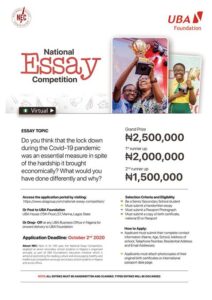
UBA Foundation, the corporate social responsibility arm of the United Bank for Africa (UBA) Plc, has today commenced the 2020 edition of its annual National Essay Competition in Nigeria with a call for entries.

Now in its tenth year, the National Essay Competition (NEC) is part of UBA Foundation’s education initiative which is aimed at promoting the reading culture and encouraging healthy and intellectual competition amongst secondary school students in Nigeria and across Africa.

This year’s edition, which is the 10th since inception, has been modified to ensure ease of access and increased participation of senior secondary school students from the comfort of their homes through the introduction of a digital submission portal.

Taking into consideration the effects the Covid-19 pandemic has had on lives and incomes across board, the UBA Foundation has also increased the prize money for the 2020 edition of the NEC by 33 per cent as the first prize winner will get an educational grant of  N2.5m, up from N2m in 2019. The second and third prize winners will now receive N2m and N1.5m educational grants respectively, from N1.5m and N1m which were awarded in the previous year’s competition.

The Chief Executive Officer, UBA Foundation, Mrs. Bola Atta stated that with the newly introduced digital submission portal, more students in secondary schools across the country will have the opportunity to scan and send in their entries and compete to win educational grants for study at any university of their choice on the African continent.

She said, “As a Foundation, which is the CSR arm of the United Bank for Africa – a fully digitalised bank, we are driven by the mantra to always innovate and adapt to our constantly changing environment. This year, we thought hard about how to ease the pains that everyone is feeling. Students have not been able to go to school and there has been a lot of anxiety in families trying to ensure that educational gaps do not emerge.  It is imperative for us at the UBA Foundation that our impact programmes do not wane. We also need to design them to be as inclusive as possible so that those students who don’t have easy access to computers can still participate in the competition with a chance to win grants towards their tertiary edification.’

Atta explained that the choice of topic for this year’s edition is one that helps promote creative and analytical thinking in students whilst helping them become problem solvers. The essay topic selected is “Do you think that the lock – down during the Covid-19 pandemic was an essential measure in spite of the hardship it has brought economically? What would you have done differently and why?”

All entrants are to hand write their essays and upload scanned copies of their handwritten entries as well as ID on the digital portal at www.ubagroup.com/national-essay-competitionbefore October 2, 2020. They may also drop off the handwritten essays at their nearest UBA business office for onward submission to the UBA Foundation.

The judges who are made up of esteemed professors from reputable Nigerian Universitieswill receive all the essays on a digital drive, evaluate them and select the top 12 finalists all of who will take home consolation prizes including personal computers. 

The finale of the NEC this year will be conducted virtually as the initiative rolls out across 19 more countries in Africa.

UBA Foundation embodies the UBA Group’s CSR objectives and seeks to impact positively on societies through several laudable projects and initiatives. The Foundation has donated hundreds of thousands of books to students across Africa under the ‘Read Africa’ initiative aimed at encouraging and promoting the reading culture in African youths.

Students can apply for the National Essay Competition 2020 at: www.ubagroup.com/national-essay-competition;

ZENITH BANK GMD SEEKS EXPANSION OF NON-OIL EXPORTS POST COVID-19

The Group Managing Director/Chief Executive of Zenith Bank, Mr. Ebenezer Onyeagwu has called for a concerted effort towards diversifying the country’s export base through the promotion of non-oil exports. He made the call during a Webinar themed “Prospects of Non-Oil Export During and Post COVID-19” organized by the bank on Wednesday, August 26, 2020.

According to him, the onset of the COVID-19 pandemic which has impacted the demand for oil and, by extension, the price of crude oil in the international commodities market has further exposed Nigeria’s over-dependency on crude oil earnings and its susceptibility to oil-related shocks. He added that the events of the last couple of months have also highlighted the limited range of the country’s value-added products exported to foreign markets.

He noted further that boosting non-oil export is imperative in view of the opportunities that exist in the broader contexts of ECOWAS Trade Liberalisation Scheme and the African Continental Free Trade Area (AfCFTA) which seeks to create a continent-wide market of 1.2 billion people with combined Gross Domestic Product (GDP) of $2.5 trillion and about $4 trillion in consumer and business spending.

Whilst commending the efforts of the government and the Central Bank of Nigeria (CBN) to deepen the non-oil export business in the country, Onyeagwu urged players in the non-oil export value-chain including exporters and financial institutions to play their part in the drive towards expanding the nation’s non-oil export base.

Delivering the keynote address, the Director of Trade & Exchange, Central Bank of Nigeria (CBN), Dr. (Mrs) Ozoemena Nnaji, who commended Zenith Bank for organizing the webinar at a time like this, observed that the impact of the COVID-19 pandemic is a wake-up call for the country, as it has once again exposed the over-dependence of the Nigerian economy on one product. She therefore called for a deeper policy look at the non-oil sector to find ways of genuinely improving the quality and quantity of our non-oil export goods.

Also speaking at the Webinar, the Chief Executive/Executive Director of the Nigerian Export Promotion Council (NEPC), Mr. Olusegun Awolowo commended the efforts of Zenith bank in promoting non-oil export business in Nigeria, describing the bank as ‘the Export Trade Bank of Nigeria’. Speaking on the topic “Repositioning Non-oil export as a Leading Revenue Earner: Government Plans and Programmes”, Awolowo noted that the crash in oil prices following the COVID-19 pandemic and OPEC’s price war with Russia reinforced what everyone already knows – the mono-product economy of the country is not sustainable, calling for a buy-in into the Zero oil policy of NEPC.

Zenith Bank remains committed to the promotion of the non-oil export sector in Nigeria by identifying emerging opportunities which help in stimulating non-oil exports and developing robust financial products and incentives for operators in the sector. The bank l

Exit mobile version