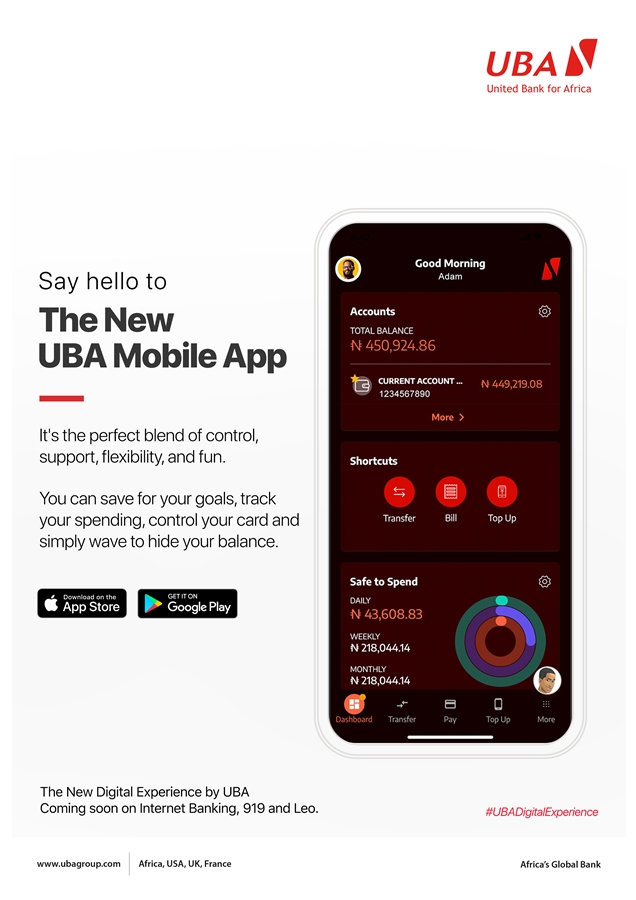
Pan African financial institution, United Bank for Africa (UBA), Plc is set to change the face of digital banking services with its new mobile banking app aimed at delivering first-rate services to customers.
The new UBA mobile banking app, has been armed with benefits and features designed to give its customers increased control and accessibility to carry out transactions with ease.
UBA’s Group Head, Digital Banking, Kayode Ishola, who spoke about the new banking app to members of the press during an international virtual media parley on Monday, explained that apart from being able to decide where they want their cards to operate and block, view, or request new cards straight from the app to suit their specific needs, the app has been tailor-made to give customers what they want, how and in the way they want it.
Reeling off some of the features and benefits of the app, he said a lot of investment in cutting edge technology and attention to details was put into the new UBA mobile app.
Ishola said, “The new UBA Mobile App is your personal finance manager built with a distinctive user interface that will change the face of banking. With this app, we are reimagining banking as our engagement has moved from being channel-based to being platform-based. The speed of the platform has been made to match the speed of light as we have cut down significantly on the number of processes expected to carry out your transactions.
“Interestingly, we have worked towards creating behavioural insight for our customers and working around this to address the real needs of our customers using the Omni channel platform and running on our open digital platform, which is very interactive and armed with lifestyle services. It is sleek and trendy with seamless user interface” Ishola stated.
UBA’s Head, SME Banking, Sampson Aneke, said that apart from the fact that the app has been created with journey that has a high-level of intelligence – as it can work based on frequent transactions, it can also speak to the specific country where it is being used as the new mobile app runs concurrently in the 20 countries of UBA’s operation interacting in the different languages and cultures in line with the specific needs and regulation of the country in focus.
“This all-encompassing platform which boasts of a new user interface because of its sleek, modern nature of delivering seamless experience across several devices; can be used as a budgeting tool, loan application and also allows customers view their expenses according to their various categories such as the amount spent on data within a particular period;” Aneke added.
On the security features of the app, UBA’s Group Chief Information Officer, Onyebuchi Akosa, said that security of the app are best in class adding that the new platform, which will revolutionise the way banking services are offered, promises to deliver increased personalized banking via a watertight and highly-effective security system.
“The new app has also been built with the best-in-purchase security features and has been modelled appropriately to ensure that all the features are working properly to secure transactions maximally. It is also important to mention that the bank took into consideration the virtually impaired, and thus has used voice recognition as a channel for transaction which suits both convenience and the visually impaired customers,” he said.
United Bank for Africa Plc is a leading Pan-African financial institution, offering banking services to more than twenty million customers, across 1,000 business offices and customer touch points, in 20 African countries. With presence in New York, London and Paris, UBA is connecting people and businesses across Africa through retail, commercial and corporate banking, innovative cross-border payments and remittances, trade finance and ancillary banking services.
First Bank of Nigeria Limited is supporting schools with an array of educational based products and solutions targeted at enabling the acquisition of various facilities to boost the continuous expansion and improvement of the educational sector. Parents are not left out, as the Bank has bespoke products which empowers parents and guardians to meet the educational needs of their children.
The Bank’s educational products and solutions include the FirstEdu Loan, Operational Vehicle Loan, Term Loans for constructing new sites and extension of existing sites, Personal Loan Against Salary (PLAS) and FirstAdvance which enhances Parents/Guardians’ capacity to pay their wards’ school fees.
The FirstEdu loan offers short-term finance to private pre-primary, primary and secondary schools/ registered A level educational institutions with steady flow of income. The product offers opportunity for private schools to access flexible funding to meet urgent cash flow needs, replace old furniture and equipment or assets, purchase of fairly-used school buses, as well as refurbishing dilapidated buildings and classroom blocks. This product helps school owners/proprietors in bridging the “no-income” gap between school terms, and to enhance diverse assets acquisition. It allows schools access up to N20 million with no tangible collateral required apart from the domiciliation of school fees with the Bank. Schools with CAC registration that are yet to get Ministry of Education approval can access up to N2million without collateral for up to 90days. In a bid to cushion the effect of covid-19 pandemic, the Bank is in partnership with Lagos State Employment Trust Fund (LSETF) to finance low-cost private schools at a single digit interest rate where schools can access up to N5million.
The Bank is also in partnership with the apex association of private school owners in Nigeria, National Association of Proprietors of Private Schools (NAPPS) to finance member schools at a highly competitive rate. This reduces the cost of borrowing to the customer and eliminates the challenges posed by the provision of additional demanding collaterals.
The Operational Vehicle Loan is targeted at registered businesses. It allows the entrepreneur to acquire brand new vehicles for the day to day operation of the business. Organisations can take advantage of this facility to purchase school buses in the case of school proprietors and even upscale their staff welfare schemes through provision of staff buses. The product terms and conditions is competitive.
Personal Loan against Salary (PLAS) offers customers in paid employment access to cash to meet immediate financial needs such as payment of school fees, medical treatment, holiday expenses, etc. PLAS has a flexible repayment plan spread up to 48 months for our customers’ convenience. There is no equity contribution or collateral requirement.
FirstAdvance is a 30days tenured digital loan also available to salary customers who are in need of assistance to meet immediate financial needs. It empowers customers to access upto 50% of their net monthly salary in less than a minute at any desired time by dialing *894*11# or through our FirstMobile App. Only a salary account domiciled with FirstBank will qualify you for PLAS and FirstAdvance.
Beyond these, FirstBank is at the forefront of promoting virtual learning, whilst exposing not just school children but individuals of all ages to various e-learning initiatives, designed to promote innovation and skills development on emerging technologies through focus areas such as Artificial Intelligence, Coding, Cloud, Internet of Things, Blockchain, Data Science and Analytics, and Cybersecurity.
In achieving this, the Bank has collaborated with Lagos State government, IBM and Curious Learning to ensure the e-learning initiative swiftly moves across the country to school children and individuals with the need to promote the pursuit of knowledge, irrespective of age.
Speaking on the Bank’s support for schools, Mr. Chuma Ezirim, FirstBank’s Group Executive, e-Business & Retail Products, said “at FirstBank, we recognize the indelible roles the educational sector plays in promoting national economic development and we are delighted to support schools with collateral free educational solutions to meet various needs and projects to advance to the next level.”
“As schools proceed with the new term, we enjoin interested schools to visit the nearest branch or the Bank’s website for more information and encourage everyone to access our e-learning driven initiatives to keep learning and get exposed to various opportunities to stay ahead in today’s technologically advanced world.”
When Mark Zuckerberg recognised UBA’s Leo at Facebook F8
Technology has been a veritable gift to mankind, and over the years, it has been responsible for creating amazingly useful resources which put all the information individuals need at their fingertips. The development of technology has also led to so many mind-blowing discoveries, better facilities, and better luxuries, which has in-turn helped to improve lifestyle and standard of living.
For instance, through relevant technological development, the average individual has been empowered to shop online and carry out seamless transaction any time of the day or night from the comfort of his own home or business place.
To this end, forward thinking companies and financial institutions with eyes in the future who have been conversant with the new trend in customer behaviour, have painstakingly designed new products and services tailor-made to meet the growing needs of customers anytime anywhere.
It is bearing this in mind that Pan-African financial Institution, United Bank for Africa (UBA) Plc, changed the face of e-banking in the African continent for the first time with the introduction of Leo – UBA’s Chat Banker. The idea of Leo, which was birthed in 2018, was to enable customers make use of their social media accounts to carry out key banking transactions with ease.
This is the first time ever that a financial institution in Africa evolved a one-stop solution to simplify the way customers transact, a key essential in today’s fast-paced world with demands for quick-time transactions and response.
With Leo’s help, customers have been able to open new accounts with ease, receive instant transaction notifications, check their balances on the go, transfer funds and airtime top up. Cheque confirmation, bill payments, loan application, account freezing, request for mini statements, flight bookings, airtime and data purchases, are some other services that the chat banking BOT has been helping customers to carry out since 2018.
And Leo, the Artificial Intelligent Bot which carries out seamless conversations with his customers – who he calls his friends by the way- has achieved this and more in its three-year existence; allowing users to carry out quick, fast and recurring transaction with ease from their popular social media accounts such as Facebook and Whatsapp.
No wonder the bank has earned a lot of laurels and accolades in the last three years confirming Leo’s global acceptance and recognitions, as pointed out by UBA’s Group Manging Director, Mr. Kennedy Uzoka, some of which are:
‘Africa’s Best Digital Bank of the year’ by Euromoney; The Most; Innovative Bank of the year’ by International Finance; ‘Best Customer Engagement Tool’ by Africa Fintech; Pulse magazine rated Leo on WhatsApp as ‘The best WhatsApp Banking App’; ‘The Best Social Banking platform’ in Uganda; ‘Excellence in Automated Chatbot Initiative’ by Finnovex Awards; ‘Next Generation Class of 2019’ by CIBN; ‘Best Automated Chatbot Initiative, Application or Programme’ by The Asian Banker. The list is endless.
“The formulation of this product, is consistent with UBA’s Customer 1st philosophy, where we have been doing things not the way we like, but focusing on what the customers want, where they want it, and in the exact platform they want it; Uzoka explained. “At UBA, we have been continuously working with technology giants that have the global capacity to ensure not only seamless but also effortless banking for the millions of our customers across Africa; as all the bank’s subsidiaries in Africa have activated Leo to perform financial services for customers.
Continuing, he said, “Since 2018, Leo has been helping with most transactions and to deliver any form of banking services. And this has been highlighted more especially during the lockdown occasioned by the COvid-19 virus, as Leo assisted all its users on all major social media platforms to carry out all their banking activities without having to physically visit a branch. This, to us, remains an admirable feat because with Leo, the banking needs of our customers have become easy and simple – as simple as chatting”; Uzoka pointed out.
Within three years of operations, UBA’s Leo has recorded a number of milestones including opened a total of 390,756 accounts; achieving 2,169,384 subscribers; conducting a total of 9,605,703 transaction count worth a value of N81,530,918,868.Leo which has over 2.1m unique users has also generated over 20 million conversations and over 85 million engagements; with such impressive feedback and usage and remains the only AI BoT showcased at the F8 in Mark’s Zuckerberg’s opening remarks.
UBA’s Group Head, Digital Banking, Sampson Aneke, reiterated that Leo is not just a chat machine, but an artificial intelligence personality meant to address any type of banking concerns raised by customers.
“Leo has been operating a secure lifestyle banking platform on Facebook messenger, WhatsApp and IOS and Andriod to assist customers with their transactions while chatting with your friends and business partners. The security with this platform has been that for every transaction, a One Time Password (OTP) is generated to the phone number that is registered on your account,” he explained, and added that the bank is working tirelessly to improve LEO’s services to the customers in the coming weeks.
United Bank for Africa Plc is a leading Pan-African financial institution, offering banking services to more than twenty-one million customers, across over 1,000 business offices and customer touch points, in 20 African countries. With presence in the United States of America, the United Kingdom and France, UBA is connecting people and businesses across Africa through retail; commercial and corporate banking; innovative cross-border payments and remittances; trade finance and ancillary banking services.
First Bank of Nigeria Limited, Nigeria’s leading financial inclusion services provider has launched the Virtual Payment card, a Naira denominated debit card and digital representation of the plastic debit card. The card is designed to be linked to either a customer’s operative account or wallet account.
The FirstBank Virtual Payment Card is a suitable alternative to the use of cash and cheques, with its wide-range features which include the ability of cardholders to protect his/her card using the block and unblock capabilities; PIN Reset; Change PIN as well as view statement at one’s convenience. It also enables diaspora customers to spend from his/her FirstBank account within the spend limit advised by the bank without the need for a physical card.
The FirstBank Virtual Payment Card is a safe, convenient, and easy way of making e-commerce payments amongst other functionalities.
The Virtual Payment Card can be created via the Bank’s leading digital channels; FirstMobile or Firstmonie Wallet applications. Customers can download the card, activate the card and consummate transactions all at once from the comfort of their homes/offices. No branch visit is required. Customers are advised to update their mobile application to the latest version, then select Card Services on the FirstMobile App and My Virtual Card application to create a Virtual Card at the cost of N215 (VAT Inclusive).
Speaking on the launch, Mr. Gbenga Shobo, Deputy Managing Director, First Bank of Nigeria Limited said ‘the launch of our Virtual Payment Card is yet another secure and seamless way we promote electronic banking, whilst enabling customers to carry-out their transactions on the web”
“The Virtual Payment Card is also designed to guard against the spread of the COVID-19 as it does not require physical interaction between the customer and FirstBank Branches. We enjoin our customers to download the application and stay ahead in modern banking,” he concluded.
Similarly, FirstBank recently launched the FAST Track ATM, the next generation ATM and first of its kind in Africa, designed to promote financial activities on the ATM without any form of physical interaction with the machine.
For more information on the Virtual Payment Card, kindly click here for the Frequently Asked Questions (FAQs).
– SPEARHEADS INNOVATION IN ELECTRONIC BANKING IN NIGERIA
In the light of COVID-19, FirstBank has launched the FastTrack ATM, a Next Generation ATM and first of its kind in Africa, designed to promote financial activities on the ATM devoid of any form of physical interaction with the machine. The introduction of the FastTrack ATM which is done in partnership with Inlaks enables customers carry out cash withdrawals without having to touch the interface of the ATM.
With the FastTrack ATM, widely referred to as Touchless Solution, the customer carries out the transaction by using his or her mobile phone to perform the needed steps designed originally for implementation on the ATM. By using one’s phone, the transaction is carried out – in advance – through the Bank’s USSD or mobile banking option. Upon the schedule, the customer visits the FastTrack ATM to complete the transaction by tapping a contactless Near Field Communication (NFC) card on the ATM to withdraw his or her cash.
FirstBank customers can now leverage the real-time mobile banking capabilities of their cellphone to activate cash withdrawals at the FastTrack ATM. The ATM solution is the Bank’s response to control the spread of COVID-19, whilst promoting the safety of customers that carry out transactions at the ATM.
Speaking on the launch of the FastTrack ATM, Dr. Adesola Adeduntan, CEO, First Bank of Nigeria Limited said ‘at FirstBank, we are driven to provide seamless financial solutions to ensure our customers are able to timely carry out their transactions in safe, secured and efficient ways, thereby putting them ahead in digital banking, not just in Nigeria but Africa. We are delighted to set the pace regarding the use of the Next Generation ATM in Africa which enables customers to use their mobile phones to remotely initiate ATM-based cash withdrawals via our *894# USSD banking or FirstMobile application. At the core of our strategy lies innovation which is critical to adapting to the new normal’.
According to Olufemi Adeoti, Managing Director, Inlaks, “given that consumers are more adaptable to mobile technology Inlaks – the Africa’s leading Information Technology Solutions provider together with Hyosung ATM OEM are partnering with FirstBank to introduce the first fully compliant COVID-19 FinTech ATM. This is in alignment with the ‘new normal’ desired customer experience which includes digitalization and delivering a secure contactless cash access to the bank’s FirstMobile customers for better user experience, simplicity, speed and convenience”
In recognition of its giant strides at promoting electronic banking in the country, FirstBank’s mobile banking application – FirstMobile – was recently awarded the Best Mobile Banking App award 2020 in the Global Finance Best Digital Bank Awards 2020 as well as 2019 Best Mobile Banking App by Global Business Outlook.
FirstBank has been at the forefront of promoting electronic banking solution in Nigeria. In 2017, the Bank was recognized as the first financial institution in Nigeria and the West-Africa sub-region to issue 10 million ATM cards to customers across the country. The bank was the second in Africa to achieve the milestone.
These feats are achieved through the trusts in its industry leading innovative banking solutions by over 10 million customers on its USSD *894# banking platform and over 4.1 million customers on its FirstMobile banking application, endearing the Bank to process about 30% of card transactions in the entire banking industry in the country.
The Lagos State Governor, Babajide Sanwo-Olu on Friday, November 13, 2020, unveiled the first Nigerian electric car named Hyundai Kona.
The car, which is a product of Stallion Group, was launched at the VON Automobiles Nigeria in Ojo, Lagos State where the car was manufactured.
The new Kona, an Electric car is regarded in European motoring industry as the world’s number one, with the cost, put at about N24 million
While speaking during the unveiling of the product, Sanwo-Olu observed that VON has over 40 to 50 years of vehicle manufacturing history, when they were assembling various Volkswagen products.
The governor was full of commendation for Stallion Group for the noble initiative, just as he promised that Lagos State Government will make provisions for electricity charging points for the vehicle across the state, to make it easy for users to enjoy their Electric Vehicles (EV).
Hyundai Kona
The Governor also promised the completion of the Lagos-Badagry Expressway, which was started under the administration of former governor of the state, Babatunde Fasola, in order to facilitate business activities in the state.
Sanwo-Olu said, “Lagos-Badagry Expressway which has been expanded from 2 to 10 lanes will soon be complete, we are not rushing the road; we are building a first-class road construction project.’’
The Managing Director, VON Automobiles, Mr Rohtagi Manish, while explaining the essence of the launch, pointed out that Kona will change things positively in the Nigerian auto market.
According to Manish, the changes in global temperature and weather patterns are seen today are caused by human activity. Kona, he said, is one way to respond to the global weather challenges, so as to achieve a greener environment.
This appears to be a huge boost for the promoters of more environmentally friendly automobile and subsequently promote a green environment. This will also help to drive the Federal Government’s efforts to shift focus from petrol-based automobile to vehicles with a cheaper source of energy.
The PS5 is finally here and while games are undoubtedly the most important part of any console launch, the PS5’s new user interface is a treasure trove of pretty cool new options. We had an in-depth look at the options and found a few tips and tricks to help supercharge your PlayStation experience.
Some are handled seamlessly during set-up but others are buried in a mountain of settings and options. We thought it was worth breaking down.
Here’s what we think is worth doing when you first turn on your PS5, to help tailor your PS5 experience to your own specific preferences.
PlayStation 5
1. Check out your privacy settings
During the initial PS5 set-up you’ll be asked to select from a series of four different privacy settings with names like “Social and Open” or “Solo and Focused”. It’s essentially letting you control your online profile and what others can see.
But those settings can be broken down further within those categories, giving you complete control over whether you’ll show up in search results, or who can add you as a friend, etc.
These settings can be found under the “Users and Accounts” tab in settings.
2. Select your power settings
The PS5 gives you the ability to better control how much power your PS5 is pulling, mostly when you put it into “rest mode”. As with the privacy settings, you’ll be able to choose between profiles during set-up, with presets that can be broken down further if you feel like diving deeper. Those presets determine how long it takes for your PS5 to power down when idle and also whether or not the console will automatically download updates — very useful if you want to avoid the dreaded system update when you want to play something online.
3. Mess around with HDR sliders
If you have a TV that’s HDR capable, you’ll definitely want to make sure you have these settings right.
Again, the PS5 allows you to tinker with the contrast and brightness during set-up but, personally, I went back and forth with these settings a few times, mainly because if you change the settings on your TV after set-up (say, to a Game Mode) those HDR settings will be affected. It makes sense to go back and optimize. Especially if you’re as picky about picture quality as I am! (I’ve spent an embarrassing amount of time fixing these settings.)
4. Experiment with the sub-menu
Possibly my favourite parts of the PS5’s UI is the sub-menu you can bring up whilst in-game. Basically if you push the big PlayStation button in the middle of the controller this sub-menu pops up in game. Very nifty.
Older consoles have had some variation of this feature for a while now, but I’m a huge fan of the PS5’s version. It’s unobtrusive, subtle and allows for customization.
You can access settings, mess around with sound levels and add additional devices like headphones. You can even link your Spotify account and choose music from the sub-menu. VR options are also available from here, which will be a big help for those trying to fix VR issues on the fly.
You can easily switch between recently played games in this sub-menu as well, negating the need to go to the homepage to start a new game.
But my favourite part: It’s possible to customize your sub menu. You can even add the PS5’s accessibility options to the sub, which I’d imagine will be incredibly helpful for disabled gamers.
5. Choose between performance and resolution
Those of you with a PS4 Pro will most likely be aware that games are going a bit PC. Games like God of War and Horizon Zero Dawn let you choose whether you’d prefer the PS4 Pro focus its extra processing power on resolution or performance (which essentially means frame-rate).
Personally, I always prefer a focus on performance over resolution. And if you have a TV that doesn’t do 4K, you’ll definitely prefer performance over resolution.
Either way, to save you the hassle of selecting your preferences anew with each game, the PS5 allows you to select a default choice in the settings. Head to Saved Data Game/App settings and select game presets.
6. Pick your default difficulty
In the game presets section, there’s a lot of good stuff — you can even choose which difficulty you prefer as a default.
Personally, that’s not something I’d be doing. I reckon game difficulty is way too subjective and differs wildly between games. But I know there are folks out there that like to immediately crank to the toughest setting straight away and, vice versa, people who just like to play games for the story.
7. Check your controller settings and have a tinker
This is an absolute must.
This isn’t exactly a new thing, but the PS5 lets you set up default controller settings that are applicable to all games. First and foremost, you can make “invert” your default on first-person shooters or in third-person games with camera controls.
I am constantly having to dive into game settings to change that, so that’s a must for me.
You’ve probably heard that the PS5 DualSense controller is a big leap forward in terms of its adaptive triggers and vibrate functions. You can also make changes to the intensity of the effect. Personally I wouldn’t touch it. I’m very happy with the default, but it’s there if you want to tweak it.
8. Choose your spoiler settings
I couldn’t believe this one exists but it does!
You can actually control the level of spoilers you will see when navigating through the PlayStation Store. You can select between eliminating “all” potential spoilers, or eliminating spoilers as determined by the developers of the game.
So if you happen to be incredibly sensitive to spoilers, you can head to the Saved Data Game/App section of the settings and click on Game Presets. The option is in there.
First Bank of Nigeria Limited, Nigeria’s premier and leading financial inclusion services provider, will host an SME webinar themed “Rebuilding your Business” by 10am on Tuesday, 10 November 2020 via Zoom meetings.
The event is organised in collaboration with FBN Insurance Brokers and FBN Quest with its discussants including: Tunde Owolabi, Group Executive, Retail Banking (Lagos & West), FirstBank; Olumide Ibidapo, MD/CEO FBNInsurance Brokers and Ijeoma Agboti, Managing Director, FBNQuest Funds.
As a brand committed to putting its stakeholders first, the SME Webinar is designed to empower the participants and promises to provide ways to access opportunities such as business financing, advisory, wealth preservation and appropriate business coverage. These opportunities are essential elements in the rebuilding and rebounding efforts, as well as safety of businesses, towards their continued contribution to national development.
Speaking on the event, Mr. Gbenga Shobo, Deputy Managing Director, FirstBank said “at FirstBank we identify with the indelible roles played by SMEs towards the continued growth of the Nigerian economy as without a doubt, they remain the engine of not just our economy but the global economy.”
“I enjoin every business owner to participate in this event in order to be enlightened with essential information to promote the safety and economic security of their business, especially at this time’’
Only recently, FirstBank partnered with the Lagos State Employment Trust Fund (LSETF) in a matching fund scheme to cushion the impact of COVID-19 pandemic on low-cost private schools by ensuring lending at an attractive interest rate.
Since the start of the year, the Bank has held several SME events including; an SME Business Clinic train that moved from Lagos to Abuja and Port-Harcourt in February.
The Bank later embarked on virtual SME-based events, in order to adhere to the social distancing guideline essential to promoting the safety of every participant in view of the COVID-19 pandemic. These SME based webinars include SME Business Clinic in May as well as the SME Connect webinar to promote the growth of education sector held in July amongst others.
Interested participants are required to click here to register.
The rabbit hole of uncertainty, confusion and fear that pupils and their parents fell into in the dying days of March when the country was in lockdown was best captured in a Saturday Sun feature of May 16, titled, “COVID-19: Troubles of e-Learning.”
The story catalogues the challenges that erupted out of the disruption caused by the coronavirus pandemic, the fears and frustrations brewed by the new abnormality foisted on the world, the pessimism that pervaded the globe from developed to underdeveloped countries and the possibilities that blew up in the aftermath in the education stratosphere.
With the new order of social distancing, self-isolation, government-enforced quarantine and the ubiquitous lockdown, the prospect of indefinite stay at home until at least an elusive vaccine is found, loomed. This precipitated a distress as never seen before in the education space.
Yet, a panacea was at hand: Digital learning, though hitherto given scant attention. But crossing into that nirvana was an uphill task, especially, in this part of the world. Why: The existence of a huge digital deficit both in infrastructure and the requisite skill. The dilemma confronting parents, pupils and tutors are multi-dimensional as illustrated by these three vignettes from the story:.
Leadership Newspaper
The rabbit hole of uncertainty, confusion and fear that pupils and their parents fell into in the dying days of March when the country was in lockdown was best captured in a Saturday Sun feature of May 16, titled, “COVID-19: Troubles of e-Learning.”
The story catalogues the challenges that erupted out of the disruption caused by the coronavirus pandemic, the fears and frustrations brewed by the new abnormality foisted on the world, the pessimism that pervaded the globe from developed to underdeveloped countries and the possibilities that blew up in the aftermath in the education stratosphere.
With the new order of social distancing, self-isolation, government-enforced quarantine and the ubiquitous lockdown, the prospect of indefinite stay at home until at least an elusive vaccine is found, loomed. This precipitated a distress as never seen before in the education space.
Yet, a panacea was at hand: Digital learning, though hitherto given scant attention. But crossing into that nirvana was an uphill task, especially, in this part of the world. Why: The existence of a huge digital deficit both in infrastructure and the requisite skill.
The dilemma confronting parents, pupils and tutors are multi-dimensional as illustrated by these three vignettes from the story:
Oko Odinakachi, a student of Abia State University, faced frustration on two fronts: her institutions dillydallying about adopting the e-learning strategy on the one hand; her little faith in digital learning, on the other hand. “I was on the verge of writing my first-semester examination. How possible can we do that digitally when there are issues with even JAMB CBT here in our country?”
A father whose daughter, a student of Federal Government College Shagamu preparing for her Senior School Certificate Exam, was compelled to seek a suitable e-learning portal because WAEC advised students to be studious during the lockdown as they’d be going straight into the exam hall at short notice as soon as the pandemic is over. The search led him to an online WAEC Preparatory Class that demanded payment for requisite online resources. “One subject is N1, 500, four subjects N4, 500 and six subjects cost at N6, 500. I didn’t go further because of the fee, which I think is exorbitant, given the current state of the country,” he complained. He joined the rank of other parents who raised concerns over exploitation by mercenaries masquerading as e-learning groups.
Abolade Kunle, a JSS3 student was aware of the government-sponsored tutorial on the radio but he was unable to enjoy the benefits: “We don’t have a radio set in the house. I use my dad’s phone once in a while but he doesn’t allow me to use it all the time,” he railed. A related drawback was cited by one of his teachers at the public school in Mushin: “In the past five weeks, we have had barely three days of electricity supply. It is not every parent that can afford a generator. Is it not when you have electricity supply that the children can watch [government educational programme on] the television?”
The absence of curative or prophylactic breakthrough against the virus meant that academic activities would remain in limbo, while pupils and their parents are faced with the undaunted possibility of a long spell at home. The prospect of a long lull of academic inactivity struck a palpable fear that fueled the scramble unto digital learning platforms as educationists and institutions across the country experimented with remote learning, albeit on a trial-and-error basis. The efforts were at best tangled; the process muddled; the result ineffective. Even, for students of tertiary institutions, the online class was to many a Lala-land.
With the option inevitably narrowed down to digital learning, a Catch-22 situation evolved. Who’s going to make it happen? How? When?
Best foot forward
Eventually, the first foot forward––and indeed the best one––came and it was from First Bank Nigeria Limited.
The bank, a leading financial inclusion services provider, announced its intention to roll out an innovative e-learning initiative on the heels of its philanthropic contribution of the sum of one billion naira to the Coalition Against COVID-19 (CACOVID), a private-sector task force that partners the Federal Government, the Nigeria Centre for Disease Control (NCDC) and the World Health Organisation (WHO) to combat the coronavirus in Nigeria.
In the months to come, the bank’s effort would resonate forcefully in the education space. The reason for this was not farfetched. Since responsiveness remains a cornerstone of Corporate Social Responsibility, when it is timely, it becomes a major coup. The severity of the pandemic required “uncomfortable, transformative responsiveness,” not the usual CSR response where organisations choose and design responsiveness on their own terms, described by Wayne Visser in Evolution and Revolution of Corporate Social Responsibility, as “when giving is easy and cheque-writing does nothing to upset their commercial applecart.”
Taking on the e-learning challenge head-on was an self-assigned project for which the bank was not under any compulsion to undertake. That it volunteered to tackle the challenge is an indication of the largeness of its CSR aorta.
Suffice to say that a handful of digital learning initiatives exist before the advent of the Covid-19 lockdown; the First Bank effort, however, resonates louder because it has a measurable stated goal: Moving one million pupils into e-learning platform.
A response apt and adequate Lagos State’s prompt response to the pandemic included the immediate shutdown of schools. By March 25 (four days before Lagos State went into total lockdown on the order of the President), the First Bank initiative was rolled out, and it inalienably took the optics of “the” response to the glitch caused to the education system by the coronavirus pandemic.
First Bank went into collaboration with Lagos State Government and an indigenous mobile learning platform, Robert and John Limited, whose trademark Roducate e-solution, a comprehensive curriculum-based education, is a cornucopia for a broad spectrum of students.
Having powered similar projects in the past, Robert and John was an obvious best in the e-learning business, a fact reinforced by First Bank CEO, Adesola Adeduntan: “In searching for the best fit solution, several options were considered by educators and teachers from the state and First Bank over the last couple of weeks before adjudging Roducate the offering from Robert and John, an innovative technology firm, to be the best of all reviewed.”
Is Roducate the Rosette stone of online learning? The facts were in its favour. Its claim of being the “most comprehensive e-learning platform in Nigeria and indeed Africa” is justified on its curriculum-based education for primary, secondary, and tertiary students. Moreover, ;it has been active in the e-learning space as far back as 2014 and has perfected the mechanics of effective digital learning, winning endorsements along the way from NUC, NERDC, JAMB and Lagos State Ministry of Education.
And by tweaking its blueprint, it came up with an e-learning mother lode––lecture notes, assignments, mock exams, videos, podcasts, and educational games––a rich vein of contents for primary, secondary and tertiary institutions, structured in consonance with the government-accredited curriculum. From the interactive tutorial videos to the innovative feature that enables the learner to take notes for quick reference, it was a whole new experience and an enjoyable learning process.
Suffice to reiterate that the First Bank/LASG Roducate is not the first of its kind; before it, there was Glo Mobile Tutor (since 2014) and UBA LEARN (unveiled in 2018) amongst others. However, certain factors gave it an edge.
The comparative advantage
The CSR takeaways from the initiative are writ large in what makes it different from others––in other words, its comparative advantages.
On the first count, the effort surfaced at a time of need, a time when there was an urgent need to close the gap caused by the disruption in children education due to schools closure following the Covid-19 lockdown. In one fell swoop, a solution materialised that provided succour for all, from kindergartens kids to grad-year students of tertiary institutions.
Secondly, while it is indeed a rolling scheme, it nevertheless came with specific number goal of one million pupils to be empowered with digital learning; this calibrated objective makes the intervention easy to evaluate, compared to other similar initiatives.
Thirdly, the biggest boon: subscription-free.
Consider what this means to parents such as the one cited in Sun story who had to shell out approximately N6, 000 for his daughter to access the needed resources. With the First Bank initiative, students simply get on the platform by registering free at https://www.firstbanknigeria.com/e-learning/.
And then the masterstroke: the enhanced offline feature of the initiative. It means students can study offline without having to bear the burden of buying data. What’s more, First Bank gave further impetus by providing 20, 000 devices that came preloaded with the curriculum.
Elaborating on the low-end devices preloaded with Roducate offline content, Adeduntan disclosed that “the phones have SIMs and limited data tied, only, to the Roducate learning product.”
Kayode Abayomi, the spokesperson for Lagos State Ministry of Education, further hit the nail on the head.
“The devices are efficient and fit for purposes for all students especially indigent students given the fact that data consumption of most e-learning solutions has been a major stumbling block for the majority of students and teachers alike,” he said.
Its fourth edge is from its collaborative nature. One of First Bank’s collaborators on the project is a partner with leverage in the education space: the Lagos State Government. That made a big difference, as it gave the initiative authority and legitimacy that immediately gained traction.
In return, the initiative was well-appreciated by Lagos State Governor Sanwo-Olu: “It is not out of place that we are witnessing more infusion of technology in learning and this intervention by First Bank could not have come at a better time.”
Lastly, the First Bank e-learning project took care of both the short-term and the long-term interest of Nigeria in the digital race. Beyond the exigency of the moment, which was to get the children into learning mode, the intervention took on the imperative of helping young Nigerians develop relevant skills in emerging technologies, thereby enhancing their competitiveness in the interconnected world of today.
How? Via two other initiatives, both partnerships with IBM (that schooled youths in coding Artificial Intelligence, cloud, internet of things, blockchain, data science, analytics and cybersecurity) and Curious Learning (which offers academic contents for pre-learning and early-stage children aged 3-8 through self-guided learning apps). These two threw open the door of digital technology and made available for free the opportunities to transform them into tech geeks.
Taking responsibilities
For organisations with a sense of CSR, Covid-19 was an opportunity that was too good to miss. Where and how they responded depend on their preexisting corporate responsibility culture, their focus, the heft of their commitment.
Adeduntan said of the First Bank initiative: “We are warmed by the fact that different organisations have risen to the various challenges and are supporting in areas such as health and welfare, and we feel the peculiar needs of our children and youth must not be left out and have therefore elected to focus on contributing to solving the current education challenge.”
He said further: “It is a responsible approach to empower them, given that they are our future and the foundation to build our country to greatness. By partnering on this, we are solving a problem for families and our future.”
In September, schools re-opened, and education activity, deflated for months, gradually regains shape and gathers momentum. The number of students enrolled on the platform has increased significantly. The big question: is it going to be one of those projects that got abandoned after the ovation died down? Or is it likely to be sustained?
The cue is in the stated goal of the initiative. FirstBank has placed on itself the onus to continue to build on the effort and to give the needed impetus that will accelerate the achievement of the set goal of 1,000, 000 registered children in record time. It is expected that First Bank will sustain the race to the finishing line.
Twitter suffered a glitch that put so many of its users in the US and Great Britain into frenzy, the incident that happens yesterday evening caused the homepage of the leading interacting app to go blank for about four hours before it was restored.
In the first of a series of tweets by the twitter support handle, they claimed the down was due to trouble with internal system and that there are no evidence of security breach of hack.
This seems to become necessary as the tech giant has been in a running battle with some people loyal to President Trump over the admin’s decision to pull-down a cache of emails and other selected data purportedly from a laptop owned by Hunter Biden son of the leading opposition Democratic Party presidential candidate, Joe Biden which were published earlier by the New York Post.
Twitter had blocked links or images of the material which they said is in line with the organisation’s hacked materials policy. The fact that the app suffered the down time just when they were having such battle cause many to be looking the President Trump side with suspicious glance.
Others were also of the opinion that the glitch may not be unconnected to the announced app update barely a day before the down time.
Many twitter users had expressed their frustration about the glitch with a trending #TwitterDown which is currently topping the trending stories on the app, though the glitch has been announced solved people are still talking about the downtime while hackers and President Trump has been absolved of any wrong doing.