The Minister of Marine and Blue Economy, Adegboyega Oyetola, has listed roles expected to be played by various stakeholders in the affairs of the country for the current reforms championed by the administration of President Bola Tinubu to achieve desired results.
Oyetola gave the list on Monday, in Ile-Ife, Osun State, at the first International Conference on Public Policy, Governance and Development Agenda organised by the Department of Public Administration, Obafemi Awolowo University, Ile-Ife.
He specifically said that for the reforms to work as envisaged by the policymakers, the government must demonstrate courage, while the public would have to exercise patience as the members of academia provide support for the process with intellectual honesty during transitional hardships for lasting gains to be recorded.
Represented by the Managing Director, National Inland Waterways Authority, Mr Bola Oyebamiji, accompanied by many members of his AMBO political movement, a group in the fold of the All Progressives Congress in Osun State, Oyetola, who served as the chairman of the occasion, commended President Bola Tinubu, for his willingness to engage and re-evaluate public policies for greater results.
“At this point, please permit me to mention that the President and Commander-in-Chief of the Armed Forces, and the Visitor to this great University, His Excellency, President Bola Ahmed Tinubu, GCFR, has demonstrated his willingness to engage and re-evaluate public policies for greater results.
“His trajectory in the last two years has revealed him as an unapologetic reformist who deserves our collective support as a nation. I urge us all to continue to support Mr. President and Commander-in-Chief.
“As we gather to re-evaluate policies, we must confront the unconfrontable reality: that reform requires not just government courage, but citizen patience, and intellectual honesty to endure transitional hardships for lasting gains,” Oyetola said.
He further posited that Tinubu’s Renewed Hope Agenda offers hope of a stronger economy that would enable prosperity for all.
He subsequently urged Nigerians to collectively support the lofty initiatives of the federal government, packaged in policies and programmes that would directly benefit the masses and strengthen the economy for the betterment of all and sundry.
In his remarks, the Chairman, OAU Governing Council, Siyan Oyeweso, emphasised the need for contributions of all Nigerians towards the economic stability of the nation, saying everyone must rise up and support the government’s efforts aimed at rebuilding the nation.
The Federal Inland Revenue Service has condemned the Federal Capital Territory Administration for shutting down one of its offices in Abuja.
The agency described the action as “malicious” and “unprofessional.”
In a statement released via X (formerly Twitter), Aderonke Atoyebi, Technical Assistant on Broadcast Media to the FIRS Executive Chairman, accused the FCTA of unfairly targeting the agency.
“It is highly unprofessional of the Wike-led FCTA to close our office, disrupting staff from performing their duties when we have done nothing wrong, especially during a crucial week as we prepare to sign the Tax Reform Bills. FCTA, you have erred gravely; FIRS owes you nothing,” Atoyebi asserted.
She further accused the FCTA of attempting to use FIRS as a scapegoat, adding, “If you are looking for a fall guy, look elsewhere. We should not be your scapegoat when you know full well that the falsehoods you spread in the media and your malicious, illegal actions will harm our operations.”
Atoyebi maintained that the agency has no outstanding rent payments to the FCTA for the past 25 years and insisted that all obligations had been settled up to 2023.
“We have the evidence,” she emphasised, pushing back against claims of indebtedness.
According to her, the incident comes at a critical juncture for Nigeria’s tax system, with major reform legislation expected to be finalised soon.
She warned that such disruptions could undermine public confidence and delay the implementation of key fiscal policies.
Analysts caution that escalating tensions between federal agencies may affect service delivery and create institutional instability.
Meanwhile, the National Assembly indicated that it might pass the harmonised Tax Reform Bills by Tuesday, following a successful review of contentious clauses.
James Faleke, Chairman of the House Committee on Finance and leader of the House delegation for the bills’ harmonisation exercise, disclosed this via his official X account on Sunday.
He tweeted, “The Conference Committee set up by the House and the Senate on the Tax Reform Bills has successfully concluded its work. The joint committees thoroughly reviewed all sections, addressed grey areas in the four Bills, examined each clause strategically, and resolved contentious issues.”
Earlier, PUNCH Online reported that the FCTA sealed the FIRS office in Abuja for similar violations alongside an Access Bank branch and a Total petrol station in Zone 6, Wuse, Abuja, over non-payment of ground rent spanning 34 years.
Adron Homes Refutes FIJ’s Misleading Report, Sets Record Straigh
Adron Homes & Properties Ltd. has recently become aware of a serious allegation published by the Foundation for Investigative Journalism (FIJ) on May 22, 2025. The report claims that our company failed to refund a land payment to a client, Mr. Solomon Oludare Akinbo, after he allegedly made full payment for a plot at our Treasure Park and Garden, Phase 2, located in Shimawa, Ogun State.
We would like to express our strong disappointment that FIJ did not take the necessary steps to reach out to us for verification of these claims before making such serious allegations. The report contains significant misrepresentations that we categorically reject as malicious, defamatory, and misleading. It is imperative that we clarify the facts not only for the benefit of the public but also for our esteemed clients who trust us.
First and foremost, Adron Homes has at no point denied Mr. Akinbo his rightful plot allocation or refused his request for a refund. In fact, land was provisionally allocated to him, aligning with his initial expressed intent to construct a building on the plot. Our allocation policy, which is explicitly detailed in the Contract of Sale that Mr. Akinbo signed, stipulates that clients must formally indicate their readiness to build through a written notice before the allocation is finalized. This policy is designed to facilitate a well-planned development process and to prevent the occurrence of undeveloped or abandoned plots across our estates.
Additionally, it is crucial to point out that Mr. Akinbo voluntarily requested that Adron Homes manage the construction of his building project. Following his request, he selected a design for his building, and we prepared a detailed Bill of Quantities (BOQ) for his review. At no point were either Mr. Akinbo or his legal representative coerced into accepting this proposal, as they have inaccurately claimed. We uphold a policy of allowing all our clients the freedom to engage any registered builder or construction engineer of their choice.
The allegations that Adron Homes solicited additional payments from Mr. Akinbo are entirely unfounded. Such statements are simply untrue and reflect a blatant intent to defame our company. We encourage the public to disregard these inaccurate claims in their entirety.
Concerning the matter of the refund request, it is important to highlight that Adron Homes has a transparent refund policy explicitly outlined in the same contract signed by Mr. Akinbo. This policy requires him to submit a written refund request. Upon receipt of such a request, Adron Homes will provide a Refund Form for him to complete, sign, and return. Moreover, Mr. Akinbo is expected to return all contractual documents currently in his possession before we can proceed with the closure of his account and the issuance of his refund cheque. Regrettably, despite multiple official communications reminding him of these requirements, both he and his legal representative have not complied.
It is particularly disheartening that FIJ chose to publish the report without giving space for Adron Homes to present its side of the story. Despite their claim of prior outreach, the publication did not reflect our official position nor did it verify the facts before going to press. This one-sided approach contradicts the principles of ethical journalism and has resulted in the propagation of false and damaging narratives about our company and its reputation.
In light of these developments, we formally demand the immediate removal of the misleading article from all FIJ platforms. We also request a formal retraction along with a written public apology. Additionally, we seek the publication of a follow-up article that accurately presents our perspective and rectifies the misinformation that has been circulated.
Adron Homes & Properties Ltd. remains steadfast in its commitment to transparency, professionalism, and upholding the highest standards of service for all our clients. We will continue to work diligently to protect our reputation and to serve our clients with integrity and trust.
For further media enquiries or clarification, please contact clientservice@adronhomesproperties.com or publicrelations@adronhomesproperties.com
The National Bureau of Statistics, NBS, disclosed this in its Foreign Trade statistics report for the fourth quarter of 2024 (Q4’24).
According to the bureau, total merchandise trade stood at N138 trillion in 2024 rising by 55 per cent YoY from N88.8 trillion in 2023.
This consisted of imports valued at N60.6 trillion, up by 96 per cent, YoY from N30.86 trillion in 2023, while exports rose 115 per cent YoY to N77.4 trillion from N35.96 trillion in 2023.
Further analysis of data contained in the report showed that Nigeria’s trade with the Economic Community of West African States (ECOWAS) member states rose by 159.8 per cent year-on-year (YoY) to N6.08 trillion in 2024 from N2.34 trillion in 2023.
The data showed that exports to ECOWAS rose by 161 per cent YoY to N5.64 trillion in 2024 from N2.17 trillion in 2023.
Similarly, the value of imports from ECOWAS grew by 160.7 percent YoY to N438.56 billion in 2024 from N168.22 billion in 2023.
Further analysis of quarterly trend showed that the country’s trade with ECOWAS stood at N1.4 trillion in the first quarter of 2024 (Q1’24), rose by 31.4 per cent to N1.84 trillion in Q2’24 but fell by 12 per cent to N1.62 trillion in Q3’24 and also by 22.8 per cent to N1.2 trillion in Q4’24.
NBS said: “Exports to ECOWAS member states totaled N1.2 trillion while imports amounted to N77.10 billion.
“Further analysis of trading patterns in the region revealed that Nigeria’s main trading export partner in Q4, 2024 was Ivory Coast with N756.37 billion worth of goods, followed by exports to Senegal Republic (N236.87 billion), Togo (N47.97 billion), Ghana (N36.26 billion), and Benin, Republic with N31.56 billion altogether representing 94.33 per cent of total export to ECOWAS countries.
“In the same vein, Nigeria’s major trading import partner within ECOWAS was Ivory Coast (N41.40 billion), followed by Ghana (N22.96 billion), Liberia (N4.04 billion), Niger Republic (N2.62 billion) and Togo of (N2.21 billion) representing (90.45 per cent) of total imports from the ECOWAS region.
“Analysis by commodities showed that the main commodities exported to ECOWAS countries in Q4 2024 were Petroleum oils and oils obtained from bituminous minerals worth N911.38 billion or 77.52 per cent of total exports to ECOWAS countries, Electrical energy valued at N75.66 billion or 6.44 per cent, Dredgers valued at N73.99 billion or 6.29 per cent, Cigarettes containing tobacco worth N27.24 billion or 2.32 per cent of total exports to the region and Other Liquefied petroleum gases and other gaseous hydrocarbons valued at N10.81 billion or 0.92 percent of total exports to the region.
“The top five exported products represent 93.49 per cent of the total exports to the ECOWAS region.
“Further analysis of trading patterns in the region revealed that Nigeria’s main trading export partner in Q4, 2024 was Ivory Coast with N756.37 billion worth of goods, followed by exports to Senegal Republic (N236.87 billion), Togo (N47.97 billion), Ghana (N36.26 billion), and Benin, Republic with N31.56 billion altogether representing 94.33 per cent of total export to ECOWAS countries.
“In the same vein, Nigeria’s major trading import partner within ECOWAS was Ivory Coast (N41.40 billion), followed by Ghana (N22.96 billion), Liberia (N4.04 billion), Niger Republic (N2.62 billion) and Togo of (N2.21 billion) representing (90.45 per cent) of total imports from the ECOWAS region.
“Analysis by commodities showed that the main commodities exported to ECOWAS countries in Q4 2024 were Petroleum oils and oils obtained from bituminous minerals worth N911.38 billion or 77.52 per cent of total exports to ECOWAS countries, Electrical energy valued at N75.66 billion or 6.44 per cent, Dredgers valued at N73.99 billion or 6.29 per cent, Cigarettes containing tobacco worth N27.24 billion or 2.32 per cent of total exports to the region and Other Liquefied petroleum gases and other gaseous hydrocarbons valued at N10.81 billion or 0.92 percent of total exports to the region.
“The top five exported products represent 93.49 per cent of the total exports to the ECOWAS region.
Oando PLC, Nigeria’s leading indigenous energy group listed on both the Nigerian Exchange Limited (NGX) and Johannesburg Stock Exchange (JSE), said its trading subsidiary, Oando Trading, has emerged as the preferred bidder for the lease of the Guaracara Refining Company Limited (GRC)’s refinery assets from Trinidad Petroleum Holdings Ltd (TPHL).
Oando said this follows the announcement by the Honorable Minister for Energy of Trinidad and Tobago on Thursday February 27, 2025, adding that the award underscores Oando’s track record of reliability, innovation, infrastructure development and aligns with its Corporate Strategic Vision of expanding across the Caribbean region.
The company said the partnership represents a strategic bridge between Africa and the Caribbean as Oando’s involvement in the Refinery will serve as a catalyst for deeper AfroCaribbean collaboration in the energy sector, paving the way for increased trade, investment, and knowledge exchange.
Chief Compliance Officer & Company Secretary of Oando PLC, Ayotola Jagun, stated in a statement that, “This initiative underscores Africa’s growing influence in the global energy landscape and highlights the role of indigenous African companies in fostering economic transformation across borders.”
Also, commenting on the announcement, Wale Tinubu CON, Group Chief Executive of Oando PLC, said: “We are honored by the confidence the Trinidadian government has placed in us with this award. This strategic investment aligns with our long-term vision of expanding into high-potential regions and growing our operational footprint, leveraging our vast technical expertise and global partnerships to finance projects.
“We recognize the significance of this opportunity and look forward to working with all stakeholders to deliver maximum value for all parties involved.”
The Refinery, located in Pointe-à-Pierre, Trinidad and Tobago, is a vital energy asset in the Caribbean. It was established over a century ago and historically has been the cornerstone of Trinidad and Tobago’s oil industry.
With a capacity of 175,000 barrels per day and a Nelson Complexity Index of 8.0, the refinery is well-suited for processing regional crude oils and supplying both domestic and regional markets with refined products. However, the company said: “The next steps in the process involve detailed discussions with the government and regulatory authorities to finalize the lease agreement and operational framework. As this process progresses, Oando PLC will continue to provide timely updates to stakeholders and the public.”
Nigeria and Jamaica are set to explore the possibility of a direct flight route as both countries strengthen the Bilateral Air Service Agreement.
This was contained in a statement signed by the Special Adviser on Media and Communications to the Ministry of Aviation and Aerospace Development, Tunde Moshood, on Wednesday.
Aviation Minister, Festus Keyamo, welcomed the Jamaican Ambassador to Nigeria, Lincoln Downer, and his Consular, Andre Hibbert, to his office in Abuja for this engagement.
Downer emphasised the potential for mutually beneficial diplomatic engagements between Jamaica and Nigeria.
He highlighted the importance of improving and enhancing bilateral relations, including reviewing the existing Bilateral Air Services Agreement.
“I have been tasked by my country to review and improve on the diplomatic engagements between Jamaica and Nigeria, especially concerning air services,” said Downer.
The Jamaican ambassador also shared the growing interest in Nigerian culture, particularly Afrobeat music and Nollywood films, which are trending in Jamaica.
This cultural exchange, he noted, further reinforces the need for enhanced diplomatic and air connectivity.
“There is no reason why we should not have a direct flight between our countries. Nigerians love Jamaica, and there is a rising demand for Jamaican spices in Nigeria,” Downer added.
Keyamo in his response, welcomed the ambassador’s proposals and expressed his eagerness to take the next steps.
“I am delighted to start the BASA arrangements. To ensure a swift resolution, we will set up a committee to expedite the process,” said Keyamo.
He further committed to visiting Jamaica if necessary, stating that he would be willing to travel to Jamaica to finalize and sign the BASA agreement in person.
It was noted that Downer disclosed that Jamaica currently lacks a national carrier, relying on neighbouring Trinidad and Tobago for air transport.
He proposed the idea of combining the BASA between Jamaica and Trinidad and Tobago to address the air services gap, underscoring the increasing demand for travel from Nigeria to Jamaica.
Downer expressed his deep appreciation for Nigeria, revealing an intriguing discovery from his four months as the Jamaican envoy to Nigeria.
“I have since discovered that Nigeria might be my ancestral home after all,” said the ambassador
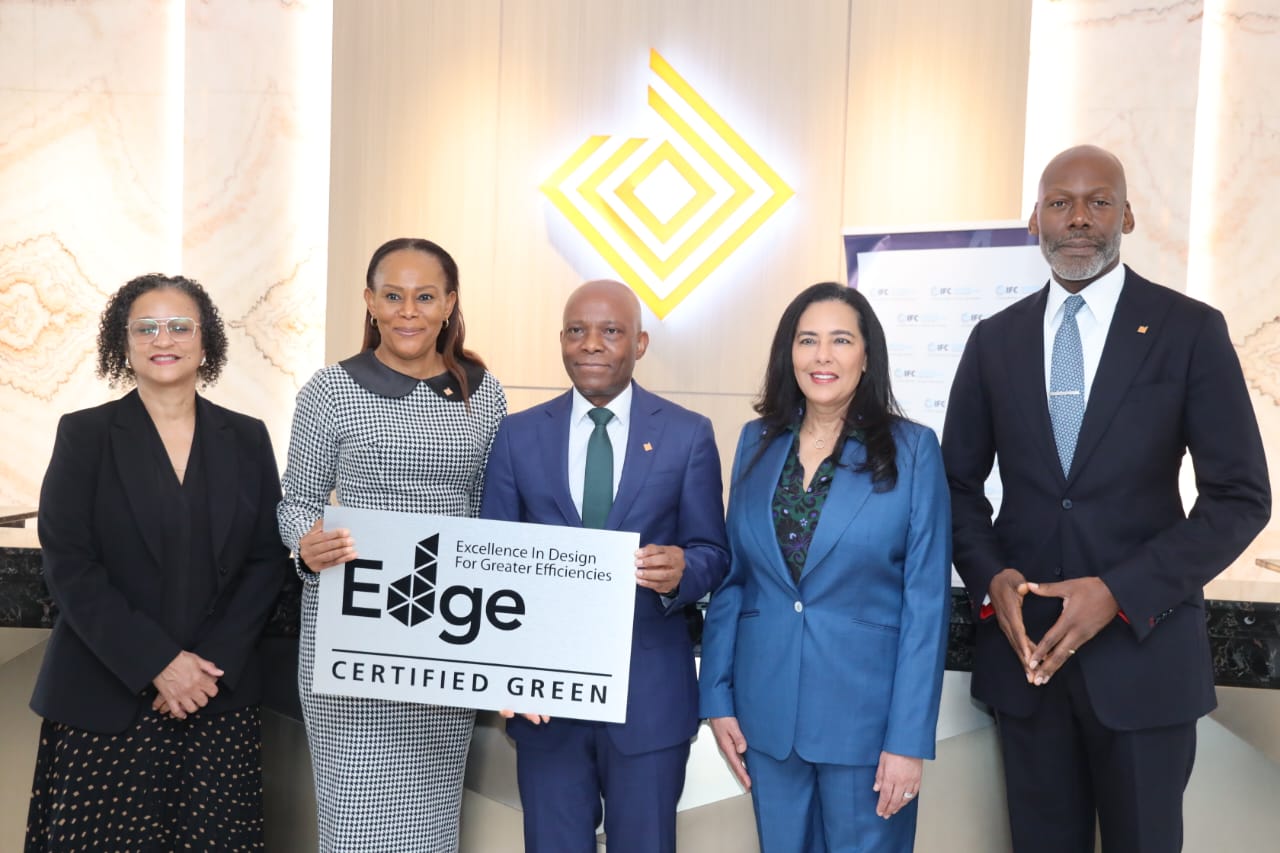
Lagos, Nigeria – March 9, 2025: Access Bank PLC (Access Bank), a leading African bank, has received the IFC EDGE (Excellence in Design for Greater Efficiencies) Green Building Certification for its banking headquarters, called Access Tower, located in Oniru, Victoria Island, Lagos.
The EDGE Green Building certification program, supported by the Japan Government in Nigeria and globally funded by the UK Government’s Department for Energy Security and Net Zero (DESNZ), with initial funding from Switzerland’s State Secretariat for Economic Affairs, SECO, recognises Access Bank’s commitment to sustainable building practices and its efforts to reduce energy consumption, water usage, and embodied carbon in building materials.
Access Bank’s Head Office has achieved a 20per cent reduction in energy use, a 33per cent reduction in water use, and a 99 per cent reduction in embodied carbon in materials. The building features sustainability measures such as insulated roof, high-performance glass, fresh air pre-conditioning system, smart meters for energy, water-efficient faucets in bathrooms and kitchen, efficient water closets and low embodied carbon materials reflecting Access Bank’s commitment to environmental responsibility. The building implemented retrofits to meet the EDGE water standard by installing flow regulators in all their water closets, faucets and showers. These reductions in energy, water, and embodied carbon are expected to result in significant cost savings and a reduced environmental footprint for the Head Office.
Commenting on this feat, Gregory Jobome, Executive Director, Risk Management at Access Bank, said:
“At Access Bank, we have always understood that our purpose goes far beyond banking. We are architects of change, custodians of the future, and now, we stand proudly at the intersection of finance and environmental leadership. This building and this certification embody our vision to set a new standard for building, operating, and growing responsibly.
“Our collaboration with the EEN team was transformational, and together, we have shown that environmental performance and business performance are not rivals, but partners. We believe that in that partnership lies the future of banking, the future of corporate Africa, and ultimately, the future of our planet.”
The EDGE certification is a globally recognised standard for green buildings, designed to make buildings more resource efficient. The certification process involves a rigorous assessment of a building’s design and construction, including independent third-party audits, ensuring that it meets the highest standards of sustainability.
IFC’s EDGE program aims to promote green building practices globally by providing a standardised approach to designing and certifying resource-efficient buildings. The program has been utilised in nearly 200 countries, with over 100 million square metres in certified floor space, enabling developers worldwide to create buildings that reduce energy use, water consumption, and embodied carbon.
Globally, IFC collaborates with financiers, governments, developers, and building owners to accelerate green building development in emerging markets. In Nigeria, cumulatively, over 800,000 square meters of offices, homes, hospitals, retail stores, student accommodation, hotels, and mixed-use projects are EDGE-certified.
PHOTO CAPTION:
L-R: Alexandra Celestin, Regional Industry Manager, IFC Financial Institutions Group, Central Africa and Anglophone West Africa; Njideka Esomeju, Head, Retail Banking, Access Bank PLC; Dr. Gregory Jobome, Executive Director, Risk Management, Access Bank PLC; Dahlia Khalifa, IFC Regional Director, Central Africa and Anglophone West African, and Amaechi Okobi, Chief Communication Officer Access Holdings PLC, after presentation of IFC EDGE Certification of Access Tower to Access Bank at its Headquarters in Oniru, Victoria Island, Lagos…recently.
The Nigerian National Petroleum Company Limited has initiated fresh negotiations with the Dangote Petroleum Refinery over the renewal of the naira-for-crude agreement, as talks are underway in anticipation of the expiration of the initial deal, which ends on March 31, 2025.
The NNPCL disclosed this in a statement issued on Monday in response to claims that the government-owned oil company had suspended the naira-for-crude deal until 2030, as it has forward-sold all its crude oil.
This came as fresh findings by The PUNCH indicated that crude oil worth about N486.31bn was received by the $20bn Lekki-based refinery under the deal between October and December 2024.
Recall that on October 1, 2024, the government commenced the sales of crude oil in naira to local refineries to improve supply, save the country millions of dollars in petroleum product imports, and ultimately reduce the pump prices of refined products.
The NNPCL Chief Corporate Communications Officer, Olufemi Soneye, in the statement on Monday, explained that the initial deal was for six months, confirming The PUNCH exclusive report last year, adding that discussions for the renewal of the agreement are currently ongoing, with the aim of establishing a new contract.
He also stated that under the deal initiated in October 2024, the 650,000-capacity refinery has received 48 million barrels to refine for petroleum products, while a total of 84 million barrels has been supplied to the refinery since it commenced operations in 2023.
The spokesperson also clarified that the deal was subject to availability.
The statement read, “NNPC Limited has noted recent reports circulating on social media regarding the alleged unilateral termination of the crude oil sales agreement in naira between NNPC and Dangote Refinery.
“To clarify, the contract for the sale of crude oil in naira was structured as a six-month agreement, subject to availability, and expires at the end of March 2025. Discussions are currently ongoing towards emplacing a new contract.
“Under this arrangement, NNPC has made over 48 million barrels of crude oil available to Dangote Refinery since October 2024. In aggregate, NNPC has made over 84 million barrels of crude oil available to the refinery since its commencement of operations in 2023.”
The national oil firm further reaffirmed its commitment to supplying crude oil for local refining based on mutually agreed terms and conditions. “
Naira-for-crude policy intact
Similarly, the Chairman of the Technical Sub-Committee on the naira-for-crude deal, Zacch Adedeji, reaffirmed the government’s stance, emphasising that the termination of the contract was never a consideration.
He said there is substantial evidence supporting the policy as the correct approach and affirmed that it will continue to contribute positively to the nation’s economy.
“The policy framework enabling the sale of crude oil in naira for domestic refining remains in force. The initiative was designed to ensure supply stability and optimize the utilisation of local refining capacity. There has been no decision at the policy level to discontinue this approach, nor is it being considered. After implementing the policy for some months, evidence abounds that it is the right way to go, and it will continue to help the economy.
“The framework for domestic crude transactions is designed to promote a competitive and efficient pricing environment,” the Federal Inland Revenue Chairman said in an e-signed statement.
He also revealed that local refineries have not been excluded from domestic crude supply and the Nigerian Upstream Petroleum Regulatory Commission is actively ensuring compliance with the Domestic Crude Oil Obligations provisions of the Petroleum Industry Act.
“The engagement process for crude oil supply to domestic refineries therefore remains in place by structured agreements, balancing factors such as availability, demand, and market conditions. There is no exclusion of local refineries from access to domestic crude oil. The Nigerian Upstream Petroleum Regulatory Commission is actively ensuring compliance with the Domestic Crude Oil Obligations provisions of the Petroleum Industry Act.
“We remain committed to ensuring the efficient execution of this initiative in line with its core objectives – enhancing local refining, reducing foreign exchange exposure, and stabilising the domestic fuel supply,” he concluded.
Commenting on the ongoing contract renewal discussions, the Publicity Secretary of the Crude Oil Refinery-Owners Association of Nigeria, Eche Idoko, stated that the renewal was part of the original plan, emphasising that there have been no changes to the initial discussions.
However, he urged the government to honour its commitment to meeting the 27,000 barrels per day demand from modular refineries, stressing the importance of fulfilling this promise for the continued success of the industry.
Speaking in an interview, the publicity secretary said, “What the Federal Government said to us during our meetings last year was that they were going to start the pilot phase with Dangote, and when it ends, the second phase, which will start after March, will cover other refineries with a capacity of 27,000 barrels. The reason they started with Dangote was because they needed a refinery that could produce petrol, and only Dangote could do that.”
“But we also know that diesel is consumed by trucks that carry foodstuffs, which ultimately drives up the price of products, so modular refineries are important, and we really hope that they would fulfil that promise, as discussed, to include other refineries.”
He also highlighted the gains of the agreement, stressing that “We have seen a reduction in the price of products on one hand, and the naira has performed well against the dollar. Given this success, we are supposed to just enter the second phase and not say the government is renegotiating with Dangote. It is supposed to be with all the refineries.”
Meanwhile, an analysis of crude oil liftings obtained from the NNPCL monthly presentations at the monthly Federal Account Allocation Committee meetings between October 2024 and the last FAAC meeting held in February 2025 showed that the Dangote refinery received crude supply worth N486.31bn.
The national oil firm noted that the transactions were valued at $373.76m, and payments were made at an Afrexim Bank-advised exchange rate payable in naira, amounting to N486.31bn.
However, as of last month, the documents indicated that a total of $126.99m at an equivalent of N199.96bn was listed as obligations due for remittance and yet to be paid.
It further stated that all products were supplied to the refinery under a credit facility, with a payment due date set for 45 days from the date of barrel liftings.
It was observed that the crude oil figures were disclosed post facto, with the December data shared during the company’s last meeting in February 2025. The figures reported in January and February are expected to be presented to the FAAC committee during its meeting in March and April 2025.
The report revealed that on October 14, 2024, the $20 billion Lekki-based refinery received its highest allocation of crude oil, totalling 598,125 barrels. In contrast, on October 30, 2024, the refinery’s lowest allocation was 5,000 barrels. Additionally, the government only fulfilled its daily oil requirement on four occasions during this period.
A detailed breakdown of each transaction revealed that the first shipment, which was loaded onto the Sienna vessel carrying 100,000 barrels of crude oil, was received on October 14. This shipment was sold at a unit price of $78.56 per barrel, corresponding to invoice number PSC10.24.001. The total value of the transaction amounted to $7,856,870, which, when converted at N1,628, equals approximately N12.797bn.
The second transaction with invoice number PSC 10.24.002 was initiated on the same day with 598,125 barrels supplied. It was sold at a unit price of $78.56 per barrel with a dollar value of $46,993,903 and the equivalent of N76.54bn using an exchange rate of N1,635 per dollar.
The next allocation with invoice number PSC.10.24.009 was initiated on October 23, with 597,917 barrels delivered via vessel Sonangol Kalandula to the refinery. It was estimated at a unit price of $78.67 per barrel and a total value of $47,043,332 and naira equivalent of N77.64bn. An exchange rate of N1,650 was used for this transaction.
Similarly, a supply of 350,000 barrels was delivered on the same date at the same unit price and exchange rate. This transaction with invoice number PSC 10.24.008 was valued at $27,537,545 and a naira equivalent of N45.45bn.
The next day, October 24, another supply of 250,000 barrels was submitted at a unit price of $75.37 per barrel at a total cost of $18,844,675 and N30.814bn naira equivalent. An exchange rate of N1,635 was utilised for this transaction with invoice number PSC.10.24.018.
Also, the next allocation with invoice number PSC.10.24.017 was initiated on October 24, with 202,716 barrels delivered via vessel Constantios to the refinery. It was estimated at a unit price of $75.37 per barrel and a total value of $15,280,468 and naira equivalent of N24.98bn. An exchange rate of N1,635 was used for this transaction.
On October 30, the lowest supply of 5,000 barrels was submitted at a unit price of $78.18 per barrel at a total cost of $390,943 and N600.03m naira equivalent. An exchange rate of N1,534 was utilised for this transaction with invoice number PSC.10.24.013.
A summation showed that 2,103,758 barrels were supplied in the month of October. However, there was a significant decline in the supply during November, with only two transactions approved throughout the entire month.
Both transactions occurred on November 4, 2024, with a combined supply of 798,374 barrels of crude oil. The unit price for the oil was $75.82 per barrel, bringing the total value of the transactions to $60,534,073. This amount was equivalent to N100.87 billion, using an exchange rate of N1,666 to the dollar. The invoice number for these transactions was PSC/EXP/OML/146/09-24/RO-19.
In December. On the second day of the month, four vessels conveying 799,737 barrels of crude oil berthed at the refinery terminal. It was sold at a unit price of $74.87 per barrel, a total dollar value of $59,879,328, and a naira equivalent of N93.59bn. An exchange rate of N1,562 was used for these transactions and was paid in naira.
On December 11, 233,401 barrels of crude oil were supplied at a unit price of $76.21 per barrel at a total cost of $17,787,886 and N23.03bn naira equivalent. An exchange rate of N1,294 was utilised for this transaction with invoice number PSC.12.24.001. A remark on this transaction stated that Dangote paid based on the received volume of 193,320 barrels as against the invoice volume of 233,401.
Also, a pending crude oil supply of 956,061 barrels at a unit price of $74.9 and a total value of $71.61 was postponed to January.
The documents, however, didn’t reveal the supply of petroleum products received from the refinery under the deal.
NCDMB Commends Heritage Energy, Pledges Support for OML 30 Projects
The leadership of Heritage Energy & Oil Services Limited and its joint venture partners recently visited the Executive Secretary of Nigerian Content Development and Monitoring Board (NCDMB), Engr. Felix Omatsola Ogbe, and received assurances of support for their operations on oil mining lease (OML) 30.
The meeting held at NCDMB’s Lagos liaison office, and the oil company visited with their JV Partners, Shoreline Natural Resources, and NNPC Exploration and Production Limited (NEPL). Heritage is the operator of OML 30 on behalf of Shoreline/NEPCL JV, and the discussions focused on the short, medium, and long term plans around their asset.
The group thanked NCDMB for supporting their operations and solicited for accelerated approval of documents relevant to their tenders for drilling and other projects. The documents include: Technical Invitations to Tender, Technical and Commercial Evaluation Template, Nigeria Content Compliance Certificates, Letter for approval of Human Capacity Development Trainings and other support to enable the company comply fully with the provisions of the Nigerian Oil and Gas Industry Content Development (NOGICD) Act.
The group’s plan is to grow production from the current 45,000 barrels per day (bpd) to 100,000 barrels per day (bpd) by 2030. This growth projection would require substantial investment, including drilling several new wells, the officials said.
The officials confirmed that their consortium has kicked off a four-rig campaign to boost production, focusing on underdeveloped fields, gas development, which would support Nigeria’s gas master plan, and exploration. The company officials added that
“we anticipate a significant production increase in oil production over the next five years from these initiatives. It’s not just about increasing output; it’s about local economic development, job creation, and sustainable resource utilization. We are also investing in produced water disposal to enhance operational efficiency and optimize production. Our strategic investment also includes flare gas gathering/gas development and monetization, unlocking a new value stream for the Asset. Additionally, we are revamping and investing in the Trans Forcados Pipeline (“TFP”) to support the expected increased production from OML 30 and other assets that leverage the TFP for crude evacuation.
In his remarks, the Executive Secretary commended Heritage and the entire OML 30 team for the strides they have achieved with their operations. He assured that NCDMB would support their investment plans, which would lead to increased oil and gas production, job creation, and economic enhancement in line with President Bola Tinubu’s renewed hope agenda for the country.
The NCDMB helmsman highlighted several initiatives the agency was championing, as well as its partnership with international and indigenous oil producing companies to accelerate oil and gas projects and crude oil production, in line with Mr. President’s charge to the oil industry.
Senior officials of the NCDMB team at the meeting included the Director Planning, Research and Statistics, Mr. Isaac Yalah, Director Project Certification & Authorisation, Engr. Abayomi Bamidele, General Manager Corporate Communication and Zonal Coordination, Mr. Esueme Dan Kikile, Esq and General Manager, Strategy and Transformation Projects, Ms. Amanda Yekorogha.
OML 30 lies onshore within the Niger Delta, in one of the most prolific oil and gas provinces in the world. The licence covers 1,097 square kilometres and includes eight producing fields such as Olomoro, Oleh, Uweh, Uzere, Ewvreni, Eremu, Oroni, Kokori and several other partially appraised fields with oil and gas contained in numerous stacked reservoirs.
Elon Musk said X was hit by a major cyberattack on Monday as outages plagued users of the platform once known as Twitter.
“There was (still is) a massive cyberattack against X,” Musk said in a post on the platform.
Musk blamed a cyberattack, providing no evidence, for crashing the site last year when an interview with Donald Trump was to be streamed.
In his post Monday, Musk included an X post from a DogeDesigner account that some on Reddit speculated could be a puppet of the tycoon himself.
The post noted protests against the Department of Government Efficiency (DOGE) that Trump entrusted to Musk, along with Tesla shops being vandalized, suggesting a cyberattack could signal another burst of animosity towards Musk.
Musk is chief or Tesla, his electric car company.
“It would take a lot of (money) to do an attack of this magnitude,” read a post in the exchange by the account of Jammies
Musk also maintained such an attack would take tremendous resources, speculating it was the work of a country or large coordinated group.
Outages on the X social media platform left tens of thousands of users unable to access the site, according to monitors.
Reports of problems with X started in the early hours of Monday, with users in Asia, Europe, and North America saying they could not access the platform, according to the Downdetector tracking site.
At the peak, more than 40,000 people reported outages, the site said.
The bulk of the reports were from people trying to use X on smartphones, but people on web browsers also reported the service down.
“Twitter keeps breaking?” asked a post by @Lalaslovely in the Downdetector chat section.
After Musk bought Twitter for $44 billion in late 2022, the majority of employees left or were fired, raising concerns about whether staffing was in place to keep the platform safe and stable