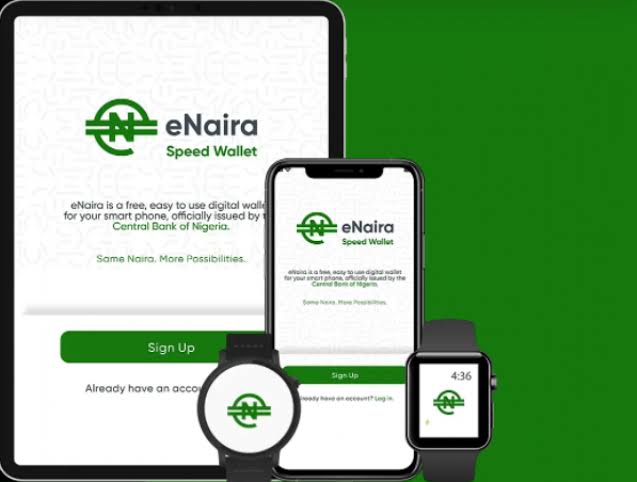
Four hours after President Muhammadu Buhari launched the digital currency, eNaira App, Nigerians are having problems signing into the Central Bank of Nigeria (CBN) digital currency platform.
The eNaira, which was launched 24 days behind schedule, has recorded more than 5000 downloads on Google Playstore and 442 reviews by downloaders, who rated the Central Bank Digital Currency (CBDC) mobile app 2.3 out of five.
The eNaira was launched by the President on Monday.
Complaints have trailed the app’s functionality as users encountered two problems, email, and Bank Verification Number (BVN) confirmation.
But the latter was common among individuals who had downloaded the App.
Attempts by Ripples Nigeria to log into the App were unsuccessful with the message below appearing on the system.
“We have encountered a problem with the BVN validation service, please try again later. Service timeout.” the eNaira App stated after initially showing “Oops, an error occurred, please try again later.”
A quick check on Google Playstore showed a series of complaints with one Nkwachiukwu Cornelius stating: “I am being asked to sign up through my bank only. Is there no other alternative method for signing up? I have tried signing up through my bank but the system is having a problem verifying BVN.”
Another user, Blessing Kay Fash, said: “A great initiative from CBN. However, 2 stars because l am unable to sign in after passing through the first steps of registration using my bank, full name, phone number, and BVN. Not knowing what is happening!”
Etubi Paul retorted: “After filling my details (Names, BVN, DOB, Account Number) it brings a red pop-up message that says, ‘We have encountered a problem with the BVN validation service.’ Pls work on this. The 2 STAR is for the availability of the app in the first place though.”
Biletiri Andrew said: “My BVN is not verified, please how this error can be rectified? It keeps telling me I should try again later or contact support.”
Titilope James lamented, “I give one star only. I tried my best to register but keep saying TOO MANY FAILED ATTEMPT ON BVN. Pls help me out.”
On his part, Chinedum Emezie said: “Very poor app, I filled in all my details correctly and yet it keeps telling me that my account number is incorrect even though it is after several trials it now tells me to contact customer support. Too many attempts were made with the same BVN. Very poor and how can I get this solved.”
Hassan Ahmad noted: “The steps are too much for an average person. Why can’t you just register people with their BVN? I have put all details but it’s saying the first name doesn’t match.”
The Central Bank of Nigeria has integrated 33 Banks into the eNaira platform with N500m successfully minted by the apex bank for the take off of the digital currency programme.
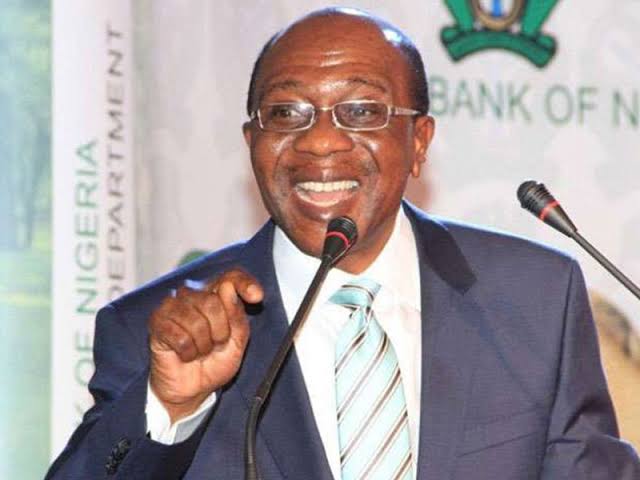
The CBN Governor, Mr Godwin Emefiele, said this on Monday at the official launch of the Nigerian Central Bank Digital Currency (CBDC), known as the eNaira, at the State House, Abuja.
The launch of the eNaira is a culmination of several years of research work by the Central Bank of Nigeria in advancing the boundaries of payments system in order to make financial transactions easier and seamless for every strata of the society.
Following series of engagements with relevant stakeholders including the banking community, fintech operators, merchants and a cross section of Nigerians, the CBN designed the digital currency.
The eNaira, according to the apex bank, marks a major step forward in the evolution of money in Nigeria.
Speaking at the event, Emefiele said since the eNaira platform went live, there has been overwhelming interest and encouraging response from Nigerians and other parties across the world with over 2.5 million daily visits to the website.
He said so far, N200m has been issued to financial institutions, while over 2,000 customers have been onboarded.
According to him, over 120 merchants have successfully registered on the eNaira platform.
He said, “Today, customers who download the eNaira Speed Wallet App will be able to onboard and create their wallet; fund their eNaira wallet from their bank account; transfer eNaira from their wallet to another waller; make payment for purchases at registered merchant locations.
“Mr President, today you make history, yet again, with the launch of the eNaira – the first in Africa and one of the earliest around the world.
“Mr. President, as you make ground breaking reforms, there have been continuing debate on the true value of the Naira.
“Rather than worry today on the direction of the exchange rate, let us take a step back and analyze how we got here in the first place.”
Nigerian billionaire businessman and investor, Femi Otedola, on Friday, reportedly took over First Bank of Nigeria Plc.
According to The Street Journal, Otedola took over the bank with the acquisition of about ₦30 billion worth of shares, making him the single largest shareholder of the bank.
Otedola, being the largest shareholder, holds the highest voting shares, giving him power to dictate the direction of the bank through his voting power.
Recall that Femi Otedola had in 2019 divested his 75% direct and indirect share holding in Forte Oil, via a merger of his company Zenon Oil and former African Petroleum.
This act made many wondered why he made such a decision especially because of the lucrative nature of the oil and gas sector.
The billionaire had expressed interest in going into refining and petrochemicals as well as investing in the real estate and financial sector.
It was gathered that Otedola decided to take over First Bank Nigeria because of the internal crisis rocking the bank.
Recall that the leadership crisis rocking the bank led to the Central Bank of Nigeria sacking both the chairman of the bank, Ibukun Awosika and Obafemi Otudeko, the chairman of FBN Holdings.
Wigwe, Emefiele honoured with Juris Law Award for outstanding contributions in finance sector
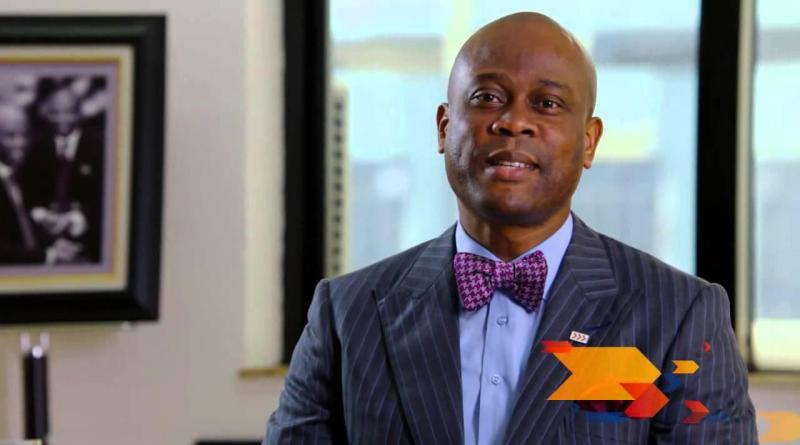
The Chairman, Body of Bank CEOs and Group Managing Director of Access Bank PLC, Herbert Wigwe, has been recognised for his outstanding contributions to Corporate Governance and Rule of Law in Nigeria’s Banking Industry.
Wigwe was presented the Juris Law Award by Chief Justice of Nigeria, Ibrahim Tanko Muhammad at the 2021 Judges Workshop on Banks and Other Financial Institutions Act (BOFIA) 2020 which held on Tuesday, 12 October 2021 in Abuja.
Also honoured with an award was the Governor, Central Bank of Nigeria (CBN), Godwin Emefiele. The Juris Law Award is presented in honour of leaders who are taking significant steps towards promoting economic growth in Nigeria through deepening institutions, corporate governance and Rule of Law.
Accepting the award, Wigwe stated that he was honoured to receive the award, adding that “through innovative banking initiatives and our underlying sustainability drive, Access Bank will continue to create shared value for all our stakeholders, striking a balance between competitive advantage and corporate social responsibility.”
Wigwe and Emefiele have partnered in the creation of several positive socio-economic initiatives such as the Creative Industries and Financing Initiative; a loan scheme developed to provide access to long-term and low-interest financing for entrepreneurs in Nigeria. In addition, Wigwe, Emefiele and Aliko Dangote were key parties in the formation of the Coalition Against COVID-19 (CACOVID) – a vehicle created to spearhead corporate Nigeria’s support for the federal government’s fight against the deadly virus. The successful coalition funded the establishment of response centres, acquisition of medical equipment, supplies and food palliatives for vulnerable Nigerians.
The 2021 Judges Workshop on Banks and Other Financial Institutions Act (BOFIA) 2020 focused on reforms and the statutory requirements imposed by CBN on all banks and other financial institutions in Nigeria to adopt policies on anti-money laundering and combating the financing of terrorism and cyber security in Nigeria.
Also in attendance of the workshop were the Attorney General of the Federation and Minister of Justice (AGF); Abubakar Malami (SAN); the Appeal Court President, Justice Monica Dongban-Mensen; the Chief Judge of the Federal High Court, Justice John Tsoho; the Former Chief Justice of Nigeria and former Chairman, Board of Governors, National Judicial Institute, Hon. Justice Mahmud Mohammed and other high ranking judicial officers and the legal community.
Winners Emerge in 7th UBA Bumper Savings Account Promo
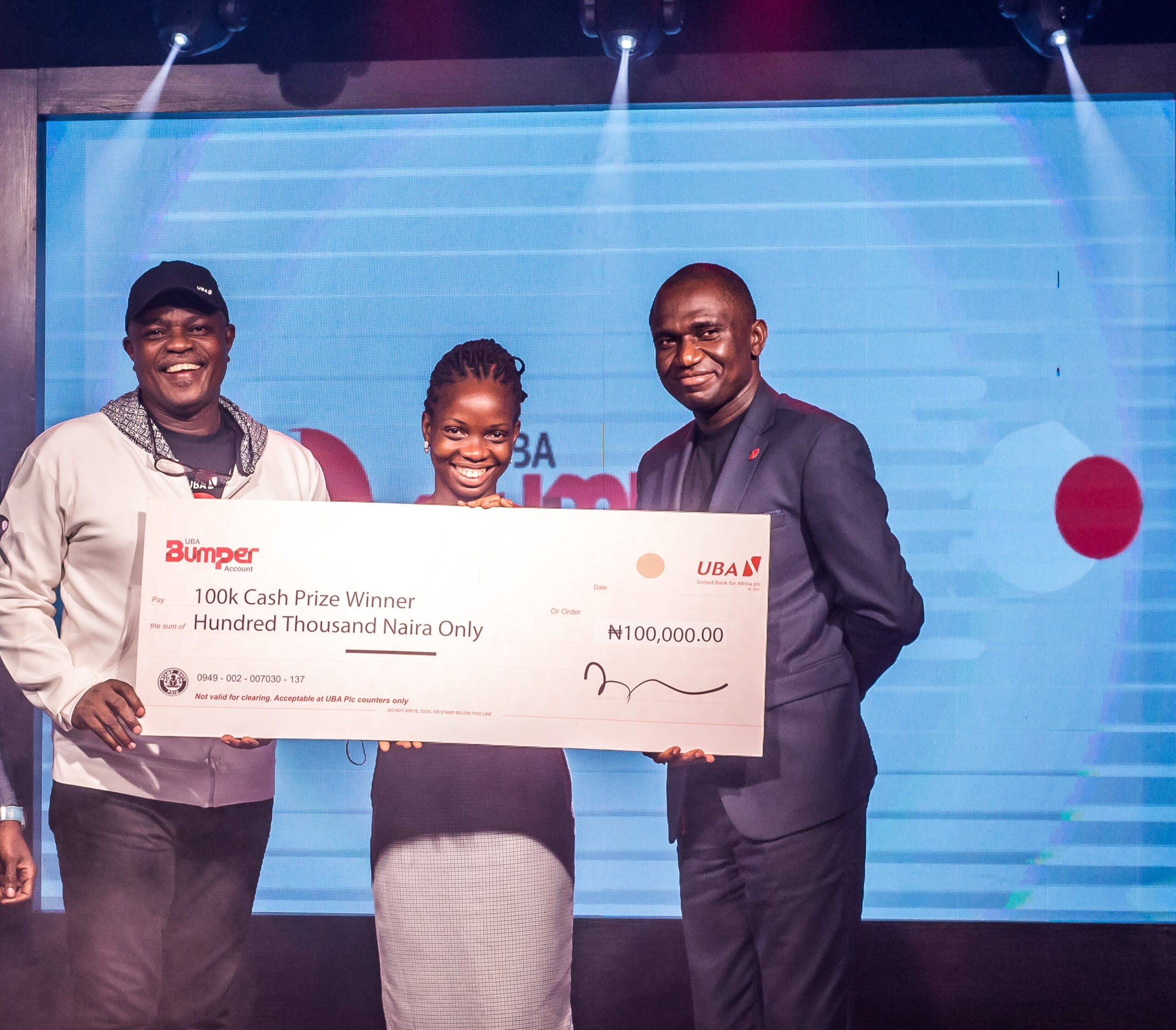
L-R: Group Head, Customer Fulfilment Centre (CFC), United Bank for Africa(UBA), Prince Ayewoh; Winner of N100,000 cash prize in the UBA Bumper Savings Account Promo, Onyenwenyi Chidinma Confidence and Head of Small and Medium Enterprises (SME) Liability, Babatunde Ajayi, during the presentation of cash prizes to winners of the Bumper Savings Account promo draw, held in Lagos, recently
Pan African financial institution, United Bank for Africa (UBA) Plc, has again rewarded its loyal customers in its Bumper Savings Promo in line with its unwavering commitment towards prioritising its customers’ financial well-being as well as boosting savings culture in Nigeria.
Since the bank commenced the promo in 2020, over 200 winners have emerged from the initiative that continues to reward loyalty and encourage customers to cultivate a savings habit that helps to stay afloat especially during challenging times.
The promo is open to account holders of the bank from the six geographical zones in Nigeria, and customers only need to open a UBA Bumper account and save a minimum of N5000 in a month to qualify. The more multiples of N5000 they saved, the higher their chances of winning cash prizes and other juicy benefits.
The electronic raffle draw, which is the 7th since inception, was held at Kairo’s Hub on Wednesday, and was witnessed by relevant regulatory bodies including the National Lottery Regulatory Commission and Consumer Protection Council who were on ground to ensure transparency and accountability.
Winners who emerged from the draw, include, Olunwa Osita Ambrose who smiled home with the star prize of a whooping N2m, while Saheed Adeshina Adediran won N1.2m rent for a year. Adewunmi Olaniyi Sobowale, another lucky winner got 500k shopping allowance.
Others who equally smiled home with N100,000 cash prizes were; Bayode Peter Oluwaseun, Archibong Unyime Gift, Yakubu Fali, Alaegbu Promise Uchenna, Onyenwenyi Chidimma Confidence, Maria Obianuju Onyeneke, Emmanuel Kalu, Aramide Afolabi Temitope, Ijeoma Juliet Okika, Taiwo Micheal Odofin, Daina Ochekema Egbe, Ighodalo Thompson, Mercy Effiong, Alice Gabriel, Imrana Bello, Onyedika Promise Umeji, Uzoma Chibuike Timothy, Adewole James Idowu, Opeyemi John Kolawole and Israel Ojima Daniel.
Olunwa Osita Ambrose who won N2m could not hide his excitement when he was contacted over the phone. He screamed, “Thank You God” over and over and took time to appreciate UBA for the wonderful gesture saying; “This is indeed great. Thank you. You people cannot understand the great impact you have made in my life with this reward. It will transform my life greatly. May God almighty bless this bank and all those who conceptualized the UBA Bumper Account Savings Promo,” Ambrose gushed excitedly. “I am committed to the bank for life,” he concluded.
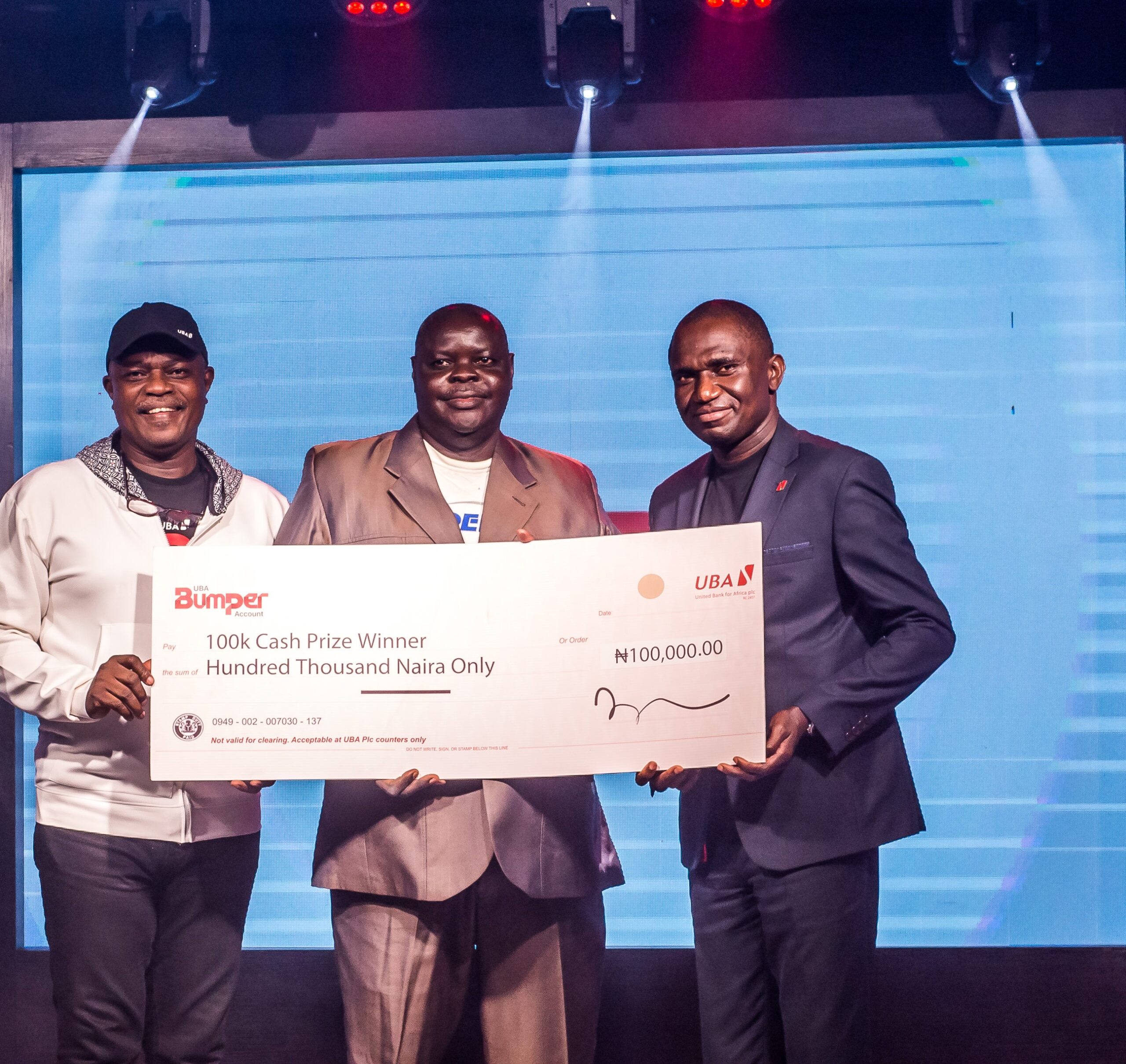
L-R: Group Head, Customer Fulfilment Centre, United Bank for Africa(UBA), Prince Ayewoh; Winner of N100,000 cash prize in the UBA Bumper Savings Account Promo, Bayode Peter Oluwaseun; and Head of Small and Medium Enterprises (SME) Liability, Babatunde Ajayi, during the presentation of cash prizes to winners of the Bumper Savings Account promo draw, held in Lagos, recently
UBA’s Head of Personal Banking, Ogechi Altraide, who presented gifts to some of the winners who were physically present at the event told customers that UBA places them at the very heart of its business which, according to her, is why the bank remains passionate about their overall success and added that this has consistently been proven in numerous ways which is why the bank has continually invested in cutting-edge technology to improve its service delivery and its overall aim of delighting customers.
She said, “With customer-centric promos like the UBA Bumper promo, we have created an ever-increasing list of millionaires who continue to join the UBA customer millionaire club. For this edition of the promo, we decided to pick the month of October, which is the month of independence commemoration so we can give more Nigerians reasons to cheer while celebrating the country’s independence anniversary”.
“We know that this promo will put lasting smiles on the faces of our customers and will also assure them that UBA truly values them’” Altraide said.
Head, Marketing, Diana Ubah also spoke of UBA’s passionate commitment to give back to its customers especially during these challenging economic periods, where people need all the support they can get to make life more meaningful.
“I have witnessed a lot of events like this and I must say the happiness and live changing moments that comes with a customer getting an unexpected reward is indeed a special one! To this end, I encourage those who are yet to join the winning team, should do so quickly. Without any iota of doubt, you always win with UBA” said Ubah.
United Bank for Africa Plc is a leading Pan-African financial institution, offering banking services to more than twenty-one million customers, across over 1,000 business offices and customer touch points, in 20 African countries.
With presence in the United States of America, the United Kingdom and France, UBA is connecting people and businesses across Africa through retail; commercial and corporate banking; innovative cross-border payments and remittances; trade finance and ancillary banking services
Winners Emerge in 7th UBA Bumper Savings Account Promo
Pan African financial institution, United Bank for Africa (UBA) Plc, has again rewarded its loyal customers in its Bumper Savings Promo in line with its unwavering commitment towards prioritising its customers’ financial well-being as well as boosting savings culture in Nigeria.
Since the bank commenced the promo in 2020, over 200 winners have emergedfrom the initiative that continues to reward loyalty and encourage customers to cultivate a savings habit that helps to stay afloat especially during challenging times.
The promo is open to account holders of the bank from the six geographical zones in Nigeria, and customers only need to open a UBA Bumper account and save a minimum of N5000 in a month to qualify. The more multiples of N5000 they saved, the higher their chances of winning cash prizes and other juicy benefits.
The electronic raffle draw, which is the 7th since inception, was held at Kairo’s Hub on Wednesday, and was witnessed by relevant regulatory bodies including the National Lottery Regulatory Commission and Consumer Protection Council who were on ground to ensure transparency and accountability.
Winners who emerged from the draw, include, Olunwa Osita Ambrose who smiled home with the star prize of a whooping N2m, while Saheed Adeshina Adediran won N1.2m rent for a year. Adewunmi Olaniyi Sobowale, another lucky winner got 500k shopping allowance.
Others who equally smiled home with N100,000 cash prizes were; Bayode Peter Oluwaseun, Archibong Unyime Gift, Yakubu Fali, Alaegbu Promise Uchenna, Onyenwenyi Chidimma Confidence, Maria Obianuju Onyeneke, Emmanuel Kalu, Aramide Afolabi Temitope, Ijeoma Juliet Okika, Taiwo Micheal Odofin, Daina Ochekema Egbe, Ighodalo Thompson, Mercy Effiong, Alice Gabriel, Imrana Bello, Onyedika Promise Umeji, Uzoma Chibuike Timothy, Adewole James Idowu, Opeyemi John Kolawole and Israel Ojima Daniel.
Olunwa Osita Ambrose who won N2m could not hide his excitement when he was contacted over the phone. He screamed, “Thank You God” over and over and took time to appreciate UBA for the wonderful gesture saying; “This is indeed great. Thank you UBA. You people cannot understand the great impact you have made in my life with this reward. It will transform my life greatly. May God almighty bless this bank and all those who conceptualized the UBA Bumper Account Savings Promo,” Ambrose gushed excitedly. “I am committed to UBA for life,” he concluded.
UBA’s Head of Personal Banking, Ogechi Altraide, who presented gifts to some of the winners who were physically present at the event told customers that UBA places them at the very heart of its business which, according to her, is why the bank remains passionate about their overall success and added that this has consistently been proven in numerous ways which is why the bank has continually invested in cutting-edge technology to improve its service delivery and its overall aim of delighting customers.
She said, “With customer-centric promos like the UBA Bumper promo, we have created an ever-increasing list of millionaires who continue to join the UBA customer millionaire club. For this edition of the promo, we decided to pick the month of October, which is the month of independence commemoration so we can give more Nigerians reasons to cheer while celebrating the country’s independence anniversary”.
“We know that this promo will put lasting smiles on the faces of our customers and will also assure them that UBA truly values them’” Altraide said.
Head, Marketing, Diana Ubah also spoke of UBA’s passionate commitment to give back to its customers especially during these challenging economic periods, where people need all the support they can get to make life more meaningful.
“I have witnessed a lot of events like this and I must say the happiness and live changing moments that comes with a customer getting an unexpected reward is indeed a special one! To this end, I encourage those who are yet to join the winning team, should do so quickly. Without any iota of doubt, you always win with UBA” said Ubah.
United Bank for Africa Plc is a leading Pan-African financial institution, offering banking services to more than twenty-one million customers, across over 1,000 business offices and customer touch points, in 20 African countries.
With presence in the United States of America, the United Kingdom and France, UBA is connecting people and businesses across Africa through retail; commercial and corporate banking; innovative cross-border payments and remittances; trade finance and ancillary banking services
Heritage Bank Director, LASAA seeks sustainable PPP model for financing advertising sector
…Commends Lagos State’s smart city project
The Executive Director, Heritage Bank Plc, Jude Monye disclosed that one of the ways out-of-home advertising industry can attain massive growth was via the adoption of public-private-partnership (PPP) model to ensure its sustainability.
Monye commended the Governor of Lagos State, Babajide Sanwo-Olu’s administration for the implementation of the smart city plan with the rollout of 6,000km metro fibre optics, which is the requisite infrastructure for the smart city project.
According to the Bank’s director, “if you have deposit money bank, that is the commercial bank coming in with huge portfolio, you will see massive growth in this industry and to crown it all for me, the governor said what I didn’t know of, all the things that the government is doing with the Fibre optic projects which is towards the smart city that LASAA has also shown to us. With that alone, the PPP model, the banks are going to key into funding this so that the industry can grow.”
He revealed that deposit money banks are careful to lend to the advertising players due to lots of unstructured issues and if tackled, the banks will be willing to lend once they see that the risks in the industry have been reduced.
He, however, stated that the move by Lagos State government for the adoption of digital technology would lead to increased patronage and rev banks’ participation.
“I think lots of unstructured issues that we face and most of the banks that you see on digital media outside is not borne out of the need to advertise because it has not appealled to them, or engaging to their audience, but some of them are just pay back for the loan that they have given,” he stated.
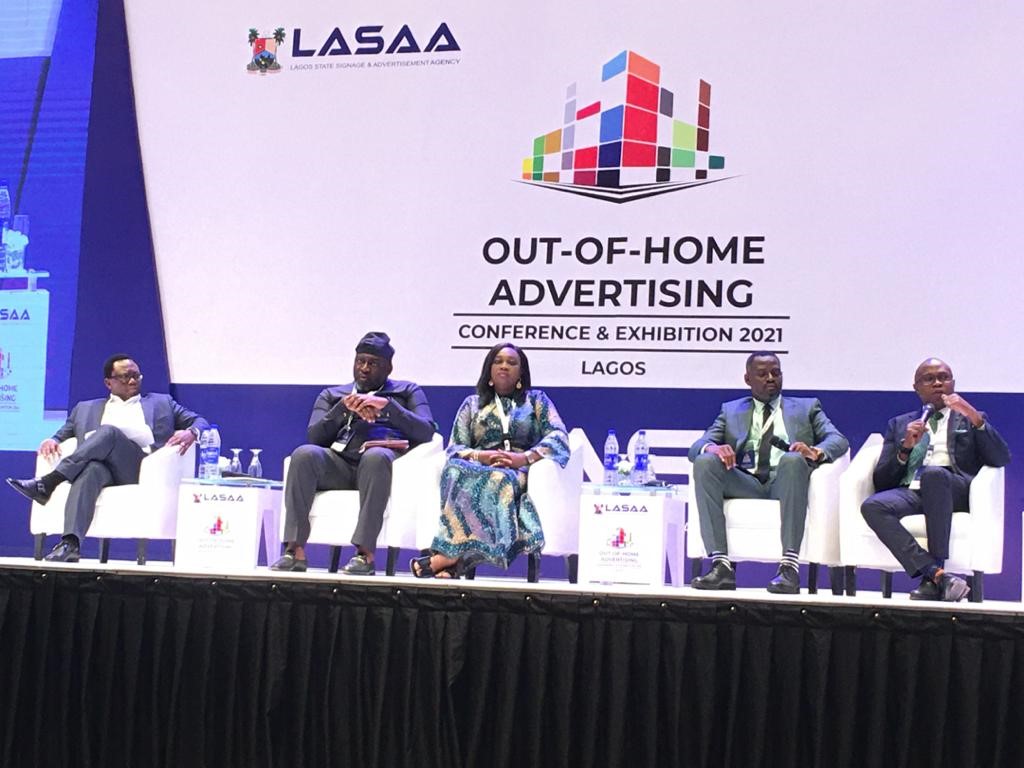
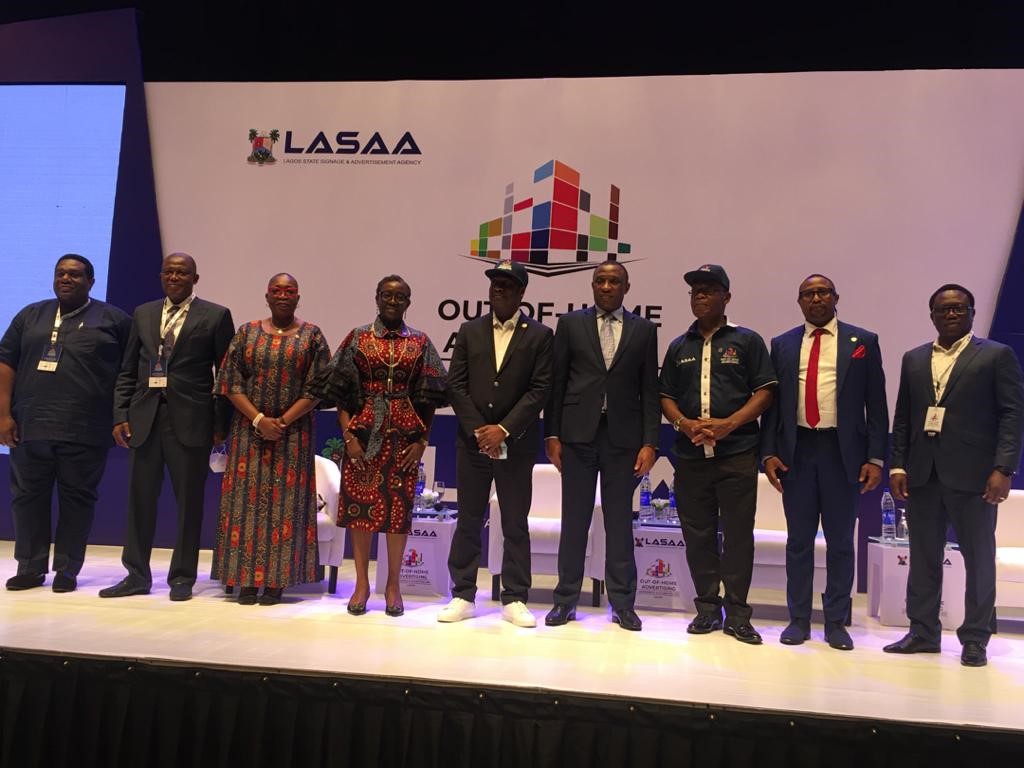
HB LASAA PIX1 R-L: Jude Monye, Executive Director of Heritage Bank Plc; Adedamola Docemo, MD/CEO of Lagos State Signage and Advertisement Agency (LASAA); Joe Igbokwe, Senior Adviser to Governor on Drainage services; Tunji Bello, Commissioner of Environment; Hamzat Obafemi, Deputy Governor Lagos state; Belinda Odeneye, Permanent Secretary, Ministry of Environment & water resources; Adenike Adedoyin-Ajayi, PS Ministry of Tourism; Kayode Pitan, MD of Bank of Industry and kunle Adeniran, MD of Vatebra, during the 2021 Out-of-Home Advertising Conference and Exhibition organised by the Lagos State Signage and Advertisement Agency (LASAA) in partnership with Heritage Bank, held in Lagos recently.
Jude, who reaffirmed that PPP actually was the model, added that there should be a kind of intra-ministerial integrated approach, as this would propel the lending capacity of banks.
Speaking earlier on the topic, “Road map for the Growth of Signage and Out-of-Home Advertisement post-Covid-19 in Lagos,” the Governor who stated that the state was making appreciable progress in the ongoing laying of the metropolitan optic fibre, as well as the installation of smart cameras in strategic locations across the State, affirmed that the technology would help enhance and support the growth of advertising in the Lagos.
Sanwo-Olu, represented by his Deputy, Obafemi Hamzat said his administration would continue to leverage technology to transform the state’s economy while easing impediments for businesses to flourish.
The MD/CEO of LASAA, Adedamola Docemo said the agency would be rolling out policies and programmes that would improve sectoral investment, drive sustainable growth, encourage regular engagement and development of the State.
He stated that with Lagos being the leading state in Out-of-Home advertising investment in Nigeria, the industry has evolved and has consistently contributed its quota over time to the growth and development of Lagos state.
Super Brands Must Synergize To Solve Africa’s Problems – Akinwuntan
The Managing Director, Ecobank Nigeria, Patrick Akinwuntan has advocated a synergy between super brands in Africa to solve the multifarious challenges facing the continent. Akinwuntan, who made this submission at the International Advertising Association (IAA) Africa Rising 4 virtual conference, posited that recent happenings in the global arena such as covid 19 pandemic further reinforces the need for bigger brands on the continent to collaborate effectively to achieve sustainable solutions to challenges facing the continent.
According to Akinwuntan, “It is not just about digitization but understanding that life itself has deeper substance. What we have learnt in the past 18 months calls for common agenda for human race, an opportunity for collaboration to search for sustainable solutions to the myriad challenges facing the continent. This also reenforces the fact that until we are comfortable, no part of the globe is comfortable. This provides a completely new direction between developed worlds, developing worlds and whatever categorization that you want to bring to the table. With people having to stay at home because of the pandemic, we quickly saw that being disconnected from the economy fabric is much more dangerous than the health risk that we are trying to avoid from the social distancing and stay at home”.
On how Ecobank as an African Super Brand responded to the covid 19 pandemic, Mr. Akinwuntan noted that the bank’s success story in handling the outbreak and spread of Ebola disease in some parts of Africa came handing, adding that the bank’s investment in technology also paid off as it was able to provide financial services seamlessly to its customers in countries where the operates.
“We came out with strategies to ensure that small business and women enterprise leaders are able to learn to improve their capacity and source for labor without physical contact and able to access market without physical contact and be able to be financially strong without having to physically visit distant locations. For the small businesses, it is enabling them to have faith in themselves to be able to see that tomorrow has a brighter future. The covid-19 pandemic was a leveler and therefore everyone felt the impact. For a brand like Ecobank, we needed to demonstrate our ability to reach everyone at the same time. First is knowledge, people need to know, is this circumstance unique to my country, or to my own livelihood? if it is not, what has worked for other people and how have we leveraged it. That is quite a lot of learning that we focused on. We actually partnered with NEPAD and brought about leveraging on technology and capacity building for the small and medium scale business.” Akinwuntan explained.
Aligning with Akinwuntan’s submission, another speaker at the session, Group Executive for Marketing, MTN, Bernice Samuels said it was imperative super brands in Africa have a common platform to address and offer solutions to challenges facing the continent. The captivating session was moderated by Robyn Curnow, Anchor & Host of CNN Newsroom
Earlier in his welcome address, World President and Chairman, IAA, Joel Nettey said the 2-day virtual conference with the theme: ‘Africa To The World’ is aimed at projecting African brands to the world and bringing together the best on the continent to discuss trends and key developments. According to him, “as the most influential network of industry leaders with a broad spectrum of expertise, we help brands grow, strengthen, and forge new paths around the world through meaningful relationships with consumers. We use our thought leadership, initiatives in education and development, and world-class events to help our members navigate through the ever-changing worlds of business and technology. We are delighted to be able to put together this conference in such trying times to add value and bring together those who shape the industry’s future. The African continent is endowed with vibrancy, creativity, culture, its people, and strong brands weaving coherently into what makes the engines of economies move.”
The International Advertising Association’s (IAA) Africa Rising for Leadership Conference 2021 is first IAA virtual conference and it is congregating speakers and participants from across the globe – Nigeria, Kenya, south Africa, USA, Italy, Russia, Malaysia and several other leading countries where IAA has presence.
FINTECH 5.0: EVALUATING HOW FIRSTBANK STRENGTHENS COLLABORATION
…To drive financial inclusion
It was Sir Isaac Newton, in his letter to Robert Hooke in 1675, who wrote the now-famous quote: “If I have seen further (than others), it is by standing on the shoulders of giants.”
The shoulders of giants Sir Newton referred to has to do with leverage provided by the discoveries and experiences of people who have gone before or walked that same path earlier, that pave the way for and enable other people and a new generation to take things to a totally new dimension.
The truth is, giants whose shoulders provide such leverage to the next generation can be found in various fields and various nations. In Nigeria, for example, such giants exist in various fields and they are known and recognised.
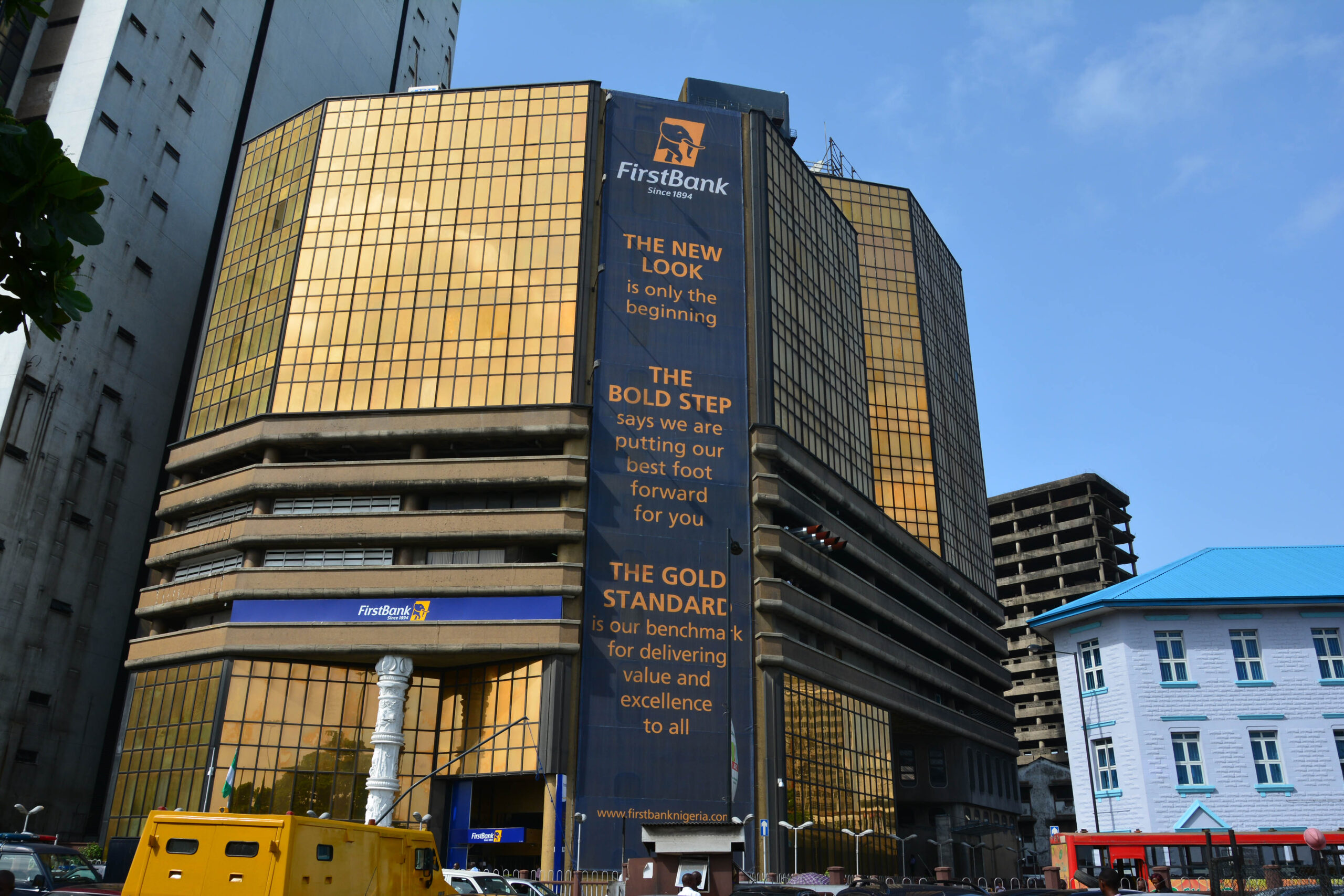
Take the fintech (financial technology) space in Nigeria, where one bank is known to have stood as a giant with very broad shoulders, having capacities that have been built up and accumulated over 127 continuous years. Every year since 2016 (apart from 2017 when it was implementing ideas from 2016, including a Digital Innovation Lab), this well-recognised bank has provided a platform for the most robust engagement of the fintech industry in Nigeria. Tagged Fintech Summit, the annual engagement has continued to help in catalysing the fintech sector to ever-higher levels from year to year.
Held in Lagos the commercial capital of Nigeria and arguably the fintech capital of Africa, given Nigeria’s status as the leading nation in the fintech space in Africa, the annual FirstBank Fintech Summit has attracted an average of a thousand participants, who are mostly fintech owners, workers and enthusiasts, yearly. Last year’s Summit, Fintech Summit 4.0 with the theme
“How Blockchain and Artificial Intelligence will Disrupt Fintech in Nigeria”, however, drew an unprecedented number of participants – over 6,000 from across 52 different countries. It was the first virtual Summit due to the restrictions imposed because of the COVID-19 pandemic and it featured as keynote speaker Silicon Valley-based innovator of international repute, Chinedu Echeruo, who founded HopStop that was later sold to Apple for US$1 billion. Imagine the inspiration, dreams and aspirations young people soak up while listening to speakers with such a profile.
Far from being one-directional – with all the talk flowing from only the speaker to the audience – the yearly Summit is actually a platform for multidimensional engagement involving various stakeholders in the fintech industry – operators, regulators, investors, enthusiasts, fintech journalists and writers, bankers, et cetera.
It offers an unequalled opportunity for networking among fintech and other stakeholders, leading to opportunities for collaboration within the community. For small businesses and start-ups powered by FirstBank’s support, the annual Summit has been a veritable platform for showcasing them. The platform has also served for the announcement of policy initiatives coupled with pronouncements that provide clarifications to policy. This is due to invitations extended to regulators and the important role they are assigned in conversations facilitated during the Summit.
The Summit that preceded last year’s, i.e., the third edition of Fintech Summit 3.0 held in 2019, featured another heavyweight in Nigeria’s fintech industry, Victor Asemota, founder of Swifta Systems & Services, as keynote speaker. The theme “Banking + Tech = Solving Real Problems”, included panel sessions featuring experts with over two hundred combined years of experience in both the financial and technological industries.
They applied their knowledge, expertise and experience to address challenges in the technologically-driven business world, structured in terms of Solving Business Problems; Solving Regulatory, Security and Legal Problems; and Solving Lifestyle Problems. At the end of the Summit, participants must have felt that the Summit delivered on the confidence the Chief Executive Officer of FirstBank, Adesola Adeduntan, had expressed when he remarked in his welcome address, “I am optimistic that every organisation represented here will be empowered to provide services with greater speed and solve real societal problems to the advantage of the Nigerian populace through the insights that will be gained from this event.“
Fintech Summit 3.0 had built on the success of the second edition, Fintech Summit 2.0 held in 2018, which had “The Future of Banking – The Role of Artificial Intelligence (AI) and Big Data” as a theme. Adia Sowho, the Managing Director of Mines in Nigeria, had, as the first keynote speaker, stressed the importance of collaboration between legacy banks and fintechs in the overall good of their shared financial services space. The Deputy Managing Director of FirstBank, Gbenga Shobo, had, in his welcome address, said that FirstBank was committed to finding the right balance in its approach in supporting the budding fintech industry. It is gratifying that the bank has since found that right balance and pushed ahead enthusiastically with the continual annual engagement that is its yearly Fintech Summit.
For those who like to bring up the argument that deposit money banks (DMBs) and fintech are rivals competing in the same space for the same customers and wonder why FirstBank, a leading deposit money bank, would itself be involved in efforts to catalyse the fintech industry, they need to wake up and smell the coffee. FirstBank is continuously evolving and staying on the cutting edge of technology in order to better serve its customers, who are themselves evolving and adapting to newer and more efficient and convenient technologies as they become available.
And FirstBank is on a journey to a future where it is happy, in the spirit of the African tradition of Ubuntu, to take all fintech along with it. In the words of another famous quote, “The sky is too big for two [or many] big birds flying in it to collide.” FirstBank believes there is ample room for all players – deposit money banks, fintech, et cetera – to fulfil their unique roles. Therefore, collaboration, not competition, is FirstBank’s watchword. And FirstBank considers fintech partners in progress in its avowed commitment to driving financial inclusion.
FirstBank’s own evolution and the transition is causing some people to question its continuous classification by the Central Bank as a deposit money bank (with a preponderance of bricks-and-mortar banking operations) rather than a digital bank. And the reasons for their argument cannot be easily waved aside. In 2020, for example, over 85 per cent of the banking transactions that were required by customers of FirstBank were performed on the bank’s self-service channels.
That means customers of the bank only needed the attention of the bank’s staff or branches for just 15 per cent of all the banking transactions they required in 2020. There are now as many as over 16 million customers between FirstBank’s digital channels of online banking (called FirstOnline), mobile banking (christened FirstMobile) and USSD banking (called *894# quick banking).
Between FirstOnline and FirstMobile, a growth of 21 per cent in the user base was experienced in 2020. Customers on both platforms conducted approximately 256 million transactions worth N15.7 trillion in the same year. FirstOnline, as of June 2021, had an impressive 597,466 customers on the service, a 17 per cent growth on the previous year and 578,292 transactions per month, averaging a value of N388 billion per month.
For FirstMobile, besides the impressive gain in numbers, it gained recognition as “Best Mobile Banking App” at the Global Finance Best Digital Bank Awards, for providing excellent self-service through its user-friendly app. FirstMobile had, as of June 2021, 4,596,203 users on the platform, which is a nine per cent growth on the previous year and an average of 27,730,830 transactions every month. While these numbers point to the giant statue of the bank, none of it excites FirstBank as much as Firstmonie, because of its invaluable role in driving financial inclusion at the grassroots level, one of FirstBank’s overriding commitments.
Firstmonie, the agent banking network of FirstBank, currently has over 130,000 agents across the country, making it the largest bank-led agent network anywhere in Africa. As the foremost financial inclusion service in the country, it has achieved over 750 million transactions worth N15 trillion (about US$30 billion) processed from inception to date.
Over 295 million of those transactions with a total value of N6.65 trillion were processed in 2020 alone – the same year COVID-19 caused widespread disruptions across the globe. Firstmonie agency banking scheme has empowered agents across all Local Government Areas in the country, providing employment to thousands of people.
FirstBank through the Firstmonie platform further supports the fintech industry via partnership collaborations with local and international fintechs. All these are geared towards expanding financial inclusion and providing a variety of services to customers of the bank with giant shoulders that customers and fintechs can stand on to see further.
As for Sir Isaac Newton, the giant of a scientist whose famous quote began this piece, if he could read us from the grave, he would feel very proud today to see that celebrated line from his 1675 letter being aptly used to represent the relationship that exists between the broad, energetic and dynamic shoulders of Nigeria’s banking behemoth, FirstBank, and the rapidly emerging beautiful bride of Nigeria’s economic sectors, the fintech industry. This relationship climaxes every year in the annual Fintech Summit and the forthcoming Fintech Summit 5.0 promises to take the relationship to a whole new dimension.
UBA’s LEO Continues to Evolve, Remains Smartest Banking Chatbot
…Hits 3 million user mark
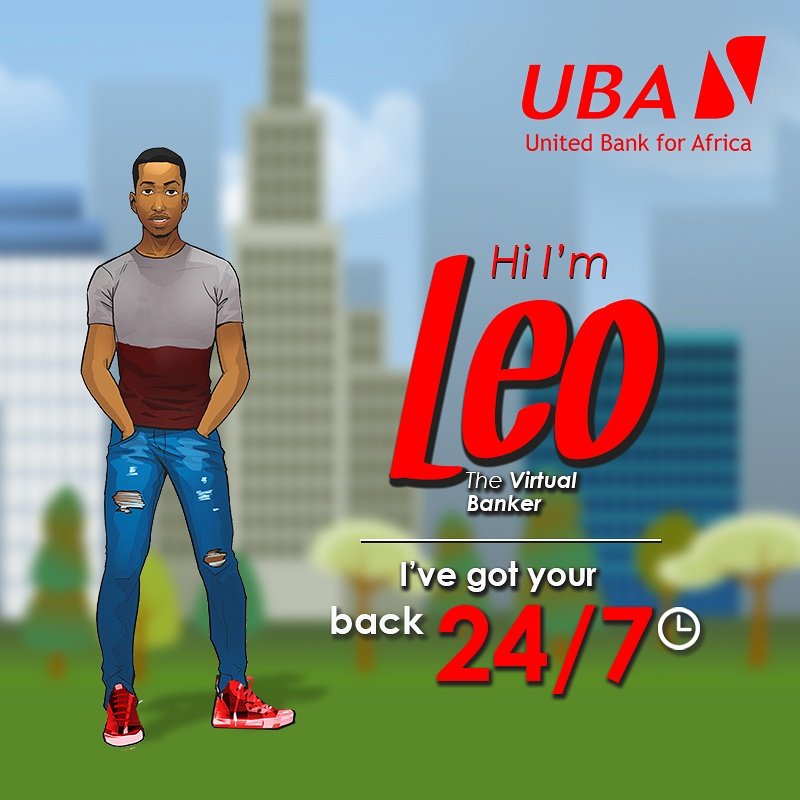
Pan African financial institution, United Bank for Africa (UBA) Plc, has in the last three years won the hearts of its customers with its artificial intelligence chat bot, LEO, which has proven to be the most formidable artificial intelligence chat bot till date; serving an ever-increasing clientele who now have less transaction hassles to worry about.
Leo is an AI chatbot for banking services currently available on Face-book Messenger, WhatsApp, Apple Device and is set to launch soon on other social media platforms.
Birthed January 11, 2018, with a firm resolve to prioritise its customers as well as put the bank at the heart of disruptive technologies that will transform the experience of esteemed customers, UBA did just that with a million users becoming hooked in less than three months of its LEO’s inception.
Three years later, and with over 3 million customers and counting, UBA’s LEO, has without doubt, remained the smartest Banking Chatbot in Nigeria because of its speed and quick learning intelligence and has continued to evolve with plenty to offer its teeming customers. While other financial institutions are still trying to figure to find their feet as regards AI, UBA’s LEO has become a massive success as the AI continues to consolidate on it successes and accolades winning several awards overtime.
The chat bot continues to enjoy periodic and systematic upgrade with special emphasis on enhanced advancements and specialised unique features which have clearly earned the chatbot over 3 million Users.
UBA’s Group Managing Director/Chief Executive Officer, UBA, Mr. Kennedy Uzoka, affirmed that UBA customers indeed agree that LEO is one of the bank’s biggest investments in cutting-edge technology and has been steadily changing the face of banking in the continent.
“UBA’s vision has always been and will remain a dominating force in Africa’s digital banking space. Our resolve is to provide unparalleled experience across all channels. We are a technology-driven institution with vast knowledge in the business that we do and LEO, being a tested, dependable and intelligent personality, replicated on WhatsApp the success it recorded on the Facebook Messenger platform where it started its journey and later on the IOS (iPhone Operating System) platform . It is a solution that is from the customer’s standpoint, easy to use by anyone regardless of demography. LEO is always ready and waiting to help with any form of banking service,” Uzoka said.
“As an app that has been in existence for over nine years, reaching more than 1.5 billion people in over 180 countries, WhatsApp has become very essential in lifestyle and that is why UBA saw the need to include LEO’s services in that very important app and the premium private chat platform has assured that there will be no spam messages, as the development is to enable businesses serve their customers with useful information,” the GMD stated,
Uzoka explained that LEO is already present in over 20 African countries and in three languages and has a number of rich and robust features bound to mesmerise existing and potential customers with services that are extremely fast and secure as all transactions and enquiries are encrypted, end-to-end.
LEO has the ability to do a wide range of things, including funds transfer, call card top-up, checking of account balance, retrieval of bank statements, instant account openings for new customers, statement to embassy/other banks/microfinance, purchase of airtime/ data, paying of bills (LCC, PHCN, Cable TV), effectively helping with savings and spend limit.
The AI chatbot also boosts of remarkable innovative features that allows customers make banking Services – Request/stop/confirm Cheques, Block card, Log & track complaints, ATM/Branch Locator, Freeze accounts, and check weather etc. Other features include Customer Care complaint resolution, linking of new account, flight Payment, linking and Funding of Prepaid Card, Travel Notification, Wakanow services and Dubai Visa service.
The GMD pointed out that, customers who have engaged with LEO are more than delighted about their experience and credit it for automatically extracting account details without hassles, adding that “Testimonies abound about how it is generally easier to use LEO compared to its counterparts. For example, LEO automatically detects account numbers via a customer’s WhatsApp mobile number and goes ahead to seamlessly help customers check their account balance as well as top-up airtime”.
Reviews from customers note that LEO is more personable, more humane, and it feels like talking to an experienced customer service/Fulfilment representative. The Bot also allows customers to easily lodge and process complaints with adequate and timely feedback.
UBA offers banking services to more than twenty-five million customers, across over 1,000 business offices and customer touch points, in 20 African countries. With presence in the United States of America, the United Kingdom and France, UBA is connecting people and businesses across Africa through retail; commercial and corporate banking; innovative cross-border payments and remittances; trade finance and ancillary banking services.