Whist they may not necessarily be bringing music, they know how to shake things up.
From broken hearts, to shaky friendships, and boys just trying to be boys- Aminu, Louis, Tayo and Lanre are back for another suspense and drama infused season of The Mens’ Club.
Will Tumini come back in Aminu Garba’s life? Has Louis finally found love that can rid him of his ‘Mummy’s boy title’? Does Lanre understand that these older women are more than just years, you need experience with them- someone better tell him! And can Tayo just make up his mind and ease us out of his numerous love triangles ?
Discover your favourites in this new season of The Men’s Club, set to drop on REDTV , on 22nd July, 2020.
Follow @itsredtv on IG, Twitter, Facebook and YouTube to stay up to date on exciting new shows, premium lifestyle entertainment and events.
Nigeria’s leading financial services group and holding company, FBN Holdings Plc, has won the 2020 Best Corporate Governance in Nigeria Award by the World Finance. World Finance is renowned for its comprehensive coverage and analysis of the global financial services industry, international business, and the global economy.
FBN Holdings Plc is winning this award for the second consecutive year on the back of its strong corporate governance practices and outstanding leadership in the Nigerian financial services industry
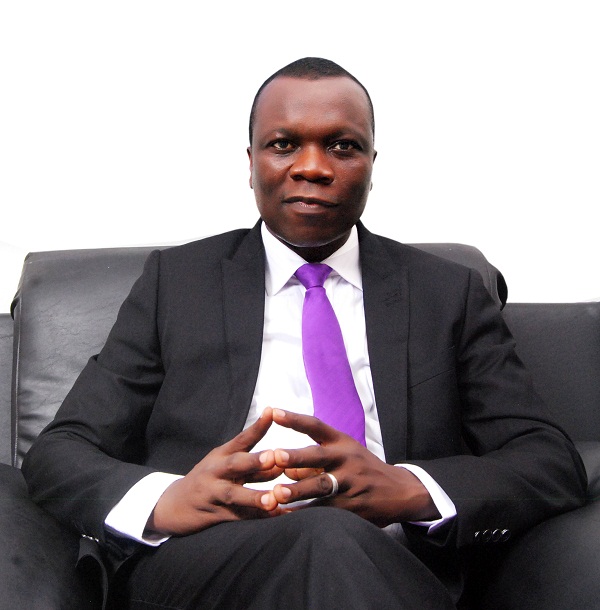
Commenting on the award on behalf of FBNHoldings, UK Eke, MFR, its Group Managing Director said; “winning the award in quick succession is a demonstration of not only the strength of our corporate governance practices but also its resilience. As a holding company, we emphasize the highest standards in corporate governance across all operating entities in our quest to deliver value to our numerous stakeholders”
For the past thirteen years, World Finance has been celebrating corporate achievements in the areas of corporate governance, innovation, and market leadership in the financial services sector across all the regions of the World.
American Internet Business School (AIBS) has announced a free seven days workshop for artistes, musicians, comedians, producers, and entertainment executives.
Dr. Ope Banwo, Chief Executive Officer (CEO) and Founder of AIBS unveiled the workshop from his base in America, as part of a digital business empowerment and awareness initiative for the entertainment industry.
The one of a kind free workshop targeted at operators of the entertainment industry will hold from Monday, June 29th to Saturday, July 4th.
Tagged ‘Digital Business Survival Workshop’, the online training will avail attendees the opportunity to learn digital business strategies that any creative artiste or executive can tap into to create multiple streams of additional income for their brand, creative works and fan base.
Explaining the rationale behind the workshop, Dr. Banwo said: “The American internet business school recognise that even before the COVID-19 pandemic came and decimated the finances of many individuals and companies in virtually every industry, many creative artistes have struggled to understand how they can generate extra income from their talents, artistic catalog and huge fan basee without the investment of capital, technical skills or digital business experience.
“While most serious creative artists, entertainers, and executives do have some impressive presence online, most have barely scratched the surface of the amazing potential of the internet to multiply the returns on their creative assets and brand and create sustainable levels of income that will far outlast their active days as creative artistes.
“This first of its kind seven days ‘Digital Income Survival Workshop’, complete with real time case studies of how some of the strategies have been successfully applied in the global marketplace, will provide a simple step by step blueprint that creative artistes, actors, actresses, musicians, producers, and executives can follow in using the internet to create multiple income streams for themselves through their talents, catalog, brand and fan base,” Dr. Banwo said.
Highlighting the schedule of the workshop, Training Director at AIBS, Nancy Hicks described the workshop as a special post-COVID-19 economic survival palliative program to provide the much needed strategies for digital monetisation to the highly resourceful and talented members of the entertainment industry.
According to her, AIBS invites all members of the entertainment industry to attend the seven days free breakthrough workshop and get introduced to some very simple streams of digital income that have been specially customized for members of the entertainment industry.
“Every day, for three hours, during the seven days conference, Dr. Banwo and a team from the American Internet Business School will be breaking down one digital business income stream peculiar to the entertainment industry and providing attendees with the blueprint on how they too can get started in monetizing their skills, creative assets, and fan base as entertainers or entertainment executives.
“The seven days workshop is free for all Musicians, Actors, Actresses, Producers, Comedians, Executives and anyone connected with the entertainment industry, but everyone must pre-register to lock down their spot since the digital training room they would be using can provide access to 100 participants only.”
Training areas during the seven days workshop include: Affiliate Marketing Income Stream For Creative Industry, Info Marketing Income Stream For Entertainers, Freelancing Income Stream For Creative Artistes, Celebrity Dropshipping Income Stream, Celebrity Membership Sites Income Stream, and Social Media Income Stream For Entertainers.
Affirming the fact that there is indeed a lot to be benefitted from the workshop, Dr. Banwo said: “This is the time for all members of the creative industry to take the ability to generate multiple income streams from their talents, creative assets and fan base to the next level. We encourage everyone involved in the industry to come and benefit,”
The primary objective of American Internet Business School (A.I.B.S.) is to provide modular internet-based training in the form of Online and Live Training; Recorded Training and Home Study courses for doing business on the internet.”
The American Internet Business School (AIBS), is renowned for equipping businesses and individuals on how to maximize their productivity and profitability on the internet. Over the years, AIBS has also provided training on key areas of internet business such as brand building, communication, marketing and sales.
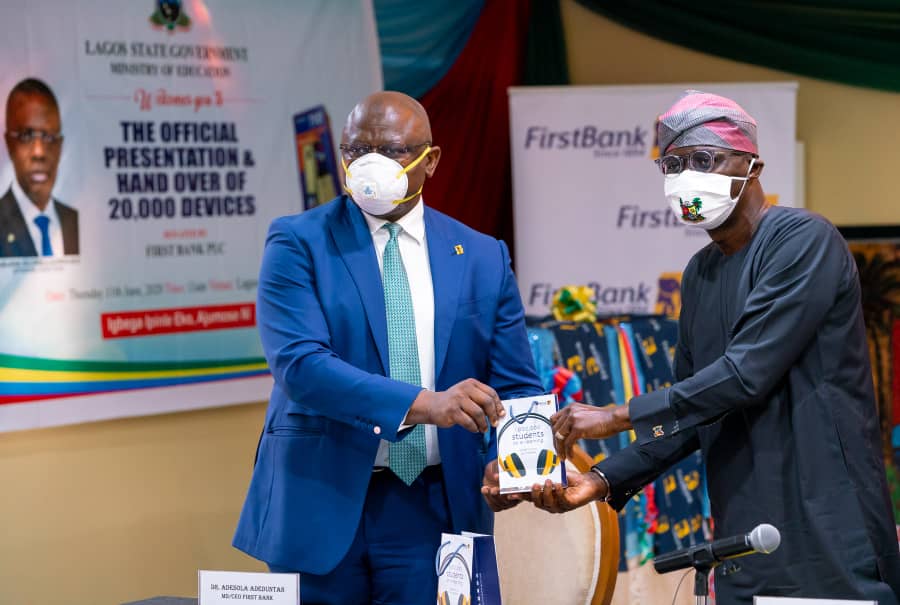
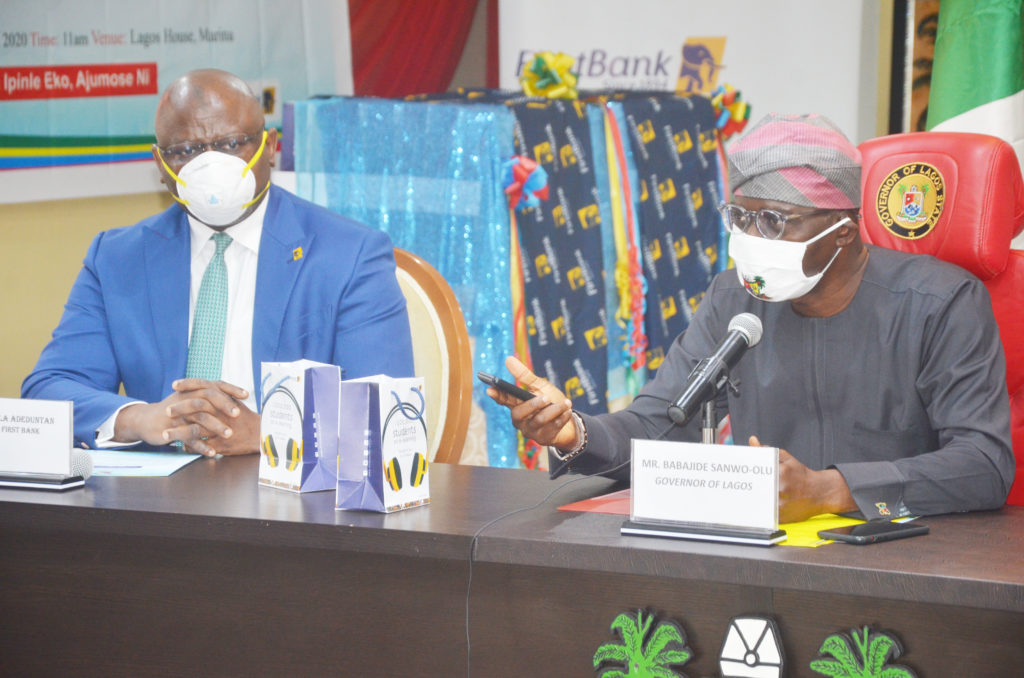
First Bank of Nigeria Limited, Nigeria’s leading financial inclusion services provider on Thursday, 11 June 2020, presented 20,000 units of e-learning devices to the Lagos State government at the State House in Marina, Lagos. The devices are planned for distribution to school children.
With the gesture, the Lagos State governor, Babajide Sanwo-Olu said the State had found a “real development partner” in FirstBank, noting that the intervention came at a time the Government was massively deploying technology to transform the conventional mode of teaching and learning.
The presentation of these devices which is also in partnership with Robert & John (an edu-tech company that owns Roducate) is part of activities implemented to close the gap caused by the disruption in children education’s due to schools’ closure, following the COVID-19 pandemic. So far the Bank has enabled over 10,000 free sign-ups to the Roducate e-learning platform with the goal to empower one million students.
“When we were developing our vision to change the face of education in Lagos, we knew from the outset that we could not achieve much progress in improving the quality of learning without using technology as a strong enabler. So, it is not out of place that we are witnessing more infusion of technology in learning and this intervention by FirstBank could not have come at a better time,” said Babajide Sanwo-Olu, the Governor of Lagos State.
“It feels great when you have people and organisations share in your vision and working with you to realise it. I’m glad to say that we have found a real development partner in FirstBank, which has supported us to actualise the vision we have signed to achieve. Many years back, nobody foresaw Coronavirus (COVID-19) would come and disrupt our ways of life. These devices will be useful to our pupils in the current circumstances we have found ourselves.”
“FirstBank and all technical partners that worked on this project have written their names in the heart of students that will be using the device to learn. They will be forever grateful for passing the future to them.”
The e-learning device is configured in line with the government’s accredited curriculum for primary, secondary and tertiary schools across various fields of academic endeavours, such as science, commercial and arts. It is built to promote cost-effective learning as there is minimal need for internet connectivity, whilst learning on the device is on-going.
Speaking on the presentation, Dr. Adesola Adeduntan, Chief Executive Officer, First Bank of Nigeria Limited said “the e-learning initiative aligns with our Corporate Responsibility and Sustainability initiatives and falls under one of our key strategic pillars, Education.”
“We are excited to promote education and have consistently demonstrated this in our support of 10 universities and 3 secondary schools on infrastructure projects; our support of 10 universities with professorial Chairs and provision of financial literacy, entrepreneurial and career counselling to over 80,000 students in over 80 secondary schools in the country”, he added.
The Bank has also collaborated with IBM and Curious Learning to ensure the e-learning initiative swiftly moves across the country to school children and individuals with the need to promote the pursuit of knowledge, irrespective of age.
The partnership with IBM, offers the Digital-Nation Africa program, an online youth-focused learning programme that enables innovation and skills development on emerging technologies through focus areas such as Artificial Intelligence, Coding, Cloud, Internet of Things, Blockchain, Data Science and Analytics, and Cybersecurity whilst Curious Learning offers academic-based contents for students aged 3-8, using fun, self-guided learning apps to help them with their cognitive skills at a fundamental level.
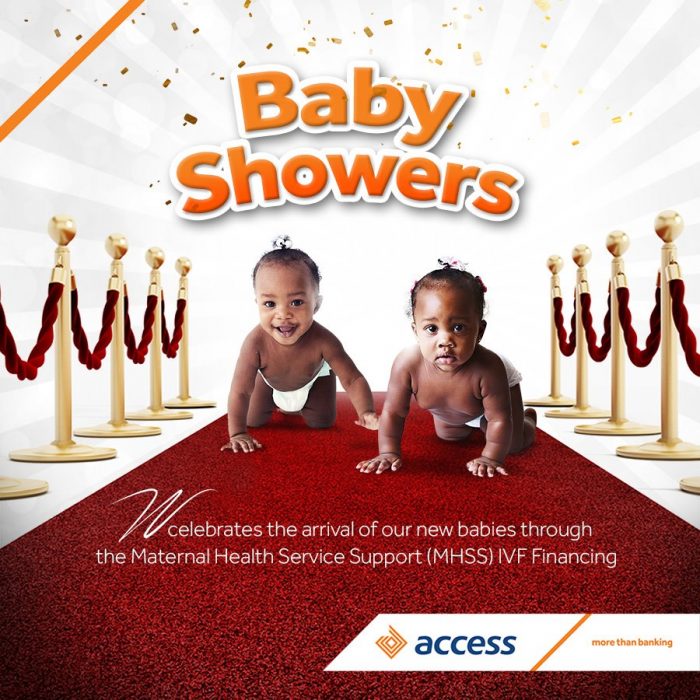
Access Bank has added another feather to its cap through the women market programme – The W-Initiative Maternal Health Service Support (MHSS) scheme.
Recall, the W-Initiative has recently welcome the birth of two new babies to the couples who accessed the MHSS financing for their IVF (In-Vitro Fertilization) procedure having waited several years.
Since 2014, The W-Initiative through its MHSS health financing programme has supported the advancement of the Assisted Reproductive Technology (ART) to enable couples access fertility treatment such as IVF.
Having successfully financed hundreds of procedures including fertility treatments, child delivery, fibroid treatments, surrogacy, bone marrow transplant and other specialised procedures, The W-Initiative remains ever committed to supporting more women and families by restoring hope and saving lives through its health financing scheme.
Women interested in accessing this health financing solution from the Bank can go through their service touch points- www.thewcommunity.com, or send a direct email to wcares@accessbankplc.com or call 01-2273005
…To fast-track 10% contribution of mining sector to GDP
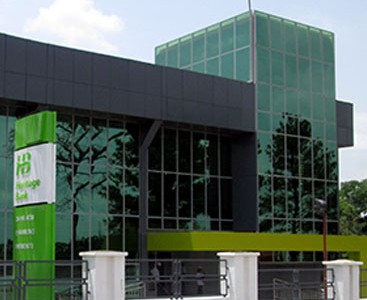
The Federal Government of Nigeria has commended Heritage Bank for being part of a valuable private sector collaboration with Dukia Gold & Precious Metals Refining Co. Ltd, saying such partnership stands to create new opportunities for Nigeria to grow its potential reserves of 200 million ounces of gold.
The Vice President, Yemi Osinbajo, disclosed this during a Zoom- meet & chat session, a virtual platform at the launch of nationwide Dukia-Heritage Bank Gold & Precious Metals Buying Centres held yesterday
He affirmed that the launch of this expansive project between Heritage Bank and Dukia Gold would enable Nigeria to mine reserves properly, trade responsibly, refine locally and boost the nation’s foreign reserves.
He stated, “What we are looking at here is an extremely valuable new source of trade, jobs and foreign exchange.
“This project will create primary employment for local artisanal miners and mining cooperatives, and across the solid minerals value chain. Off-take agreements between Dukia Gold and local mining communities and owners of recyclable gold will be a useful provider of jobs in our post-covid economy.
“The positive multiplier is expected to extend even further than this as the Dukia Gold project will also encourage the emergence of smaller-scale mining companies who, for the first time, will now have a transparent and welcoming market for their mined gold and precious metals. This is set to create jobs and unleash the economic potential of mining communities.”
Osinbajo further counted the enormous benefits of the project, “This provides a sustainable way for Nigerians to exchange their gold jewellery and other precious items for cash. This system of exchange not only helps encourage a culture of recycling, but will also serve as a complementary source for the raw materials needed for the Dukia Gold & Precious Metals Refining Company. These buying centres will also enable the responsible management of some of electronic waste.”
Meanwhile, the project would further drive the diversification of the nation’s economy, Heritage Bank Plc, Dukia Gold which have given birth to a new gold and precious metal market that will grow the mining industry’s contribution to gross domestic products to over 10% by 2026.
Records have shown that the growth of mining production at the end of 2019 in Nigeria was 0.1% and the sector still contributes less than 0.5% of GDP compared to other African economies who are strong in mining like Botswana (38%), Democratic Republic of Congo (25%), South Africa (18%), Zambia (18%), Guinea (12%) and Ghana (7%).
However, the MD/CEO of Heritage Bank Plc, Ifie Sekibo stated that the partnership that would boost the mining industry production have given birth to a new market, a platform that will contribute immensely to the transformation of Nigeria’s economy.
According to him, the operationalization of this initiative aligns with the overall Economic Transformation Agenda of the Federal Government of Nigeria especially as it relates to the full stream diversification of the Nigerian economy, job and wealth creation, development of the solid mineral space amongst others.
Sekibo affirmed, “It is our believe that as the economy of Nigeria is being recalibrated, given the impact of the global pandemic, the government’s committed aspiration to build a robust and resilient economy will be further enhanced through the operationalization of this initiative working with all stakeholders across States and Government Parastatals, the Central Bank, Private Sector and other international actors towards the development of the solid minerals sector and its appendages.”
He explained that this would enhance a regulated market that would see precious metals and other commodities take centre stage in endeavour to ensuring irreversible economic growth and development in alliance with a modernized Exchange for commodities trading in Nigeria.
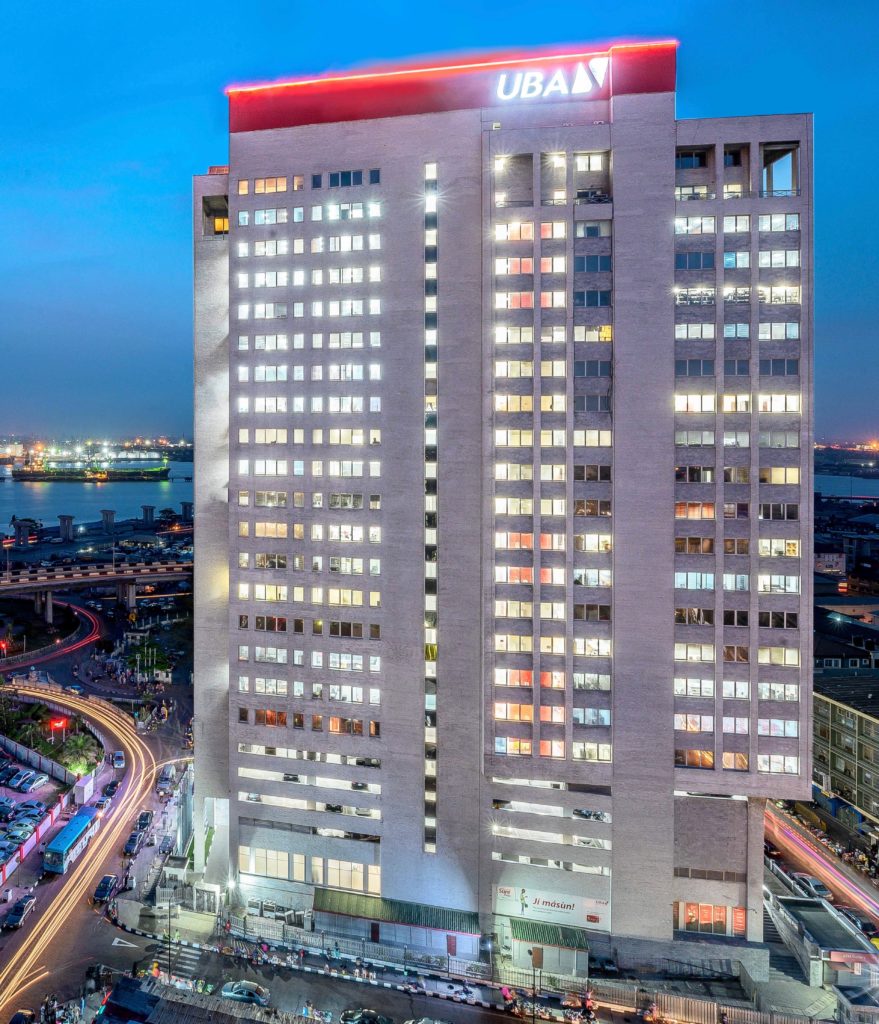
Pan African Financial institution, United Bank for Africa (UBA) Plc has rewarded another set of 100 loyal customers with a total of N10m in the UBA Bumper account draw. The 100 customers won N100,000 each in this month’s edition of the draw which began in January 2020.
The virtual and transparent draw which was held at the UBA Head Office in Lagos on Wednesday, was transmitted live via the Facebook platform in strict compliance with social distancing rules as directed by the Federal and Lagos State Government.
Just like the previous draw held in May, lucky winners, who were contacted via their mobile phone numbers were overjoyed as they emerged the latest winners of N100,000 each. While expressing gratitude to the bank, they said the winnings will go a long way in meeting their pressing needs especially in these trying times, when the Covid-19 pandemic has made most businesses vulnerable.
UBA’s Group Head, Consumer and Retail Banking, Jude Anele, who congratulated the lucky winners, said they were rewarded for their loyalty to the bank. He also noted that the bank is dedicated to supporting customers and remains passionate about their success and overall growth.
He said, “I will like to reiterate that UBA is always happy to reward and support customers. There is no better time to give back and delight customers than this challenging economic period where people need all the support they can get to make life more meaningful. With this in mind we decided to prioritize them as we always like to do at UBA by giving them ample reason to be joyful.
Continuing, Anele said, “Our key objective is to encourage our customers save regularly. We are here to support them likewise encourage them save and ultimately grow as well, because we are aware that they are invaluable to all that we do”.
UBA’s Group Head Marketing & Customer Experience, Michelle Nwoga, who explained that the main purpose of the UBA Bumper Account is to ensure that Nigerians fully embrace the savings culture; noted that the monthly, quarterly and targeted draws will also go a long way to assist customers through these turbulent times, by providing them with funds that will help ease the difficulties occasioned by the pandemic.
Explaining the modalities for the draw, Nwoga said that all new and existing customers need do to qualify for the draw is to ensure that they have a minimum deposit of N5,000 in their UBA Bumper Account. Current UBA customers are to dial *919*20*1# to migrate to the UBA Bumper Account whilst potential customers should dial *919*20# if interested in opening a UBA Bumper Account.
She also added that for the bumper account a monthly shopping allowance of N100,000 for a year is also up for grabs. “No fewer than five account holders will get a whopping N2 million each across all participating regions every quarter.
Speaking further, Nwoga disclosed that UBA is constantly working on best ways to serve the interest of customers by making their lives easier, “This is why as a bank, we continue to invest in cutting edge technology that guarantees ease as is evident in our recent mobile app upgrade which offers a more interactive, user friendly interface that makes available a myriad of opportunities from the comfort of customers’ homes,” Nwoga stated.
She explained that the new mobile app will now prompt users to use their device enabled biometrics, adding that the menu has been reduced and divided into sub-menus to enable users view Transaction History, Net worth, Trends amongst others at a glance.
“One other key feature of the app, worthy of mention is that it includes the live chat option, where users can communicate on the go with dedicated staff trained to assist with any enquires and challenges; biller validation; as well as group transfer – a new menu where users can create groups, save members and transfer funds to up to 100 members on the group. You can be assured that UBA never relents in guaranteeing premium customer satisfaction”, she said.
First Bank of Nigeria Limited, Nigeria’s premier and leading financial inclusion services provider, has announced that it has reinforced its technology infrastructure to enable anyone in the country open a FirstBank account through their mobile phones, without visiting any of its branches nationwide.
The investment in the Bank’s mobile banking infrastructure is in furtherance of the need to deepen financial inclusion in the country, enabling account opening to be carried out on its *894# USSD banking, FirstMobile (self-service telephone banking), its website – www.firstbanknigeria.com – as well as the Bank’s staff, through the Direct Sales Executive (DSE) application installed on their mobile phone, ATMs and the bank’s over 55,000 FirstMonie Agents spread across the country. Opening an account with FirstBank through any of these means is seamless, convenient, fast, and user-friendly.
The DSE App is an end to end encrypted mobile application installed on the phone(s) of FirstBank staff which enables them to open an account for to-be customers. Upon the completion of the account opening process via the DSE App, the customer is notified of his or her account number through a text message on the mobile phone used to register the account.
With FirstBank’s *894# USSD banking, various banking activities are carried out on a mobile phone – across the four major GSM network operators in the country – without the use of the internet. To open an account via this means, dial *894# then select ‘open an account’ to provide the information required or by simply dialling *894*0#. The Bank currently has over 9.5 million of its nearly 20 million customers on its USSD banking platform.
The FirstMonieAgent Banking is an agent banking initiative from the bank that is designed to take banking closer to people, thereby bridging the gap between the banked and unbanked. FirstMonie is a channel through which various banking activities like FirstBank account opening, funds transfer, bill payments, data and call credit recharge services, amongst others are carried out. The Agent Banking initiative has also contributed to reducing poverty, being responsible for the indirect employment of over 150,000 people across the country.
According to Chuma Ezirim, Group Executive, e-Business & Retail Products, First Bank of Nigeria Limited, “beyond opening an account in any of our over 700 branches, we are delighted with the investments at reinventing our business processes over the years, especially with the use of technology. This has been critical to staying relevant in the industry for over 126 years and being the financial partner of the first choice to all our customers and Nigerians, irrespective of where they are.”
Creating these virtual ways of opening a bank account with us – thus; the staff DSE App, ATMs, FirstMonie Agents, *894# USSD banking, FirstMobile and our website – reinforces our resolve to ensure that more Nigerians and residents have access to banking, especially through our state of the art financial services and we remain resolute to being the key to banking, enabling business and financial activities that would continue to propel the country’s economic growth and development.
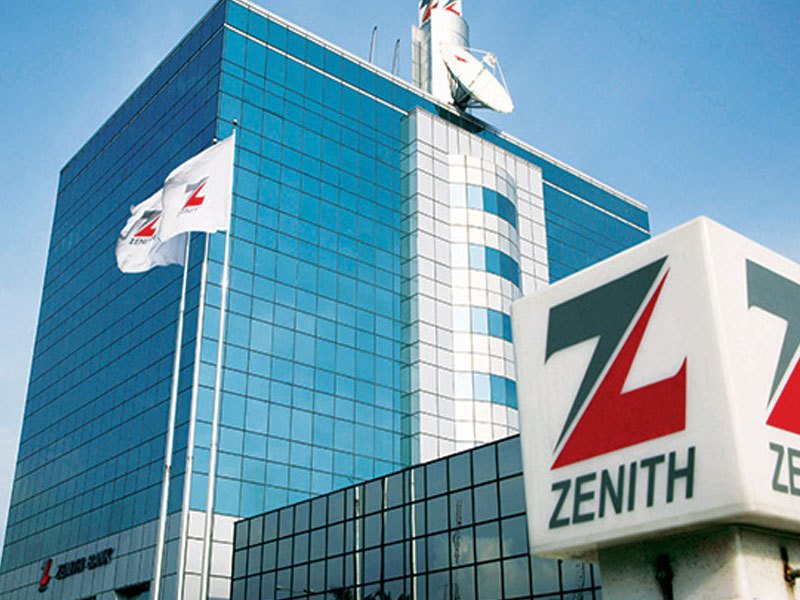
Zenith Bank Plc, Nigeria’s leading financial institution, has emerged as the Best Bank in Nigeria in the recently released Global Finance Magazine World’s Best Banks Awards 2020.
The awards, which was published in the May 2020 edition of the Global Finance Magazine, was based on the performances of the banks in their respective regions and countries over the period from January 1 to December 31, 2019.
Global Finance’s “World’s Best Banks Awards” are recognized amongst the world’s most influential banking/finance and corporate professionals as the most coveted and credible awards in the banking industry, with winners chosen in more than 150 countries across Africa, Asia-Pacific, Central & Eastern Europe, Latin America, the Middle East, North America and Western Europe.
Founded in 1987, Global Finance regularly selects the top performers among banks and other providers of financial services and the awards have become a trusted standard of excellence for the global financial community.
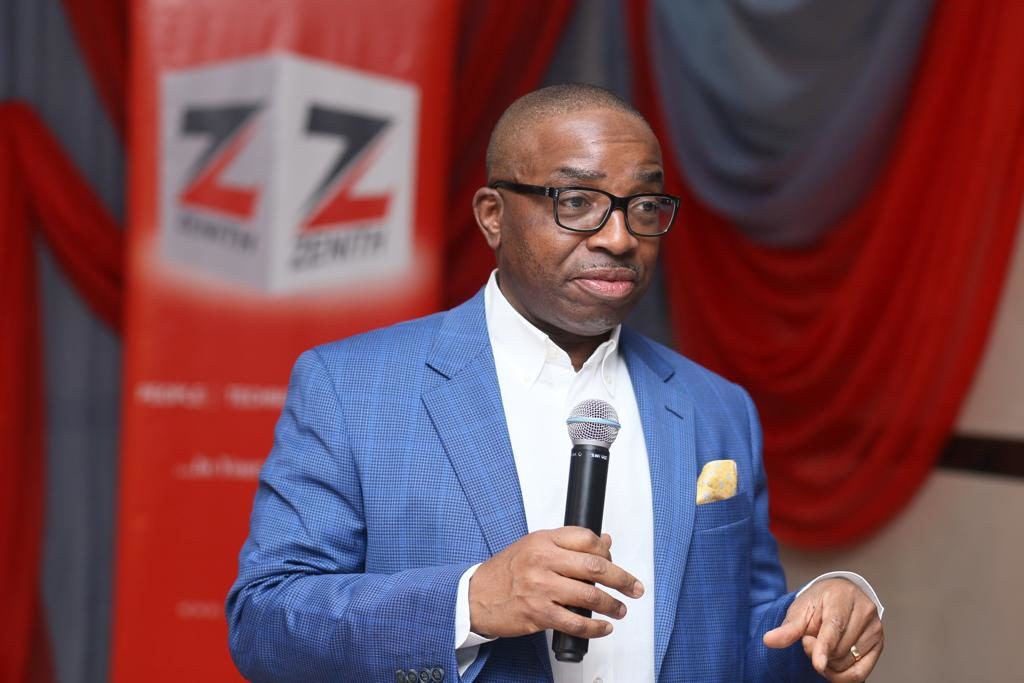
Commenting on the recognition, the Group Managing Director/Chief Executive of Zenith Bank, Mr, Ebenezer Onyeagwu said that “this award is a clear demonstration of the bank’s market leadership, occasioned by our superior product offerings, best-in-class service and top-of-the-range technology which create value for our teeming customers.”
Zenith Bank has clearly distinguished itself in the Nigerian financial services industry through superior service quality, unique customer experience and sound financial indices. The bank, with a knack for setting the pace and raising benchmarks, is a clear leader in the digital space with several firsts in the deployment of innovative products, solutions and an assortment of alternative channels that ensure convenience, speed and safety of transactions.
As a testament to its resilience and market leadership, Zenith Bank announced an impressive result for the year ended December 31, 2019, with profit after tax (PAT) of N208.8 billion, achieving the feat as the first Nigerian Bank to cross the N200 billion mark. In the recently released Q1 2020 unaudited financial results, the bank also recorded an improved result over the corresponding period in 2019, with gross earnings rising by 6% to N166.8 billion and profit before tax (PAT) growing 3% to N58.8 billion.
Consistent with this superlative performance and in recognition of its track record of exceptional performance, Zenith Bank was ranked as the Best Commercial Bank in Nigeria 2019 by the World Finance and the Best Digital Bank in Nigeria 2019 by Agusto & Co. The bank was also voted as Bank of the Year and Best Bank in Retail Banking at the 2019 BusinessDay Banks and other Financial Institutions (BAFI) Awards. Most recently, the bank was recognized as the Most Valuable Banking Brand in Nigeria, for the third consecutive year, in the Banker Magazine “Top 500 Banking Brands 2020” and the Bank of the Decade (People’s Choice) at the ThisDay Awards 2020.
Advocate Partnerships between Private Sector and Government
African thought leaders and great minds have noted that the development of homegrown solutions and adequate investment in human capacity building and agricultural expansion are key steps that will help to rebuild Africa and put the continent on a stronger footing post Covid-19.
Analysing the theme ‘Domestic Policies, Regional Development and a Global Agenda: SDGs and African Development at Crossroads; the speakers collectively gave this submission during the second panel session of the 2020 edition of United Bank for Africa (UBA) African Day Conversations.
The virtual session, which was moderated by Veteran Journalist and Media Consultant, Eugenia Abu, was made up of thought leaders from across Africa, including the Regional CEO, UBA West Africa, Abiola Bawuah (Ghana); Senior Program Coordinator, Regional Network of Agricultural Policy Research Institutes, Dr Nalishebo Meebelo (Zambia); Leadership Coach and Chairman, Go Ahead Africa Ltd, Roland Kwemain (Cameroon); Founder and Executive Director, Social Change Factory, Sobel Aziz Ngom (Senegal); Special Assistant to the President Muhammadu Buhari on Digital and New Media, Tolu Ogunlesi (Nigeria); and Social Entrepreneur and Founder, LEAP Africa, Ndidi Nwuneli (Nigeria).
Abiola Bauwah who emphasised how Africa should rely less on foreign donors, said, “There are five areas we should work on more for us to reach the SDG goals; the private sector; rapid industrialization; institutions and the rule of law; develop our human capital; remove the barriers across Africa. We should institute Africapitalism which is an economic philosophy that says that the human and capital resources of Africa are the only ways in which we can develop Africa.”
Nalishebo Meebelo noted that there’s a lot that young people can do along the value chain of manufacturing, transporting, technology and marketing, adding that, “Government cannot do it alone, they need to work with other stakeholders. Cut and paste solutions do not work for us here in Africa, we need to have our own homegrown solutions to fight this pandemic.”
Eugenia Abu, who focused on the huge role that women and youth must play in rebuilding the continent, said that Africa had to work together to provide solutions to its numerous challenges. “Women, entrepreneurial champions, young people and collaborations between African countries are very key to developing Africa,” she stated.
Ndidi Nwuneli who was saddened that the agricultural sector remained hugely untapped, emphasised the need for a change of mindset where people usually equated agriculture to poverty. “This is a $1 trillion industry and we are neglecting it; therefore my charge to you is that we invest in the agricultural sector, prioritize it, leverage it, transform our educational system to prepare our young people for this sector, change the mindset and trade with each other,” she explained.
Sobel Aziz Ngom pointed out the need for the youth to take charge in Africa. “It is time to not just serve young people, but to trust them to lead. The challenge that we have at the domestic and continental level is making the change in our structure and in the political system that give the place to young people to be 100% engaged,” Ngom stated.
In his own submission, Tolu Ogunlesi, said, “All over the countries young people are seizing opportunities, and we need to start thinking about how to make sure that this is not just for the age of COVID but for now and beyond COVID-19. Even if the pandemic was to disappear today, I hope that the lessons we’re learning, we’re not going to forget them and go back to where we used to be.”
For Roland Kwemain, more institutions need to tow the line of UBA in events such as UBA Africa Conversations. “If 100 multinationals in Africa were doing that UBA is doing, we would go far because CSR is an amazing leverage not just for the brand but also for supporting people & women in terms of activities. The truth is that we need partnership between the government, corporates and the civil society,” he said.
The United Bank for Africa is a leading pan-African financial institution offering banking services to more than twenty million customers globally. With footprint in 20 African countries and presence globally in the United Kingdom, the USA and France, UBA is connecting people and businesses across Africa through retail, commercial and corporate banking, innovative cross border payments and remittances, trade finance and ancillary banking services.