Shoprite Nigeria’s supermarkets have offered early Black Friday deals and big discounts on everyday essentials as customers are increasingly looking for value, given the pressure many households are currently experiencing.
The Shoprite bumper black Friday offer begins from 25th November and ends in 29th November, 2020 and it’s a pan-Nigeria value added offer.
According to the Shoprite statement, “ In response to COVID-19 pandemic, Shoprite will for the first time offer early Black Friday deals and keep the deals valid for longer, to allow customers more time to plan and shop, and to prevent overcrowding.”
The statement further stated that some of the great deals on offer include Coca-Cola, Fanta, Sprite products, Power Vegetable Cooking, Ariel Washing Powder and many others products.
Stringent hygiene and sanitizing protocols will be in place at all Shoprite supermarkets in Nigeria to help protect customers and employees as far as possible.
These include, but are not restricted to, the use of face masks, hand sanitizer, social distancing and limited entry where necessary to avoid overcrowding. Customers are encouraged to pay by card and to capitalize on the extended trading hours to make the most of the deep-cut specials that will be on offer.
Named Africa’s Leading Business Hotel for the Sixth Consecutive Year
Transcorp Hilton Abuja has been honoured with four (4) awards including Africa’s Leading Business Hotel for the sixth consecutive year at the 27th annual World Travel Awards.
The hotel, which is owned by Transcorp Hotels Plc, the hospitality subsidiary of Transnational Corporation of Nigeria Plc, also won the awards for Nigeria’s Leading Hotel, Nigeria’s Leading Business Hotel and Nigeria’s Leading Hotel Suite (the Presidential Suite).
Commenting on the award, the General Manager of Transcorp Hilton Abuja, Kevin Brett, said, “We are delighted once again to receive the World Travel Awards in various categories. It is a testament to the fact that the hard work and commitment our team put in daily is recognised and appreciated”. Speaking further, he said “I thank our guests who through their continuous patronage and feedback have helped us retain the number one position in the Nigerian hospitality industry”
The Managing Director, Transcorp Hotels Plc, Dupe Olusola, in her remarks, highlighted the significance of receiving such an award during the COVID-19 Pandemic. She said, “It is such a pleasure to receive the ultimate seal of excellence in the global tourism and hospitality industry from the World Travel Awards. At a time were travellers are exploring only the best hospitality products, the significance of this recognition is truly important”
According to the organiser of the award, this year’s World Travel Awards nomination programme reported record and never before seen visitor traffic and engagement from the public voter (the all-important tourism consumer) despite the incredible challenges faced by our industry over the course of 2020. This shows that as the global recovery begins, the appetite for tourism has never been as keen and offers hope and much-needed encouragement to us all.
World Travel Awards was established in 1993 to acknowledge, reward and celebrate excellence across all key sectors of the travel, tourism and hospitality industries. Today, the World Travel Awards brand is recognised globally as the ultimate hallmark of industry excellence.
First Bank of Nigeria Limited, Nigeria’s premier and leading financial inclusion services provider has announced its variant account products – KidsFirst and MeFirst – created to encourage the right savings culture among children from 0 – 17 years. The offerings have relevant enhancements including appropriate parental guidance and financial discipline for children as they grow into adulthood. Both accounts can be opened with zero balance and operated with a minimum balance of N100.00.
KidsFirst Account is designed for children between the ages of 0 and 12 years to sensitise them on how exciting saving can be. The account comes with a trendy gift item for the child when the account is opened with a minimum of N10,000.00. The account is automatically transited to MeFirst account when the child is 13 years old.
MeFirst account, on the other hand, is designed for teenagers between the ages of 13 and 17. This account is created in recognition of the need to help teenagers embrace the culture of financial responsibility and cashless payment as they develop into young adults. They have access to attractive and trendy pre-paid cards through which parents/guardians can credit weekly/monthly allowance and monetary gifts. MeFirst account holders can select from 5 exciting card design options that suites their trendy style.
The Mefirst cards are enabled to pay for micro online shopping as desired – mobile games, apple music, Spotify and local POS transactions as well. Teens are thereby exposed to the cashless culture and electronic payment activities early in life, which is expedient in today’s digital age. Parents and guardians of the child are granted access to track and control the spend pattern.
Speaking on the accounts, Gbenga Shobo, FirstBank’s Deputy Managing Director said, “we are delighted with the role we play in promoting financial literacy amongst children and teenagers in the country. Our KidsFirst and MeFirst accounts are designed to ensure that parents and guardians are able to have their wards exposed to the right savings culture and financial discipline as they evolve to adulthood.”
“With these accounts, parents are able to save and strengthen their preparedness for various financial obligations of their children like paying for school fees as they progress with their academic pursuit which is pivotal to securing the future of the children. MeFirst and KidsFirst accounts are essential gifts from parents to their children”.
Ecobank Nigeria has concluded plans to step up awareness on non-communicable diseases particularly diabetes to commemorate this year Ecobank Day. Ecobank Day is a special day set aside every year by Ecobank Group, for management and staff of the bank to embark on Corporate Social Responsibility (CSR) activities that impact its immediate environment and people.
This year’s theme is ‘Take Action Against Diabetes’ It is scheduled for Wednesday 18th November at 11amJoin live event . Two specialists on Diabetes, Dr. Mosunmoluwa Obafemi Adio, Consultant Endocrinologist, Presidential Emergency Plan for AIDS Relief (PEPFAR) at UCH, Ibadan, & currently a Consultant Endocrinologist With Evercare and Dr. Mazeedat Erinosho, Public Health Practitioner & Director, Saving One Million Lives Programme, Ministry of Health, Lagos State, who will speak on how best to maintain a healthy lifestyle as a Diabetic patient and new breaks on the dreaded disease. Also, a survivor will share his life experience. 2020 Ecobank Day events are being held virtually, to ensure safety from Covid-19. Registration is through
Patrick Akinwuntan, Managing Director, Ecobank Nigeria, said “At Ecobank we take great pride in our commitment to ‘giving back’ to our communities and since 2013 we have held our annual Ecobank Day as our flagship event to do so. It is a day on which Ecobankers voluntarily give up their free time to help deserving causes and is also a focus for the Bank to make donations. Each year, a specific cause is supported, and these include education, maternal healthcare, safe water supplies, malaria prevention and cancer screening”. He noted that the pan African bank last year decided to focus on raising awareness and helping to prevent Non-Communicable Diseases as a three-year campaign with this year focusing on Diabetes.
Biyi Olagbami, Chief Risk Officer, Ecobank Nigeria, said “We all need to do everything that we can to raise awareness to help prevent Diabetes and the other NCDs in Nigeria. Regrettably, most people don’t know that they have it. It can cause all sorts of complications, including kidney damage, sight loss, amputation of feet and even premature death.” Olagbami, who also doubles as the lead CSR champion for Ecobank Nigeria disclosed that planned activities aimed at raising awareness about Diabetes, include informational webinars and controlled screening in strict adherence to measures outlined by the government to combat the spread of Covid-19. He added that donations will also be extended to credible organisations for training healthcare professional, equipping care structures, field monitoring and evaluation, advocacy.
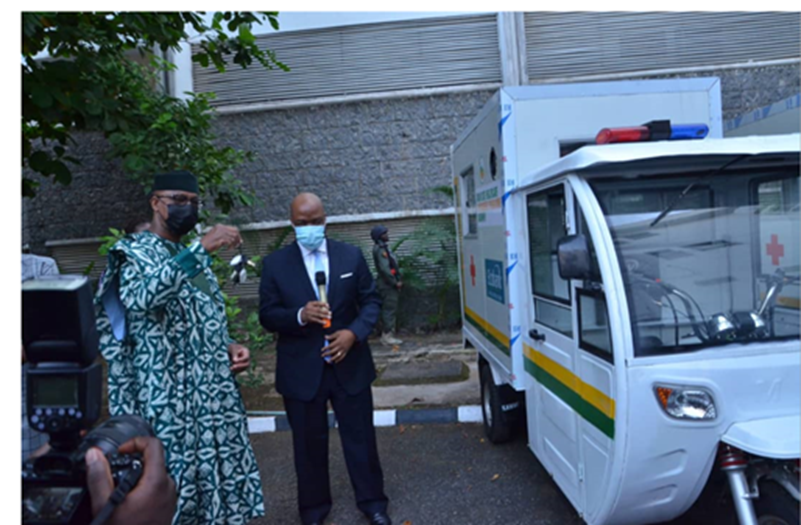
Ogun State Governor, Prince Dapo Abiodun has commended the management of Ecobank Nigeria for donating rural health tricycle ambulances to the state, saying the gesture will go a long way in complementing government’s efforts on primary healthcare delivery. The presentation was made at the Governor’s office, Oke-mosan, Abeokuta during a courtesy call on Governor Dapo Abiodun by some members of Ecobank Nigeria Executive Management Team last week.
According to him, the bank’s donation speaks directly to government’s plan to ensure that healthcare is available to all citizens in the state, noting that most people in the state live in rural areas that are not accessible to the regular ambulance services.
“On behalf of the entire people and government of Ogun state, we express our very deep and sincere appreciation to the board and management of Ecobank for thinking through and supporting us with this ambulance that is built on a frame of a tricycle. It is an ingenious innovation, I must say. We appreciate you for this gift. Most of our people reside in the nooks and crannies, where vehicles cannot access easily. So, this is a gift we appreciate and will go a long way in assisting healthcare delivery particularly our pregnant women in the rural area.”
The Governor further solicited for more collaboration and partnership with Ecobank in other sectors of the state’s economy.
Speaking in the same light, the state Commissioner for Health, Dr. Tomi Coker, commended Ecobank for the donation, saying that the ambulances would further help to address the issue of maternal mortality in the state.
According to her, “We are extremely grateful to Ecobank’s leadership for this. It is part of our vision to reduce mortality rate as well as increase the life expectancy of Ogun state people. This is going to help us achieve this aim, though our state is one of the states in the country that has low maternal mortality rate. We can also use this for other non-communicable disease patients that need transfer. On behalf of all the citizens of Ogun state, I thank everyone here for coming to witness this occasion.”
Making the presentation, Managing Director, Ecobank Nigeria, Patrick Akinwuntan said the donation is a way of supporting the efforts of the government at delivering primary healthcare to the people, noting that the ambulance is designed to reach people at the grassroots.
“On behalf of the board, management and staff of Ecobank, it is our pleasure to present this ambulance fitted for grassroots, so that health services can reach every door step in Ogun state. This is also to complement government’s effort in this regard. We are honoured to have had the cooperation of your ministry of health, headed by Dr. Tomi Coker. To the glory of God and in service to humanity; we are pleased to present this to you.”
Other members of the bank’s visiting Executive Management Team include the Executive Director, Commercial Banking, Carol Oyedeji ; Head, Consumer Banking, Korede Demola- Adeniyi; Segment Head, Public Sector/AgriBusiness, Mojisola Oguntoyinbo; Regional Head, South West/Mid-West, Christopher Olusola; Regional Manager, Public Sector, South West/Mid-West, Victor Inyang and Business Manager, Abeokuta branch, Olusegun Makinde.
The Lagos State Governor, Babajide Sanwo-Olu on Friday, November 13, 2020, unveiled the first Nigerian electric car named Hyundai Kona.
The car, which is a product of Stallion Group, was launched at the VON Automobiles Nigeria in Ojo, Lagos State where the car was manufactured.
The new Kona, an Electric car is regarded in European motoring industry as the world’s number one, with the cost, put at about N24 million
While speaking during the unveiling of the product, Sanwo-Olu observed that VON has over 40 to 50 years of vehicle manufacturing history, when they were assembling various Volkswagen products.
The governor was full of commendation for Stallion Group for the noble initiative, just as he promised that Lagos State Government will make provisions for electricity charging points for the vehicle across the state, to make it easy for users to enjoy their Electric Vehicles (EV).
Hyundai Kona
The Governor also promised the completion of the Lagos-Badagry Expressway, which was started under the administration of former governor of the state, Babatunde Fasola, in order to facilitate business activities in the state.
Sanwo-Olu said, “Lagos-Badagry Expressway which has been expanded from 2 to 10 lanes will soon be complete, we are not rushing the road; we are building a first-class road construction project.’’
The Managing Director, VON Automobiles, Mr Rohtagi Manish, while explaining the essence of the launch, pointed out that Kona will change things positively in the Nigerian auto market.
According to Manish, the changes in global temperature and weather patterns are seen today are caused by human activity. Kona, he said, is one way to respond to the global weather challenges, so as to achieve a greener environment.
This appears to be a huge boost for the promoters of more environmentally friendly automobile and subsequently promote a green environment. This will also help to drive the Federal Government’s efforts to shift focus from petrol-based automobile to vehicles with a cheaper source of energy.
First Bank of Nigeria Limited, Nigeria’s premier and leading financial inclusion services provider has announced that its mobile banking application, FirstMobile, has been awarded the 2020 Best Mobile Banking App award 2020 in the Global Finance Best Digital Bank Awards 2020. The achievement of this feat is largely attributable to the Bank’s relative strength and success of its web products and services, notably FirstMobile.
Speaking on the 2020 Global Finance awards Joseph D. Giarraputo, publisher and editorial director of Global Finance said; “This year, a global pandemic accelerated the transition to digital banking, but forward-thinking banks were already on that road. The Digital Bank Awards hone in on the institutions that are leading the shift toward a new world of banking.”
According to Global Finance, winning banks were selected based on various criteria, including strength of strategy for attracting and servicing digital customers, success in getting clients to use digital offerings, growth of digital customers, breadth of product offerings, evidence of tangible benefits gained from digital initiatives, and web/mobile site design and functionality. winners chosen from entries evaluated by a world-class panel of judges at Infosys, a global leader in consulting, technology and outsourcing. The editors of Global Finance were responsible for the final selection of all winners.
Appreciating the award on behalf of the Bank, Gbenga Shobo, Deputy Managing Director, FirstBank said “the Global Finance 2020 Best Mobile Banking App award is testament to our continuous commitment to putting our customers first which was demonstrated in our recent upgrade of the leading mobile banking application, FirstMobile. The upgrade on FirstMobile is designed to suit the social pattern and lifestyle of all our customers.
“We dedicate this award to all customers and appreciate Global Finance for the recognition.”
Only recently, Global Business Outlook awarded FirstMobile with the 2019 Best Mobile Banking App.
Access Bank has restated commitment to deliver superior service to its customers.
The Bank in a statement said it is concerned by the inconvenience that some of its customers are currently experiencing and would play its part to ensure that they have access to their accounts as quickly as possible.
“We want to express our sympathy for the inconvenience that eight of our customers are going through due to the restrictions on their accounts as mandated by a Federal court order. We are eager for this to be resolved as soon as possible.”
The Bank noted that “It is common knowledge that we and the entire banking industry are regulated entities and therefore operate under the authority of our regulators and law enforcement agencies. As such we are compelled to comply with regulatory directives”.
“While acknowledging the concern of all well-meaning parties, we urge that enquiries and views be channeled to the relevant regulatory and judicial agencies where the matter is receiving attention. It is therefore surprising that some individuals still choose to target Access Bank in a negative manner despite not being the source of the action.
The Bank has always been at the forefront of innovative efforts in support of the development of our country. We embrace this role as we are also the largest employer of labour – a sizable number of which are youth.
Access Bank has always led the way with regard to support for young Nigerians in terms of capacity building and development of SMEs. Recall that Access Bank launched an initiative to boost the creative industry with loan facilities aimed at capacity building and employment for individuals and businesses in movie production and distribution, fashion, IT and music. Our commitment also extends to the support of small business owners through initiatives that provide access to finance for growth and expansion.
We continue to be concerned by the inconvenience that our affected customers are experiencing. We stand ready to play our part to remedy the situation and have them using their accounts as quickly as possible.
The PS5 is finally here and while games are undoubtedly the most important part of any console launch, the PS5’s new user interface is a treasure trove of pretty cool new options. We had an in-depth look at the options and found a few tips and tricks to help supercharge your PlayStation experience.
Some are handled seamlessly during set-up but others are buried in a mountain of settings and options. We thought it was worth breaking down.
Here’s what we think is worth doing when you first turn on your PS5, to help tailor your PS5 experience to your own specific preferences.
PlayStation 5
1. Check out your privacy settings
During the initial PS5 set-up you’ll be asked to select from a series of four different privacy settings with names like “Social and Open” or “Solo and Focused”. It’s essentially letting you control your online profile and what others can see.
But those settings can be broken down further within those categories, giving you complete control over whether you’ll show up in search results, or who can add you as a friend, etc.
These settings can be found under the “Users and Accounts” tab in settings.
2. Select your power settings
The PS5 gives you the ability to better control how much power your PS5 is pulling, mostly when you put it into “rest mode”. As with the privacy settings, you’ll be able to choose between profiles during set-up, with presets that can be broken down further if you feel like diving deeper. Those presets determine how long it takes for your PS5 to power down when idle and also whether or not the console will automatically download updates — very useful if you want to avoid the dreaded system update when you want to play something online.
3. Mess around with HDR sliders
If you have a TV that’s HDR capable, you’ll definitely want to make sure you have these settings right.
Again, the PS5 allows you to tinker with the contrast and brightness during set-up but, personally, I went back and forth with these settings a few times, mainly because if you change the settings on your TV after set-up (say, to a Game Mode) those HDR settings will be affected. It makes sense to go back and optimize. Especially if you’re as picky about picture quality as I am! (I’ve spent an embarrassing amount of time fixing these settings.)
4. Experiment with the sub-menu
Possibly my favourite parts of the PS5’s UI is the sub-menu you can bring up whilst in-game. Basically if you push the big PlayStation button in the middle of the controller this sub-menu pops up in game. Very nifty.
Older consoles have had some variation of this feature for a while now, but I’m a huge fan of the PS5’s version. It’s unobtrusive, subtle and allows for customization.
You can access settings, mess around with sound levels and add additional devices like headphones. You can even link your Spotify account and choose music from the sub-menu. VR options are also available from here, which will be a big help for those trying to fix VR issues on the fly.
You can easily switch between recently played games in this sub-menu as well, negating the need to go to the homepage to start a new game.
But my favourite part: It’s possible to customize your sub menu. You can even add the PS5’s accessibility options to the sub, which I’d imagine will be incredibly helpful for disabled gamers.
5. Choose between performance and resolution
Those of you with a PS4 Pro will most likely be aware that games are going a bit PC. Games like God of War and Horizon Zero Dawn let you choose whether you’d prefer the PS4 Pro focus its extra processing power on resolution or performance (which essentially means frame-rate).
Personally, I always prefer a focus on performance over resolution. And if you have a TV that doesn’t do 4K, you’ll definitely prefer performance over resolution.
Either way, to save you the hassle of selecting your preferences anew with each game, the PS5 allows you to select a default choice in the settings. Head to Saved Data Game/App settings and select game presets.
6. Pick your default difficulty
In the game presets section, there’s a lot of good stuff — you can even choose which difficulty you prefer as a default.
Personally, that’s not something I’d be doing. I reckon game difficulty is way too subjective and differs wildly between games. But I know there are folks out there that like to immediately crank to the toughest setting straight away and, vice versa, people who just like to play games for the story.
7. Check your controller settings and have a tinker
This is an absolute must.
This isn’t exactly a new thing, but the PS5 lets you set up default controller settings that are applicable to all games. First and foremost, you can make “invert” your default on first-person shooters or in third-person games with camera controls.
I am constantly having to dive into game settings to change that, so that’s a must for me.
You’ve probably heard that the PS5 DualSense controller is a big leap forward in terms of its adaptive triggers and vibrate functions. You can also make changes to the intensity of the effect. Personally I wouldn’t touch it. I’m very happy with the default, but it’s there if you want to tweak it.
8. Choose your spoiler settings
I couldn’t believe this one exists but it does!
You can actually control the level of spoilers you will see when navigating through the PlayStation Store. You can select between eliminating “all” potential spoilers, or eliminating spoilers as determined by the developers of the game.
So if you happen to be incredibly sensitive to spoilers, you can head to the Saved Data Game/App section of the settings and click on Game Presets. The option is in there.
Alibaba’s Singles Day sales were over $74 billion, the Chinese retail giant reported shortly after midnight.
Singles Day on November 11, or Double 11, is a Chinese shopping holiday started by online retailer Alibaba to celebrate single people, in opposition to Valentine’s Day, although the day mostly revolves around the online deals available. Sales each year surpass Black Friday and Cyber Monday combined, making it the world’s single largest shopping event.
This year, Alibaba has adopted some of the same strategy as US retailers around Black Friday, expanding the sale. Some sales started between November 1-3, including American brands like Adidas, Nike, and Apple. Alibaba didn’t release sales numbers for the first Singles Day window, but it said in a statement that sales “indicate strong consumption rebound and higher-than-ever demand in China.”
Alibaba Group Executive vice chairman Joe Tsai said in a livestreamed event that the Chinese economy has bounced back to pre-pandemic levels, pointing to the 17% growth year over year of ecommerce in China. As of 11 p.m. in China, US businesses passed $5 billion in sales, the most of any country outside of China.