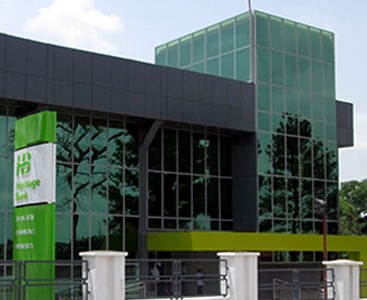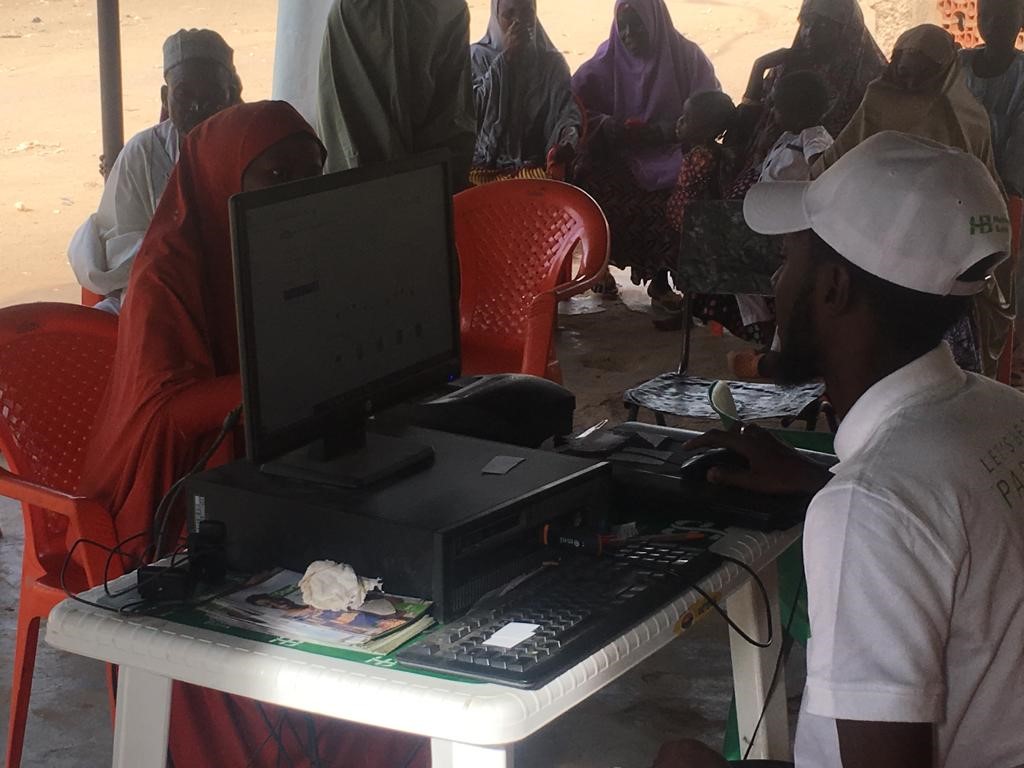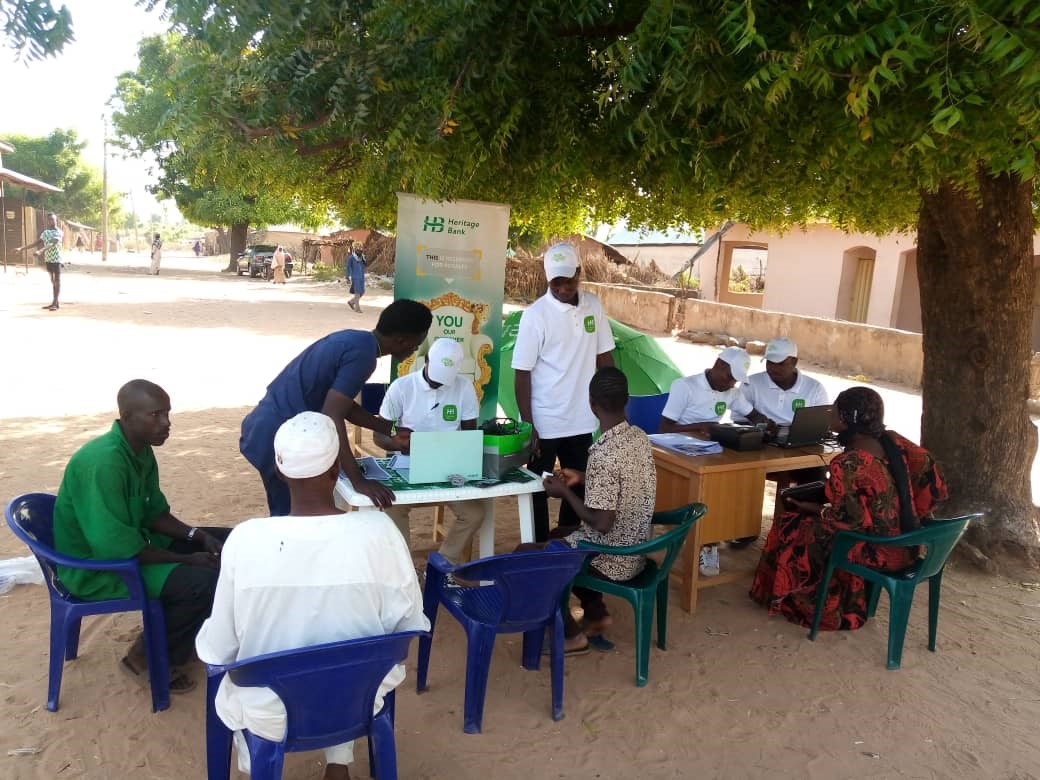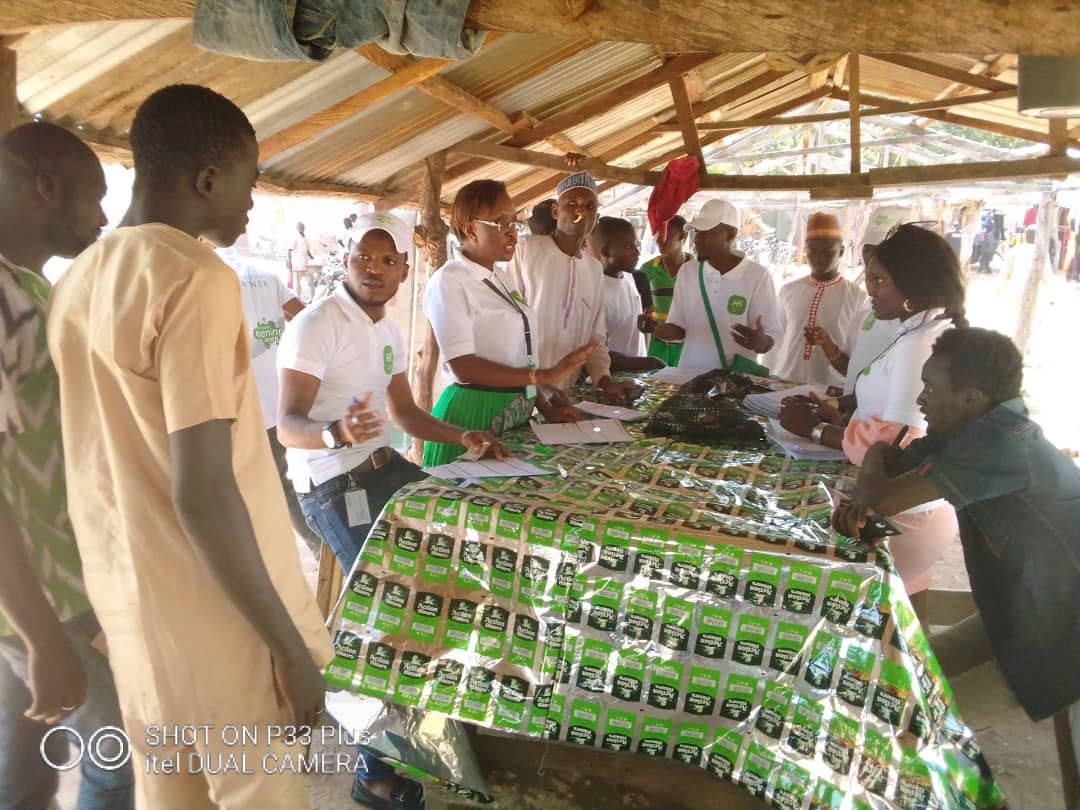
As part of efforts to consummate the Central Bank of Nigeria (CBN) initiated policy aimed at reducing the figure of the unbanked populace by 20 percent by 2020 and to ensure greater participation in the nation’s financial sector, Heritage Bank Plc has keyed into this initiative to drive financial inclusion and promote economic growth.
CBN has mandated all banks in line with the 2020 financial inclusion target, to have a nationwide Account Opening Week.
The Account Opening Week is an initiative of the CBN, Bankers’ Committee and other Stakeholders to provide opportunities for financially excluded Nigerians and Micro Small and Medium Enterprises to open accounts with formal financial institutions, with the overall aim to access financial services to reduce the current 36.8per cent financially excluded to 20per cent and stimulate economic growth.
Towards this developments, Heritage Bank strategically deployed its technology and large number of staff to reach the large populace who do not have bank accounts in selected states were sensitised and mobilised to designated centres in rural areas, where they opened their personal accounts.
Speaking on this exercise, the MD/CEO of the bank, Ifie Sekibo stated that Heritage Bank has been at the fore front and continued to give its unreserved backing towards reducing the exclusion rate to 20per cent by 2020, create jobs, reduce poverty and improve the welfare of the people.
According to him, the bank succeeded in opening more than 2, 000 bank accounts in designated centres of the following six (6) states; Kano, Ebonyi, Nasarawa, Gombe, Bayelsa and Ondo.
Meanwhile, Sekibo made recourse to Heritage Bank’s supports so far, thereby noting that the bank have been taking aggressive approach with the introduction of agent banking partners.
He pinpointed that the bank has brought on board over 10,000 agent partners since the commencement and launching of ‘corner shop’, which lends credibility to the consistency of the service and how it is changing lives and empowering Nigerians across the country.
At this steady growth rate of approximately 17.5 percent new agent per month, one can say that hitting the long term vision of 100,000 active agents in five years is well within reach.
However, Sekibo explained that financially excluded persons constitute a gap in the financial system and there is no way to create a perfect economy except all these people are brought on board.
“Another issue is that the older generation seem to be averse to technology because they have not been exposed to it and the fear of fraud,” he also said, but assured that the CBN and the banks will continue to improve its technology space.
Pan African financial Institution, United Bank for Africa during the weekend held a Micro Small and Medium Enterprises (MSME) capacity training in Onitsha where about 400 small and medium scale business entrepreneurs in Onitsha, Anambra State, benefitted immensely from the impactful training.
The beneficiaries were trained in record keeping, cost reduction, stock compiling, financial and taxation planning, maximising opportunities, financial planning and projections.
UBA’s Regional Head of Anambra II Anyanuno Ozioma, who flagged of the MSME training said the capacity development workshop is intended to add value to customers’ businesses through improving their knowledge and skills. It was also conceptualised to fill the existing gaps observed in business and allay beneficiaries’ hitherto fears of expanding their businesses.
He said: “Modern day business requires that an average businessman regularly updates his knowledge to cope with the changing economy. Besides, this is an internet/ technology driven age and our customers need to learn new ways of doing business and how to package their businesses for increased patronage.”
Anyanuno said the turnout was a demonstration of the bank’s acceptance by the traders and the importance they attached to the workshop. He promised a repeat of the exercise to accommodate more people.
Head of E-banking Babatunde Ajayi said the programme was part of the bank’s Corporate Social Responsibility (CSR) in furtherance of its responsiveness to customers’ needs while also assuring that the bank is 100 percent committed to the overall growth and success of its customers.
Entrepreneurs who spoke after the training commended and appreciated UBA for such a novel initiative which they noted is what their businesses truly needs to succeed.
Nigeria’s leading financial inclusion services provider, First Bank of Nigeria Limited, has announced proactive measures it has taken to control the spread of the COVID – 19 (Coronavirus) pandemic.
The Bank’s Group Head, Marketing & Corporate Communications, Folake Ani-Mumuney, said “embedded in our corporate strategy is business continuity management that ensures the delivery of products, services and initiatives to our stakeholders and enabling the economy in the long-term with minimal impact.
Therefore, we have employed necessary measures to keep our employees, customers and the general public safe-guarded and sensitised on preventive steps to flatten the curve at the fastest possible rate. These include the deployment of temperature measuring tools; hand sanitisers; face masks and adopting social distancing including utilizing virtual meetings. We have also cancelled owned and partnered planned events in the interim; suspended staff travels and have put measures in place to identify and communicate to staff who are arriving from affected countries to self-quarantine following the established protocols by the World Health Organisation and the government.
In addition, we have been amplifying all necessary official information from relevant health bodies and partners such as encouraging everyone to adhere to good hygiene practices which comprise regular cleaning of all surface areas – for example, tables, door handles – with disinfectants, consistent washing of hands as well as avoiding close contact with people and staying away from crowded environment”.
Encouraging the use of cashless transactions, Mrs. Ani-Mumuney said; “we implore all our customers to embrace cashless transactions across our self-service platforms like *894# USSD banking services, FirstMobile, WhatsApp Banking, First Online for their needs like funds transfers, various bill payments, credit and internet data recharge and much more. In need of quick loans, these self-service platforms are also designed to meet their immediate needs through our FirstAdvance service”.
For enquiries and complaints, customers are encouraged to contact the Bank’s 24 hours multi-lingual customer care centre, FirstContact, on 01-4485500 or email, firstcontact@firstbanknigeria.com.
She noted that the Bank is committed to protecting the health and safety of all its staff, customers and host communities as together the fight against Coronavirus would be won.
The National Centre for Disease Control (NCDC) should be reached on its Toll-Free Number: 0800 9700 001 for immediate medical attention and advise.
Zenith Bank Plc, Nigeria’s leading financial institution, has donated N100 million to the Emergency Relief Fund set up by the Lagos State Government for the victims of the Abulo-Edo explosion.
The Group Managing Director/ Chief Executive Officer of Zenith Bank Plc, Mr. Ebenezer Onyeagwu made the pledge on Wednesday, March 18, 2020, when the Management of the Bank visited the State Governor, Mr. Babajide Sanwo-Olu, at the State House, Marina, Lagos to condone with him and the good people of Lagos State on the unfortunate incident of March 15, 2020 which led to the loss of lives and properties at the Abule-Ado area in Amuwo Odofin Local Government Area of the state.
Speaking during the visit, Mr. Onyeagwu said: “For us in Zenith, we share in the concerns and the very traumatic experience that Lagos state is passing through. Our thoughts and prayers are with the families of the victims, those who lost their lives and those who are still in the hospitals, recovering. We can only but pray that God will comfort the families. We are also very impressed with the fact that the response from the Lagos State Government was quick, rapid and immediate. There is nothing you can do to quantify the loss of lives. The only thing one can do is to ameliorate the sufferings, the pains and the discomfort of those who have been terribly impacted. So, we would like to let Mr. Governor know that we share with him at this moment. We are aware that you’ve also set up a relief fund account and we are willing to make an immediate contribution of N100 million”.
On his part, the Lagos State Governor expressed his sincere appreciation to the Management of the Bank for taking time out of their busy schedule to embark on the sober visit and stand with the State Government in this trying moment. While thanking the bank for the N100 million donation to the emergency relief fund set up by the State Government for victims of the explosion, he also expressed his delight at the bank’s acceptance of the offer to co-house the fund.
Mr. Babajide Sanwo-Olu had on Monday while speaking with stakeholders and journalists at the explosion site, disclosed that a N2 billion Abule Ado/Soba Emergency Relief Fund had been set up for the victims. He said the state government have donated N250 million to the fund and solicited for support from all Nigerians including the private sector.
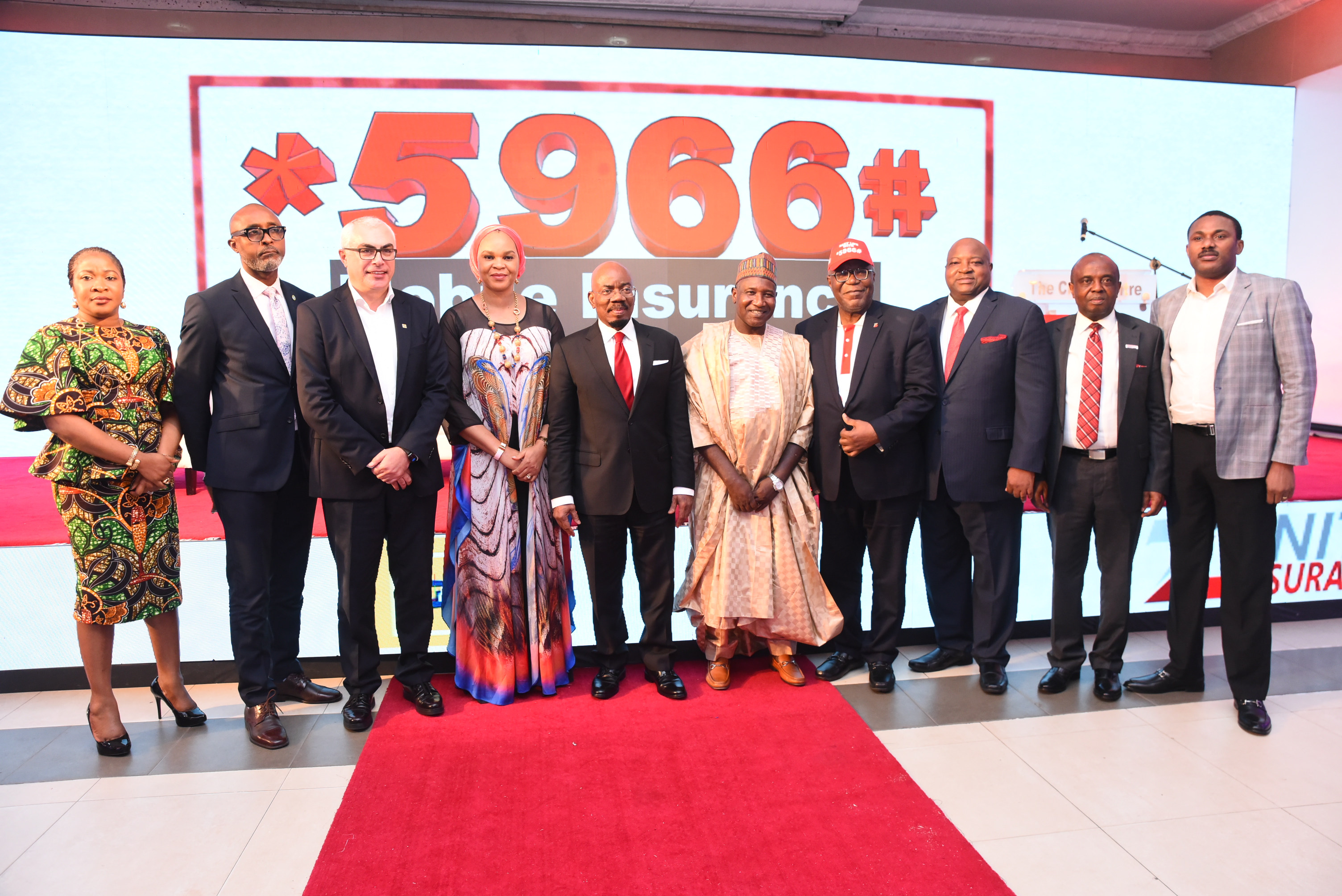
Prudential Zenith Life Insurance has launched a payment service which allows mobile phone customers in Nigeria to buy protection policies wherever they are.
Customers who dial *5966# on their mobile phones will be able to purchase a life insurance or hospital cash plan policy in a matter of minutes.
Speaking at the launch of the product at the Civic Centre, Victoria Island, Lagos on Wednesday, March 18, 2020, the Chairman of Prudential Zenith Life, Mr. Jim Ovia (CON), said “We are pleased to announce this exciting and innovative initiative that will democratize access to insurance for all Nigerians. We are strongly committed to deepening financial inclusion”.
On his part, the Chief Executive Officer of Prudential Africa, Matt Lilley said: “We launched Prudential Zenith Life in 2017 to help minimize uncertainty from the lives of Nigerians. I believe that this service will make it easier for people to access life insurance cover that gives them and their families financial peace of mind, if an accident or the worst were to happen.”
Research shows that Nigerians are significantly underinsured despite the adoption of mobile phones for insurance purchase in several parts of the world. Only one per cent of Nigerians have insurance whilst more than 95 per cent of the population have mobile phones. Prudential Zenith Life seeks to increase the number of families that have financial protection by making it convenient to purchase insurance on their mobile phones.
Prudential Zenith Life Insurance Limited is part of Prudential Plc, one of the oldest and most strongly capitalised life insurance companies in the world. It provides a range of insurance and investment-linked savings products designed to suit corporate and individual customers’ budgets.
Prudential Zenith Life seeks to remove uncertainty from life’s big events, providing customers with the freedom to confront the future with greater confidence. It is equally committed to meeting the long-term savings and protection needs of families and businesses in Nigeria. Whether someone is starting a family, saving for a child’s education or planning for old age, Prudential Zenith Life provides customers with financial peace of mind.
Mr. Jim Ovia, CON, Chairman, Prudential Zenith Life (5th Left) flanked by Onyinye Ikenna-Emeka, GM, Enterprise Marketing, MTN Nigeria (1st Left); Ajibola Olabisi Bankole, Deputy Director (Inspectorate), NAICOM (2nd Left); Mazen Mroue, Chief Operating Officer, MTN Nigeria (3rd Left); Lynda Saint-Nwafor, Chief Enterprise Business Officer, MTN Nigeria (4th Left); Alhaji Mohammed C. Babajika, Director, Licensing and Authorization, NCC (5th Right); Professor Oyewusi Ibidapo-Obe, Former Vice Chancellor, University of Lagos (4th Right); Kehinde Borisade, CEO, Zenith General Insurance (3rd Right); Chuks Igumbor, MD, Prudential Zenith life Insurance (2nd Right); and Olubayo Adekanmbi, Chief Transformation Officer, MTN Nigeria (1st Right) at the launch of the Prudential Zenith Life Mobile Payment Service in Lagos on Wednesday, March 18, 2020.
The parent company of one of Africa’s biggest financial institutions, Ecobank Group, Lome (ETI) Ecobank Transnational Incorporated has announced two new board appointments in persons of Dr. Georges Agyekum Nana Donkor and Mrs. Zanele Monnakgotla.
According to a release signed by Adenike Laoye, the bank’s Group Head, Corporate Communications,
Dr. Georges Agyekum Nana Donkor, a Lawyer, Banker and Marketing Consultant with over twenty-five years experience in Senior Management Capacities in several fields which are Finance, Strategic management, Marketing, Law, Compliance and Administration replaced Mr. Bashir Mamman Ifo as a Non Executive Director and representative of Ecowas Bank for Investment and Development (EBID). He also became EBID’s president after Mr.Bashir Mamman Ifo’s retirement.
Another Board appointment made was that of a Non-Executive Director and Nominee of the Public Investment Corporation (PIC) of South Africa in the person of Mrs. Zanele Monnakgotla. She has over 20 years experience spanning across the public and private sector. Her core is Structured Finance and Strategy. She replaced Dr. Matjila, Chief Executive Officer of PIC.
Speaking on the change of Board of Directors, ETI’s Chairman, Mr. Emmanuel Ikazoboh appreciated Mr. Bashir Ifo, former Ecowas Bank for Investment and Development representative and Dr. Matjila, erstwhile CEO of PIC for their hardwork and contributions to Ecobank group.
The ETI (Ecobank Transnational Incorporated) is listed on the Nigeria Stock Exchange in Lagos, it is also listed in Ghana Stock Exchange in Accra and it is listed in the Bourse Regionale des Valeurs Mobilieres in Abidjan.
The Ecobank group must also be commended for its contributions to the work force in Africa by employing over 15,000 people and meeting the needs of over 20,000 customers, and its amazing services towards improving banking on the continent which includes bank and deposit accounts, loans to aid businesses, cash management, advisory, trade, securities, wealth and asset management.
We, as a continent feel honoured to have ETI and Ecobank group on our shores and we encourage them to keep up the good work in providing good banking solutions in Africa.
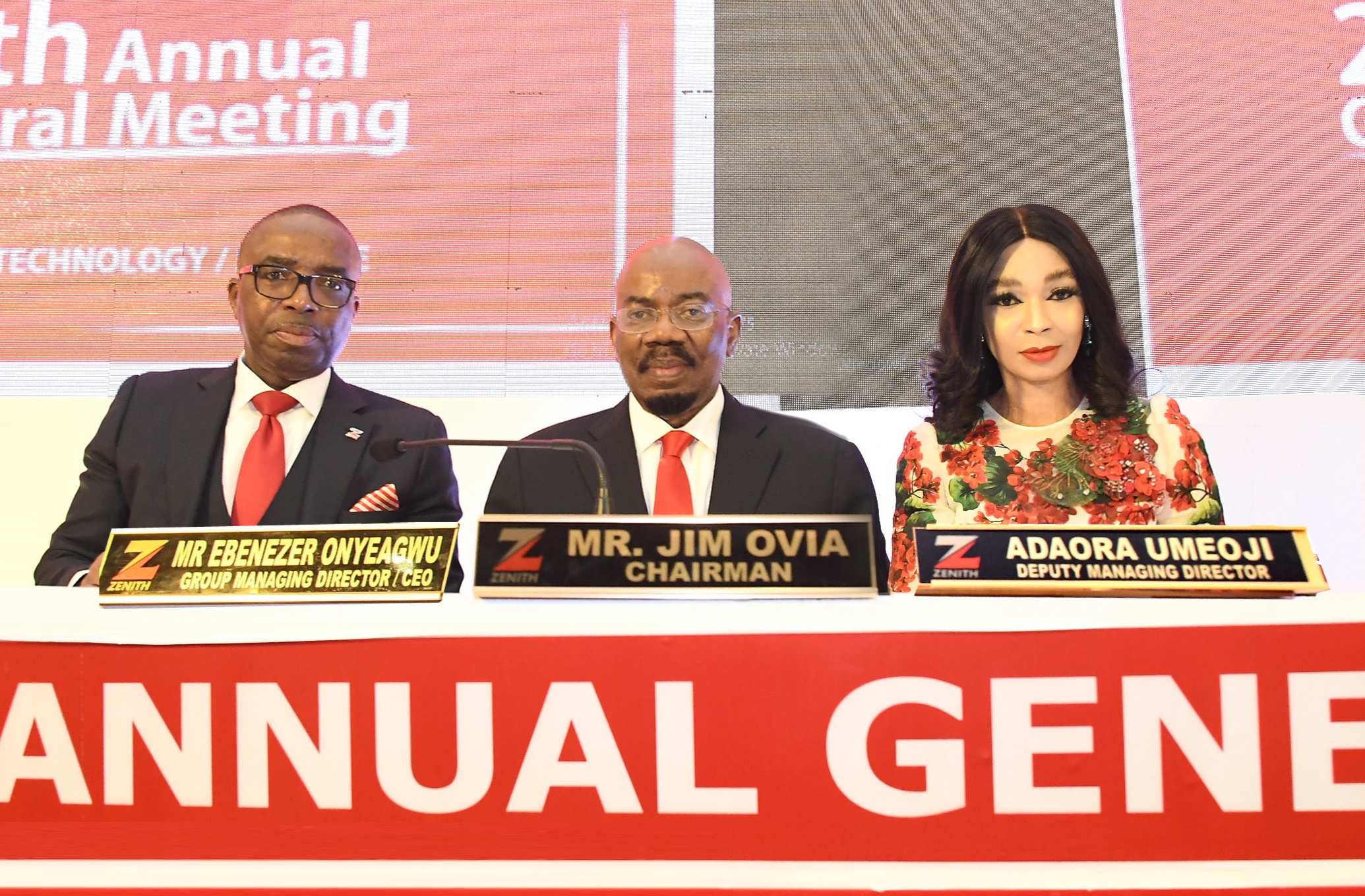
Zenith Bank Plc, on Monday, March 16, 2020 held its 29th Annual General Meeting (AGM) in Abuja, Nigeria, during which the Bank’s shareholders unanimously approved the proposed final dividend of N2.50 per share, bringing the total dividend payment for the 2019 financial year to N2.80 per share with a total value of N87.9 billion. This followed the recent release of the Bank’s audited financial results for the 2019 financial year.
According to the Chairman of the Board, Mr Jim Ovia (CON), the AGM was an opportunity for the bank to engage shareholders on its 2019 financial year performance. In his statement, Mr Jim Ovia said “Zenith Bank is committed to consistently deliver superior returns to our highly esteemed shareholders by ensuring that a good chunk of our profit is set aside for you. In a clear demonstration of this, we had declared and paid you an interim dividend of 30kobo per share in the course of the 2019 financial year. We hereby propose a final dividend of N2.50kobo per share. If approved, this will bring the total dividend for the year ended December 31, 2019, to N2.80kobo per share”.
Zenith Bank reaffirmed its leading position in the Nigerian banking industry posting an impressive Profit Before Tax (PBT) of N243bn, representing a 5 per cent increase over the N231.6bn recorded in the corresponding period of 2018. Profit after Tax (PAT) stood at N208.8bn over N193bn, an increase of 8 per cent, thus making Zenith Bank the first Nigerian bank to cross the 200billion Naira mark.
The bank’s result showed an increase in gross earnings from N662bn to N630bn, indicating dominance in market share, while its assets grew by 5 per cent from the N5.9 trillion to N6.3 trillion, a growth driven by the 29% increase in non-interest income from N179.9 billion in 2018 to N231.1 billion in 2019. The Bank’s fees on electronic products continue to grow significantly with a 108% Year-on-Year (YoY) from N20.4 billion in 2018 to N42.5 billion in 2019.
The drive for cheaper retail deposits coupled with the low-interest yield environment helped reduce the cost of funding from 3.1% to 3.0%. However, this also affected net interest margin, which reduced from 8.9% to 8.2% in the current year due to re-pricing of interest-bearing assets. Although returns on equity and assets held steady YoY at 23.8% and 3.4% respectively, the Group still delivered an improved Earnings per Share (EPS) which grew 8% from N6.15 to N6.65 in the current year.
The Group created new viable risk assets as gross loans grew by 22% from N2.016 trillion to N2.462 trillion. This was executed prudently at a low cost of risk of 1.1% and a significant reduction in the non-performing loan ratio from 4.98% to 4.30%. Prudential ratios such as liquidity and capital adequacy ratios also remained above regulatory thresholds at 57.3% and 22.0% respectively.
Financial analysts noted this unprecedented feat by a Nigerian Bank as remarkable, and an indication of strong financial leadership and resilience.
As a testament to this superlative performance, the bank emerged as the Most Valuable Banking Brand in Nigeria, for the third consecutive year, in the recently released Banker Magazine “Top 500 Banking Brands 2020”, the Best Bank in Nigeria 2020 in the Global Finance World’s Best Banks Awards 2020 and the Bank of the Decade (People’s Choice) at the Thisday Awards 2020. In addition, the Bank was also voted as the Best Commercial Bank in Nigeria 2019 by the World Finance and the Best Digital Bank in Nigeria 2019 by Agusto & Co.
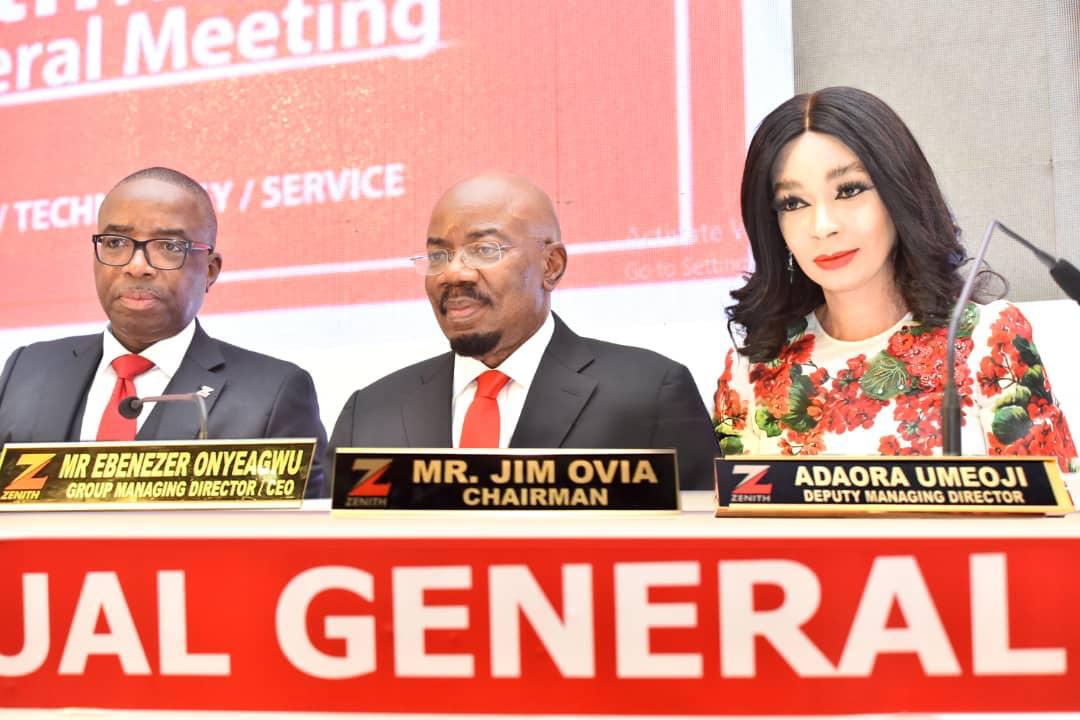
Chairman, Zenith Bank Plc, Mr Jim Ovia (Centre) flanked by the Group Managing Director/ CEO, Mr. Ebenezer Onyeagwu (Left) and the Deputy Managing Director, Dr. Adaora Umeoji (Right) at the 29th Annual General Meeting of the bank held at the Shehu Musa Yaradua Centre, Abuja on Monday, March 16, 2020
The Managing Director/Chief Executive Officer, Fidelity Bank Plc, Mr. Nnamdi Okonkwo on Monday commiserated with traders and others victims of Sunday’s tragic explosion in Abule Ado, Amuwo Odofin Local Government Area (LGA) of Lagos State. Accompanied by other Executive Management staff, Okonkwo who visited the affected market areas was received by the leaders of the Balogun Business Association (BBA), Auto Spare Parts and Machinery Dealers Association (ASPAMDA) and Association of Progressive Traders (APT). He prayed for the repose of the souls of those who died in the explosion and disclosed the bank’s readiness to make some token contributions to members of the traders’ associations whose shops and properties were destroyed. “We thought to come this morning to commiserate with you and see first-hand the damages caused by effects of the explosions” said Okonkwo.
Responding, the market leaders thanked the bank for the gesture, noting that Fidelity Bank has been a true supporter and remains the most responsive of all financial institutions in the market. “Fidelity is not the only bank in this market. Coming here barely 24 hours after this incidence and offering financial support in addition, is quite commendable. We are still evaluating the extent of damages and the number of our members affected” said President BBA, Chief Anthony Obih.
The Presidents of ASPAMDA and APT also expressed gratitude to Fidelity Bank. “You have indeed demonstrated to us that we are indeed partners. We will reciprocate this kindness and will continue to do everything within our powers to support the bank” stated President ASPAMDA, Chief Daniel Oforkansi. On his part the APT Market Association President Chief Eric Ilechukwu called on other corporate entities to emulate Fidelity Bank saying “it is people and organizations like you that we want. If others are like you, things will be better for it”.
Several residential and commercial buildings as well as cars were destroyed in the explosion that rocked Abule Ado to its core. The resulting fire, from the explosion, later spread to the Nigerian National Petroleum Corporation (NNPC) oil pipeline passing through the area, although the pipeline was shut down as a precautionary measure. The explosion caused widespread panic among Lagos residents after it shook many houses in Ijegun, Festac Town and other communities outside Amuwo Odofin.
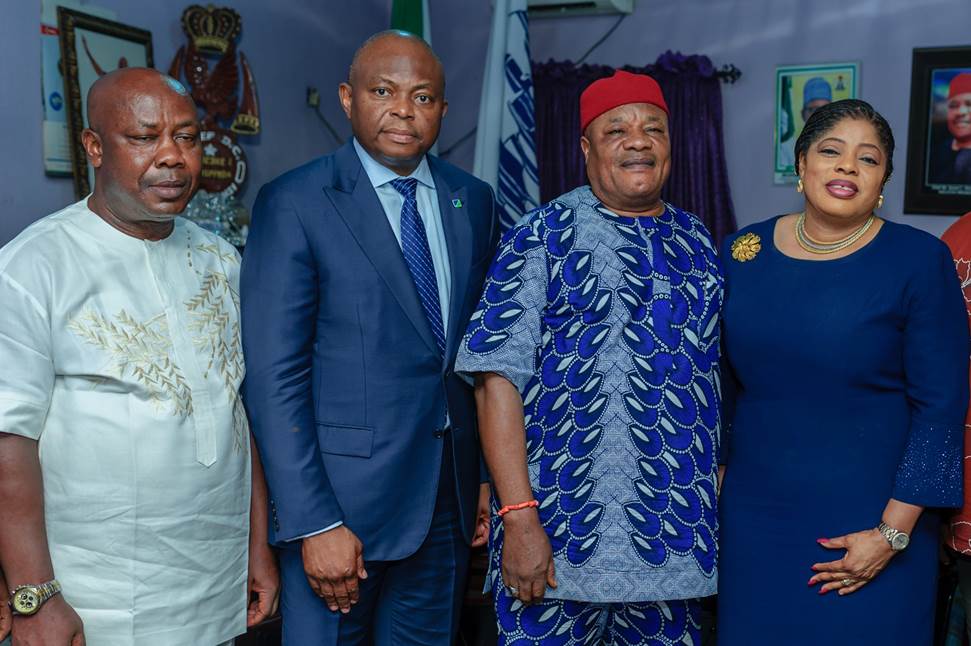
L-R: Ezenwa Oguadinma, Treasurer, Balogun Business Association (BBA); Nnamdi Okonkwo, Managing Director/Chief Executive Officer, Fidelity Bank Plc; Tony Obih, President, BBA; Emeka Igbosupolu, Vice President, BBA during the visit to the markets at BBA, ASPAMDA and APT to commiserate with the victims of the Lagos explosion on MondayL-R: Eric Ilechukwu, President, Association of Progressive Traders (APT); Nnamdi Okonkwo, Managing Director/Chief Executive Officer, Fidelity Bank Plc; Nneka Onyeali-Ikpe, Executive Director, Lagos & South-West, Fidelity Bank Plc and Daniel Oforkansi, President, Auto Spare Parts and Machinery Dealers Association (ASPAMDA), during the visit to the markets to commiserate with the victims of the Lagos explosion on Monday.
…Emerges Lead Settlement Bank, Transaction Adviser
The Nigerian agricultural sector is set to witness a huge growth, as Heritage Bank Plc the lead settlement bank for Gezawa Commodity Market (GCMX) has collaborated with key stakeholders to revolutionise agricultural value-chain, aimed at providing fully integrated ecosystem for commodity Exchange.
Heritage Bank was appointed as the Lead Settlement Bank and Transaction Adviser to the Gezawa Commodity Market and Exchange Ltd and Memorandum of Understanding (MoU) was signed between the two firms, whilst over 10, 000 farmers in 3000 cooperatives in the 44 local governments of Kano States were hosted.
The partnership between Heritage Bank and the Exchange would facilitate the ease of agro commodity trading in a more structured way, especially with the closeness to the Dawanu, the largest grain market in Africa.
The MD/CEO of Heritage Bank Plc, Ifie Sekibo, who was a panelist at the 2nd GCMX Farmers’ Cooperative Forum in Kano at the weekend, stated that the partnership is targeted to de-risk the sector that would bring about structured and enhanced agro-business and attain food security that leads to economic development.
Sekibo, who was represented by the Executive Director, Jude Monye explained that the partnership which would help bridge the huge gap associated to risk, will fast track effective price discovery mechanism and traceability and enhanced trade settlement services.
Specifically, the bank’s helmsman stated that under the Central Bank of Nigeria’s Anchor Borrowers Programme (ABP) and the Nigeria Incentive-Based Risk Sharing System for Agricultural Lending (NIRSAL), Heritage Bank would provide on-lending funding to aggregated farmers in the 2020 farming season to grow various products that will serve as raw materials to the processors, thereby ensuring market linkages and access to the market as well as reduce importation and conserve Nigeria’s external reserves.
According to him, with its assigned position Heritage Bank would play a pivotal role in ensuring that there would be an effective and readily available platform for market linkages among players in the agribusiness value chain, involving FMCGs, warehouse operators, collateral managers, processors, farmers’ cooperatives to transact in a seamless way that guarantee quality, quantity, payment and delivery.
Speaking the event, the ED/CEO of Nigerian Export Promotion Council (NEPC), Segun Awolowo affirmed that the initiative would help foster diversification of non-oil export trade.
He, however, stated that NEPC would ensure that the primary for the signing of the MoU would be achieve, whilst calling for the need to ensure adequate and seamless supply of agricultural commodities for the business to be sustainable.
The Gezawa Project Consultant, Binchang Binfa, Managing Director of Makarios Global Resource, disclosed, “the ultimate goal was to unlock the vast potential of agricultural value chain via partnerships and synergy with likeminded enterprises, organisations and institutions that will mutually create wealth, generate local employment and contribute significantly to the economic growth and GDP the nation.”
He stated that the Exchange would provide services on price discovery and transparency, increase foreign exchange earning capacity, commodity storage and warehouse receipt system, employment generation of 15, 000 direct and indirect jobs, investment opportunities, increase in non-oil export, ease of doing business, weather report, soil test report, as well as 24/7 online trading of commodities on alive trading platform.
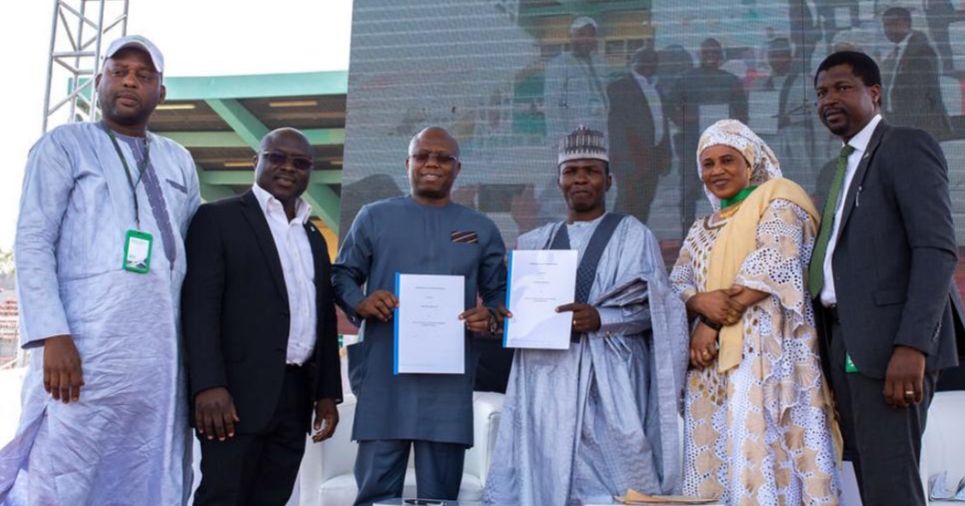
L-R: Ibrahim Muhammad-Fari, Cluster Head/Experience Centre Manager, North Zone, Heritage Bank; Ahmad Isa-Dutse, Regional Head, North-East & North-West, Heritage Bank; Jude Monye, Executive Director, Heritage Bank; Binchang Binfa, MD, Makarios Global Resources Ltd and Project Consultant to Gezawa Commodity Market & Exchange Limited; Haj. Bilkisu Aliyu, Head of Operations – Project Implementation, Gezawa Commodity Market & Exchange Limited and Adelana Ogunjirin, Team Lead, Agric. Finance & Export, Heritage Bank, during the Heritage Bank signing of MoU, as the Lead Settlement Bank and Transaction Adviser to the Gezawa Commodity Market and Exchange Ltd, in Kano, at the weekend.L-R: Alh. Faruk Rabiu Mudi, Panalist; Alh. Abdullahi Sidi-Aliyu, Director Export Development & Incentives, NEPC; Jude Monye, Executive Director, Heritage Bank; Alh. Kabiru Mohammed, MD, Bank of Agriculture; Prof. Abdu Yaro Kust, representative of the VC, Kano State University of Science & Technology and Alh. Isyaku Mohammed, Business Executive, Commercial Banking, North, Representative of MD, Sterling Bank, panelists at the 2nd GCMX Farmers’ Cooperative Forum in Kano, where Heritage Bank signed an MoU as the Lead Settlement Bank and Transaction Adviser to the Gezawa Commodity Market and Exchange Ltd, at the weekend.
First Bank of Nigeria Limited is taking steps to ensure that women and women-led businesses are empowered. The bank has, through its FirstGem; FirstMonie and First Women Network empowered and brought several unbanked women into the financial system. This it proved during this year’s International Women’s Day (IWD) celebration, writes COLLINS NWEZE.
Empowering women through improved access to finance and social support are crucial in achieving the desired growth for the economy. This is the belief of First Bank of Nigeria Limited, even as it maintained that investing in women’s economic empowerment sets a direct path towards gender equality, poverty eradication and inclusive economic growth.
It acknowledges the enormous contributions made by women, whether as business women, farmers, entrepreneurs or employees, or by doing unpaid care work at home.
This it demonstrated during this year’s International Women’s Day (IWD), a worldwide event that celebrates women’s achievements – from the political to the social. It is also a day that stakeholders in Nigeria and in the Diaspora canvassed gender equality in society and workplace.
The event brings together governments, women’s organisations, corporations and charities for purposes of development and inclusion.
According to the World Bank, women empowerment is the process that creates power in individuals over their own lives, society and in their communities.
Women’s empowerment is all about equipping and allowing them to make life-determining decisions through the different problems in society.
Also, empowering women by granting them access to vast opportunities and information will not only lead to personal development for them but also the development of the communities and societies they operate in.
First Bank is, therefore, supporting women’s economic empowerment through FirstGem, which gives them economic voice and bring many unbanked women to the financial system.
The bank has advanced N58 billion loans to over 81,000 women-led businesses and interests. Besides, 44,356 women (corporate and individual, including members of staff of the bank) currently own and operate the FirstGem account with a seating balance of N2.4 billion.
Also, the Agent Banking platform – which the bank leads in the industry – has promoted not just the financial inclusion of women but also independence as there are many women among its Agent Banking. Data showed that there are 38,185 male banking agents, and 11,762 female banking agents.
First Bank Managing Director/CEO Adesola Kazeem Adeduntan, said women-led businesses constitute a large part of the banks’ balance sheets and stream of income, even as he added that the bank will continue to give priority to issues that affect women.
He said the bank is also in tune with the Nigerian Sustainable Banking Principles (NSBP) which requires that companies promote gender equality in workplace.
To support the NSBP project and give women voice in the workplace, FirstBank boss said women remain some of the best workforces and always make great impact in establishments.
FirstBank believes that women needed to be economically empowered. Unless social concerns such as gender disparity and women economic empowerment are addressed, economic and environmental goals and overall sustainable development will be difficult to achieve.
Adeduntan said the introduction of FirstGem, a female-focused product by the bank has contributed to the development of the Nigerian economy.
Speaking at the FirstGem third anniversary conference held in Lagos, the bank chief said he was delighted that FirstGem is promoting savings culture, financial literacy, loan management, wealth creation and healthy lifestyle for women.
Adeduntan said the product has a wide array of advisory, health and current awareness services for the discerning woman.
He said: “On October 28, 2016 we launched this women-centric account, designed specifically to meet the financial needs of both corporate and entrepreneurial women. This product, apart from being an account dedicated solely to women, is lifestyle-enhancing.
“It provides a total lifestyle support for discerning women to enable them to meet their economic needs and aspirations. It goes without saying that economic stability does impact overall stability of individuals, institutions, communities and nations.
“With FirstGem, therefore, our long-term focus is on national economic development. I believe that with the indices we have so far, FirstGem is on the right performance track.”
In sports, the Female Basketball team, Elephant Girls, have, over the years, dominated the Women Basketball League of the Nigeria Basketball Federation, representing Nigeria in the International Basketball Federation (FIBA) Africa Women’s Champions.
According to FirstBank, Corporate Responsibility and Sustainability (CR&S) involves meeting the needs of our stakeholders now and in the future. Our CR&S approach is three-pronged: citizenship, stakeholder management and impact management.
“Citizenship and stakeholder management involves putting into consideration the needs of stakeholders in making decisions, while impact management is basically about minimising our negative impacts and increasing our positive impacts on society.
“FirstBank prides itself in being an equal opportunity employer and have integrated diversity and inclusion policies and awareness into its practices.
The bank said its efforts at engendering diversity in the workplace include having in place a policy that encourages inclusion. The group’s diversity and inclusion objective is to be a recognised industry leader in workforce diversity and leverage diversity for the growth of the group and the success of the customers and communities we serve. We have a male: female ratio of 61:39 across the workforce,” he said.
Also, the bank’s Board and Senior Management Teams have consistently supported women development by deliberately designing a dedicated platform called FirstGem to drive financial inclusion and all-round development of women.
The bank’s CR&S approach is designed to deliver value in a structured way in the areas of education, health and welfare; financial inclusion; responsible lending and procurement.
Inclusivity ties in with our people empowerment goal which includes improving the lives of our stakeholders through the bank’s agenda of nation-building by empowering women and girls to access the opportunities and societal benefits to grow and advance societal and economic benefits. The bank is committed to promoting diversity, inclusion through our products, services and programmes.
Advancing the FirstGem vision
FirstBank explained that in recognition of the impact of women’s contribution to economic development, the bank is steadily advancing the vision of FirstGem through active and value-adding participation in many women empowerment programmes, international conferences, seminars, workshops, and roadshows across different cities and states of Nigeria over the past couple of years.
It revealed that at the forefront of these engagements is the Chairman of Board of Directors of the Bank who happens to be a female.
It said the bank is committed to maintaining a positive work environment and to conducting business in a positive, professional manner by consistently ensuring equal employment opportunity.
FirstBank Women Network is aimed at addressing the gender gap at the senior levels and taps the opportunities presented by enabling our women to contribute even more if given the necessary strategic support and an enabling environment. This includes providing a platform that enables women to become more engaged in their workplace, set and achieve goals, have greater influence in their lives and achieve more of their potential.
The initiative was launched with the International Women’s day (IWD) celebration that held on March 8, 2018 with the theme #PressforProgress.
Also, the First Women Network is built around six pillars which are influence career pipeline, networking opportunities, grooming, etiquette and poise, mentoring, coaching and sponsorship opportunities, counselling, support and welfare, financial planning and empowerment.
Coaching/mentoring scheme
FirstBank has a coaching and mentoring scheme dedicated to female members of staff in the bank. This is to enable older female members of staff to handhold and coach the younger ones with reference to their experience as they climbed the career ladder.
For her, the types and number of products and services available to women include the facilities and polices provided to support gender diversity in the work place, among others.
Also, 2,708 female employees have special opportunities as nursing mothers: The Bank recognises that pregnancy and childbirth may take its toll on the women.
In addition to the three months’ maternity leave with pay, our practice allows for nursing mothers to resume two hours later than the normal resumption period, or close two hours earlier than the normal closing hours. This is applicable for the first three months after resumption from maternity.
All these have made the bank winner of the Nigeria Sustainable Banking Awards on Women Empowerment Category, which is driven by the Central Bank of Nigeria, among other laurels.
From left: Mr. Soji Apampa, CEO, Convention & Business Integrity; Mrs. Bamidele Abiodun, First Lady of Ogun State; Ibukun Awosika, Chairman FirstBank; Dr. Zainab Shinkafi A. Bagudu, First Lady of Kebbi State; Prof. Mefta Kandarp, Senior Lecturer, IESE, Business School Barcelona at the FirstGem third year anniversary conference held in Lagos last year.