

RE: DISSOLUTION OF SPECIAL ANTI-ROBBERY SQUAD (SARS
In line with the directives of the Inspector – General of Police, IGP Mohammed A. Adamu, NPM, mni, concerning the dissolution of the Special Anti-Robbery Squad (SARS), the Commissioner of Police, Osun State Command, CP Undie J. Adie psc (+), wishes to inform the good people of Osun State that, the IGP’s directives has been complied with and the redeployment of SARS personnel is underway.
It should be noted that, the dissolution of SARS is in response to the yearnings of the people. He assures that a new policing arrangement to address anticipated policing gaps the dissolution of SARS would have caused has been developed and shall be announced in due course.
The Commissioner of Police appeal to the members of the public in the spirit of community policing to collaborate with the police by giving prompt and useful information that will promote security of lives and property in the state.
He appreciates and commends all citizens, particularly those who genuinely express their concerns for a better policing orientation in an organized, patriotic and civil manner.
The CP assures good people of the state to go about their lawful business without fear of molestations from any person(s) as adequate security measures have been emplaced for maximum security of lives and property of the citizens.
Signed
SP OPALOLA YEMISI OLAWOYIN
Police Public Relations Officer
For: Commissioner of Police
Osun State Command, Osogbo
APAPA PRESIDENTIAL TASKFORCE: ALLEGATION OF SHOOTING ACP BASELESS, UNFOUNDED.
The attention of the Lagos State Police Command has been drawn to the news making waves on the social media and some Nigerian dailies that one ASP Kayode Falade shot at the Area Commnader, Area B, Apapa, Lagos State, ACP Soji Akinbayo, while on routine patrol and traffic control in the area on Friday.
The Command was taken aback by the trending news which is false, unfounded and malicious, as the Area Commmader was never shot or attacked by any police officer.
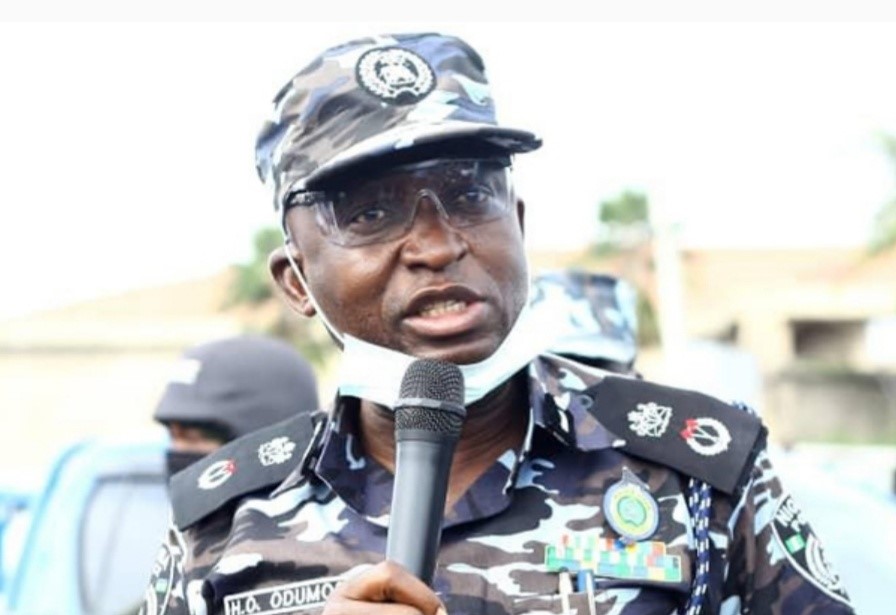
The Commissioner of Police, Lagos state, CP Hakeem Odumosu, personally investigated the matter and discovered that the ASP, who was challenged and cautioned by the ACP for improper dressing, while on duty, was unruly and made some complimentary statements on the superior police officer. The ASP did not fire any shot or attack the Area Commander as wrongly reported in the fake news.
The Commissioner of Police has promised to handle the unruly behaviour of the ASP departmentally, while the Police boss assured the general public that the command, under his watch, will maintain discipline, uphold and respect rule of law, ethics and core values of modern policing according to the international standards.
The Commissioner of Police then appealed to the general public to regard the news as false, malicious and mischievous to heat up the state more so that the #endsars# protests are ongoing.
SIGNED
SP OLUMUYIWA ADEJOBI(mnipr)
POLICE PUBLIC RELATIONS OFFICER
LAGOS STATE COMMAND
IKEJA.
I woke up this morning after my morning devotion; I dabbled into a mind boggling report on my WhatsApp platform.
I told myself: The TRUTH be told, what are the roles of the MEDIA obligated and bestowed with the sole ethical responsibilities of being the watchdog of the society; must have PLAYED in the long aged corruptions that have infested and given birth to loss of lives, heinous carnage, wanton destruction of our personal and national wealth over the years in Nigeria???!!!
After reading through this long revealing poetic but mind boggling report on my WhatsApp platform, calls for concerns.
I was forced to cull the below excerpts of the old historic but recent report and adaptation of the events that pluck up, and pull down many great African countries today.
“…Nigeria is fast ascending to the very path that Freetown took. The path that ruined Congo and Libya. The expressway to Rwanda, that is the path Nigeria is fast speeding into. Yet, this path is not a new path to us. It’s a familiar terrain that we have taken before. In 1966, long before even the Rwandan path was paved. We wasted over 3 million people as hundreds of innocent souls were slaughtered before even the war started.
Long before the Rwandan path was paved, religious differences and ethnic intolerance as being repeated today, led to a civil war that took our best, took our leaders, took innocent souls and took us backward.
The backwardness is still hunting and hurting us till day. And, it’s the wounds of the war that was not treated in a round table talk, talk, that is leading to another war. Yet, the leader of the nation insists that he’s comfortable exactly the way things are.
So, it’s either history is unfair to us or our leaders are blind to it. Indeed, the death meant to kill a dog does not allow her to smell faeces. And, like the saying goes, those who do not understand history are bound to repeat it.
Even if we hadn’t experienced a civil war before, what happened in Free Town, Monrovia, Abidjan in recent history ought to have taught us a lesson. The way Tripoli was turned from a fast developing city into a slave town where war lords reign should serve as a lesson.
But no, we learnt nothing. Just “over” 50 years after, when those that played major role to the last civil war are still alive, here the snowball of war goes rolling down from the snow mountain of stupid arrogance, gathering with it all the ethnic intolerance and religious divide that paved the path of Rwandan.”
Now, the key QUESTIONS:
1. What roles will the Nigerian MEDIA (the Fourth Estate or Fourth Power of the Realm) are known for to have played in the history of NIGERIA OF TODAY & NIGERIA OF THE FUTURE?
2. How can the MEDIA forthwith contribute greatly and use as tools for unbiased dispersion of information to show the dark side of every human lives and distribute truth?
Posterity will surely catch up with every genuine and qualified professional in this world of journalism, hence whilst, there is urgent need and call to create that sense of balance and transparency in our society, in Nigeria.
I can’t say it all here. We all know the role of the Rwandan Media in the historic 1994 genocide amongst the Hutu and Tutsi of the Republic of Rwanda.
Amongst others, #ENDSAR Protest would pass as a litmus test for the Nigerian Media if they truly stand for the TRUTH and want to be identified for SHAPING PUBLIC OPINIONS/REACTIONS for PEACEFUL and PROGRESSIVE NATION.
LET’S CHANGE THE NARRATIVES, AS A FORCE FOR PEACE, BE THE AGENT OF SOCIETAL CHANGE; AS THE WATCHDOG OF OUR SOCIETY, OUR OWN COUNTRY!!!
The Speaker of the Lagos State House of Assembly, Rt. Hon. Mudashiru Obasa, has appealed to residents to support the ongoing effort of the government to put life back into state.
Obasa said this when he led other members of the House on a visit to some of the areas destroyed or burnt down by some people who took advantage of the protest against the now disbanded Special Anti-Robbery Squad (SARS).
The lawmakers visited the ravaged palace of the Oba of Lagos, HRM, Rilwan Akiolu, and the Isokoko Police Station.
Other areas visited by the team of lawmakers are the Pen Cinema Police Station, the Fagba Police unit and Television Continental.
Obasa, while lamenting the level of destruction that took place in the state, noted that Lagos had always maintained a very respected place in the country and in Africa.
He urged aggrieved residents to be conscious of the fact that rebuilding the state is a major task that must be done with unity while noting the effort of the government to see that something is done in relation to those who lost their lives as a result of SARS brutality.
According to him, Lagos is a mini-Nigeria and it habours people irrespective of where they come from and political and religious sentiments.
He pleaded with the residents to abstain from further destruction of properties and the heritage that binds the people together.
To him, unity and love should become the new focus as this would encourage, empower and inspire the government’s direction at this critical time.
He promised residents that as representatives of the people, the members of the House of Assembly would always stand for what would benefit them and develop the state.
Obasa commended the management of the Television Continental for its quick return despite the magnitude of the destruction experienced.
He urged the television station to continue to sustain its tempo as one of the biggest news media in the country.
The rabbit hole of uncertainty, confusion and fear that pupils and their parents fell into in the dying days of March when the country was in lockdown was best captured in a Saturday Sun feature of May 16, titled, “COVID-19: Troubles of e-Learning.”
The story catalogues the challenges that erupted out of the disruption caused by the coronavirus pandemic, the fears and frustrations brewed by the new abnormality foisted on the world, the pessimism that pervaded the globe from developed to underdeveloped countries and the possibilities that blew up in the aftermath in the education stratosphere.
With the new order of social distancing, self-isolation, government-enforced quarantine and the ubiquitous lockdown, the prospect of indefinite stay at home until at least an elusive vaccine is found, loomed. This precipitated a distress as never seen before in the education space.
Yet, a panacea was at hand: Digital learning, though hitherto given scant attention. But crossing into that nirvana was an uphill task, especially, in this part of the world. Why: The existence of a huge digital deficit both in infrastructure and the requisite skill. The dilemma confronting parents, pupils and tutors are multi-dimensional as illustrated by these three vignettes from the story:.
Leadership Newspaper
The rabbit hole of uncertainty, confusion and fear that pupils and their parents fell into in the dying days of March when the country was in lockdown was best captured in a Saturday Sun feature of May 16, titled, “COVID-19: Troubles of e-Learning.”
The story catalogues the challenges that erupted out of the disruption caused by the coronavirus pandemic, the fears and frustrations brewed by the new abnormality foisted on the world, the pessimism that pervaded the globe from developed to underdeveloped countries and the possibilities that blew up in the aftermath in the education stratosphere.
With the new order of social distancing, self-isolation, government-enforced quarantine and the ubiquitous lockdown, the prospect of indefinite stay at home until at least an elusive vaccine is found, loomed. This precipitated a distress as never seen before in the education space.
Yet, a panacea was at hand: Digital learning, though hitherto given scant attention. But crossing into that nirvana was an uphill task, especially, in this part of the world. Why: The existence of a huge digital deficit both in infrastructure and the requisite skill.
The dilemma confronting parents, pupils and tutors are multi-dimensional as illustrated by these three vignettes from the story:
Oko Odinakachi, a student of Abia State University, faced frustration on two fronts: her institutions dillydallying about adopting the e-learning strategy on the one hand; her little faith in digital learning, on the other hand. “I was on the verge of writing my first-semester examination. How possible can we do that digitally when there are issues with even JAMB CBT here in our country?”
A father whose daughter, a student of Federal Government College Shagamu preparing for her Senior School Certificate Exam, was compelled to seek a suitable e-learning portal because WAEC advised students to be studious during the lockdown as they’d be going straight into the exam hall at short notice as soon as the pandemic is over. The search led him to an online WAEC Preparatory Class that demanded payment for requisite online resources. “One subject is N1, 500, four subjects N4, 500 and six subjects cost at N6, 500. I didn’t go further because of the fee, which I think is exorbitant, given the current state of the country,” he complained. He joined the rank of other parents who raised concerns over exploitation by mercenaries masquerading as e-learning groups.
Abolade Kunle, a JSS3 student was aware of the government-sponsored tutorial on the radio but he was unable to enjoy the benefits: “We don’t have a radio set in the house. I use my dad’s phone once in a while but he doesn’t allow me to use it all the time,” he railed. A related drawback was cited by one of his teachers at the public school in Mushin: “In the past five weeks, we have had barely three days of electricity supply. It is not every parent that can afford a generator. Is it not when you have electricity supply that the children can watch [government educational programme on] the television?”
The absence of curative or prophylactic breakthrough against the virus meant that academic activities would remain in limbo, while pupils and their parents are faced with the undaunted possibility of a long spell at home. The prospect of a long lull of academic inactivity struck a palpable fear that fueled the scramble unto digital learning platforms as educationists and institutions across the country experimented with remote learning, albeit on a trial-and-error basis. The efforts were at best tangled; the process muddled; the result ineffective. Even, for students of tertiary institutions, the online class was to many a Lala-land.
With the option inevitably narrowed down to digital learning, a Catch-22 situation evolved. Who’s going to make it happen? How? When?
Best foot forward
Eventually, the first foot forward––and indeed the best one––came and it was from First Bank Nigeria Limited.
The bank, a leading financial inclusion services provider, announced its intention to roll out an innovative e-learning initiative on the heels of its philanthropic contribution of the sum of one billion naira to the Coalition Against COVID-19 (CACOVID), a private-sector task force that partners the Federal Government, the Nigeria Centre for Disease Control (NCDC) and the World Health Organisation (WHO) to combat the coronavirus in Nigeria.
In the months to come, the bank’s effort would resonate forcefully in the education space. The reason for this was not farfetched. Since responsiveness remains a cornerstone of Corporate Social Responsibility, when it is timely, it becomes a major coup. The severity of the pandemic required “uncomfortable, transformative responsiveness,” not the usual CSR response where organisations choose and design responsiveness on their own terms, described by Wayne Visser in Evolution and Revolution of Corporate Social Responsibility, as “when giving is easy and cheque-writing does nothing to upset their commercial applecart.”
Taking on the e-learning challenge head-on was an self-assigned project for which the bank was not under any compulsion to undertake. That it volunteered to tackle the challenge is an indication of the largeness of its CSR aorta.
Suffice to say that a handful of digital learning initiatives exist before the advent of the Covid-19 lockdown; the First Bank effort, however, resonates louder because it has a measurable stated goal: Moving one million pupils into e-learning platform.
A response apt and adequate Lagos State’s prompt response to the pandemic included the immediate shutdown of schools. By March 25 (four days before Lagos State went into total lockdown on the order of the President), the First Bank initiative was rolled out, and it inalienably took the optics of “the” response to the glitch caused to the education system by the coronavirus pandemic.
First Bank went into collaboration with Lagos State Government and an indigenous mobile learning platform, Robert and John Limited, whose trademark Roducate e-solution, a comprehensive curriculum-based education, is a cornucopia for a broad spectrum of students.
Having powered similar projects in the past, Robert and John was an obvious best in the e-learning business, a fact reinforced by First Bank CEO, Adesola Adeduntan: “In searching for the best fit solution, several options were considered by educators and teachers from the state and First Bank over the last couple of weeks before adjudging Roducate the offering from Robert and John, an innovative technology firm, to be the best of all reviewed.”
Is Roducate the Rosette stone of online learning? The facts were in its favour. Its claim of being the “most comprehensive e-learning platform in Nigeria and indeed Africa” is justified on its curriculum-based education for primary, secondary, and tertiary students. Moreover, ;it has been active in the e-learning space as far back as 2014 and has perfected the mechanics of effective digital learning, winning endorsements along the way from NUC, NERDC, JAMB and Lagos State Ministry of Education.
And by tweaking its blueprint, it came up with an e-learning mother lode––lecture notes, assignments, mock exams, videos, podcasts, and educational games––a rich vein of contents for primary, secondary and tertiary institutions, structured in consonance with the government-accredited curriculum. From the interactive tutorial videos to the innovative feature that enables the learner to take notes for quick reference, it was a whole new experience and an enjoyable learning process.
Suffice to reiterate that the First Bank/LASG Roducate is not the first of its kind; before it, there was Glo Mobile Tutor (since 2014) and UBA LEARN (unveiled in 2018) amongst others. However, certain factors gave it an edge.
The comparative advantage
The CSR takeaways from the initiative are writ large in what makes it different from others––in other words, its comparative advantages.
On the first count, the effort surfaced at a time of need, a time when there was an urgent need to close the gap caused by the disruption in children education due to schools closure following the Covid-19 lockdown. In one fell swoop, a solution materialised that provided succour for all, from kindergartens kids to grad-year students of tertiary institutions.
Secondly, while it is indeed a rolling scheme, it nevertheless came with specific number goal of one million pupils to be empowered with digital learning; this calibrated objective makes the intervention easy to evaluate, compared to other similar initiatives.
Thirdly, the biggest boon: subscription-free.
Consider what this means to parents such as the one cited in Sun story who had to shell out approximately N6, 000 for his daughter to access the needed resources. With the First Bank initiative, students simply get on the platform by registering free at https://www.firstbanknigeria.com/e-learning/.
And then the masterstroke: the enhanced offline feature of the initiative. It means students can study offline without having to bear the burden of buying data. What’s more, First Bank gave further impetus by providing 20, 000 devices that came preloaded with the curriculum.
Elaborating on the low-end devices preloaded with Roducate offline content, Adeduntan disclosed that “the phones have SIMs and limited data tied, only, to the Roducate learning product.”
Kayode Abayomi, the spokesperson for Lagos State Ministry of Education, further hit the nail on the head.
“The devices are efficient and fit for purposes for all students especially indigent students given the fact that data consumption of most e-learning solutions has been a major stumbling block for the majority of students and teachers alike,” he said.
Its fourth edge is from its collaborative nature. One of First Bank’s collaborators on the project is a partner with leverage in the education space: the Lagos State Government. That made a big difference, as it gave the initiative authority and legitimacy that immediately gained traction.
In return, the initiative was well-appreciated by Lagos State Governor Sanwo-Olu: “It is not out of place that we are witnessing more infusion of technology in learning and this intervention by First Bank could not have come at a better time.”
Lastly, the First Bank e-learning project took care of both the short-term and the long-term interest of Nigeria in the digital race. Beyond the exigency of the moment, which was to get the children into learning mode, the intervention took on the imperative of helping young Nigerians develop relevant skills in emerging technologies, thereby enhancing their competitiveness in the interconnected world of today.
How? Via two other initiatives, both partnerships with IBM (that schooled youths in coding Artificial Intelligence, cloud, internet of things, blockchain, data science, analytics and cybersecurity) and Curious Learning (which offers academic contents for pre-learning and early-stage children aged 3-8 through self-guided learning apps). These two threw open the door of digital technology and made available for free the opportunities to transform them into tech geeks.
Taking responsibilities
For organisations with a sense of CSR, Covid-19 was an opportunity that was too good to miss. Where and how they responded depend on their preexisting corporate responsibility culture, their focus, the heft of their commitment.
Adeduntan said of the First Bank initiative: “We are warmed by the fact that different organisations have risen to the various challenges and are supporting in areas such as health and welfare, and we feel the peculiar needs of our children and youth must not be left out and have therefore elected to focus on contributing to solving the current education challenge.”
He said further: “It is a responsible approach to empower them, given that they are our future and the foundation to build our country to greatness. By partnering on this, we are solving a problem for families and our future.”
In September, schools re-opened, and education activity, deflated for months, gradually regains shape and gathers momentum. The number of students enrolled on the platform has increased significantly. The big question: is it going to be one of those projects that got abandoned after the ovation died down? Or is it likely to be sustained?
The cue is in the stated goal of the initiative. FirstBank has placed on itself the onus to continue to build on the effort and to give the needed impetus that will accelerate the achievement of the set goal of 1,000, 000 registered children in record time. It is expected that First Bank will sustain the race to the finishing line.
On Monday morning, October 19 after an unusually emotional weekend across Nigeria, where #ENDSARS protesters had revealed the name of those killed over the years by the rogue police unit, the city of Abuja was experiencing an uneasy calm. In the weekend before, the Vice President has shocked the world when he publicly apologized to Nigerians for the errors of SARS after a week that saw their ban- announced by both the President and the IG.
Then came the enfant terrible of South West Politics. The sleazy and uncanny gap toothed Governor of Ekiti state, whose plastic smile bellies his ambition to emerge a national player in 2023 by all means, he led a group of Northern Governors into a clandestine meeting with the President. Having seen a potential opening, he went for the gauntlet as he seized the mantle of circumstance to manipulate President Buhari in their little over one hour private discussions about the #EndSARS movement that had rattled the establishment in the previous 10 days.
The plan was simple; Fayemi speaking on behalf of his colleagues, whom he claimed disagreed with their southern counterpart and with whom he clearly agreed, stated they needed the President to reinstate the dreaded Police Unit in their domain despite the nationwide protests. The President, normally taciturn, listened carefully and promised to revert. He also asked Governor Fayemi to stay behind.
During his elongated meeting with the President, Fayemi was said to have nailed Asiwaju Bola Ahmed Tinubu as the real sponsor of the protests that was rocking Buhari’s presidency. Using proof of Asiwaju’s son relationship with the technology and creative world who were leading minds behind the the protest, he told the President to leave sorting Tinubu to him. Which set off the black operations of Tuesday, October 20.
Fayemi, whose close relationship with Nigeria’s and foreign intelligence network is well known, immediately swung into operation and found an opening in a matter of hours with a deception. First, he leaked his meeting with the President to Asiwaju through his aides, and then seemingly boxed Asiwaju into a corner on Tuesday morning that he had to reveal his sympathies for protesters publicly while calling for an end to protest. This reportedly incensed the President.
Secondly, his security operative network, having mobilized youths the previous night in Abuja to go around marauding on behalf of the President, in which process several lives were lost including cars burnt then proceeded to activate Lagos. This time around instead on focusing on targeting Igbos, he reportedly decided to take advantage of the gap between the curfew commencement to unleash terror on innocent protesters.
As a proof that Governor Fayemi had a hand in the plan, detachments of Black Ops soldiers moved into Ekiti as early as Monday night. A few of them were then sent to Lekki to carry out the hatchet job. The idea behind the Lekki shooting was to insight Lagos against Tinubu and cut off the economic power base of Tinubu’s political power. Such was the power of this narrative, that Black Ops social media handles (now mostly taken down), were the ones that promoted the initial stream of fake pictures from the Lekki protest site after the shooting. A lot of these were later debunked later on Wednesday as the state took stock.
However, it was too late. Mob action promoted by operatives in various Whatsapp forums was busy directing attacks on various institutions of Lagos state, including homes and businesses of both the Governor and Tinubu. The mob action was very coordinated and aligned with the desire of Fayemi. Some evidence of dark money funding of the arsons on TVC and The Nation, were also obtained by our corespondent.
As at the time we are going to Press, the Tinubu political family is in deep state of mourning and are now demanding explanations from the President. This is inclusive of a demand that the President address the nation, and the shooters be brought to book while arsons across the state controlled.
In an emotional interview granted to Channels TV on Wednesday morning, Tinubu confirmed that “they accused me of sponsoring the protesters last week, and now accuse me of shooting them”. Who is this “they” is what inquiring minds like to know…..
– Tanko Yusuf writes from Suleja Yusuf writes from Suleja
The Twitter has been buzzing with the trend of a young intelligent and hardworking Nigerian who died as a result of the now hijacked #EndSARS protest.
According to many Twitter users who are trending the #RIPOke, in honour of Okechukwu Obi-Enadhuze the now dead website designer, they were of the opinion that he died by the bullet of the police and thereby heaping the blame of his death on the government.
In a new twist, his younger brother, Obi-Enadhuze Daniel has come out to clear the air that against the belief that he fell to the bullet of the police the young Oke died to the dagger of a mob when he was defending his mother and younger brother from attack.
It is to note that the Federal Government under the leadership of General Buhari is to blame for the sudden death of another Nigerian that is supposed to fly the country’s flag in future for not being proactive in tackling the demands of the Nigerian Youths who wants better for the country, it is even more disheartened that the president has not deemed it fit to talk to the people since the protest has started.
In the statement shared on his twitter handle the younger Obi-Enadhuze explained how his brother died.
Below are the tweets;
Good day, My name is Obi-Enadhuze Daniel younger brother of the now deceased Okechukwu Obi-Enadhuze @O_Okee . I, my brother and mother lived at makinde police barracks, mafoluku, Oshodi, Lagos State. Today at about 11 o'clock in the morning… https://t.co/CSmvFitFBe
…this they set their sights to the barracks and began the assault, they proceeded to destroy every car in the barracks, my mom's 2 cars where destroyed and set on fire and then they infiltrated our house by breaking the door…
…but got my chin instead, after this my mom and I carried my brothers body to the entrance of the station soliciting for help from the thugs still ravaging the barracks, we were finally able to put him in a wheelbarrow and took him to a hospital where he was…
…we have lost every single thing we own, as our house was completely ransacked and set on fire the only thing left is my brothers phone and at about 8 o'clock this evening the barracks was still on fire but Okechukwu has paid with the ultimate price…
While we were holed up in the house the three of us said these words together and we say it again " THREE OF US ARE HERE, THREE OF US ARE TOGETHER, THREE OF US ARE SAFE"…
Lekki Concession Company (LCC) has said that it did not send anyone to remove the CCTV cameras at the Lekki toll gate which it manages.
Recall that social media reports had said that the cameras were removed hours before soldiers allegedly opened fire on EndSARS protesters on Tuesday.
In statement issued, LCC said that the cameras are still there and that the removal would require the use of machinery to reach the heights that they have been installed and are still installed.
The statement reads: “Lekki Concession Company Limited (LCC). strongly condemns the shooting of peaceful protesters at the Admiralty Circle Toll Plaza yesterday, 20 October, 2020, LCC would NEVER support or condone such unscrupulous act meted out on unarmed protesters. Since the commencement of the protests, LCC has allowed free access to the protesters without any disruption to their activities.
“LCC has cooperated with the protesters from onset, identifying with the cause and need to end the police brutality. We provided lights, toilets among other items to the youths as a show of solidarity.
“As the protests progressed, our tolling equipment were being looted. We recovered items daily with the help of some of the protesters. Such items included air conditioners, violation alarm bells, monitors, keyboards etc.
“On the 20th of October, we received feedback that some of the tolling equipment were being pulled off, hence we went into the lanes to recover more items including analogue BOSCH tolling devices-used to-monitor-transactions-carried out in the toll lanes.
“The perimeter closed circuit television system (CCTV) are Mobotix Digital cameras. They were not removed and are still installed in the lanes even now. There was no instruction from ANYONE to remove the perimeter CCTV cameras. Removing them will require the use of machinery to reach the heights that they have been installed and are still installed.”
On the issue of power going off on the night of the attack, LCC said that it “receives power from the IPP grid, the power albeit stable is taken off from time to time. At such times, LCC relies on the backup generators for power supply, however, following the declaration of the curfew by the state governor. LCC withdrew ALL her staff from the office locations. This is the reason why the lights could not be restored when the mains from IPP went off temporarily. This is verifiable.
“We sincerely regret this unfortunate incident and condemn the shooting of unarmed protesters Toll Plaza and other locations in the State.”
#ENDSARS PROTESTS – THE REMEDY FOR NATIONAL MALADIES IS MORE, NOT LESS, DEMOCRACY’
For the past twelve days, our country has witnessed massive protests by youths in different cities, which were ignited by widespread disenchantment with the gross human rights abuses including torture, extortion, harassment, intimidation and even extra-judicial killings of Nigerians by members of the disbanded Special Anti-robbery Squad (SARS). The demands for fundamental police reforms by the protesting youths are in pursuit of our aspiration in our national anthem “to build a nation where peace and justice shall reign”. Justice as one of our greatest writers has memorably noted is “the first condition of humanity”. A society where those who are paid from the public purse to protect the lives and property of the people become themselves threats to the liberty, safety and dignity of the people; where human life is difficult to distinguish from Thomas Hobbes ‘State of Nature – ‘solitary, poor, nasty and brutish’ is not one fit for free and decent people to live in. Such impunity and lawlessness are incompatible with the values and tenets of a democratic society governed by the supremacy of the rule of law.
It is impossible for anyone truly committed to the rule of law, democracy and good governance to be opposed to the concern and demands of the protesters. There is no way that any society can make meaningful progress without the enthronement of these values. The protesters have for the better part of the commencement of their civil action conducted themselves with an admirable sense of responsibility, restraint and maturity. This is commendable. Indeed, the high level of organization demonstrated by the protesting youths shows a new level of consciousness of the capability of a vigilant civil society as well as the efficacy of people’s power. This can only ultimately strengthen the country’s democratic evolution and sustainability.
Arnold Toynbee, the great 19th century historian observed that societies progress through a process of ‘challenge and response’. Society confronts challenges such as injustice, impunity, corruption, dictatorship and are forced to respond in resistance and struggle for emancipation. The result is the triumph of justice over injustice, liberty over tyranny and right over wrong thus enabling the society to be elevated to a higher level of good, accountable, responsible and responsive governance. It was through this process that colonialism, apartheid, and all forms of dictatorship, misrule and tyranny have been overcome across time and space. Our current democratic dispensation was borne of struggle in response to the challenge of military dictatorship.
The impunity of SARS was thus a challenge that the youth have responded positively and courageously to and has triggered the commencement of the fundamental reform of the country’s policing system. But then, the protesters must admit that the President Muhammadu Buhari administration has acted with commendable dispatch by not only scrapping SARS but also accepting the five-point demand that triggered the protests. This shows a laudable sensitivity to the grievances of the youths. It is only fair that government must be given the chance to implement the reforms demanded by the protesters. This can certainly not be done instantaneously by the waving of a magic wand. If government had not implemented promised reforms in the past, the swiftness with which it has responded to the demands of the protesters this time around shows that that there is a positive change by government both of attitude and of a new sense of urgency.
The protesters have made considerable gains within a very short period. But they should also be careful not to fritter away such gains due to lack of moderation and strategic thinking. For instance, it is unfortunate that hoodlums, thugs and assorted criminals have seized on the protests to perpetrate violence, disrupt civil life and harass, intimidate and assault innocent persons going about their lawful business. The intent of the organizers of the protests is to achieve stated objectives on police reform, which the government has in principle accepted. It can certainly not be their motive to cause generalized anarchy or effect regime change. If they give the impression that that is their goal, then any government will necessarily have to act with the requisite decisiveness and force to restore law and order and preserve constitutional rule.
The vigour and vibrancy of the protests are an indication of the growing strength of the democratic culture in Nigeria. It is a demonstration of the beauty of democracy and its promotion and protection of people’s power. However, the protesters must be careful not to set the stage for the erosion or destruction of the same democratic process that gives them the freedom and right to protest in the first place. Their democratic right to protest must not be exercised in such a way that impedes the democratic right of other citizens to freedom of movement, expression and the liberty to pursue their livelihoods. The fight for police reforms is surely to promote and protect the wellbeing of millions of Nigerians. It is a contradiction for the protesters to act in ways that will further worsen the economic well being of the very people they are fighting for.
It is important that the ruling All Progressives Congress (APC) utilize this protest as an opportunity to go back to the drawing board and recommit itself to the values for which the party was formed through extraordinary hard work, dedication and commitment. There is no doubt that the party has recorded tremendous achievements in diverse sectors since 2015. But it now has to sit back, examine the gaps between its promises and its performance in order to make necessary amends. It is important that all members of the party put aside petty and shortsighted ambitions, needless infighting and unite to support the government of President Muhammadu Buhari to focus on delivering on its mandate for the remainder of its tenure.
In the final analysis, the cure for protracted and delicate national problems is to continue to strengthen the democratic process rather than engage in acts that can lead to generalized anarchy in which democracy cannot thrive. The protests have forcefully demonstrated the reality and potency of people’s power and the new energy must be tapped and channeled to strengthen, not weaken the country’s democracy. Surely, the country cannot remain the same after this. The government has demonstrated its sensitivity to the demands of the youth and must now be supported to implement the reforms it has committed itself to. It is a good sign that Governor Babajide Sanwo-Olu in Lagos and a number of other state governments have speedily set up judicial panels of inquiry into acts of police brutality over the years. I urge the state governments which are yet to do so to emulate this example. This process of change should be supported and this cannot be done in an atmosphere of endless protests that are also crippling an economy already enfeebled by the COVID-19 pandemic.
Let me commend all our religious leaders, Christians and Muslims for their patriotism and high sense of responsibility at this sensitive time. I appeal to them to call on their teeming followers to call of the protests for now and give peace a chance. Finally, I also strongly appeal to the protesters – YOU HAVE MADE YOUR POINT. GOVERNMENT HAS MADE ITS COMMITMENT TO YOU. PLEASE, PLEASE AND PLEASE, CALL OFF THE PROTESTS. GIVE GOVERNMENT A CHANCE TO IMPLEMENT YOUR DEMANDS. GOD BLESS YOU.
Heritage Bank Plc, Nigeria’s Most Innovative Banking Service providers is set to commence the account opening with Bank Verification Numbers (BVN) for the earmarked 774,000 participants of the SPW Programme in their branches, throughout the 774 Local Government Areas.
The participants are to be paid an allowance of N20, 000 (Twenty thousand Naira) only, monthly and the programme is to kick off from 1st November 2020, and a total of 129 LGAs have been assigned to Heritage Bank Plc.
The SPW is a post-COVID-19 poverty alleviation initiative, approved by President Muhammadu Buhari and the Federal Ministry of State for Labour and Employment to implement 774,000 Jobs in all the 774 LGAs in Nigeria, for a period of three (3) months.
As part of the modalities of the programme, the 6 participating banks, Heritage Bank inclusive have been mandated to open accounts for all the beneficiaries and capture BVN. Also, a special feature form has been provided by the Federal Government to capture participant’s Bio-data for this exercise.
In a bid to align with the rudimentary arrangements, the Divisional Head, Corporate Communications, Fela Ibidapo disclosed that Heritage bank has prepared seamless process flow for the commencement of the BVN enrolment/ account opening documentation of the assigned shortlisted beneficiaries.
Meanwhile, he noted, “For locations that the Bank does not have physical presence, the Agency Banking Team has engaged Super Agents to cover these areas and ensure smooth on boarding in such locations.”
He stated that Heritage Bank would definitely adhere strictly to the beneficiary list forwarded to the Bank from the Federal Government for account opening/BVN enrolment to avoid any infractions and work according to the rules set by the government and its agency, National Directorate of Employment (NDE).
Ibidapo reiterated the bank’s success stories and legacies in similar exercises sustained through various entrepreneur schemes in the support for economic growth, which had always focused on dependable job-creating sectors, such as agricultural value chain (fish farming, poultry, snail farming), cottage industry, mining and solid minerals, creative industry (tourism, arts and crafts), and Information and Communications Technology (ICT).
Recall that 1,000 participants were drawn each from the 774 local government areas in Nigeria for the Special Public Works Programme. In response to the nature of diversity and remoteness of some participants, the Minister of State for Labour and Productivity, Festus Kenyamo allayed the fears of missing out from the registration by the beneficiaries, stating that it has gotten assurance from the banks that even in places where they have no physical presence or branch, registration centers would be provided; hence participants don’t need to travel far.
The minister said, ‘‘The banks assured us that even in LGAs where they don’t have branches, temporary registration centers would be opened in such LGAs so that the participants would not have to travel far to open their accounts”.
Explaining the core areas of the SPW programme, Kenyamo said, “Special Public works department is one of the four (4) core focus of the NDE. It seeks to identify and optimize employment opportunities that abound in the public works sector by organizing the skilled, un-skilled and semi-skilled persons that are unemployed to carry out utility, environmental, infrastructural development and sanitation works.”